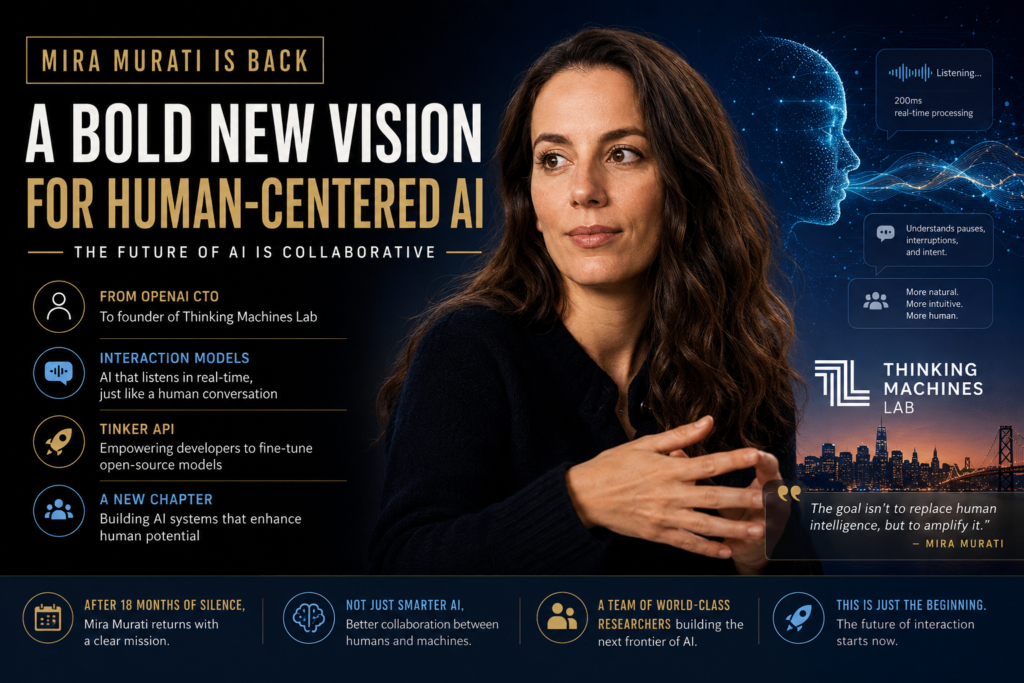
After 18 months of near-total silence, Mira Murati has re-entered the public conversation — and the vision she outlined is one of the most provocative bets in AI today. Here is what you need to know about her new company, her candid reflections on OpenAI, and why her return matters for the entire industry.
Who Is Mira Murati?
Mira Murati is a computer scientist and technology executive best known as the former Chief Technology Officer of OpenAI, a role she held for roughly six years. Born in Albania, she studied mechanical engineering at Dartmouth College before building a career at companies including Goldman Sachs, Leap Motion, and Tesla, before joining OpenAI in 2018.
During her tenure as CTO, Mira Murati was the technical architect behind some of the most consequential AI product releases in history, including GPT-4, DALL·E, and the initial deployment of ChatGPT. She was not the company’s loudest public voice — that role largely belonged to CEO Sam Altman — but insiders consistently described her as the operational brain behind OpenAI’s research-to-product pipeline.
She left OpenAI in September 2024 to found her own lab. Since then, she has been conspicuously absent from the conference circuit, media interviews, and social media — until June 2026.
Why the 18-Month Silence Mattered
Why did Mira Murati go quiet for so long after leaving OpenAI?
The silence was strategic. Building a credible frontier AI lab from scratch — hiring world-class researchers, securing compute infrastructure, and developing proprietary models — requires focus that a busy media presence would fragment. Staying heads-down also preserved optionality: announcing too early in a crowded, fast-moving market invites competitive pressure before a product is ready.
But silence has a shelf life. By mid-2026, the companies competing for the same talent, customers, and investment had only grown louder. OpenAI remains a constant presence in the news cycle. Anthropic’s momentum has become a dominant conversation in enterprise AI. And Elon Musk’s xAI, folded into SpaceX ahead of a massive anticipated public offering, commands enormous gravitational pull on both attention and capital.
In that environment, continued invisibility starts to cost more than it saves. As the TechCrunch report on her Bloomberg appearance put it, “staying heads down has diminishing returns; at some point, you have to make some noise just to remind the market you exist.”
Mira Murati’s Bloomberg interview in San Francisco on June 4, 2026 — her first major media appearance in roughly 18 months — was precisely that calculated signal.
What Is Thinking Machines Lab?
Thinking Machines Lab is the AI research company that Mira Murati founded in late 2024. The lab’s core thesis, as Murati has described it, is that the path to powerful artificial intelligence runs through closer human collaboration, not around it.
That philosophical premise shapes everything from the company’s research agenda to its product roadmap. Rather than pursuing AI systems that operate autonomously with minimal human oversight, Thinking Machines Lab is working on models that are designed to be deeply responsive to the texture of human communication — including interruptions, pauses, and mid-thought corrections.
The company has operated largely in the background since its founding: raising capital from undisclosed investors, hiring researchers (and navigating some high-profile departures), and shipping one product publicly.
Tinker: The First Product
Thinking Machines Lab’s first public-facing release is Tinker, an API designed for fine-tuning open-source AI models. While not a consumer-facing splash, Tinker reflects the lab’s pragmatic approach: establish revenue streams and developer relationships before launching frontier capabilities.
Fine-tuning APIs are a competitive but growing market, serving companies that want to customize off-the-shelf open-source models for specific use cases — from customer support to code generation — without the cost of training from scratch. Tinker positions Thinking Machines Lab as a serious infrastructure player, not just a research lab with grand ambitions and no products.
Interaction Models: The Bold Bet
The more ambitious — and genuinely novel — claim Mira Murati surfaced during her Bloomberg appearance is what Thinking Machines Lab calls “interaction models.”
What are interaction models?
Interaction models are a fundamentally different kind of AI interface, distinct from the turn-based prompt-and-response format that defines most AI products today. Rather than waiting for a user to finish a query, submit it, and receive a reply, interaction models are designed to process continuous streams of audio, text, and video in 200-millisecond intervals. The goal is an AI that perceives human communication the way a conversation partner does — picking up on hesitations, clarifying interruptions, and the pacing cues humans use to signal meaning.
Murati was careful to frame this as a first step, not a finished product, and declined to attach a specific release date to anything. But the concept represents a meaningful departure from how current frontier models handle real-time interaction.
Mira Murati on the OpenAI “Blip”: What She’d Do Differently
One of the most closely watched dimensions of Murati’s Bloomberg interview was her account of the November 2023 episode that first brought her into sharp public focus: the chaotic week when OpenAI’s board abruptly fired Sam Altman and she became interim CEO.
Inside OpenAI, that week came to be known as “the blip.” Mira Murati said she felt clear about her decisions in each moment — that protecting the organization’s mission and its team provided a through-line that made her choices feel obvious even as the situation appeared to be unraveling from the outside. She stated that the company would have “imploded” without her steady involvement through that five-day stretch and its immediate aftermath.
Yet she was equally candid about the limits of her clarity. In retrospect, she said, she would have pushed harder for more information, a better transition plan, and greater transparency throughout the process. The distinction she drew — between clarity of intent and clarity about consequences — is a subtle but important one, and it tracks with how many observers assessed her performance during that period: competent and principled under pressure, but operating with incomplete information in an impossibly compressed timeline.
She declined to say directly whether she thinks the outcome of that episode was ultimately good.
What about Sam Altman? Does Mira Murati still trust him?
She sidestepped the question. Her pivot away from it was itself informative: rather than defending or criticizing Altman personally, she redirected toward the structural concern she returned to multiple times during the interview — the concentration of consequential AI decisions in too few hands.
The Governance Problem No One Wants to Talk About (But Murati Does)
The thread that ran most consistently through Mira Murati’s Bloomberg appearance was not product announcements or competitive positioning. It was AI governance — specifically, the absence of structural checks on how frontier AI labs make decisions.
Her concern, as she expressed it, is less about the character of any individual leader and more about the architecture of accountability. Good people make bad calls. Well-intentioned organizations drift. The tech industry has invested enormous energy in building capable AI systems, and comparatively little in building durable institutional structures to govern how those systems are developed and deployed.
This framing puts Mira Murati in an interesting position. She is a founder competing directly with the organizations she is critiquing. But the argument she is making is structural, not personal — and it echoes concerns that have grown louder across the research community, in policy circles, and among some of the most thoughtful voices inside the labs themselves.
When asked about the future of AI more broadly — including the legitimate fears about job displacement and more extreme risks like the potential misuse of AI for weapons development — Murati pushed back on both techno-utopianism and inevitable dystopia. Neither outcome is predetermined, she argued. The period we are in now is the one that will determine which way things go.
Her closing frame was striking in its directness: if humans take their hands off the wheel too soon, the future will look very different, and not better.
Thinking Machines Lab vs. the Competition
How does Thinking Machines Lab stack up against the labs it is competing with for talent, capital, and enterprise customers?
| Dimension | Thinking Machines Lab | OpenAI | Anthropic |
|---|---|---|---|
| Founding year | 2024 | 2015 | 2021 |
| Key founder background | Former OpenAI CTO | Former OpenAI CEO | Former OpenAI researchers |
| Core thesis | Human-collaborative AI, interaction models | Broadly capable general AI | Safe, steerable AI systems |
| Public product(s) | Tinker (fine-tuning API) | ChatGPT, GPT-4o, Sora, API | Claude, API, enterprise products |
| Governance structure | Private, undisclosed investors | For-profit / nonprofit hybrid; ongoing restructuring | Public Benefit Corporation (filed IPO, June 2026) |
| Media visibility | Deliberately low; first major appearance June 2026 | Constant; Altman is a prolific public communicator | Growing; Dario Amodei increasingly prominent |
| AI safety positioning | Governance-focused; human oversight emphasis | Safety-oriented in stated mission; criticized for governance gaps | Explicit safety-first mission; Constitutional AI approach |
| Stage | Early; research + one product | Mature; revenue-generating at scale | Growth stage; IPO filing |
The competitive picture makes clear that Thinking Machines Lab is at an early stage relative to its rivals. What it has, that others may lack, is a founder with deep technical credibility, a distinctive product vision in interaction models, and the benefit of having watched both the triumphs and the failures of the labs she helped build and left.
Key Takeaways From Mira Murati’s Bloomberg Interview
What can founders, investors, researchers, and observers take from Mira Murati’s first major public appearance in 18 months?
- Visibility is a strategic asset, not a vanity metric. In a crowded AI market, sustained silence eventually becomes indistinguishable from irrelevance. Mira Murati’s re-emergence was deliberately timed, not accidental.
- Interaction models represent a genuine product category bet. The 200-millisecond continuous-stream processing model is not just a feature — it is a different philosophy of how humans and AI systems should relate to each other in real time.
- The OpenAI board crisis left lasting lessons. Murati’s reflections suggest she internalized something important: intent and outcome are not the same thing, and clarity under pressure does not guarantee clarity about consequences.
- Governance is the under-discussed frontier. Her most consistent argument across the interview was structural: the AI industry has built extraordinary technical capability while lagging in accountability infrastructure. This is not a radical claim — but hearing it from a founder at this level carries different weight.
- Researcher departures are a known cost of early-stage lab building. Murati acknowledged staff turnover with relative calm, framing it as an expected byproduct of the intense organizational compression involved in standing up a frontier lab quickly.
- The human-AI collaboration thesis is a differentiator. Most frontier labs pursue autonomy as an end goal. Thinking Machines Lab’s stated thesis inverts that: human involvement is not a stepping stone to be eventually removed, it is the destination.
- She is not interested in killing competitors. Her comment about not waking up thinking about how to defeat rivals — met with audience laughter — signals a culture-building orientation that may become a recruiting advantage, especially among researchers fatigued by the intensity of larger labs.
What This Means for the Future of AI
What does Mira Murati’s return signal about the direction of the AI industry?
The most significant signal is thematic, not technical. In an industry dominated by scale races — larger models, more parameters, faster inference, bigger data — Mira Murati is making a bet on a different axis: the quality and texture of human-AI interaction.
If interaction models work as described, they represent a meaningful departure from the conversational AI paradigm that ChatGPT, Claude, Gemini, and their successors share. The turn-based prompt-response format has become so ubiquitous it feels inevitable. But it is not inevitable — it is a design choice, and one that Thinking Machines Lab is explicitly questioning.
The governance thread is equally important. Mira Murati is not the first prominent AI leader to raise concerns about concentrated decision-making power in the industry. But she may be uniquely positioned to act on those concerns, having operated at the highest levels of the most consequential lab in the world and having watched governance failures unfold from the inside.
For investors, the Bloomberg appearance was almost certainly a calculated signal ahead of a fundraising cycle. For researchers, it was an invitation. For competitors, it was a reminder that Thinking Machines Lab is still in the game. And for anyone watching the broader AI landscape, it was a thoughtful — if carefully measured — argument that neither triumphalism nor catastrophism serves us well in this moment.
What Mira Murati is building may not be the biggest bet in AI right now. But it may be among the most considered.
Frequently Asked Questions
What company did Mira Murati found after leaving OpenAI?
Mira Murati founded Thinking Machines Lab in late 2024, after departing OpenAI in September of that year. The lab is focused on human-collaborative AI systems, including a novel category the company calls interaction models.
What are interaction models?
Interaction models are AI interfaces designed to process continuous streams of audio, text, and video in real time — approximately every 200 milliseconds — rather than waiting for a user to complete and submit a query. The goal is an AI that responds to the natural rhythm and texture of human communication, including hesitations, corrections, and interruptions.
What was Mira Murati’s role during the OpenAI board crisis in 2023?
When OpenAI’s board fired Sam Altman in November 2023, Mira Murati became interim CEO. She served in that role for several days during the chaotic period before Altman was reinstated. She has since stated she believes the company would have collapsed without her stabilizing role during that stretch, while also acknowledging she would have sought more information and pushed for greater transparency had she known then what she knows now.
What is Tinker?
Tinker is Thinking Machines Lab’s first public product — an API for fine-tuning open-source AI models. It targets developers and companies that want to customize existing open-source models for specific applications without training from scratch.