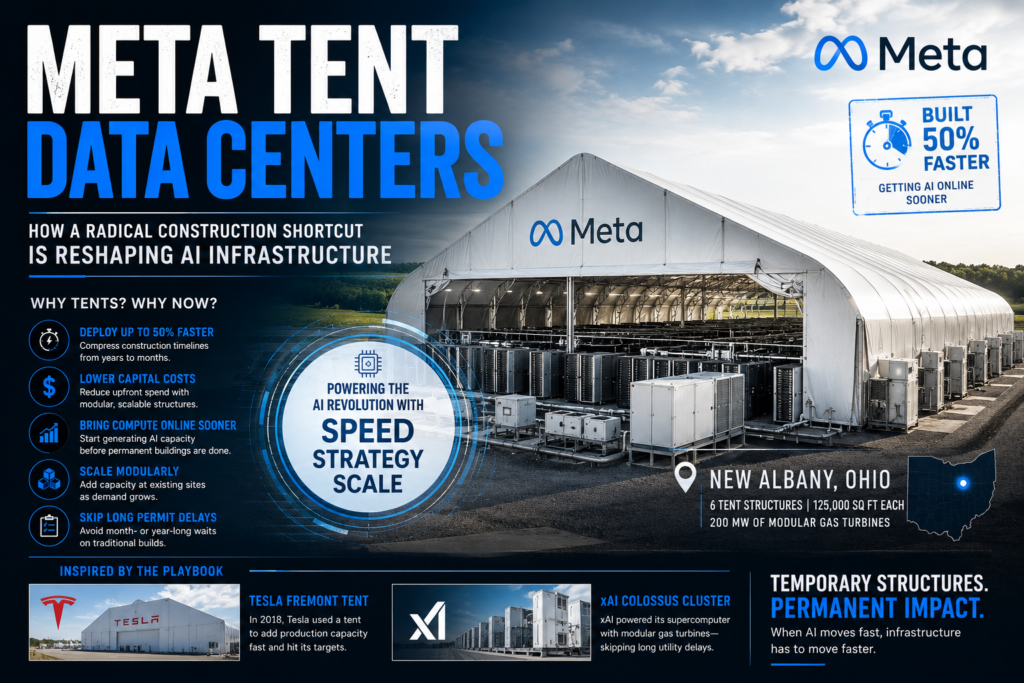
Meta is building its AI future inside tents — and it just cut its construction timeline in half doing it. Dubbed “rapid deployment structures,” Meta’s tent data centers represent one of the boldest cost-cutting and speed-maximizing moves in the history of AI infrastructure buildout. Meta tent data centers
If you’ve been watching the AI arms race heat up in 2026, this story tells you exactly how serious the pressure has become.
What Are Meta’s Tent Data Centers?
Rapid Deployment Structures, Defined
A rapid deployment data center is essentially a large-scale, weatherproof industrial tent — an engineered fabric structure capable of housing thousands of high-value AI chips and the supporting cooling and power equipment they require. These are not the camping tents of your backyard imagination. They are massive, engineered enclosures designed to protect sensitive, multi-billion-dollar hardware from the elements while being assembled in a fraction of the time a conventional concrete-and-steel building requires.
Meta refers to these internally as “rapid deployment structures.” Outside analysts and data center trackers have a simpler name: tent data centers. Whatever you call them, the concept is the same — prioritize speed of deployment over permanence of construction.
Where Are Meta’s Tent Data Centers Being Built?
According to Michael Thomas, founder of Cleanview, a firm that tracks data center deployments, Meta has constructed six tent structures outside of New Albany, Ohio. City permits reviewed by Thomas show that Meta began building five 125,000-square-foot tents between April and June 2026. Satellite imagery confirms all structures are now standing.
New Albany, Ohio has become one of the hottest data center corridors in the United States, attracting major hyperscalers due to available land, access to power infrastructure, and favorable local permitting. Meta’s decision to concentrate its tent deployments there is strategic, not accidental.
Why Meta Is Turning to Tents — The Economics
The $145 Billion Problem
Meta has publicly committed to spending up to $145 billion on data centers and other capital expenditures. Wall Street hasn’t been enthusiastic. Meta’s stock has traded down roughly 5% this year as investors process the scale of that commitment.
At the same time, Meta’s latest AI model — Muse Spark — is reportedly complete, but the APIs developers need to access it have faced repeated delays, according to a Wall Street Journal report. The company is caught in a classic infrastructure bottleneck: the AI models are ready, but the compute capacity to serve them at scale is still being built out.
Tents offer a potential escape valve. By deploying Meta tent data centers instead of conventional buildings, the company can:
- Compress construction timelines by up to 50%, getting chips online faster
- Reduce upfront capital expenditure on permanent structures
- Begin generating AI compute capacity before full campuses are complete
- Scale modularly, adding tent structures at existing sites without full construction projects
- Sidestep long permitting processes that can stall conventional data center builds by months or years
Construction Time Cut in Half
Traditional hyperscale data centers take anywhere from 18 to 36 months to design, permit, construct, and commission. That timeline is increasingly incompatible with the pace of AI model development and competitive pressure.
Meta’s tent-based approach targets a dramatic reduction in that window. Fabric structures of the scale Meta is deploying can be erected in weeks rather than months. The structural components are prefabricated, delivered flat, and assembled on-site with minimal heavy construction equipment. While electrical, cooling, and networking infrastructure still take time to commission, the building envelope itself — traditionally one of the longest construction phases — is compressed dramatically.
In a market where being six months late to deploy compute capacity can mean falling behind a competitor’s model release, that speed advantage is not trivial.
The Tesla and xAI Playbook: Who Invented This?
Meta’s tent data centers did not emerge from a vacuum. The strategy borrows directly from two high-profile precedents in the tech industry.
Tesla’s Fremont Factory Tent
In 2018, Tesla faced a production crisis with the Model 3. Demand was sky-high, factory floor space was maxed out, and Elon Musk needed more assembly capacity — fast. His solution: erect a large industrial tent in the parking lot of Tesla’s Fremont, California factory and stand up a full General Assembly production line inside it.
The tent was widely mocked at the time. Analysts questioned whether a car company could reliably produce vehicles inside a temporary structure. Tesla answered the skeptics by hitting its production targets, using the tent line as overflow capacity until permanent expansion was complete.
Meta appears to be running the same playbook. When permanent data center capacity can’t be built fast enough, a robust temporary structure becomes a bridge to that future.
xAI’s Off-Grid Modular Power Strategy
The second influence on Meta’s approach comes from Elon Musk’s AI venture, xAI. When xAI built its “Colossus” supercomputer cluster in Memphis, Tennessee, it powered the facility using modular gas turbines rather than waiting for utility grid connections — a process that can take years.
Meta’s New Albany tent sites follow the same model. The facilities are reportedly powered by 200 megawatts of modular gas turbines sourced from Williams Companies. This off-grid strategy eliminates one of the biggest bottlenecks in data center construction: waiting for utility infrastructure to be upgraded or extended to the site.
The combination of tent structures + off-grid modular power is a coherent speed-maximization strategy. Neither element alone is novel, but together they represent a deployable formula for getting AI chips operational in months rather than years.
Traditional Data Center vs. Meta Tent Data Center: A Direct Comparison
Understanding the trade-offs between conventional hyperscale facilities and rapid deployment structures is essential for evaluating Meta’s bet.
| Feature | Traditional Hyperscale Data Center | Meta Tent Data Center |
|---|---|---|
| Construction Timeline | 18–36 months | Weeks to a few months |
| Building Material | Reinforced concrete, steel | Engineered weatherproof fabric |
| Upfront CapEx | Very high | Lower (structure cost) |
| Permanence | Decades-long asset | Medium-term, potentially relocatable |
| Power Source | Utility grid (typical) | Modular gas turbines (off-grid) |
| Cooling Approach | Built-in precision cooling | Installed systems inside structure |
| Permitting Speed | Slower (full building codes) | Faster (temporary structure permits) |
| Typical Use Case | Long-term hyperscale capacity | Bridge capacity, speed-to-market |
| Weather Resilience | Extremely high | High (engineered for environment) |
| Scalability | Fixed once built | Modular, addable units |
The table above makes clear that Meta tent data centers are not a permanent replacement for conventional infrastructure — they are a strategic tool for closing the gap between AI model development speed and physical infrastructure delivery speed.
What’s Inside the Tents?
AI Chips Worth Billions of Dollars
The contents of Meta’s tent data centers are anything but cheap or temporary. Inside these fabric-walled structures sit racks of AI accelerators — almost certainly NVIDIA H100 or the newer Blackwell-architecture chips — collectively worth billions of dollars.
This is perhaps the most counterintuitive aspect of the entire strategy. The containers are low-cost and fast to erect. The contents are among the most expensive and strategically important hardware on the planet. The contrast is striking, but it is also logical: the fabric structure does not need to be permanent because the chips will be cycled out and upgraded on a rolling basis anyway.
Power and Cooling Infrastructure
Each tent structure must also house the supporting systems that keep AI chips running:
- Power distribution units stepping down voltage from the modular gas turbines
- Cooling systems, likely a combination of precision air conditioning and emerging liquid cooling rows for the densest GPU clusters
- Networking fabric, interconnecting thousands of accelerators into a single high-bandwidth training or inference cluster
- Physical security systems, since each tent represents a multi-billion-dollar asset
The engineering challenge is real. Fabric structures are not purpose-built for the extreme thermal loads that dense GPU clusters generate. Meta’s engineering teams will have needed to design custom cooling solutions adapted for non-standard building envelopes.
The Risks and Trade-Offs of Tent Data Centers
No infrastructure strategy is without risk, and Meta’s tent approach carries several worth examining carefully.
Environmental and Weather Exposure
Engineered fabric structures are designed to handle wind, rain, snow loads, and temperature extremes. But they are not equivalent to reinforced concrete buildings. Events like tornados, extreme ice storms, or sustained high winds represent a higher risk profile for tent structures than for conventional data centers.
For a facility housing billions of dollars of irreplaceable AI chips, that risk profile matters. Insurance costs are likely higher, and redundant physical protection measures — such as blast walls or berms — may be deployed around tent perimeters.
Energy Source Sustainability
The modular gas turbines powering Meta’s New Albany tents are fast to deploy and reliable. They are not, however, carbon-neutral. Meta has committed publicly to long-term sustainability goals, and running gigawatts of AI compute on natural gas turbines creates real tension with those commitments.
The company’s apparent position is that this is a bridge solution — temporary off-grid power while permanent grid connections and renewable energy procurement are secured. Whether that bridge stretches to match the actual operational life of these facilities remains to be seen.
Regulatory and Permitting Uncertainty
Using “temporary structure” permitting pathways to speed up data center deployment is clever — but it is a strategy that local governments may decide to close. If municipalities begin treating rapid deployment structures as permanent facilities (which they functionally are, given the hardware inside), the permitting advantages erode.
Long-Term Asset Value
A conventional data center depreciates over 30–40 years and represents a durable real estate asset. A tent structure has a significantly shorter design life. Meta’s long-term capital plans will presumably include replacing tent facilities with permanent buildings, meaning the company effectively pays twice for the same compute capacity over time.
What Meta’s Tent Strategy Means for the Future of AI Infrastructure
A Template Others Will Follow
Meta tent data centers are not an isolated experiment. They represent a template that other hyperscalers will likely evaluate and potentially adopt — particularly as the competition for AI compute capacity intensifies further in 2026 and beyond.
Amazon Web Services, Google Cloud, and Microsoft Azure all face the same fundamental problem: the demand signal from AI workloads is arriving faster than conventional data center construction can respond. Any strategy that credibly compresses time-to-capacity will attract serious attention.
The modular gas turbine power model — pioneered at scale by xAI and now adopted by Meta — is already spreading. Expect more announcements of off-grid, rapid-deployment AI compute facilities from multiple players in the coming 12–18 months.
The AI Infrastructure Arms Race Enters a New Phase
For years, hyperscale data center construction was a slow, methodical, heavily engineered process. Location selection, power negotiation, permitting, construction, and commissioning each took their time. The AI boom has broken that model.
What Meta is doing in Ohio is a direct signal that the AI infrastructure race has entered a phase where speed of deployment is more valuable than construction elegance. The companies that can get chips operational fastest will have the ability to train better models, serve more users, and iterate more quickly — compounding advantages that become increasingly difficult to reverse.
Meta’s tent data center strategy is, in that light, less a construction shortcut and more a competitive weapon.
Implications for Grid Infrastructure and Energy Policy
One underappreciated consequence of the tent-plus-gas-turbine model is what it means for energy infrastructure planning. Traditionally, data centers anchored long-term utility investments — power companies would build new transmission lines and generation capacity to serve them, knowing the load would persist for decades.
Rapid deployment structures powered by modular gas turbines bypass that relationship. They draw power independently, often without any coordination with regional grids. At the scale Meta and xAI are deploying — hundreds of megawatts — this represents a meaningful shift in how AI-driven electricity demand interfaces with public utility planning.
Policymakers and regulators will eventually need to respond. Whether that response comes in the form of new permitting requirements, environmental regulations on gas turbine deployments, or incentives to accelerate grid connections remains an open question for 2026 and beyond.
Conclusion: Tents Today, Templates Tomorrow
Meta’s decision to build tent data centers in Ohio is simultaneously audacious and pragmatic. It borrows a proven speed tactic from Tesla’s manufacturing playbook, layers on xAI’s off-grid power model, and applies both to the single most pressing constraint in AI development: getting enough compute capacity online fast enough to matter.
The Meta tent data center approach is not without real risks — weather exposure, sustainability tension, long-term asset value questions, and potential regulatory pushback all deserve serious attention. But in a market where being six months behind on compute capacity can mean falling behind on model releases, the risk calculus clearly favored speed.
Whether Meta’s competitors follow suit, and whether tent data centers become a standard feature of the AI infrastructure landscape, will be one of the most interesting infrastructure stories to watch through the remainder of 2026.
One thing is certain: the AI race has stopped waiting for concrete to cure.