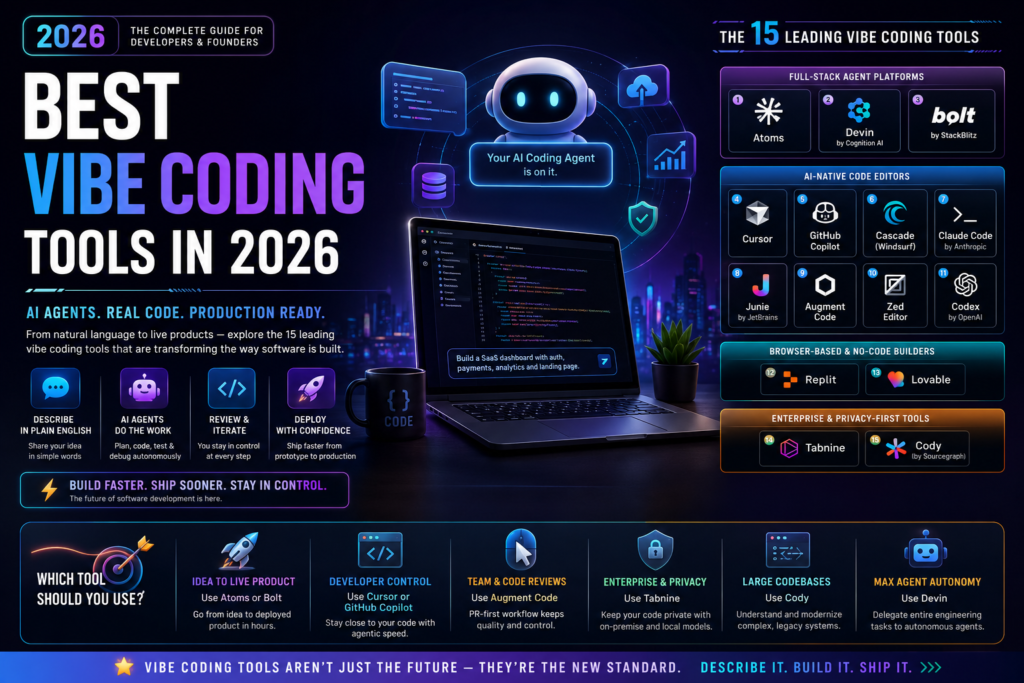
The best vibe coding tools in 2026 let you describe software in plain English and watch an AI agent build it — from prototype to production. If you’re trying to decide which tool fits your workflow, this guide covers all 15 leading options, with a comparison table and clear recommendations by use case.
What Is Vibe Coding?
Vibe coding is a natural-language-first approach to software development where a developer describes what they want to build — in plain English — and an AI agent handles the implementation.
The term was coined by AI researcher Andrej Karpathy to describe a meaningful shift away from line-by-line coding toward intent-driven software creation. Instead of writing syntax, the developer sets direction, reviews output, and iterates through conversation. The AI agent plans, writes, debugs, and in some cases deploys the code.
Why “Vibe Coding” and Not Just “AI-Assisted Coding”?
The distinction matters. Traditional AI-assisted coding adds autocomplete or suggestion layers on top of manual work. Vibe coding tools flip the model: the agent owns the execution loop, while the human steers. The developer’s role shifts from writing code to reviewing and directing it.
This changes what it takes to build software. A founder can prototype a SaaS product without a full engineering team. An experienced developer can skip boilerplate entirely and focus on architecture. Shorter feedback loops and faster iteration are the core benefits.
Why Vibe Coding Tools Are Dominating AI Software Development in 2026
Three forces converged to put vibe coding tools at the center of AI software development in 2026.
First, frontier language models became reliably capable of multi-file reasoning. Early AI coding tools could suggest a line or complete a function; modern agents can plan changes across an entire codebase, run tests, and open pull requests — all from a single natural-language prompt.
Second, the tooling ecosystem matured. Dedicated IDEs (Cursor, Zed), autonomous agent platforms (Devin, Atoms), browser-native environments (Replit, Bolt), and enterprise-grade privacy tools (Tabnine) now cover every segment of the developer market.
Third, the economics became compelling. Going from idea to a live, working prototype — which once took weeks and a team — now takes hours with the right vibe coding tool. That compression of time-to-product is rewriting how startups, enterprises, and solo developers approach software creation.
The result: vibe coding is no longer experimental. It is becoming the default workflow for a growing share of the industry.
How to Choose the Right Vibe Coding Tool
The right vibe coding tool depends on one fundamental question: how much of the implementation do you want the agent to own?
Full-stack agent platforms take a task from description to deployed product. AI-native editors keep the developer close to the code, with agents accelerating specific steps. No-code builders offer the most accessible entry point. Enterprise tools prioritize privacy and compliance over raw speed.
Before selecting a tool, evaluate these factors:
- Codebase understanding: Can the tool ingest and reason about your existing project, or does it only work on greenfield code?
- End-to-end capability: Does the tool handle the full cycle — planning, writing, testing, deploying — or only part of it?
- Human-in-the-loop controls: Does it support pull request reviews and manual checkpoints to catch agent errors before they ship?
- Privacy and data handling: Does the tool send your code to third-party servers, or can it run locally? This matters significantly for enterprise teams.
- IDE or editor integration: Does it fit your existing development environment, or does it require switching tools entirely?
- Pricing and usage limits: Is it per-seat SaaS, usage-based, or free with a paid tier? Match the model to your volume.
The 15 Best Vibe Coding Tools in 2026
Full-Stack Agent Platforms
These vibe coding tools operate at the highest level of automation. They take a natural-language description and produce a working, deployable product.
1. Atoms
Atoms is the most comprehensive full-stack vibe coding platform available in 2026. You describe what you want to build, and a coordinated team of specialized AI agents handles market research, architecture, engineering, SEO, and even ad setup. The output is a production-ready application with authentication, databases, Stripe payments, and scalable hosting included. Developers retain full control throughout and can export code or sync to GitHub at any point. For teams or founders who want to go from idea to live product as fast as possible, Atoms represents the furthest end of the automation spectrum.
Best for: Founders, product teams, developers who want a full-stack agent that ships complete products.
2. Devin by Cognition AI
Devin is positioned as an autonomous AI software engineer. It can plan, code, debug, test, and deploy applications end-to-end from a single task description. The developer assigns work and reviews results; the agent drives the execution. Cognition AI also acquired Windsurf, folding Devin’s autonomous agents into a platform that now includes a full IDE interface. Devin represents the most hands-off approach to software creation among all the vibe coding tools in this category.
Best for: Developers comfortable with high agent autonomy who want to delegate entire engineering tasks.
3. Bolt by StackBlitz
Bolt is a browser-based generative app builder focused on full-stack web projects. It converts plain-English prompts into functional web applications and can deploy in a few clicks. The entire workflow — build, preview, deploy — runs in the browser with no local setup. Bolt is particularly strong for MVPs and early-stage product validation.
Best for: Founders and developers who need a functional prototype quickly without local setup.
AI-Native Code Editors
These vibe coding tools keep the developer close to the code. They enhance and accelerate traditional workflows rather than replacing them entirely.
4. Cursor
Cursor is the most widely adopted AI-native IDE in the vibe coding category. Built for prompt-driven development, it supports multi-agent prompting and iterative edits across an entire project through its “Agent Mode.” Cursor connects to frontier models from providers like OpenAI and Anthropic, and its familiar editor interface means developers get speed without sacrificing oversight. It sits at the sweet spot between full automation and manual control — the defining balance for professional developers.
Best for: Developers who want agentic speed while staying close to the codebase.
5. GitHub Copilot
GitHub Copilot has evolved well beyond line-level autocomplete. Its Agent Mode now handles full coding tasks from a prompt — planning, editing, and iterating across files. Its primary advantage is deep integration with VS Code and the GitHub ecosystem. Developers already in that stack can adopt agentic workflows without changing tools or learning a new interface.
Best for: Developers already working in VS Code and GitHub who want agentic features without switching environments.
6. Cascade by Windsurf
Cascade is Windsurf’s AI-driven code agent, now part of Cognition’s platform alongside Devin. It supports real-time, iterative development with autonomous code generation and multi-file editing. Cascade handles context gathering in the background, which reduces the friction of re-explaining a codebase every session. The Cognition acquisition means Cascade users now have access to Devin’s deeper autonomous capabilities from the same platform.
Best for: Developers who want an iterative agentic editor with strong codebase context.
7. Claude Code by Anthropic
Claude Code is a terminal-style agentic coding interface. Users direct the AI through conversation to build, edit, and refactor code, and the model retains project context across a session. That persistent memory enables multi-step work driven entirely through natural language. Claude Code suits developers who live in the command line and want an AI agent that works natively in that environment.
Best for: Command-line-first developers who want a conversational agent that understands the full project.
8. Junie by JetBrains
Junie is JetBrains’ official AI coding agent, built for the language-aware IDE family that many professional teams already use. It supports prompt-based interaction, smart debugging, and the ability to plan and apply multi-step changes inside the IDE. For teams standardized on IntelliJ, PyCharm, WebStorm, or other JetBrains tools, Junie integrates naturally without workflow disruption.
Best for: Teams working in the JetBrains ecosystem who want agentic features without leaving their IDE.
9. Augment Code
Augment Code is built for large, mature codebases. Its chat-based interface works across editors, and its agents can plan, build, and open pull requests for human review. The PR-first model is its defining characteristic — it treats the agent like a senior engineer who submits work for approval rather than an autopilot that ships changes directly. For teams where code review is non-negotiable, Augment’s approach reduces risk without sacrificing speed.
Best for: Engineering teams maintaining large codebases who need agent output to go through a review gate.
10. Zed Editor
Zed is a performance-first code editor built for high-speed human-AI collaboration. AI assistance is embedded directly into the editing experience, and the interface is designed to stay responsive even on large, complex projects. Zed appeals to developers who find other AI editors slow or heavy and want a lightweight tool with built-in intelligence.
Best for: Developers who prioritize editor speed and want AI integrated without bloat.
11. Codex by OpenAI
Codex is OpenAI’s agentic coding system, available across the command line, IDEs, ChatGPT, and GitHub. It can read large codebases, run tests, and prepare changes for review from a single prompt. OpenAI has reported several million developers using Codex weekly. Its versatility across surfaces makes it a strong default for developers already in the OpenAI ecosystem.
Best for: Developers who want a capable agentic system with broad surface coverage across tools.
Browser-Based and No-Code Builders
These vibe coding tools lower the barrier to entry for non-developers and remove all local setup requirements.
12. Replit
Replit is a browser-based IDE with a zero-setup environment. Its Replit Agent generates code from natural-language prompts and the platform handles building, running, and hosting in one place. Shareable links make collaboration and review frictionless. Replit is a strong choice for students, hackathons, and fast concept tests where environment setup would slow things down.
Best for: Students, beginners, hackathon teams, and quick concept prototyping.
13. Lovable
Lovable is an AI app-building platform designed with a no-code experience. You describe the application, and Lovable generates both the interface and the underlying logic. It is aimed squarely at product designers and non-technical founders who have a clear vision but limited engineering background. Among vibe coding tools designed for non-developers, Lovable offers one of the most accessible starting points.
Best for: Non-technical founders and product designers who want to build without writing code.
Enterprise and Privacy-First Tools
14. Tabnine
Tabnine provides context-aware code completion with a strong focus on security and privacy. It supports local and on-device model deployment, which keeps code off third-party servers entirely. For enterprises in regulated industries — healthcare, finance, legal — where compliance and data confidentiality are mandatory, Tabnine is often the only viable AI coding tool. It sacrifices some autonomy for complete data control.
Best for: Enterprise teams in regulated industries where code cannot leave the organization’s infrastructure.
15. Cody by Sourcegraph
Cody is built specifically to handle the complexity of large, sprawling codebases. It helps developers read, understand, and update mature repositories with deep cross-file context. Cody is especially effective for refactoring, tech debt cleanup, and answering questions about legacy systems. For teams maintaining established products with years of accumulated code, Cody’s codebase awareness is its key differentiator.
Best for: Teams maintaining large, legacy codebases who need an AI that understands how everything connects.
Vibe Coding Tools Compared: Features, Best Fit, and Pricing Tier
| Tool | Type | Best For | Autonomy Level | Local/Private Option | Pricing Tier |
|---|---|---|---|---|---|
| Atoms | Full-stack agent | Founders, full-stack deployment | Very High | No | Paid (SaaS) |
| Devin | Autonomous agent | Delegating full engineering tasks | Very High | No | Paid (Enterprise) |
| Bolt | App builder | Fast MVPs in-browser | High | No | Freemium |
| Cursor | AI-native IDE | Professional developers | Medium-High | No | Freemium |
| GitHub Copilot | IDE extension | VS Code / GitHub users | Medium | No | Paid subscription |
| Cascade (Windsurf) | AI code agent | Iterative agentic editing | Medium-High | No | Freemium |
| Claude Code | Terminal agent | CLI-first developers | Medium-High | No | Usage-based |
| Junie | IDE agent | JetBrains ecosystem teams | Medium | No | Paid subscription |
| Augment Code | Code agent (PR-first) | Large codebase teams | Medium | No | Paid (Team) |
| Zed | AI-native editor | Performance-focused developers | Medium | No | Freemium |
| Codex | Agentic coding system | Multi-surface OpenAI users | Medium-High | No | Usage-based |
| Replit | Browser IDE | Students, hackathons | Medium | No | Freemium |
| Lovable | No-code AI builder | Non-technical founders | High | No | Paid (SaaS) |
| Tabnine | Code completion | Enterprise / regulated industries | Low-Medium | Yes | Paid (Enterprise) |
| Cody | Codebase AI | Legacy codebase maintenance | Low-Medium | No | Freemium |
Which Vibe Coding Tool Should You Use?
The answer depends on your context, not just your preference. Here are the clearest use-case matches across the 15 vibe coding tools:
- If you want to go from idea to deployed product as fast as possible: Use Atoms or Bolt. Both handle full-stack delivery; Atoms adds an AI agent team that covers auth, payments, and hosting out of the box.
- If you are a professional developer who wants to stay close to the code: Use Cursor or GitHub Copilot. Both integrate into familiar editors and give you agent-level speed without surrendering control.
- If you work in a large engineering team with strict review requirements: Use Augment Code. Its PR-first model ensures agent output goes through your existing review process.
- If you are non-technical and want to build without writing code: Use Lovable or Bolt. Both are designed for founders without engineering backgrounds.
- If your team works in JetBrains IDEs: Use Junie. It integrates directly and keeps the team in their existing environment.
- If you are in a regulated industry with strict data policies: Use Tabnine with local model deployment. It is the only major vibe coding tool that keeps code entirely on your infrastructure.
- If your codebase is large, legacy, and complex: Use Cody by Sourcegraph. Its cross-file context awareness is built specifically for that challenge.
- If you want maximum agent autonomy and are comfortable with a hands-off model: Use Devin. Assign a task, review the result. The agent handles everything in between.
The Future of Vibe Coding
The vibe coding tools category is consolidating quickly. Cognition’s acquisition of Windsurf is one signal: the market is moving toward platforms that combine autonomous agents with IDE interfaces rather than keeping them separate.
At the same time, the spectrum between “AI-assisted” and “AI-autonomous” is compressing. Tools that were purely assistant-level two years ago — like GitHub Copilot — now offer full agentic modes. Tools that started as full autonomous agents — like Devin — are building IDE integrations to capture developers who want more oversight.
What remains stable is the underlying shift: the developer’s role is changing from writing code to directing it. Vibe coding tools are the infrastructure of that change. The developers and founders who understand the spectrum — from no-code builders to fully autonomous agents — will be the ones who use it most effectively.
Three trends will shape the next phase:
- Multi-agent coordination will become standard. Single-agent tools will lose ground to platforms like Atoms that use specialized agents for different tasks in parallel.
- Review-native workflows will differentiate enterprise tools. Teams will favor platforms that treat human checkpoints as a feature, not a limitation.
- On-device and private models will expand. As model sizes shrink and hardware improves, even enterprise teams with strict data rules will gain access to capable local vibe coding tools.
Conclusion
Vibe coding tools have moved from novelty to infrastructure. The 15 tools in this guide cover every point on the automation spectrum — from fully autonomous platforms that ship production-ready applications to privacy-first tools that keep every line of code on your own hardware.
The common thread across all of them is speed: faster ideation, faster prototyping, faster iteration. The right vibe coding tool does not replace judgment; it amplifies it. Your job shifts from writing to directing, from syntax to architecture, from implementation to intent.
Choosing the right tool starts with an honest assessment of how much you want the agent to own — and how much you want to keep in your own hands.