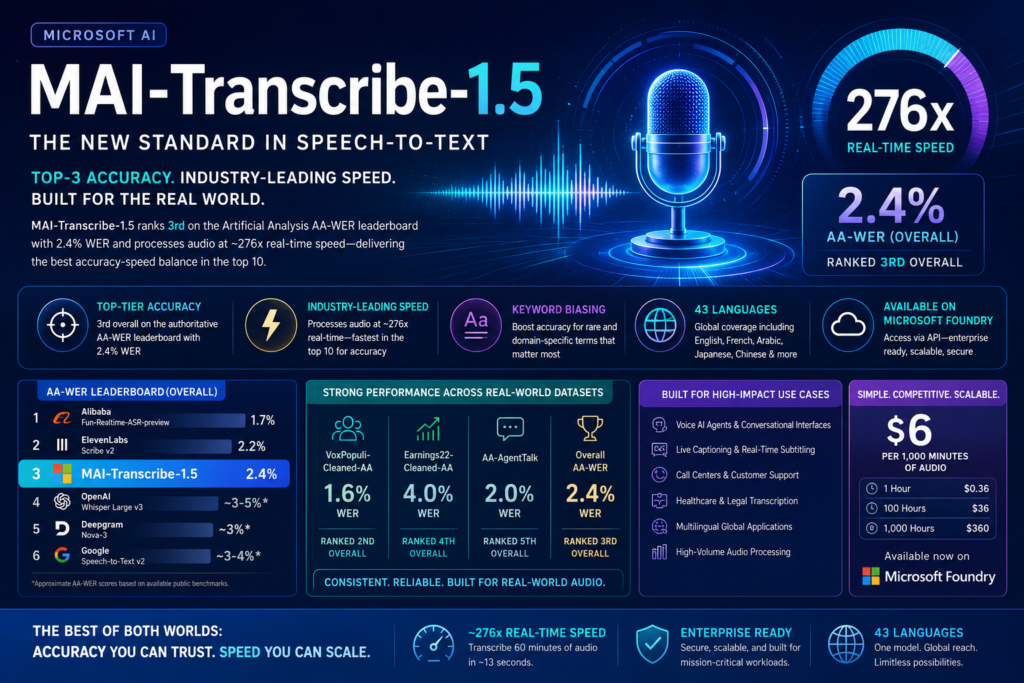
Microsoft has just redefined what’s possible in AI-powered transcription. MAI-Transcribe-1.5 delivers near-top-of-leaderboard accuracy while processing audio at approximately 276 times real-time speed — more than double its nearest competitor in the same accuracy tier.
If you’re evaluating speech-to-text models for production pipelines, voice agents, or enterprise applications, MAI-Transcribe-1.5 is the most significant release in the STT space in 2026. This guide breaks down exactly what it is, how it benchmarks, who it’s for, and how it compares to every major alternative on the market today.
What Is MAI-Transcribe-1.5?
MAI-Transcribe-1.5 is Microsoft AI’s (MAI) latest speech transcription model, released in June 2026. It is designed to occupy a unique position in the speech-to-text landscape: offering near-state-of-the-art accuracy while achieving the fastest processing speed of any model in the top 10 for accuracy.
The model is evaluated on the Artificial Analysis Word Error Rate (AA-WER) benchmark — the industry-standard independent leaderboard for comparing STT models across real-world audio conditions. On that benchmark, MAI-Transcribe-1.5 ranks 3rd overall with a 2.4% AA-WER score, trailing only Alibaba’s Fun-Realtime-ASR-preview (1.7% WER) and ElevenLabs Scribe v2 (2.2% WER).
What makes MAI-Transcribe-1.5 genuinely different is not just its accuracy ranking, but its combination of that accuracy with exceptional throughput — a balance the industry refers to as the accuracy-speed Pareto frontier.
Why the Accuracy-Speed Pareto Frontier Matters
What Is the Pareto Frontier in Speech-to-Text?
In engineering and optimization, the Pareto frontier describes the set of solutions where you cannot improve one metric without worsening another. In speech-to-text, that tradeoff is accuracy versus speed. Highly accurate models tend to be slow; fast models tend to sacrifice quality.
“Leading the Pareto frontier” means a model achieves the best possible accuracy for a given speed — or equivalently, the best speed for a given accuracy level. No other model in the top 10 for accuracy comes close to the processing speed of MAI-Transcribe-1.5. The second-fastest model in that accuracy tier runs at roughly half the speed.
This distinction matters enormously in production environments. A model that is 5% more accurate but 10 times slower may be entirely unsuitable for real-time voice applications, live captioning, or high-volume audio pipelines. MAI-Transcribe-1.5 closes that gap.
Where MAI-Transcribe-1.5 Sits on the Leaderboard
On the Artificial Analysis STT leaderboard (as of June 2026):
- 1st place: Alibaba Fun-Realtime-ASR-preview — 1.7% AA-WER
- 2nd place: ElevenLabs Scribe v2 — 2.2% AA-WER
- 3rd place: MAI-Transcribe-1.5 — 2.4% AA-WER, ~276x real-time speed
No model in the top 10 for accuracy processes audio faster than MAI-Transcribe-1.5.
MAI-Transcribe-1.5 Benchmark Performance: By the Numbers
AA-WER Results Across Datasets
MAI-Transcribe-1.5 was evaluated across multiple benchmark datasets that reflect distinct real-world audio conditions — not just a single curated test set. Its performance across datasets is consistently strong:
- VoxPopuli-Cleaned-AA: 1.6% WER — ranked 2nd overall
- Earnings22-Cleaned-AA: 4.0% WER — ranked 4th overall
- AA-AgentTalk: 2.0% WER — ranked 5th overall
- Overall AA-WER: 2.4% — ranked 3rd overall
This cross-dataset consistency is an important signal. Many models achieve strong numbers on one benchmark while underperforming on others. The breadth of MAI-Transcribe-1.5‘s performance suggests it generalizes well across different speaker demographics, audio qualities, and domain-specific vocabulary.
Speed: 276x Real-Time Processing
The speed figure for MAI-Transcribe-1.5 deserves its own explanation.
A speed factor of ~276x real-time means the model can process 276 minutes of audio in the time it would take to listen to one minute of audio in real life. This is not a marginal improvement — the second-fastest model in the accuracy-equivalent tier runs at approximately 130x real-time.
For production use cases, this matters in concrete ways:
- A 60-minute meeting transcription completes in roughly 13 seconds.
- High-volume batch jobs that once took hours can complete in minutes.
- Real-time and streaming use cases become viable without sacrificing accuracy.
How MAI-Transcribe-1.5 Compares to Top STT Models
The table below compares MAI-Transcribe-1.5 against the leading speech-to-text models currently available, based on the Artificial Analysis benchmark data (June 2026).
| Model | AA-WER (Overall) | Speed Factor | Notable Strength |
|---|---|---|---|
| Alibaba Fun-Realtime-ASR-preview | 1.7% | N/A | Highest overall accuracy |
| ElevenLabs Scribe v2 | 2.2% | Moderate | Strong on clean audio |
| MAI-Transcribe-1.5 | 2.4% | ~276x | Best accuracy-speed balance |
| OpenAI Whisper Large v3 | ~3–5%* | ~50–80x* | Open-source, widely adopted |
| Deepgram Nova-3 | ~3%* | ~150x* | Low latency for real-time |
| Google Speech-to-Text v2 | ~3–4%* | High | Cloud integration |
Approximate figures based on available public benchmarks; exact AA-WER scores vary by dataset.
The key takeaway: MAI-Transcribe-1.5 is the only model in the top three for accuracy that also leads on speed. If your use case requires both, there is currently no better option on the public leaderboard.
Key Features of MAI-Transcribe-1.5
Beyond raw benchmark scores, MAI-Transcribe-1.5 ships with a feature set designed for real-world enterprise and developer use cases.
Keyword Biasing
One of the standout additions is keyword biasing — the ability to improve recognition accuracy for rare or domain-specific vocabulary. This is particularly valuable for:
- Medical transcription (clinical terminology, drug names, procedure codes)
- Legal proceedings (case-specific names, statutes, jurisdiction terms)
- Enterprise call centers (product names, internal jargon, employee names)
- Broadcast and media (guest names, location names, brand references)
Without keyword biasing, general-purpose STT models frequently mishear or hallucinate low-frequency terms. MAI-Transcribe-1.5 addresses this with a built-in mechanism to prime the model on vocabulary that matters for a given deployment.
Multilingual Support: 43 Languages
MAI-Transcribe-1.5 supports transcription in 43 languages, including:
- English
- French
- Arabic
- Japanese
- Chinese (Mandarin)
For international enterprises and multilingual voice applications, this coverage substantially reduces the need for separate models per language.
Availability via Microsoft Foundry
MAI-Transcribe-1.5 is available through Microsoft Foundry — Microsoft’s AI model deployment and API platform. This means developers and enterprises can access it directly via API without managing their own model infrastructure.
Who Should Use MAI-Transcribe-1.5?
MAI-Transcribe-1.5 is well-suited for teams and use cases where both accuracy and throughput are non-negotiable. Below are the key use cases where it offers a clear advantage over alternatives:
- Voice AI agents and conversational interfaces that need low-latency transcription without quality loss
- High-volume audio batch processing — podcast archives, call recordings, earnings call libraries
- Live captioning and real-time subtitling for video, webinars, or broadcast
- Healthcare and legal transcription where rare terminology accuracy is critical (aided by keyword biasing)
- Enterprise customer service platforms handling thousands of calls daily
- Multilingual products serving audiences across 43 supported languages
- Developers building STT pipelines who want top-3 accuracy without paying the latency cost that typically comes with it
If your primary constraint is accuracy above all else — and speed is irrelevant — then Alibaba’s Fun-Realtime-ASR-preview holds a marginal edge. But for the vast majority of production deployments, MAI-Transcribe-1.5 offers the more practical tradeoff.
How to Access MAI-Transcribe-1.5: Pricing and Availability
MAI-Transcribe-1.5 is commercially available now via Microsoft Foundry at a price of $6 per 1,000 minutes of audio.
To put that in context:
- 1 hour of audio costs approximately $0.36
- 100 hours of audio costs approximately $36
- 1,000 hours of audio costs approximately $360
Compared to the pricing of comparable high-accuracy STT models, this positions MAI-Transcribe-1.5 as competitively priced for production-scale use. Developers can access it through the Microsoft Foundry API documentation and begin testing with standard API credentials.
For teams already operating within the Microsoft Azure ecosystem, integration with Foundry is likely to be straightforward, as it aligns with existing authentication and billing infrastructure.
What This Launch Means for the Speech-to-Text Market
The release of MAI-Transcribe-1.5 signals a meaningful shift in how the STT market is evolving. For most of the past three years, the dominant narrative has been “accuracy or speed — pick one.” The top-accuracy models were often cloud-hosted, computationally expensive, and too slow for real-time deployment. Fast models were acceptable for rough transcription but not reliable enough for regulated industries or customer-facing products.
MAI-Transcribe-1.5 collapses that binary. By achieving 2.4% AA-WER at 276x real-time, it makes the case that accuracy and speed are not fundamentally in tension — they are an engineering problem that can be solved with sufficient investment and model optimization.
For the broader market, this raises the baseline expectations buyers will bring to STT procurement. A model that ranks in the top three for accuracy but runs at slow speed will become increasingly difficult to justify when MAI-Transcribe-1.5 demonstrates the ceiling is higher.
The launch also strengthens Microsoft’s position in the enterprise AI market. With Azure, Foundry, and now a leading STT model, Microsoft is building a vertically integrated AI stack that competes directly with Google Cloud Speech and AWS Transcribe — while outperforming both on independent benchmarks for accuracy-per-latency.
Frequently Asked Questions About MAI-Transcribe-1.5
What does AA-WER stand for?
AA-WER stands for Artificial Analysis Word Error Rate. It is an independent benchmark developed by Artificial Analysis that measures the accuracy of speech-to-text models across multiple real-world audio datasets, including VoxPopuli, Earnings22, and AgentTalk. Lower WER scores indicate higher accuracy.
How fast is MAI-Transcribe-1.5 compared to other models?
MAI-Transcribe-1.5 processes audio at approximately 276 times real-time speed, making it the fastest model among the top 10 models ranked by accuracy on the AA-WER leaderboard. The second-fastest model in that accuracy tier runs at roughly half that speed.
What is keyword biasing in speech-to-text?
Keyword biasing is a feature that allows users to supply a list of rare or specialized terms — such as names, medical terminology, or brand-specific vocabulary — so the model preferentially recognizes those terms during transcription. MAI-Transcribe-1.5 includes native support for keyword biasing.
How does MAI-Transcribe-1.5 perform on multilingual audio?
MAI-Transcribe-1.5 supports 43 languages, including English, French, Arabic, Japanese, and Chinese. While most benchmark evaluations focus on English audio, the model is designed for multilingual enterprise use cases.
Where can I access MAI-Transcribe-1.5?
MAI-Transcribe-1.5 is available via Microsoft Foundry at $6 per 1,000 minutes of audio. Access is provided through the Foundry API.
Is MAI-Transcribe-1.5 suitable for real-time applications?
Yes. The model’s ~276x real-time processing speed makes it well-suited for real-time and near-real-time applications, including live captioning, voice agents, and streaming transcription pipelines.
The Bottom Line
The speech-to-text market has reached a point where incremental improvements are no longer enough. Enterprises, developers, and AI product teams are increasingly looking for solutions that can deliver exceptional transcription quality without introducing performance bottlenecks. In this environment, MAI-Transcribe-1.5 stands out as one of the most significant releases the industry has seen in recent years.
What makes this model particularly noteworthy is not that it occupies the number one position on a benchmark leaderboard. Instead, its value comes from the balance it achieves across the metrics that matter most in real-world deployments. Accuracy remains critical because every transcription error can create downstream problems, whether that means poor customer experiences, inaccurate meeting records, compliance issues, or reduced effectiveness in AI-powered workflows. At the same time, speed is equally important because modern applications increasingly depend on rapid processing, low latency, and the ability to handle massive volumes of audio data efficiently.
This is where MAI-Transcribe-1.5 distinguishes itself from many competing solutions. While some models may achieve slightly lower word error rates, they often require compromises in processing throughput or operational efficiency. Conversely, extremely fast systems frequently sacrifice accuracy in challenging audio conditions. By delivering top-tier benchmark performance while operating at remarkable processing speeds, Microsoft has demonstrated that organizations no longer need to choose one advantage at the expense of the other.
The implications extend far beyond benchmark rankings. Consider the growing demand for AI-powered customer support platforms, voice assistants, multilingual communication tools, virtual meeting summaries, and automated content generation workflows. These systems depend heavily on reliable transcription as their foundational layer. When transcription quality improves, every downstream application benefits. When transcription can also be generated at extraordinary speed, businesses gain the ability to scale operations without significantly increasing infrastructure costs or workflow delays.
Another factor contributing to the model’s appeal is its enterprise-focused feature set. Keyword biasing addresses one of the most persistent challenges in speech recognition: accurately capturing specialized terminology. Organizations operating in healthcare, finance, legal services, telecommunications, media, and technology frequently encounter domain-specific vocabulary that general-purpose models struggle to recognize consistently. The ability to guide transcription toward critical terms can significantly improve output quality and reduce the amount of manual correction required after transcription is complete.
Language support is another area where the model demonstrates practical value. Global organizations increasingly require tools that function effectively across multiple regions and linguistic environments. Managing separate transcription solutions for different languages introduces complexity, increases maintenance requirements, and creates inconsistencies in user experience. A single platform capable of supporting dozens of languages offers a more streamlined path for international deployment and long-term scalability.
Pricing also plays an important role in adoption decisions. Even highly accurate systems can become difficult to justify if operating costs grow rapidly alongside usage. Microsoft’s pricing structure positions the platform competitively within the broader speech recognition market, making it accessible not only for large enterprises but also for startups, independent developers, and organizations experimenting with AI-powered voice applications. Cost efficiency becomes particularly important when processing hundreds or thousands of hours of audio content every month.
From a strategic perspective, the release also strengthens Microsoft’s position within the broader AI ecosystem. Organizations already utilizing Azure services can benefit from tighter integration, simplified procurement processes, and unified infrastructure management. Rather than assembling multiple vendors to support AI workloads, businesses may increasingly prefer consolidated platforms that provide language models, speech recognition, deployment tools, security controls, and monitoring capabilities within a single environment.
The competitive impact on the market should not be underestimated. For years, speech recognition providers have primarily competed by emphasizing either superior accuracy or superior speed. The emergence of solutions that excel in both categories raises expectations across the industry. Future buyers are likely to evaluate vendors through a more demanding lens, expecting strong performance across multiple dimensions rather than accepting major trade-offs. This shift could accelerate innovation throughout the speech technology landscape as providers work to close the gap.
Developers evaluating transcription solutions in 2026 should pay particular attention to practical deployment requirements rather than focusing solely on leaderboard positions. Real-world success depends on factors such as processing efficiency, scalability, multilingual coverage, customization options, integration capabilities, reliability, and cost predictability. In many of these categories, MAI-Transcribe-1.5 presents a compelling combination that aligns closely with production needs.
For organizations building voice agents, customer service automation, meeting intelligence platforms, media workflows, accessibility tools, or multilingual communication systems, the model deserves serious consideration during vendor evaluations. The combination of strong benchmark performance, enterprise-oriented functionality, broad language coverage, and high-speed processing creates a value proposition that is difficult to ignore.
Ultimately, MAI-Transcribe-1.5 represents more than just another improvement in speech recognition technology. It signals a broader evolution in how modern transcription systems are designed and optimized. Rather than forcing organizations to choose between quality and performance, it demonstrates that both objectives can be achieved simultaneously through thoughtful engineering and large-scale AI investment.
As the demand for voice-driven applications continues to expand across industries, solutions that combine reliability, efficiency, flexibility, and scalability will increasingly define the next generation of speech technology. Based on current benchmark results, feature availability, deployment options, and operational economics, MAI-Transcribe-1.5 has positioned itself as one of the strongest contenders in that future. For many teams evaluating speech recognition infrastructure this year, it may not simply be another option on the shortlist—it could very well become the benchmark against which every new transcription model is measured.