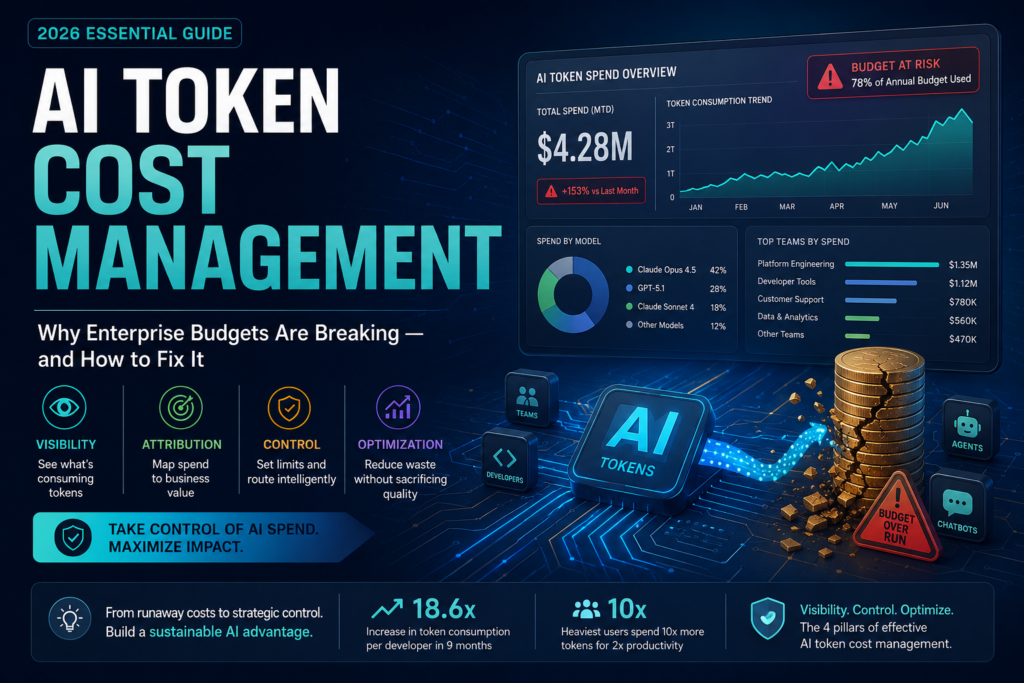
Companies deploying AI at scale are facing a reckoning: token costs are exploding, budgets are collapsing, and most organizations have no systematic way to control the damage. The discipline of AI token cost management — tracking, governing, and optimizing what you spend on AI inference — has gone from a nice-to-have to a business-critical priority almost overnight.
This guide explains what’s driving the crisis, what tools and frameworks are emerging to address it, and what your organization can do right now to gain control of AI spending without sacrificing productivity.
What Is AI Token Cost Management?
AI token cost management is the practice of tracking, governing, and optimizing an organization’s expenditure on AI model inference, measured in tokens — the discrete units of text that large language models process as both input and output.
Every time an employee runs a prompt through a coding assistant, every time an autonomous agent loops through a reasoning task, and every time a customer-facing chatbot generates a reply, tokens are consumed and billed. At low volumes, this is invisible. At enterprise scale — where thousands of developers and dozens of AI agents operate simultaneously — the tab compounds into a financial exposure that can dwarf entire IT budget lines.
AI token cost management sits at the intersection of FinOps (cloud financial operations), software engineering, and AI governance. It encompasses:
- Visibility: Knowing which teams, tools, and workflows are consuming tokens and at what rate.
- Attribution: Mapping token spend to business value — shipped features, resolved tickets, revenue generated.
- Control: Setting limits, routing queries to appropriately capable models, and establishing approval gates for high-consumption workflows.
- Optimization: Reducing token waste without degrading output quality or developer productivity.
Without all four, organizations are flying blind at extraordinary speed.
The Crisis Is Real: How Enterprises Blew Their AI Budgets
The stories emerging from the enterprise AI trenches in 2026 are remarkable in their consistency. Companies that enthusiastically adopted AI tools in 2024 and 2025 — driven by executive mandates to move fast — are now discovering that the bill has come due in ways nobody budgeted for.
Uber burned through its entire 2026 AI coding budget by April. Microsoft revoked developer access to Claude Code licenses after costs spiraled. One company, after neglecting to set usage limits, reportedly found itself with a half-billion-dollar Claude bill. A Priceline employee described a routine contract renewal for Cursor that came back four to five times more expensive than the prior year.
“In April and May, I started hearing from companies: ‘Oh my god, we are 3x over our entire 2026 token budget and it’s only April,'” J.R. Storment, executive director of the FinOps Foundation, told TechCrunch. “We started hearing existential crises.”
The irony is that per-token prices have actually been falling. The problem is that consumption has risen so dramatically — driven by two structural forces — that total spend has exploded regardless.
The Tokenmaxxing Era and Its Consequences
Tokenmaxxing refers to the practice of feeding AI models as much context and iterative prompting as possible in pursuit of the best output, with little regard for the token cost incurred. It was the dominant philosophy of early AI adoption: maximize what you can get from the model, and worry about efficiency later.
“Later” has arrived. Research from Jellyfish, an engineering management platform, found that the heaviest AI users were roughly twice as productive as lighter users — but spent ten times the tokens to get there. A survey by Faros AI across 20,000 developers found that output was rising, but so were bugs and rewrites, muddying the productivity calculus further.
The productivity premium of heavy token consumption exists, but it is not proportional to the cost. That asymmetry is the core challenge that AI token cost management must solve.
Agentic AI — The Hidden Multiplier
The second force driving costs is the rise of agentic AI — autonomous systems that decompose tasks, take multi-step actions, and loop through reasoning chains with minimal human intervention. Unlike a single prompt-response exchange, agentic workflows generate token consumption that compounds with every iteration.
New frontier models released in late 2025 — including Anthropic’s Claude Opus 4.5 and OpenAI’s GPT-5.1 — brought dramatically improved agentic capabilities. Enterprises rushed to deploy them. Per-developer token consumption rose approximately 18.6 times in nine months, according to Jellyfish’s research, largely attributable to agentic features.
A single engineer running an autonomous coding agent for a day can now consume tokens that would have taken a month of manual prompting a year ago. Multiply that by hundreds or thousands of developers, add background agents that run continuously, and the scale of the problem becomes clear.
Why Traditional Cost Controls Don’t Work for Tokens
Cloud cost management taught enterprises that visibility and guardrails can tame runaway infrastructure spend. But AI token cost management presents a fundamentally different data problem — one that breaks the tools and processes built for cloud FinOps.
“Tracking cloud costs is a hundreds-of-millions-of-rows-a-month data problem,” Storment noted. “Tracking token costs is a trillions-of-rows-a-month data problem. You can’t just stick that into whatever spreadsheet or even basic tool.”
The differences go deeper than scale:
- Abstraction: Token consumption is invisible to end users and often to managers. A developer doesn’t see a meter ticking; they see a code suggestion.
- Multi-vendor complexity: Enterprises use models from Anthropic, OpenAI, Google, and others simultaneously, with no common billing language or unit of comparison.
- Attribution difficulty: Mapping a token charge to a business outcome — a feature shipped, a bug resolved — requires connecting data across billing systems, engineering platforms, and product analytics.
- Billing opacity: Early adopters like Chris Reed, senior director of IT finance at Priceline, have already begun flagging discrepancies between vendor-reported usage and internal data — echoing the billing chaos of early cloud and early telecom spend.
“I started my career in telecom expense management, and I’m seeing all the same parallels, from telecom to cloud to AI,” Reed observed. “Anytime you introduce something new, it’s ripe for billing errors and audit and optimization opportunities.”
Effective AI token cost management requires new infrastructure — new tooling, new accounting systems, and a new operational discipline — not a spreadsheet column added to the existing cloud cost report.
The Emerging Toolkit: Solutions for AI Token Cost Management
A market is forming rapidly to meet the demand. The solutions fall into three broad categories, each addressing a different layer of the AI token cost management problem.
Pure-Play Token Optimization Platforms
These companies exist specifically to solve the cost and performance management challenge for AI inference. Pay-i tracks, measures, and optimizes the costs and performance of generative AI investments across an enterprise’s model portfolio. Paid (from former Manthex CEO Manny Medina) takes a different angle: it helps developers track costs, measure usage, and bill customers based on actual value delivered rather than flat subscription fees — shifting the cost model to align with outcomes.
Observability and Monitoring Tools
Existing infrastructure observability vendors are moving aggressively into this space. Datadog and New Relic have added AI-specific capabilities including token-level observability, cloud cost management integration, and GPU monitoring. Ramp, the financial management platform, has launched dedicated AI spend management features. Factory, a startup that builds AI coding agents for enterprises, recently launched a model router that automatically selects the right model for every task — minimizing cost by ensuring that a frontier model isn’t used when a smaller, cheaper model would suffice.
Engineering analytics platforms including Jellyfish, Waydev, and Faros AI offer a complementary angle: they don’t just show what tokens cost, but attempt to tie consumption to developer productivity and business output, answering the fundamental question of whether AI spending is generating returns.
Standards Bodies and Frameworks
Perhaps the most significant structural development in AI token cost management is the emergence of the Tokenomics Foundation, a new standards body announced by the Linux Foundation in June 2026. Modeled on the FinOps Foundation’s success in bringing discipline to cloud cost management, the Tokenomics Foundation aims to establish:
- A canonical definition and framework for “tokenomics” as a discipline.
- Open standards, specifications, and metrics for AI token usage and billing.
- New economic metrics such as cost-per-intelligence and tokens-per-watt.
- Consistent definitions that allow cost comparison across vendors.
The group plans a formal launch in July 2026 and is expected to announce additional members at the FinOps X conference. Its first deliverable — a shared framework for token cost accounting — is eagerly awaited by the companies already running over budget.
Comparison: AI Token Cost Management Solution Categories
| Category | Key Players | Primary Use Case | Limitation |
|---|---|---|---|
| Pure-Play Token Platforms | Pay-i, Paid | End-to-end cost tracking & ROI attribution | Newer category; integration depth varies |
| Observability / Monitoring | Datadog, New Relic, Ramp | Real-time token visibility, alerting, audit | Primarily surface-level spend data |
| Engineering Analytics | Jellyfish, Faros AI, Waydev | Productivity + cost correlation | Requires data integration across toolchains |
| Model Routers | Factory, OpenRouter | Automatic model selection for cost efficiency | Works best within defined agent workflows |
| Standards / Frameworks | Tokenomics Foundation (Linux Foundation) | Common language, billing standards | Framework still months from delivery |
7 Proven Strategies to Reduce AI Token Spend Without Killing Productivity
Effective AI token cost management is not about restricting access to AI — it’s about spending purposefully. The following strategies, drawn from current enterprise practice, represent the most impactful interventions available today.
- Implement model routing. Not every task requires a frontier model. Route routine queries — code completion, simple Q&A, formatting tasks — to smaller, faster, and cheaper models. Platforms like Factory’s model router do this automatically. This single change can dramatically reduce average cost per query.
- Set per-developer and per-team token budgets. Establish monthly token budgets by team or individual and surface consumption data to engineers and their managers. Visibility alone changes behavior; people spend differently when they can see a meter.
- Audit and limit agentic loop depth. Autonomous agents that iterate without limit are the single largest driver of unexpected token consumption. Define maximum loop counts and require human checkpoints for high-cost workflows.
- Cache common outputs. For repeated queries — documentation lookups, standard code patterns, policy explanations — implement semantic caching so the model is invoked once and the output is reused, rather than generating fresh tokens on each request.
- Measure productivity, not just spend. Token budgets without productivity metrics create the wrong incentive: cost minimization at the expense of output. Track the business value generated per token dollar spent — shipped code, resolved issues, closed deals — to identify where cutting spend would actually hurt, and where it wouldn’t.
- Reconcile vendor billing against internal data. Billing discrepancies between AI vendors and your internal usage data are common and often significant. Build a reconciliation process now, before the amounts involved become material audit risks.
- Adopt broad, moderate usage — not extreme usage. Research from Jellyfish suggests the best ROI comes not from pushing heavy users higher, but from moving the broad middle from low to moderate AI consumption. Democratizing access to tools with reasonable guardrails outperforms an unconstrained elite.
What Good AI Token Cost Management Actually Looks Like
The companies making real progress on this problem share several characteristics. They have moved beyond spreadsheets and reactive budget reviews to build genuine operational capability around AI spend.
At a mature organization, AI token cost management operates continuously, not quarterly. Token consumption is visible in near-real-time by team, tool, model, and workflow. Budget owners receive alerts when consumption trajectories suggest an overage is imminent — not after the fact. Engineers understand roughly what their workflows cost, which shapes their behavior without requiring heavy-handed restrictions.
Crucially, spend data is connected to engineering outcome data. When a team is consuming tokens at ten times the average rate, there’s an immediate question: are they ten times more productive? The answer drives the response. If yes — leave them alone, or learn from them. If no — intervene, guide, and optimize.
This is the operational posture that FinOps created for cloud and that the Tokenomics Foundation aspires to replicate for AI. The infrastructure to support it is still being built, but the principles are clear.
“Maybe we created a steam engine, but we still haven’t figured out the assembly line,” Vitaly Gordon, CEO of Faros AI, said of the current moment. The companies that figure out the assembly line first will have a durable competitive advantage in deploying AI cost-effectively.
The ROI Question: Is High Token Spend Ever Worth It?
This is the question that sits at the heart of AI token cost management, and the honest answer is: it depends, and most companies can’t yet tell.
“Whether extreme spend pays off comes down to the ultimate business value of shipped code — for example, revenue — which most companies still can’t measure,” Nicholas Arcolano, head of research at Jellyfish, told TechCrunch.
One CTO described to Vitaly Gordon a situation that captures the dilemma perfectly: one of his engineers had spent $40,000 on tokens in a single month. “I genuinely don’t know whether I should stop him or should I go and tell everyone else to be like him,” the CTO said.
That uncertainty is not a reason to abandon AI investment — it’s a reason to build measurement capability. Goldman Sachs projects that global token usage will multiply 24 times by 2030. The companies that survive and thrive in that environment will be those that built the operational discipline to spend on AI intentionally, measure its returns rigorously, and optimize continuously.
The goal of AI token cost management is not to spend less. It’s to spend right.
Key Takeaways
- AI token costs are a genuine enterprise crisis in 2026, driven by tokenmaxxing culture and the rapid adoption of agentic AI.
- Per-token prices have fallen, but consumption has grown far faster — pushed especially by autonomous agent workflows that loop without limit.
- Traditional cloud cost management tools and processes are not adequate for the scale and complexity of token cost data.
- A new market is forming: pure-play optimization platforms, observability tools, engineering analytics vendors, and the Tokenomics Foundation are all racing to provide the infrastructure for AI token cost management.
- The highest-ROI intervention is usually not restricting heavy users but raising moderate users — broad, measured adoption outperforms unconstrained tokenmaxxing.
- Until organizations can connect token spend to business outcomes, AI budget decisions will remain guesswork. Building that measurement capability is the most important investment enterprises can make in responsible AI scaling.