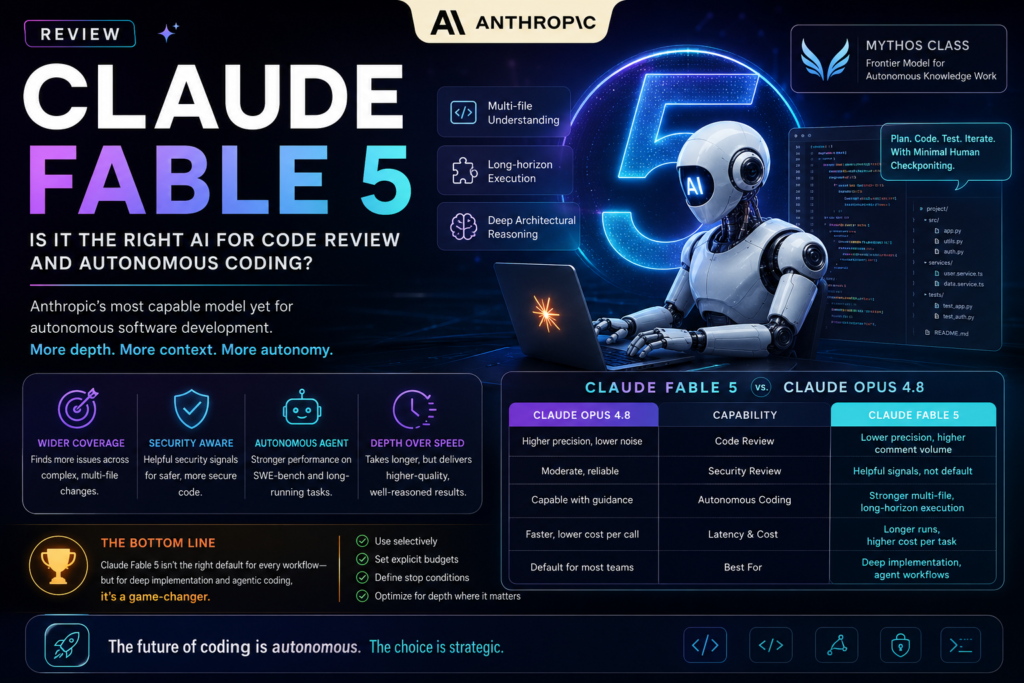
Claude Fable 5 is Anthropic’s most capable model yet for autonomous software development — but it is not the right default for every coding workflow. If you are deciding whether to adopt it for AI code review, agent-based coding pipelines, or security analysis, the honest answer is: it depends on what you are optimizing for. Claude Fable 5 Review
This review breaks down exactly what Claude Fable 5 does well, where it underperforms, and how to deploy it selectively so you get the upside without the operational risk.
What Is Claude Fable 5?
Definition: Claude Fable 5 is a Mythos-class large language model from Anthropic, positioned as a frontier model for autonomous knowledge work and complex coding tasks. Unlike incremental model updates, it represents a deliberate architectural and capability shift — designed not just for assisted coding, but for agentic, multi-step software development.
The “Mythos class” designation signals that Anthropic views this model in the same tier as its most capable offerings, intended for tasks requiring deep reasoning, extended context utilization, and multi-file coordination. In practice, this means Claude Fable 5 is built to plan, execute, and iterate on engineering work with minimal human checkpointing — a fundamentally different design goal from a fast, high-throughput completion model.Claude Fable 5 vs Opus 4.8 Autonomous Coding AI AI Code Review Tools Multi-File Software Development
At the time of writing, Claude Fable 5 is not publicly available; it is currently accessible to a small number of trusted organizations through Anthropic’s Project Glasswing, which allows early evaluation in applied engineering contexts before a broader release.
What’s New in Claude Fable 5 vs. Previous Models
Understanding the generational jump requires comparing Claude Fable 5 directly against the models it is meant to replace or complement in production workflows.
| Feature / Capability | Claude Opus 4.8 | Claude Fable 5 |
|---|---|---|
| Primary Positioning | High-capability general model | Mythos-class autonomous coding model |
| Code Review Precision | Higher precision, lower noise | Lower precision, higher comment volume |
| Security Review | Moderate, reliable | Helpful signals, not production-ready default |
| Autonomous Coding | Capable with guidance | Stronger multi-file, long-horizon execution |
| Task Latency | Faster, lower cost per call | Longer runs, higher cost per task |
| Context Utilization | Strong | Superior for architectural reasoning |
| SWE-bench Performance | Competitive | Higher, but with longer run times |
| Best For | Default production code review | Deep implementation, agent workflows |
| Recommended as Default? | Yes, for most teams now | Selectively, with explicit budgets and stops |
The key takeaway from this comparison: Claude Fable 5 trades speed and precision for depth and autonomy. For teams running high-throughput pull request reviews, that trade is not always the right one.Claude Fable 5 vs Opus 4.8 Autonomous Coding AI AI Code Review Tools Multi-File Software Development
Code Review Performance: Coverage vs. Precision
Comment Volume and Noise
In benchmarking conducted by CodeRabbit, Claude Fable 5 demonstrated close-on-coverage but weaker-on-precision characteristics in code review scenarios. In practical terms, this means the model surfaces more potential issues than previous models, but it also generates a higher volume of comments — including ones that may not represent genuine bugs or risks.
For engineering teams that use code review primarily as a quality gate, comment volume inflation is a real problem. Developers experience alert fatigue, actionable signals get buried in lower-signal observations, and review throughput slows down. This is not a disqualifying flaw in Claude Fable 5, but it is a meaningful reason not to make it the default reviewer without precision tuning.Claude Fable 5 vs Opus 4.8 Autonomous Coding AI AI Code Review Tools Multi-File Software Development
The coverage improvement is real, however. Claude Fable 5 catches a broader class of issues across more complex, multi-file changes. If your goal is exhaustive analysis of a critical refactor or a large feature branch, the wider net is a meaningful advantage.
Security Review Signals
Claude Fable 5 provides helpful security-oriented observations, but the CodeRabbit evaluation recommends against positioning it as a security review default. The model surfaces security-relevant considerations — identifying where code touches sensitive data flows, flagging potential injection vectors, noting insecure default configurations — but those signals are not yet calibrated at the precision level you would want for a dedicated security gate.
The right mental model: treat Claude Fable 5 as a security-aware implementation partner, not a security auditor. Use it to write security-sensitive code with greater awareness, not to replace a purpose-built security review process.
Autonomous Coding Agent Benchmarks
SWE-bench and Long-Running Tasks
On standard agentic benchmarks like SWE-bench, Claude Fable 5 scores higher than its predecessors. This is notable because SWE-bench evaluates a model’s ability to resolve real GitHub issues from open-source repositories — a task that requires reading and understanding large codebases, reasoning about intended behavior, and writing code that passes test suites without being told exactly what to change.
The catch is latency. Claude Fable 5 takes longer to complete these tasks than narrower or faster models. For agent workflows where you are running dozens of tasks in parallel, this has real cost and throughput implications. The model’s strength — spending more time on architectural reasoning and deeper implementation — is also the source of its operational overhead.
The evaluation conclusion from CodeRabbit: Claude Fable 5 is better suited for tasks where depth is worth the wait. If you are running an agent that needs to implement a well-defined feature across multiple files, the extra time and token spend often results in a higher-quality implementation that requires fewer follow-on correction passes.
Multi-File Project Performance
This is the area where Claude Fable 5 shows the clearest qualitative improvement over earlier models. When given sufficient context — a full repository, a clear goal, and defined constraints — Claude Fable 5 moves directly into implementation rather than over-explaining the plan or repeatedly requesting permission to proceed.
Earlier models in similar contexts tended toward cautious, incremental execution: confirming scope at each step, producing more planning artifacts than working code, and defaulting to a narrower implementation even when a broader change was clearly needed. Claude Fable 5 spends more effort on architecture, component interactions, and product shape — making it behave more like a senior engineer working autonomously than a code-completion assistant.
For multi-file implementation tasks — adding a feature that spans API layer, service layer, and UI components, for example — this shift in behavior produces meaningfully better outcomes. The model demonstrates a stronger ability to hold design intent across a longer execution horizon.
Claude Fable 5 vs. Opus 4.8: Which Should You Use?
This is the practical decision most engineering teams will face, so it deserves a direct answer.
Use Claude Opus 4.8 as your default when:
- You run high-volume pull request reviews and need consistent, precise, low-noise feedback
- Latency and cost per review are meaningful constraints
- You want a reliable, well-calibrated baseline with minimal configuration
- Your team does not yet have operational scaffolding (budgets, stop conditions, review checkpoints) for longer-running agent tasks
Use Claude Fable 5 when:
- You are building or running an autonomous coding agent for well-scoped implementation tasks
- The task benefits from multi-file reasoning and architectural thinking
- You have the operational controls in place to manage longer runs and higher token consumption
- You are doing a complex, high-stakes implementation where depth of analysis justifies the cost
The answer is not “replace Opus 4.8 with Claude Fable 5.” It is: “run Claude Fable 5 in the workflows where its specific strengths — depth, autonomy, architectural awareness — generate better outcomes than a faster, more precise but shallower model.”
When to Use Claude Fable 5 (and When Not To)
Best Use Cases for Claude Fable 5
Based on current evaluation data, here are the scenarios where Claude Fable 5 delivers clear value:
- Autonomous coding projects with a well-defined goal. Give it a clear problem statement, a repository, and explicit success criteria. It will produce a higher-quality initial implementation than models optimized for assisted completion.
- Multi-file features and refactors. When a change needs to be architecturally coherent across the service boundary, Claude Fable 5’s broader planning horizon and context utilization make it the better tool.
- Agent workflows with explicit resource budgets. When you define token limits, step counts, and review checkpoints upfront, Claude Fable 5 operates within those constraints while delivering deeper reasoning per step.
- Security-sensitive implementation work. Not for security review of existing code, but for writing new security-sensitive code where awareness of attack surface and safe API patterns matters during development.
- Complex architectural planning. When you need a model that can reason about system design, trade-offs between approaches, and long-horizon implementation strategy, Claude Fable 5 is the most capable available option in this class.
Where to Hold Back on Claude Fable 5
Equally important is knowing when not to deploy Claude Fable 5:
- Default code review traffic. Until precision calibration improves and comment volume normalizes, high-throughput pull request review is better served by Claude Opus 4.8 or your current baseline.
- Security review as a primary gate. The model’s security signals are useful but not yet tuned for the false-positive rate you need in a production security workflow.
- High-throughput agent pipelines without guardrails. Long run times and higher token consumption become serious cost and latency risks at scale unless you have explicit budgets, stop conditions, and checkpointing.
- Teams without agent operational maturity. If your team has not yet built the infrastructure to manage autonomous agent runs — monitoring, interrupts, staged review — deploying Claude Fable 5 for agentic tasks will produce inconsistent results and potential cost overruns.
Architectural Reasoning: The Real Differentiator
One of the most interesting findings from the CodeRabbit evaluation is what sets Claude Fable 5 apart from the model’s narrower peers: it thinks about product shape, not just code correctness.
Most code-completion and code-review models are optimized for correctness within a narrow scope: does this function do what the docstring says? Does this change break any tests? Are there obvious bugs in these fifty lines?
Claude Fable 5 operates with a broader frame. It considers how a component integrates with the rest of the system, whether the API design will scale cleanly, and whether the implementation reflects the right architectural trade-offs for the problem. This is what makes it more useful for planning and deep implementation — and more verbose and potentially noisy in review contexts where that broader frame generates observations that were not requested.
This characteristic is not a bug. It is a design consequence of building a Mythos-class model for autonomous knowledge work. The appropriate response is to route Claude Fable 5 to tasks that benefit from that broader frame, and to use more surgical tools for tasks that do not. Claude Fable 5 vs Opus 4.8 Autonomous Coding AI AI Code Review Tools Multi-File Software Development
Verdict: Selective Adoption Is the Right Call
Claude Fable 5 is a genuine capability advance — but it earns that classification in specific contexts, not across the board.
For autonomous coding agents, multi-file implementation, and tasks where architectural depth creates better outcomes, it is the most capable model in this class. For default code review, security gating, and high-throughput pipelines, Claude Opus 4.8 remains the more reliable production choice until Fable 5’s precision profile matures.
The operational recommendation: adopt Claude Fable 5 selectively, with explicit resource budgets and review checkpoints. Treat it as a specialist, not a replacement. As the model’s precision improves and the engineering community builds better tooling around long-running agent workflows, the use-case boundary will expand — but deploying it thoughtfully now, in its strongest scenarios, is the way to capture its real value without the operational risk.
The summary, plainly stated: Claude Fable 5 is the right model for deep engineering work. It is not the right model for everything — yet.
Frequently Asked Questions
What is Claude Fable 5? Claude Fable 5 is a Mythos-class AI model from Anthropic, designed for autonomous coding, multi-file software development, and complex engineering tasks. It is currently in limited access through Anthropic’s Project Glasswing.
Is Claude Fable 5 better than Claude Opus 4.8? It depends on the task. Claude Fable 5 outperforms Opus 4.8 on autonomous, multi-file coding tasks. Opus 4.8 outperforms Claude Fable 5 on precision, speed, and cost-efficiency for high-volume code review workflows.
Should I use Claude Fable 5 for code review? Not as a default. Claude Fable 5 shows strong coverage in code review but generates higher comment volume and lower precision than Claude Opus 4.8. It is better suited to deep implementation tasks than routine PR review.
What does “Mythos-class” mean for Claude Fable 5? Mythos class is Anthropic’s designation for its most capable frontier models. For Claude Fable 5, this means the model is built for autonomous, extended, multi-step reasoning and execution — a higher-capability tier than standard assistant models.
When will Claude Fable 5 be publicly available? As of June 2026, Claude Fable 5 is available only to a limited set of organizations through Project Glasswing. Anthropic has not publicly confirmed a general availability date.
This review is based on evaluation data published by CodeRabbit from their internal benchmarking of Claude Fable 5 in code review and agentic coding contexts, published June 9, 2026.
Bottom Line: Should You Use Claude Fable 5?
After evaluating its autonomous coding capabilities, code review performance, architectural reasoning, and real-world engineering applications, the answer is clear: Claude Fable 5 Review findings show that this model represents a significant leap forward in AI-assisted software development, but it is not a universal replacement for every coding workflow.
The most important takeaway from this Claude Fable 5 Review is that the model excels when given complex engineering tasks that require deep reasoning, long-term planning, and multi-file coordination. Unlike traditional coding assistants that focus primarily on generating snippets of code, Claude Fable 5 is designed to understand broader project goals, analyze system architecture, and execute implementation strategies across multiple components. This capability makes it one of the most advanced AI coding models available for organizations exploring autonomous development workflows.
For teams building sophisticated software products, the Claude Fable 5 Review highlights a major advantage: the model thinks beyond individual functions and files. It evaluates how changes affect APIs, services, user interfaces, and long-term maintainability. This architectural awareness allows developers to tackle larger projects with greater confidence while reducing the amount of manual planning typically required before implementation begins.
However, the Claude Fable 5 Review also demonstrates that more capability does not automatically mean better performance in every scenario. For routine pull request reviews, high-volume code inspections, and fast development cycles, the model’s tendency to generate additional observations can sometimes introduce unnecessary noise. While broader coverage can help uncover hidden issues, teams focused on speed and precision may find that traditional review-focused models remain a better default choice.
Another key insight from this Claude Fable 5 Review is the importance of operational controls. Organizations considering deployment should establish clear budgets, review checkpoints, and execution limits before integrating Claude Fable 5 into production environments. Because the model spends more time reasoning through problems, it often consumes more resources than lightweight alternatives. The extra cost is frequently justified for complex implementations, but not always for routine engineering tasks.
Security-conscious teams will also find valuable insights in this Claude Fable 5 Review. The model demonstrates strong awareness of secure development practices and can identify potential security concerns during implementation. However, it should be viewed as a security-aware coding partner rather than a dedicated security auditor. Businesses should continue relying on specialized security testing tools and human expertise for final validation and compliance requirements.
What truly sets the model apart, according to this Claude Fable 5 Review, is its ability to operate effectively within agentic workflows. As organizations increasingly experiment with autonomous AI agents capable of planning, coding, testing, and iterating independently, Claude Fable 5 appears uniquely positioned to support these emerging development patterns. Its ability to maintain context across large codebases and execute long-horizon tasks provides a glimpse into the future of AI-driven software engineering.
Ultimately, the Claude Fable 5 Review suggests that the best adoption strategy is selective deployment. Use Claude Fable 5 when projects demand deep architectural thinking, multi-file implementation, autonomous coding, and advanced problem-solving. For standard code reviews and high-throughput engineering processes, continue relying on faster, more precision-oriented solutions until the model’s review calibration matures further.
In conclusion, the Claude Fable 5 Review confirms that this is one of the most capable AI engineering models available today. While it may not be the perfect fit for every workflow, its strengths in autonomous coding, architectural reasoning, and complex software development make it a powerful tool for forward-thinking engineering teams. Organizations that adopt it strategically will likely gain significant productivity advantages while positioning themselves for the next generation of AI-assisted development.