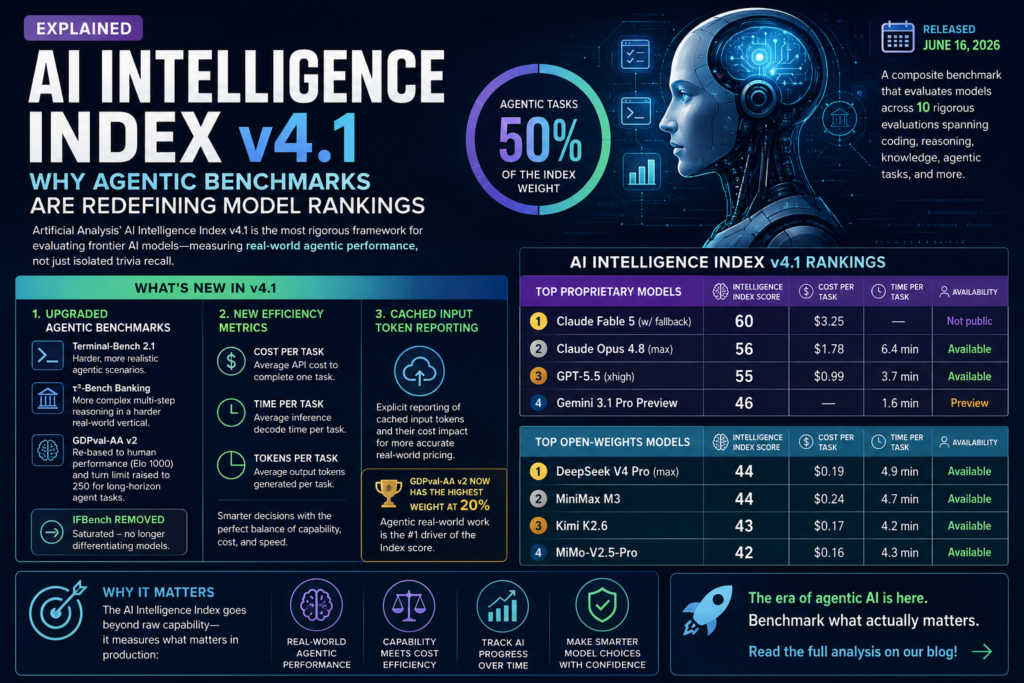
The Artificial Analysis AI Intelligence Index v4.1 is now the most rigorous framework for evaluating frontier AI models — because it measures what actually matters in 2026: real-world agentic performance, not just isolated trivia recall. Released on June 16, 2026, v4.1 marks a decisive shift away from static question-answer benchmarks toward multi-step, long-horizon agent tasks that reveal how models behave under realistic enterprise workloads.
If you’re choosing an LLM for production, comparing providers, or tracking how AI capabilities are evolving, this is the most important update you’ll read today.
What Is the Artificial Analysis AI Intelligence Index?
Definition: The Artificial Analysis AI Intelligence Index is a composite benchmark score produced by independent AI research firm Artificial Analysis. It synthesizes multiple rigorous evaluations into a single numeric score that reflects a model’s overall reasoning, knowledge, and agentic capability.
Unlike single-benchmark leaderboards, the AI intelligence index combines ten weighted evaluations spanning coding, scientific reasoning, knowledge accuracy, long-horizon agent tasks, and hallucination resistance. This multi-dimensional approach makes it significantly more reliable than any single benchmark as a proxy for real-world model usefulness.
The index is designed to track AI progress over time, enable apples-to-apples provider comparisons, and guide developers and enterprises in selecting the right model for their specific use cases.
Why an Intelligence Index — Rather Than a Single Benchmark?
Individual benchmarks saturate quickly. When every frontier model scores above 90% on a benchmark, it stops being a useful signal. The AI intelligence index solves this by continuously replacing saturated evaluations with harder, more realistic tasks — which is exactly what happened in v4.1.
What Changed in v4.1? The Three Major Upgrades
Version 4.1 of the AI intelligence index introduces three structural changes, each reflecting a broader industry maturation toward agentic AI workloads.
Upgraded Agentic Benchmarks: Harder, More Realistic Tasks
Three evaluations were upgraded or replaced:
- Terminal-Bench Hard → Terminal-Bench 2.1: This upgrade moves to a newer, more robust task set featuring harder and more realistic agentic scenarios. The new version does a better job separating frontier models that previously clustered together.
- τ²-Bench Telecom → τ³-Bench Banking: The replacement shifts the domain from telecom to banking, introducing more complex multi-step reasoning across a harder real-world vertical.
- GDPval-AA → GDPval-AA v2: The most significant upgrade. GDPval-AA v2 re-baselines Elo scores to human performance at 1000, introduces a rotating panel of frontier model judges, and raises the per-session turn limit from 100 to 250 — allowing evaluation of genuinely long-horizon agent trajectories.
- IFBench removed: Instruction-following benchmark IFBench was dropped entirely due to saturation — it no longer differentiates frontier models. Artificial Analysis will continue publishing IFBench results separately but has removed it from the composite index score.
GDPval-AA v2 now carries the highest weight in the entire index at 20%, making agentic real-world knowledge work the single most important factor in the AI intelligence index score.
New Per-Task Metrics: Cost, Time, and Tokens
v4.1 introduces three new efficiency metrics that make the AI intelligence index far more actionable for practitioners:
- Cost per Task: The average API cost to complete one Intelligence Index task, calculated by dividing total run cost by total task count.
- Time per Task: The average inference decode time per task, measured in minutes.
- Tokens per Task: The average number of output tokens generated per task.
These metrics transform the index from a pure capability ranking into an efficiency-aware decision tool. A model scoring 44 at $0.04 per task tells a very different story from a model scoring 56 at $1.78 per task.
Cached Input Token Reporting
v4.1 now explicitly reports cached input tokens and their cost impact when running the full intelligence index suite. This better reflects the true cost of operating each model in production — particularly important as context caching becomes a standard optimization strategy in enterprise AI deployments.
AI Intelligence Index v4.1 Rankings: Who Leads?
Here are the key results from the v4.1 release of the AI intelligence index, organized by category:
Top Proprietary Models:
- Claude Fable 5 (with Opus 4.8 fallback): Score of 60 — leads the index by four points, but is currently unavailable to the public as part of Anthropic’s Project Glasswing.
- Claude Opus 4.8 (max): Score of 56 — the highest-scoring model currently available to users.
- GPT-5.5 (xhigh): Score of 55 — within one point of Opus 4.8 on the AI intelligence index.
- Gemini 3.1 Pro Preview: Score of 46 — stands out for speed, completing tasks in just 1.6 minutes.
Top Open-Weights Models:
- DeepSeek V4 Pro (max): Score of 44
- MiniMax M3: Score of 44
- Kimi K2.6: Score of 43
- MiMo-V2.5-Pro: Score of 42
Open-weights models have narrowed the gap considerably, with DeepSeek V4 Pro achieving a score of 44 — competitive with many proprietary offerings at a fraction of the cost.
Comparison Table: Top AI Models on the AI Intelligence Index v4.1
| Model | Intelligence Index Score | Cost per Task | Time per Task | Availability |
|---|---|---|---|---|
| Claude Fable 5 (w/ fallback) | 60 | $3.25 | — | Not public |
| Claude Opus 4.8 (max) | 56 | $1.78 | 6.4 min | Available |
| GPT-5.5 (xhigh) | 55 | $0.99 | 3.7 min | Available |
| Gemini 3.1 Pro Preview | 46 | — | 1.6 min | Available |
| DeepSeek V4 Pro (max) | 44 | $0.04 | — | Available |
| MiniMax M3 | 44 | — | — | Available |
| Kimi K2.6 | 43 | — | — | Available |
| Grok 4.3 (high) | — | — | 1.5 min | Available |
| Claude Sonnet 4.6 (max) | — | — | 13.5 min | Available |
Cost and time figures are per Intelligence Index task as reported by Artificial Analysis, June 2026.
Cost Per Task vs. Intelligence — The Most Important Trade-Off in AI Selection
The new per-task metrics in v4.1 of the AI intelligence index reveal a striking divergence between capability and cost.
DeepSeek V4 Pro (max) achieves an intelligence index score of 44 at just $0.04 per task — making it over 20x cheaper than GPT-5.5 (xhigh) at $0.99 and over 44x cheaper than Claude Opus 4.8 (max) at $1.78. For workloads where an index score in the low-to-mid 40s is sufficient, DeepSeek V4 Pro represents an extraordinary value proposition.
GPT-5.5 (xhigh) occupies an interesting middle position: it scores within one point of Claude Opus 4.8 on the AI intelligence index at roughly 56% of the cost per task ($0.99 vs $1.78). For organizations where near-frontier performance is required but budget matters, this positions GPT-5.5 as a strong default choice.
Time per Task reveals another underappreciated dimension. Claude Sonnet 4.6 (max) takes the longest at 13.5 minutes per task, notably slower than Claude Opus 4.8 (max) at 6.4 minutes — not because Sonnet is less efficient, but because it generates more output tokens per task when running the index. Grok 4.3 (high) leads on speed at just 1.5 minutes per task.
How to Read the Intelligence vs. Cost Chart
When evaluating models against the AI intelligence index, plot your requirements along two axes:
- X-axis: Cost per task (your budget ceiling per inference)
- Y-axis: Intelligence Index score (your capability floor)
Models in the upper-left quadrant (high score, low cost) are optimal. As of v4.1, DeepSeek V4 Pro dominates this space among available models for use cases that don’t require frontier-level scores.
Why Agentic Benchmarks Matter More Than Traditional Tests
The shift to agentic evaluations in the AI intelligence index reflects a fundamental change in how AI models are actually being deployed.
Traditional LLM benchmarks like MMLU or HumanEval measure isolated, single-turn capabilities: “Can the model answer this question correctly?” These benchmarks are easy to saturate and poor predictors of production performance.
Agentic benchmarks like those now emphasized in the AI intelligence index measure something harder: “Can the model complete a multi-step goal, recover from errors, use tools, and maintain coherent reasoning over dozens or hundreds of turns?”
The difference matters because enterprise AI deployments in 2026 predominantly involve:
- Autonomous coding agents running terminal commands
- Customer-facing support agents handling complex banking workflows
- Knowledge worker assistants managing long-horizon research tasks
Terminal-Bench 2.1, τ³-Bench Banking, and GDPval-AA v2 — the three most heavily weighted evaluations in the AI intelligence index — are all designed to test exactly these capabilities.
What Is GDPval-AA v2?
Definition: GDPval-AA v2 is the highest-weighted evaluation in the AI intelligence index v4.1, accounting for 20% of the composite score. It is an Elo-based benchmark that measures a model’s ability to complete real-world knowledge work tasks over long agent trajectories.
How it works: Models are rated on an Elo scale re-baselined to human performance at 1000. A rotating panel of frontier-model judges evaluates outcomes, and agents are allowed up to 250 turns per task — enabling evaluation of genuinely long-horizon planning, execution, and error correction.
Current leaders: Claude Fable 5 (with fallback) scores 1818 on GDPval-AA v2, followed by Claude Opus 4.8 at 1638 and GPT-5.5 (xhigh) at 1531.
Full Benchmark Weights in the AI Intelligence Index v4.1
Understanding how the AI intelligence index score is constructed helps practitioners know which capabilities are being prioritized.
| Evaluation | Weight | Type |
|---|---|---|
| GDPval-AA v2 | 20% | Long-horizon agentic knowledge work |
| Terminal-Bench 2.1 | 16% | Agentic coding and terminal tasks |
| τ³-Bench Banking | 14% | Multi-step service agent tasks |
| Humanity’s Last Exam | 12% | Broad academic knowledge |
| AA-Omniscience Accuracy | 8% | General factual accuracy |
| SciCode | 8% | Scientific coding ability |
| GPQA | 6% | Graduate-level science reasoning |
| AA-LCR | 6% | Long-context reasoning |
| CritPt | 6% | Critical point identification |
| AA-Omniscience Non-Hallucination | 4% | Hallucination resistance |
The three agentic evaluations (GDPval-AA v2, Terminal-Bench 2.1, τ³-Bench Banking) together account for 50% of the total AI intelligence index score — making real-world task completion the dominant factor in a model’s ranking.
How to Use the AI Intelligence Index to Choose the Right Model
The AI intelligence index is most useful when matched to your actual deployment context. Here is a practical framework:
Step 1 — Define your minimum acceptable score. What is the lowest AI intelligence index score that would still deliver acceptable task completion in your use case? For general knowledge work, scores in the 40s may suffice. For frontier-level agentic tasks, you likely need 50+.
Step 2 — Set a cost-per-task ceiling. Using the new per-task cost metrics, determine what you can afford per inference. A score of 44 at $0.04/task may be vastly preferable to a score of 56 at $1.78/task for high-volume workloads.
Step 3 — Factor in latency requirements. The 9x spread in time per task (1.5 min for Grok 4.3 vs. 13.5 min for Claude Sonnet 4.6 max) is consequential for real-time applications. Check time-per-task alongside the AI intelligence index score.
Step 4 — Weight agentic vs. non-agentic needs. If your application involves multi-step autonomous agents, the three agentic benchmarks (collectively 50% of the index) are highly predictive. If your use case is primarily single-turn Q&A or summarization, examine the GPQA, AA-Omniscience, and Humanity’s Last Exam sub-scores instead.
Step 5 — Monitor the open-weights tier. With DeepSeek V4 Pro and MiniMax M3 both hitting 44 on the AI intelligence index, open-weights models are now a viable consideration for enterprise deployments — especially given the cost differential of 20x–44x vs. frontier proprietary models.
What This Means for the Future of AI Model Evaluation
The evolution of the AI intelligence index from v4.0 to v4.1 reflects a broader maturation in how the industry thinks about AI capability.
Saturation is real — and fast. IFBench was removed because frontier models had largely converged on high performance. The same will likely happen to other current benchmarks within 12–18 months, necessitating further upgrades. The AI intelligence index’s rotating-benchmark methodology is built for this reality.
Agentic capability is the new frontier. The 50% weighting on agentic tasks in v4.1 reflects where enterprise AI investment is flowing. Models that excel at long-horizon reasoning, tool use, and error recovery will command premium positioning — and premium pricing, as the cost-per-task data shows.
Cost efficiency is becoming a first-class metric. The introduction of cost-per-task, time-per-task, and tokens-per-task alongside the AI intelligence index score represents a recognition that raw capability without cost context is insufficient for real purchasing decisions. Expect this efficiency-aware framing to become standard across AI evaluation frameworks.
Open-weights models are closing the gap. With DeepSeek V4 Pro achieving a score of 44 at $0.04/task, the AI intelligence index is now capturing a genuinely competitive open-weights tier — one that poses a credible alternative to proprietary models for many production workloads.
The AI intelligence index, particularly in its v4.1 agentic-focused form, is rapidly becoming the reference standard for anyone making serious model selection decisions. As AI systems transition from tools to agents — from answering questions to executing long-horizon goals — benchmarks that measure those capabilities are no longer optional context. They are the map.
Frequently Asked Questions
What is the Artificial Analysis AI Intelligence Index? It is a composite score produced by Artificial Analysis that combines ten weighted evaluations — including agentic benchmarks, scientific reasoning tests, and hallucination resistance measures — into a single number representing a model’s overall intelligence and capability.
Which model leads the AI Intelligence Index v4.1? Claude Fable 5 (with Opus 4.8 fallback) leads at a score of 60, but is not publicly available. Among available models, Claude Opus 4.8 (max) leads at 56, followed closely by GPT-5.5 (xhigh) at 55.
What are the best value AI models according to the index? DeepSeek V4 Pro (max) stands out with an index score of 44 at just $0.04 per task — over 40x cheaper than Claude Opus 4.8 (max) at $1.78 per task for a score roughly 12 points lower.
Why was IFBench removed from the AI Intelligence Index? IFBench was removed due to saturation — frontier models had converged to the point where the benchmark no longer meaningfully differentiated between them. It will continue to be published as a standalone metric.