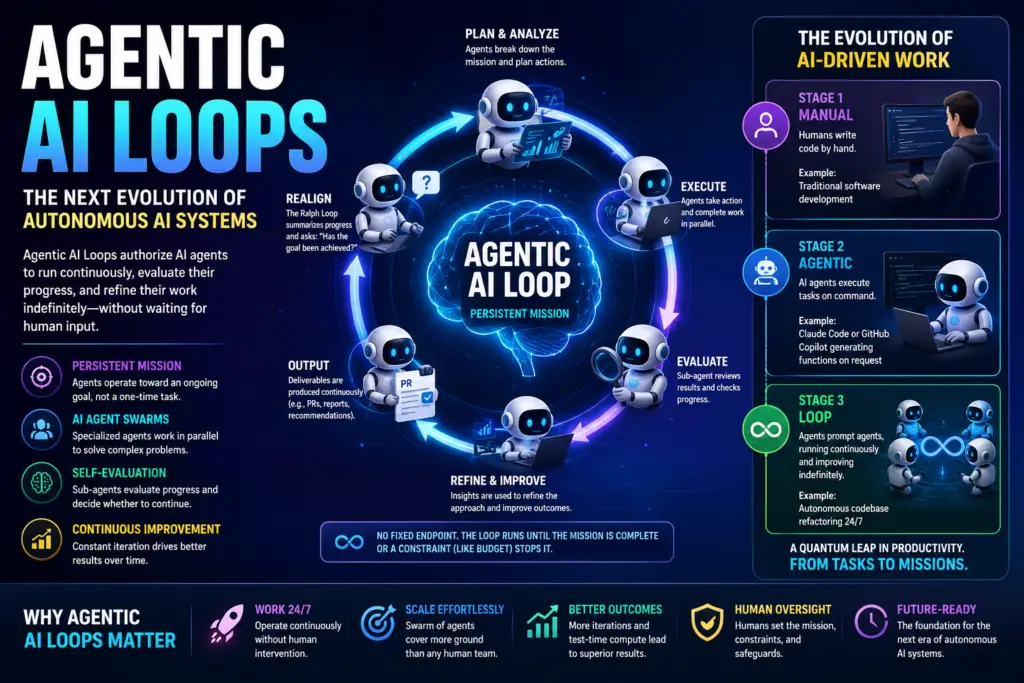
Agentic AI loops are redefining how artificial intelligence handles ongoing, complex work — authorizing swarms of agents to run continuously in the background, indefinitely, without a human pressing “go” after each task. If you want to understand the most significant shift in AI productivity since the rise of autonomous agents, this is the architecture to watch.
The concept moved from niche experimentation to mainstream conversation in June 2026, when Boris Cherny, creator of Claude Code, told an audience at Meta’s @Scale conference that loops represent a transformation just as significant as the earlier leap from humans writing code to AI agents doing it. He was emphatic: the loops are for real.
This guide explains what they are, how they work, where they deliver the most value, and what teams need to manage before deploying them at scale.
What Are Agentic AI Loops?
Definition: An agentic AI loop is a system in which one or more AI agents are authorized to run indefinitely — continuously performing, evaluating, and refining a task — without waiting for a human to restart the cycle after each output.
Unlike a standard agentic workflow, which begins when a user issues a task and ends when that task is complete, agentic AI loops have no built-in endpoint. Instead, a sub-agent within the system evaluates progress and decides whether the loop should continue. This is what makes them non-deterministic: the stop condition is chosen by the AI, not defined by a fixed rule.
The Three Stages of AI Automation
To understand why loops matter, it helps to trace the progression of AI-driven work:
| Stage | Who Does the Work | Typical Example |
|---|---|---|
| Stage 1 — Manual | Humans write source code by hand | Traditional software development |
| Stage 2 — Agentic | AI agents execute tasks on command | Claude Code or GitHub Copilot generating functions on request |
| Stage 3 — Loop | Agents prompt agents, running continuously | Autonomous codebase refactoring running 24/7 without human prompts |
Each stage represents a qualitative shift, not just an incremental improvement. In Stage 3, the human role evolves from task manager to loop architect — setting scope, defining constraints, and establishing oversight frameworks, then stepping back. Loops are to agentic AI what agentic AI was to chatbots: a different category, not a better version of the same thing.
How Loops Differ from Standard Agentic AI
The key structural difference is persistence. Standard agentic AI is task-bound: receive a prompt, execute a workflow, stop. Loops are mission-bound: receive a goal, run continuously, and produce a stream of discrete outputs — pull requests, reports, optimization recommendations — as work progresses.
This distinction has significant implications for how you design, deploy, and govern these systems. You are no longer managing individual agents toward defined endpoints. You are managing an ongoing process.
How Agentic AI Loops Actually Work
Short answer: A loop assigns one or more AI agents a persistent mission, lets them execute and self-evaluate, and relies on a sub-agent or a budget ceiling — rather than a human — to decide when work pauses or stops.
The Agent Swarm Model
Most real-world loop deployments involve multiple specialized agents running in parallel as AI agent swarms. Each agent is optimized for a narrow sub-task, and together they cover far more ground than any single agent could independently.
A concrete example from Boris Cherny’s June 2026 @Scale presentation illustrates this: one continuous AI agent scans a codebase for architectural improvements and submits pull requests, while a separate agent searches for duplicated abstractions that can be unified. Because the codebase evolves constantly, neither agent ever truly finishes its job — both simply keep working. The output is a steady stream of improvements, submitted like any other developer’s pull requests, reviewed and merged on a rolling basis.
This is the defining feature of AI agent swarms operating in a loop: task completion does not equal loop termination. Agents are aligned to ongoing missions, not finite tasks.
The Ralph Loop — Simplicity as a Superpower
One of the most widely used loop patterns is surprisingly low-tech. The Ralph Loop — named with a nod to the Simpsons character Ralph Wiggum — works by periodically summarizing all the work a model has completed and asking a single question: Has the goal been accomplished yet?
This back-and-forth continues until the model concludes the objective has been met, or until an external constraint such as a token budget halts the session.
The pattern matters because continuous AI agents face a well-documented challenge in long-running tasks: as context windows fill up, models can gradually lose track of their original objective and begin to drift. The Ralph Loop functions as a periodic realignment mechanism — bouncing the model back to its stated intent without any human intervention. It is, in essence, a non-deterministic while loop with a self-assessed exit condition, and it works with remarkable reliability.
Loops and Test-Time Compute
The loop paradigm is closely connected to the broader principle of test-time compute scaling: the idea that applying more computational resources to a problem at inference time improves the quality of the output. OpenAI researcher Noam Brown has observed that contemporary models can solve nearly any problem if you apply enough compute — which means that for certain classes of problems, simply continuing to run is a legitimate path to a better answer.
For hill-climbing problems — challenges where progress is incremental and each step can be evaluated against the last, such as continuously improving a codebase — the loop model and test-time compute scaling are a natural fit. There is always another architectural improvement to find. The agents simply keep climbing.
This reframes how organizations should think about AI investment: not “how much does this task cost?” but “how much is it worth to keep improving this outcome indefinitely?”
Agentic AI Loops vs. Traditional Agentic AI
Understanding the structural differences between these two paradigms helps teams choose the right approach for each use case.
| Dimension | Traditional Agentic AI | Agentic AI Loops |
|---|---|---|
| Trigger | Human prompt per task | One-time mission definition |
| Duration | Bounded — ends at task completion | Unbounded — runs until stopped |
| Stop Condition | Task is done (deterministic) | Sub-agent decides or budget expires (non-deterministic) |
| Human Touch Points | After every task | At loop design, monitoring, and escalation |
| Best For | Discrete, well-scoped tasks | Iterative, compounding, hill-climbing problems |
| Token Cost | Predictable per task | Open-ended — potentially very high |
| Output Cadence | Single deliverable per run | Continuous stream of incremental outputs |
| Oversight Model | Task-level review | Process-level governance |
The core trade-off is control vs. compounding throughput. Traditional agentic AI gives humans a natural review moment at the conclusion of each task. Loops surrender that granularity in exchange for continuous, accumulating improvement — a worthwhile trade only when the underlying problem is genuinely open-ended.
Where Agentic AI Loops Deliver the Most Value
Not every problem benefits from continuous looping. The highest-value use cases share a predictable set of structural properties:
- The work is iterative and never truly “done.” Software quality, content freshness, security posture, data hygiene, and regulatory compliance monitoring all belong to this category. There is no final state — only a better one.
- Progress is measurable at each step. The loop needs a reliable feedback signal to determine whether the outcome is improving. Without that signal, recursive AI agents have no principled basis for deciding whether to continue.
- Human review of individual micro-outputs is impractical. If a loop generates hundreds of pull requests per week, no team can meaningfully review each one in real time. The system works best when outputs are batched, filtered, or automatically applied below a defined risk threshold.
- Incremental gains compound over time. A codebase that is continuously refactored becomes faster, cleaner, and more maintainable — but no single loop cycle produces a dramatic transformation. The value accrues gradually and accelerates with time.
- Failures are recoverable. Because loop-based systems operate with limited oversight, they will occasionally produce incorrect or suboptimal outputs. The architecture must ensure bad outputs can be identified and reverted without causing irreversible downstream damage.
- The domain has clear evaluation criteria. Agents improve what they can measure. Domains with clear quality signals — test pass rates, latency benchmarks, compliance scores — are structurally better suited to loops than domains with ambiguous success criteria.
Current high-value deployment domains include software engineering, content optimization, data pipeline maintenance, security vulnerability scanning, and financial compliance monitoring.
The Cost and Governance Challenge
Token Burn: The Open-Ended Economics
Agentic AI loops are computationally expensive by design. A simple Q&A interaction with an AI model consumes a modest number of tokens. A single agentic task consumes considerably more. A loop — with no natural ceiling — represents an open-ended computational commitment with no obvious stopping point.
For AI providers, this is a straightforward business positive: more usage means more revenue. For enterprises, the cost structure is genuinely novel. Unlike SaaS pricing (fixed monthly fee) or traditional cloud compute (predictable hourly rates tied to defined workloads), a loop can generate unpredictable and potentially large token spend with no natural limit.
Organizations deploying loops for the first time should define two things before launch:
- A maximum token budget per loop cycle, set conservatively and reviewed after the first few runs.
- A real-time spend monitoring mechanism that flags anomalous usage before it escalates to a budget crisis.
The economics can absolutely justify themselves for the right problems — but only when they are modeled clearly in advance. Going in without a budget framework is how a valuable experiment becomes an expensive surprise.
Preventing Drift in Continuous AI Agents
Beyond cost, the second major governance challenge is drift: the gradual deviation of loop behavior from its original intent. Because stop conditions are non-deterministic and agents make their own decisions about what to work on next, there is no guarantee a loop stays within its intended scope over time. A code improvement agent given too much latitude might start restructuring modules it was never asked to touch.
Effective governance of continuous AI agents involves multiple control layers working in combination:
- Scope constraints. Define explicit boundaries around what actions agents are and are not permitted to take. Ambiguity becomes a compounding liability at scale.
- Sandboxed environments. Ensure loop agents operate in reversible contexts — branches, staging databases, draft files — where all outputs can be reviewed before merging into production systems.
- Periodic intent check-ins. Apply the Ralph Loop principle at a higher level: periodically verify that the overall loop is still pursuing its intended mission, not a version of it that has quietly drifted.
- Escalation thresholds. Define the specific conditions under which the loop must pause and surface a decision to a human before continuing. These thresholds should be defined before deployment, not after the first incident.
The governance burden is real, but it is manageable — and far lighter than the manual effort the loop displaces.
The Future of Work With Agentic AI Loops
The emergence of this looping paradigm represents a structural change in how knowledge work gets done, not simply a new tool in an existing stack.
The human role in software development, data operations, and content management is already shifting from executor to architect. With loop-based AI systems, that shift accelerates: humans design the mission, define the constraints, monitor drift, and evaluate aggregate output. They are no longer in the critical path of individual tasks — they are upstream of the entire workflow.
This is not a distant prospect. Well-resourced engineering organizations are already running loop-based systems today. The teams that develop genuine fluency in loop design, oversight, and governance over the next 12 to 18 months will hold a structural advantage as model quality continues to improve.
As test-time compute scaling matures, the viable mission space for loop-based deployments will expand. Problems that are too complex or too risky for autonomous looping today may be entirely appropriate for deployment within two years. The trajectory is clear.
The practical question for most teams right now is not whether to engage with this approach, but where to start. The answer is almost always the same: begin with a narrowly scoped, measurable, reversible use case. Master the governance layer before expanding the scope. The compounding returns on getting this right early will be significant.
Frequently Asked Questions
What is an agentic AI loop?
An agentic AI loop is a configuration in which AI agents are authorized to run continuously and autonomously, performing iterative work on a defined mission without requiring a human to restart each cycle. The loop persists until a sub-agent determines the goal has been achieved, or an external constraint — such as a token budget — terminates the session.
How are AI loops different from regular AI agents?
Regular AI agents are task-bound: they start when a human issues a prompt and stop when the task is complete. Loop-based systems are mission-bound: they start when a mission is defined and run continuously, producing a stream of outputs along the way. The critical difference is that the stop condition in a loop is non-deterministic — chosen by the AI, not predetermined by a fixed rule.
What is the Ralph Loop?
The Ralph Loop is a widely used pattern for maintaining focus in long-running AI tasks. It works by periodically summarizing all the work a model has completed and asking whether the stated goal has been met. This gives continuous AI agents a way to stay aligned with their original objective even as context windows fill up over extended operation — without requiring human intervention.
What are recursive AI agents?
Recursive AI agents are agents that use the output of one AI process as the input for another — effectively calling themselves or sibling agents to repeat and refine a task. Loop-based systems depend on this recursive pattern: a sub-agent evaluates the work of a primary agent and decides whether another cycle is warranted, creating the feedback mechanism that powers continuous operation.
Are AI loops expensive to run?
Yes, significantly so. Because there is no natural endpoint, loop-based systems consume tokens continuously. Cost management requires setting maximum token budgets per cycle, monitoring spend in real time, and modeling the economics before deployment. The cost is often justified for compounding, iterative use cases — but teams should not deploy without a clear budget framework in place.
What is test-time compute and how does it relate to AI loops?
Test-time compute refers to the practice of applying more computational resources to a problem during inference to improve output quality. This architecture is a natural expression of this principle: for problems where improvement is incremental and measurable, running the loop longer simply produces better outcomes — at the cost of proportionally more compute spend.
Conclusion
Agentic AI Loops are rapidly transforming how organizations approach automation, enabling AI systems to work continuously, improve independently, and deliver compounding value over time. Unlike traditional AI agents that stop after completing a task, Agentic AI Loops operate with persistent missions, allowing teams to automate complex workflows with minimal human intervention. As businesses seek scalable and efficient solutions, Agentic AI Loops provide a powerful framework for continuous optimization across software engineering, content creation, security, and compliance. However, success with Agentic AI Loops requires careful governance, budget controls, and clear oversight to prevent drift and manage costs effectively. Organizations that embrace Agentic AI Loops today will be better positioned to harness the next wave of autonomous AI innovation and gain a lasting competitive advantage. The future of intelligent automation is not about isolated tasks but about systems that learn, adapt, and improve endlessly. As the technology matures throughout 2026 and beyond, Agentic AI Loops are expected to become a foundational architecture for AI-driven enterprises, reshaping workflows and redefining productivity. Now is the ideal time to explore Agentic AI Loops and prepare for this transformative shift.