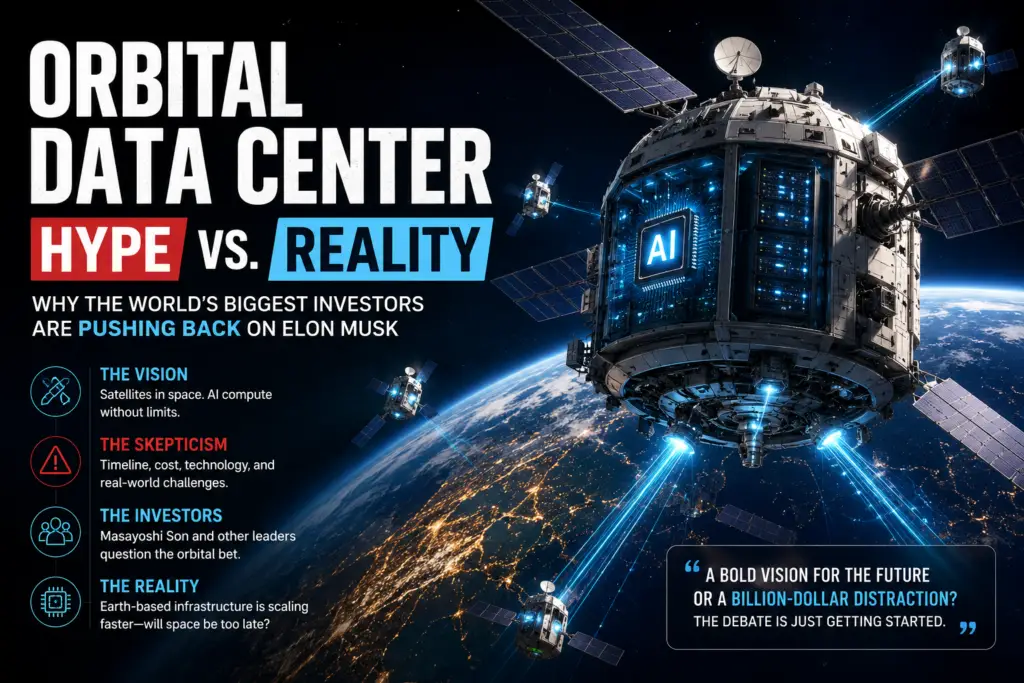
The promise of an orbital data center sounds like science fiction made investable — but the most sophisticated money in tech is starting to ask hard questions. Here’s what Elon Musk is actually proposing, who’s skeptical (and why their skepticism matters), and what this debate reveals about the future of AI infrastructure.
What Is an Orbital Data Center?
An orbital data center is exactly what it sounds like: a computing facility placed in orbit around Earth, aboard satellites, rather than built in a ground-based facility.
The concept, championed primarily by Elon Musk and SpaceX, envisions constellations of satellites loaded with processing hardware capable of running AI workloads — not just beaming internet signals down to Earth, but actively hosting computational tasks in space.
Why Would Anyone Put a Data Center in Space?
The argument has a certain logic to it:
- No terrestrial land constraints. Building data centers on Earth requires land, water, power permits, and local regulatory approval. Space has none of that.
- No NIMBYs. Opposition from local communities (“Not In My Backyard”) has slowed data center construction in many US and European regions. Orbit sidesteps that entirely.
- Passive cooling via deep space. In theory, the cold vacuum of space offers a natural thermal sink for heat-generating hardware — a major operational cost on the ground.
- Global coverage. A satellite constellation could serve AI compute requests from anywhere on Earth without the latency inherent to routing through distant ground-based servers.
Musk has framed this vision as a solution to the global AI compute shortage — a problem that is very real, very urgent, and very expensive to solve conventionally.
But “could work in theory” and “will work in practice, on a useful timeline” are two very different things. That gap is precisely where the pushback begins.
Why SpaceX Is Pushing Space-Based AI Compute
To understand why SpaceX is making this bet, you first have to understand the business environment that made it attractive.
The Global AI Compute Crunch
The demand for AI compute has grown so explosively over the past three years that virtually every major AI lab, startup, and enterprise customer reports being compute constrained — meaning the bottleneck to their AI progress is not talent, data, or ideas, but access to raw processing power.
This has created a frenzied market for anyone who can supply that compute. The result is a new category dubbed the “neo-cloud”: companies that may not have started as cloud providers but have pivoted to leasing out compute capacity. Groq, which recently confirmed a $650 million funding round, is one example. Even legacy brands in entirely unrelated industries have explored pivots into compute leasing as AI infrastructure becomes one of the most lucrative markets in tech.
SpaceX enters this market from a unique position. The company already operates Starlink — one of the largest satellite constellations ever deployed — and has extensive launch infrastructure. The leap to positioning that constellation as a compute-delivery network is shorter for SpaceX than for almost any other player.
SpaceX’s Expanding Neo-Cloud Strategy
SpaceX has been quietly building a compute-leasing business alongside its satellite and launch operations. The company has signed notable compute-supply deals with major players including Google and Anthropic, and recently inked its first post-IPO compute deal with Reflection AI, an open-source AI lab.
The pitch to investors is sweeping: an AI platform with an addressable market the size of U.S. GDP. But in practice, the near-term business looks much more like a traditional infrastructure lease: rent out compute, collect recurring revenue, and use that cash flow to fund the longer-term orbital data center vision.
The question investors and rivals are beginning to ask out loud is whether the orbital data center concept is a genuine technological roadmap — or sophisticated hype designed to support an enormous valuation.
Masayoshi Son’s Public Takedown of the Orbital Data Center Vision
In June 2026, at a SoftBank shareholder meeting, Masayoshi Son — founder and CEO of SoftBank — delivered perhaps the most high-profile public challenge to Musk’s orbital data center thesis to date.
Son’s argument was pointed: building an orbital data center won’t meaningfully cut costs, and by the time such systems could be operational, the AI race will already be decided. As he framed it, the next few years matter far more in the AI competition than whatever advantages space-based infrastructure might eventually offer a decade from now.
The Timeline Problem
This is the crux of the skepticism that serious observers have raised about the orbital data center concept.
Even if every technical challenge were solved tomorrow — heat management, radiation hardening for chips, high-bandwidth satellite-to-ground data links, in-orbit servicing for replacement hardware — the construction, launch, and commissioning of an orbital data center at meaningful scale would take years. Probably the better part of a decade.
The AI compute shortage, meanwhile, is a problem that major labs and enterprises need solved in months, not decades. OpenAI is building custom silicon with Broadcom. Hyperscalers are spending hundreds of billions on terrestrial data center campuses. The solutions being deployed right now are happening on Earth, at speed.
An orbital data center, even a successful one, would arrive after the most critical infrastructure decisions in AI have already been made and locked in.
Why the Skepticism Carries Weight
It would be easy to dismiss concerns about the orbital data center idea if they came only from parties with no skin in the game. But the lineup of skeptics is notable.
SoftBank itself has a legendary appetite for visionary, high-risk bets — it funded WeWork’s runaway burn, poured billions into Vision Fund moonshots, and has historically been one of the loudest voices in any room arguing that the future will be stranger and bigger than conventional wisdom assumes. When Masayoshi Son, of all people, is the one saying “wait, does this actually make sense?” — it signals something.
Sam Altman, CEO of OpenAI, has also rolled his eyes publicly at the orbital data center timeline, suggesting his confidence in space-based compute as a near-term AI solution is limited.
Who Else Is Questioning Orbital Data Centers?
The skeptic camp for the orbital data center concept is not small, and it spans multiple categories of concern:
- Timeline critics (Son, Altman): Argue that space-based compute will arrive too late to matter for the current AI investment cycle, which is playing out over the next two to five years.
- Cost skeptics: The economics of launching hardware into orbit, operating it in a radiation environment, and replacing it every few years (satellites degrade and deorbit) are punishing. Terrestrial data center costs are already falling as chip technology improves.
- Conflict-of-interest observers: Multiple analysts have noted that Son’s own company has committed up to €75 billion to build data centers on Earth — in France alone — giving SoftBank a direct financial interest in earthly infrastructure winning over space-based alternatives.
- Engineering realists: Thermal management in space is not as simple as “the vacuum is cold.” Without convective cooling (which requires atmosphere), heat can only be dissipated via radiation — a much slower and more engineering-intensive process. Designing chips and server racks that work reliably in that environment, under radiation bombardment, at scale, remains an unsolved challenge.
- Market structure analysts: The launch market argument — that an orbital data center constellation would essentially guarantee massive ongoing revenue for SpaceX’s launch division — raises questions about whether the concept is being driven by genuine compute economics or by internal business logic that benefits Musk’s companies collectively.
Orbital Data Centers vs. Earth-Based Data Centers: A Direct Comparison
| Factor | Orbital Data Center | Earth-Based Data Center |
|---|---|---|
| Land Requirements | None | Significant; increasingly contested |
| Regulatory Hurdles | Launch approvals; spectrum licensing | Zoning, permitting, utility agreements |
| Cooling Method | Radiative (complex engineering) | Air/liquid cooling (mature technology) |
| Construction Timeline | 7–15+ years to meaningful scale | 18–36 months for large campuses |
| Hardware Replacement | Launch new satellites; costly | On-site swap; relatively straightforward |
| Radiation Exposure | Significant; requires hardened chips | Negligible |
| Latency to Ground | Variable; depends on orbit altitude | Low; direct fiber connectivity |
| Cost per Compute Unit | Extremely high (currently) | Falling rapidly with chip advances |
| Current Operational Scale | Conceptual/early-stage | Hundreds of megawatts online globally |
| Backed By | SpaceX, Musk | Amazon, Microsoft, Google, SoftBank |
The table makes clear that the orbital data center model has genuine theoretical advantages in some dimensions — but is currently outmatched on nearly every dimension that matters most to buyers making infrastructure decisions today.
The “Talking Your Book” Problem in Big Tech AI Predictions
One of the sharpest observations to emerge from the debate over orbital data centers is a more general principle about how to interpret any tech executive’s predictions: everyone is, to some degree, talking their book.
“Talking your book” is a finance phrase for when someone publicly advocates for positions, predictions, or narratives that benefit their own holdings or business interests — not necessarily through dishonesty, but through the lens of their own financial stake in a particular future.
SpaceX’s Circular Business Model
Consider the incentive structure at play in Musk’s orbital data center pitch:
If the orbital data center vision gains credibility, SpaceX’s valuation rises. If investors and customers sign on, SpaceX gets compute lease revenue in the near term. Building the constellation requires launching thousands of satellites — guaranteeing revenue for SpaceX’s own launch business. And as those satellites naturally degrade and need replacement (every few years, as is typical for low-earth orbit hardware), the launch business gets another guaranteed revenue stream.
The orbital data center concept, in other words, is not just an AI infrastructure play. It is simultaneously a justification for SpaceX’s valuation, a mechanism for recurring compute revenue, and a self-perpetuating demand engine for SpaceX’s core rocket launch business. Each part of the pitch reinforces the others.
SoftBank’s Earthly Stakes
Son, for his part, is not a neutral observer either. SoftBank has committed up to €75 billion to build terrestrial data centers in France alone — a figure that represents one of the largest single-country data center infrastructure commitments in history. The company also holds massive positions in AI-adjacent investments across its Vision Fund portfolio.
If orbital data centers became the dominant compute paradigm of the 2030s, that earthly investment thesis would face existential questions. Son’s skepticism about space-based compute is, at minimum, consistent with protecting an enormous bet on ground-based infrastructure.
Similarly, Sam Altman’s skepticism about the orbital data center timeline is coherent with OpenAI’s strategy: the company is building custom silicon, partnering with Broadcom, and relying on terrestrial compute infrastructure for its near-term roadmap. A world where the AI race is settled in the next few years — by ground-based infrastructure — is precisely the world where OpenAI’s current investments pay off.
None of this means that Son, Altman, or their critics are being deliberately misleading. It means that in a moment of genuine technological uncertainty, every major voice in this conversation has billions of dollars riding on a particular version of the future — and that should calibrate how their confident predictions are weighed.
What This Debate Means for the Future of AI Infrastructure
The orbital data center debate is a proxy for a larger question: where will the physical infrastructure of AI ultimately live, and who will own it?
The answer over the next three to five years is almost certainly going to be Earth. The hyperscalers — Amazon, Microsoft, Google — are spending at a pace that no space-based competitor can match in the near term. OpenAI’s custom silicon push represents a deliberate move away from dependence on Nvidia and toward proprietary compute stacks that will live in traditional data centers. Groq and other specialized chipmakers are building terrestrial alternatives to GPU-centric architectures.
The orbital data center vision may yet prove its worth — but on a timeline measured in decades, not years. And decades is a long time in an industry that measures competitive cycles in months.
For now, the compute crunch will be solved the old-fashioned way: by digging foundations, pouring concrete, running power lines, and making hard deals with utilities and regulators. Space may be the long game. But for the next critical phase of the AI race, the data center that matters is the one that can be plugged in by next year.
Key Takeaways
- An orbital data center is a satellite-hosted computing facility designed to deliver AI compute from orbit, rather than from ground-based buildings.
- Elon Musk and SpaceX have championed the concept as a solution to terrestrial infrastructure constraints, land scarcity, and regulatory friction.
- SoftBank CEO Masayoshi Son publicly challenged the orbital data center thesis in June 2026, arguing the timeline is too slow for a competition where the next few years are decisive.
- Sam Altman and other industry figures have also expressed skepticism about space-based compute as a near-term AI solution.
- Every major voice in this debate — Musk, Son, Altman — has significant financial stakes that shape their narratives; independent analysis requires accounting for those incentives.
- Terrestrial data center investment is outpacing space-based alternatives by orders of magnitude, and most major AI infrastructure decisions over the next 3–5 years will be made on the ground.
Frequently Asked Questions
Q: Has any orbital data center been successfully launched and operated? No. As of mid-2026, orbital data centers remain a conceptual and early-stage proposal. No commercially operating satellite constellation for AI compute has been deployed at meaningful scale.
Q: Why can’t SpaceX use Starlink satellites as a data center today? Starlink satellites are designed for communications bandwidth — routing internet traffic, not performing heavy AI computation. Retrofitting or replacing them with compute-optimized hardware at scale would require a new generation of satellite design and a massive launch campaign.
Q: What would make an orbital data center economically viable? A dramatic reduction in launch costs (which SpaceX is actively working on with Starship), the development of radiation-hardened AI accelerator chips, and a solved approach to in-orbit thermal management would all need to come together at scale. Most analysts put that intersection at least a decade away.
Q: Is SoftBank investing in orbital data centers? No. SoftBank has publicly committed to terrestrial data center investment — including up to €75 billion in French data center infrastructure — placing it firmly in the Earth-based compute camp.