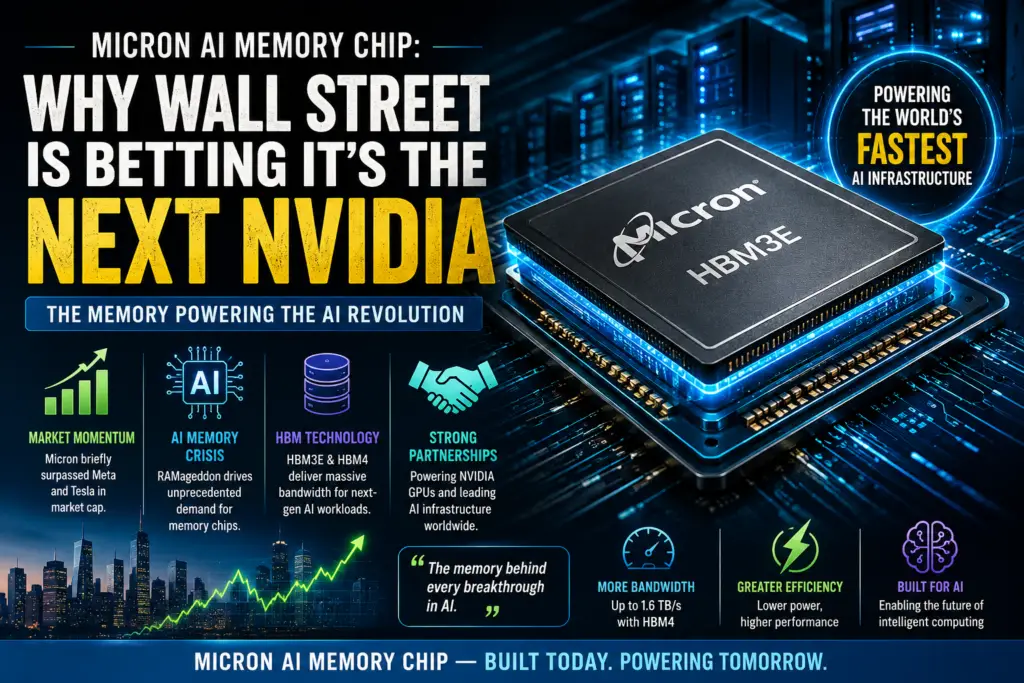
Micron Technology has transformed from a forgotten commodity chipmaker into one of the most closely watched AI infrastructure stocks of 2026. The reason is direct: the global AI buildout is consuming memory at an unprecedented rate, and the Micron AI memory chip — particularly its High-Bandwidth Memory (HBM) line — sits at the center of that hunger. In late June 2026, Micron briefly eclipsed both Meta and Tesla in market capitalization, a milestone that would have seemed laughable just 18 months earlier.
This article explains exactly why that happened, what it signals for the AI hardware landscape, and whether the market’s enthusiasm is built on durable fundamentals or speculative momentum.
What Is Micron Technology? A Clear Definition
Micron Technology is a Boise, Idaho-based semiconductor company — the only major US-headquartered manufacturer of DRAM (Dynamic Random-Access Memory) and NAND flash memory. Founded in 1978, it spent most of its history producing the memory chips that power everyday electronics: smartphones, laptops, cameras, and game consoles.
That background made it easy to overlook. Memory chips are commodities. Their prices swing with supply and demand, and the business has traditionally rewarded endurance more than excitement. The AI revolution, however, has completely rewritten that narrative.
From Commodity Memory to AI Infrastructure
As large language models like GPT, Gemini, and Claude scaled from millions to hundreds of billions of parameters, the hardware required to train and run them needed something that raw compute power alone could not supply: massive, fast, and efficient memory bandwidth.
A single high-end AI server requires magnitudes more memory than a standard enterprise server or consumer laptop. Where a gaming PC may function on 32 GB of RAM, a modern AI training cluster can demand terabytes of specialized memory per rack. That demand is precisely where the Micron AI memory chip enters the picture — not as a peripheral accessory, but as mission-critical infrastructure.
High-Bandwidth Memory (HBM)Micron stockAI chip shortageNvidia AI infrastructure
The AI Memory Crisis: What Is RAMageddon?
RAMageddon is the industry shorthand for the severe global shortage of system memory chips triggered by the AI data center buildout boom. The term captures the intensity of the supply crunch: demand for DRAM, NAND flash, and especially High-Bandwidth Memory (HBM) has so dramatically outpaced production capacity that memory scarcity has become one of the central bottlenecks in the AI arms race.
The shortage has real-world consequences that reach well beyond Wall Street:
- Consumer electronics prices are rising. Devices like Apple’s iPhone lineup and Microsoft’s Xbox consoles have seen memory-related cost increases flow through to retail shelves.
- PC manufacturers are hoarding memory. Companies like Dell and HP are stockpiling supply ahead of further price increases.
- Hyperscalers are competing aggressively for allocations. Microsoft Azure, Amazon AWS, Google Cloud, Meta, and Oracle are all securing memory contracts before prices climb further.
- The shortage is forecast to last. The International Data Corporation (IDC) projects supply tightness persisting into 2027, meaning there is no quick release valve on the horizon.
Why AI Servers Devour Memory at Scale
The root cause is architectural. Traditional servers retrieve data from storage in relatively modest, predictable bursts. AI workloads — particularly model training and high-throughput inference — require continuous, parallel access to enormous datasets. To keep a GPU fully utilized, the system must deliver data at terabyte-per-second speeds.
This is why High-Bandwidth Memory has become the lynchpin of the AI chip supply chain. Standard DDR5 memory cannot deliver the bandwidth that modern AI accelerators require. HBM, with its vertically stacked chip architecture and wide internal data buses, can — and the performance gap widens with every successive GPU generation.
How Long Will the Memory Shortage Last?
The honest answer is: longer than most expected. Expanding memory chip manufacturing is not a matter of flipping a switch. Building a new semiconductor fab — the cleanroom facilities required to produce advanced memory — takes multiple years and billions of dollars in capital investment. Micron has been expanding its US manufacturing footprint with CHIPS Act support, but even those expansions take time to produce results.
William Blair technology analyst Sebastien Naji noted in a June 2026 research note that demand growth continues to outpace the rate at which new cleanroom capacity can come online — a structural imbalance, not a temporary blip.
High-Bandwidth Memory (HBM): The Technology Fueling Micron’s Rise
What Is HBM?
High-Bandwidth Memory (HBM) is a specialized type of DRAM engineered for applications that demand extreme data throughput. Unlike conventional memory modules that connect to processors over long circuit board traces, HBM stacks multiple DRAM dies vertically — using microscopic interconnects called through-silicon vias (TSVs) — and places the resulting “cube” directly alongside the processor on a shared silicon interposer.
The result is dramatically shorter signal paths, lower latency, significantly lower power consumption, and far higher bandwidth than any traditional memory architecture can achieve.
The current production-grade standard is HBM3E, delivering over 1.2 terabytes per second (TB/s) of bandwidth per stack. Micron’s HBM3E products power leading AI accelerators including Nvidia’s H200, and the Blackwell-architecture B200 and B300 GPU platforms.
HBM3E vs. HBM4: What’s the Difference?
Micron has entered high-volume production of HBM4, its next-generation product. The performance leap is substantial:
| Feature | HBM3E | HBM4 |
|---|---|---|
| Bandwidth per stack | ~1.2 TB/s | >2.8 TB/s |
| Pin speed | ~9.2 Gbps | >11 Gbps |
| Bandwidth vs. prior gen | Baseline | ~2.3× improvement |
| Power efficiency gain | 30% better than competitors | >20% better than HBM3E |
| Max capacity per stack | 36 GB (12-high) | 36 GB (12-high) in production |
| Primary target | Current AI accelerators | Next-gen AI platforms (2026+) |
| Production status | Mature, high volume | High volume ramp underway |
This generational upgrade matters enormously. As AI models grow larger and inference workloads multiply, the performance bottleneck shifts from raw compute to memory bandwidth. A system that can feed its GPUs faster wins on both training speed and energy efficiency — two dimensions on which every major hyperscaler in the world is competing fiercely.
The Micron AI memory chip portfolio, therefore, is not a single product but an evolving technology roadmap that advances in lockstep with — and in some specifications ahead of — where AI hardware is heading.
Micron’s Q3 2026 Earnings: The Numbers That Moved Markets
Micron’s fiscal third quarter of 2026 was the catalyst that brought its story to mainstream financial attention. Revenue quadrupled year-over-year, landing at $41.45 billion. Net profit surged from $1.88 billion in the same quarter a year earlier to $28.2 billion — a result that surprised even optimistic analysts on Wall Street.
The company issued forward guidance that compounded the shock: fourth-quarter revenue was projected at $49 billion to $51 billion, implying not only sustained momentum but accelerating growth.
Micron stock reflected the magnitude of that shift. Having spent most of its history below $100 per share — consistent with its reputation as a volatile commodity chip manufacturer — it climbed above $1,100 after the AI demand surge of 2025 took hold, and then added more than 230% in a single month leading up to late June 2026.
For a brief moment on June 25, 2026, Micron’s market capitalization exceeded those of both Meta Platforms and Tesla simultaneously — a historic milestone for a company that analysts had spent years describing as one of the most cyclically treacherous investments in technology. By the close of June 27, it had settled just below those two companies at approximately $1.27 trillion.
Why Analysts Are Calling Micron the “Next Nvidia”
The Strategic Agreement Play
The Nvidia comparison is partly about market dynamics and partly about a deliberate business model shift. Nvidia’s extraordinary profitability came not only from engineering leadership, but from securing a structural position in the AI supply chain — one where demand consistently outstripped supply and customers competed for allocations rather than negotiating on price.
Micron has set out to replicate that dynamic. Rather than waiting for spot market prices to determine its fortunes, the company has proactively signed long-term supply agreements — internally called Strategic Customer Agreements, or SCAs — with key buyers across the data center, consumer electronics, and automotive markets.
Key highlights of Micron’s SCA strategy heading into Q4 2026:
- 16 strategic customer agreements signed across multiple market verticals as of the Q3 2026 earnings presentation
- Nvidia is among the anchor partners, ensuring Micron’s HBM is designed into leading GPU generations across multiple product cycles
- Anthropic, the AI safety and research company, announced a strategic partnership with Micron specifically to scale next-generation AI infrastructure
- Data center, consumer, and automotive segments are all covered, reducing dependence on any single end market
- Management described the SCA program as expected to fundamentally transform Micron’s business model — from commodity price-taker to contracted infrastructure partner
- Revenue visibility has improved materially, with a growing share of forward quarters already committed under binding agreements
This is the essence of the “next Nvidia” thesis. If Micron can sustain contracted revenue across multiple product generations, it structurally escapes the boom-bust cycle that has historically defined the memory industry.
What Analysts Are Saying
The analyst community has responded. William Blair’s Sebastien Naji reiterated an Outperform rating after the Q3 results, citing continued average selling price (ASP) growth in HBM, improving revenue visibility from the expanding SCA portfolio, and the structural supply constraint that sustains pricing power.
The broader investment case rests on a geopolitical dimension as well: Micron is the only US-based manufacturer capable of producing leading-edge HBM at scale. Its two primary competitors, Samsung and SK Hynix, are headquartered in South Korea. In a policy environment where domestic semiconductor production has become a national security priority — reinforced by the CHIPS and Science Act — Micron’s position as an American champion carries strategic weight that goes well beyond near-term earnings.
Micron vs. Nvidia: Different Roles, Shared AI Tailwinds
Precision matters when evaluating the Nvidia comparison. The two companies do not compete. They collaborate at the hardware level.
Nvidia owns the AI compute layer — the GPUs and accelerator systems that perform the tensor operations underpinning AI model training and inference. Its competitive moat rests on the CUDA software ecosystem, which has accumulated over a decade of developer investment and remains extraordinarily difficult to replicate.
Micron operates at the memory subsystem layer — the bandwidth-critical component that feeds Nvidia’s accelerators (and those of AMD, Google, and Amazon) with the data they need to function. A Micron AI memory chip is not an alternative to an Nvidia GPU; it is literally embedded inside one.
What makes Micron resemble Nvidia is a structural supply characteristic: a product that is mission-critical, increasingly difficult to substitute, produced by a small number of qualified suppliers, and demanded simultaneously by every major technology company. That combination historically produces the pricing power and margin expansion that has defined Nvidia’s decade.
What Are the Risks? The Boom-Bust Memory Cycle
No credible analysis of Micron overlooks the risks. Memory chip manufacturing has one of the most punishing cyclical histories in technology. The pattern is grimly familiar:
- Demand spikes unexpectedly
- Memory prices surge
- Manufacturers race to build capacity
- New supply arrives just as demand normalizes
- Prices collapse, margins evaporate, and stocks fall sharply
Micron has lived through multiple iterations of this cycle. In the years before the AI-driven surge, shares spent extended periods below $100, reflecting the brutal economics of selling undifferentiated DRAM in an oversupplied market.
Can Long-Term Contracts Protect Micron?
This is the central question that separates bulls from bears on the Micron AI memory chip investment thesis. The 16 strategic customer agreements are engineered to flatten exactly this cyclical volatility. By locking in revenue commitments with hyperscalers, GPU manufacturers, and AI research institutions, Micron is attempting to shift permanently away from being a price-taking commodity supplier.
The counterargument is that no supply agreement is immutable. If AI capital expenditure cycles slow — even temporarily — or if a new memory architecture disrupts HBM’s dominance before Micron can adapt, those agreements could be renegotiated. Memory manufacturing capacity, once built, is largely fixed, and is precisely the inflexibility that has triggered previous price collapses.
The evidence heading into the second half of 2026 tilts toward the optimists: IDC’s projection of supply tightness extending into 2027 is structurally consistent with the multi-year cleanroom construction timelines that Micron’s management described in its earnings call. But a demand correction remains a real, if not imminent, risk that investors should price honestly.
Is Micron a Long-Term AI Play or a Flash in the Pan?
Direct answer: It is a genuine AI infrastructure play operating within an industry that has historically been dangerous for long-term holders.
What makes the current environment different from prior memory supercycles is the nature and staying power of the demand driver. Hyperscaler AI infrastructure spending — running in the hundreds of billions of dollars annually — is treated as a strategic imperative, not a discretionary budget line. That creates a more durable floor for HBM demand than any previous memory cycle.
The Micron AI memory chip franchise, specifically the transition from HBM3E into HBM4 and the contractual framework of 16 strategic customer agreements, places the company at exactly the intersection of technological capability and long-horizon infrastructure investment. Being the sole US-based qualified HBM supplier for Nvidia’s leading GPU platforms is not a temporary accident — it reflects years of engineering investment and deep customer co-development that competitors cannot quickly replicate.
The risks are real, but so is the structural transformation. Whether it proves permanent will take years to confirm. What is already clear, in mid-2026, is that the Micron AI memory chip has moved from a supporting role in the technology stack to a starring one.
Frequently Asked Questions: Micron AI Memory Chips
What does Micron make that matters for AI? Micron produces High-Bandwidth Memory (HBM3E and HBM4), DRAM, and NAND flash storage. Its HBM products are integrated directly into the AI accelerator platforms built by Nvidia, AMD, and others, making the Micron AI memory chip a foundational component of global AI infrastructure.
Why did Micron stock rise more than 230% in one month in 2026? The surge reflects a combination of record-breaking Q3 earnings (revenue quadrupled year-over-year to $41.45 billion), the AI chip shortage dubbed RAMageddon, 16 long-term supply agreements with AI leaders including Nvidia and Anthropic, and growing investor appetite for AI-exposed equities beyond Nvidia.
What is RAMageddon? RAMageddon is the term coined for the global memory chip shortage driven by the AI data center construction boom. It is expected to persist into 2027 according to IDC, driving up prices for consumer electronics and sustaining elevated demand for Micron’s products.
Is Micron the only US company making HBM? As of mid-2026, yes. Micron is the only US-headquartered manufacturer producing High-Bandwidth Memory at scale. Its two primary competitors — Samsung and SK Hynix — are both headquartered in South Korea, which gives Micron a strategic geopolitical advantage in a supply-chain-sensitive policy environment.
How does Micron compare to Nvidia? Nvidia produces AI compute chips (GPUs); Micron produces the memory that goes inside those GPUs. The “next Nvidia” comparison refers to Micron’s potential to achieve comparable pricing power and margin expansion by holding a critical, hard-to-substitute position in the AI supply chain — not to the two companies competing with each other.
Conclusion
The story of Micron’s transformation is a microcosm of how the AI revolution is reshaping the entire semiconductor industry, from compute downward. Memory was the forgettable commodity input for decades. Today, it is the strategic chokepoint in the most consequential technology infrastructure buildout of the century.
Micron AI memory chip products — particularly HBM3E and the newly ramping HBM4 — sit squarely at that chokepoint. The company has paired genuine technology leadership with a proactive strategy to lock in durable revenue through supply agreements with the world’s most important AI companies. Its Q3 2026 financials proved the model is delivering results, at least in the current environment.
Whether Micron can truly replicate Nvidia’s decade of dominance is a question that years of market cycles will ultimately answer. But in mid-2026, one thing is already beyond dispute: in the hardware stack that powers artificial intelligence, the Micron AI memory chip has earned its place at center stage.
Meta Description: Micron AI memory chip products are driving a historic stock surge. Why Wall Street calls it the next Nvidia — and what investors need to know. (148 chars)
Slug: micron-ai-memory-chip-next-nvidia
Keyword Summary:
- Primary keyword — “Micron AI memory chip” (variants included): 11 uses
- High-Bandwidth Memory (HBM): Used throughout with definition blocks
- RAMageddon: Defined and expanded in dedicated H2
- AI chip shortage: Woven through sections 2, 5, and FAQ
- Micron stock: Referenced in earnings section and FAQ