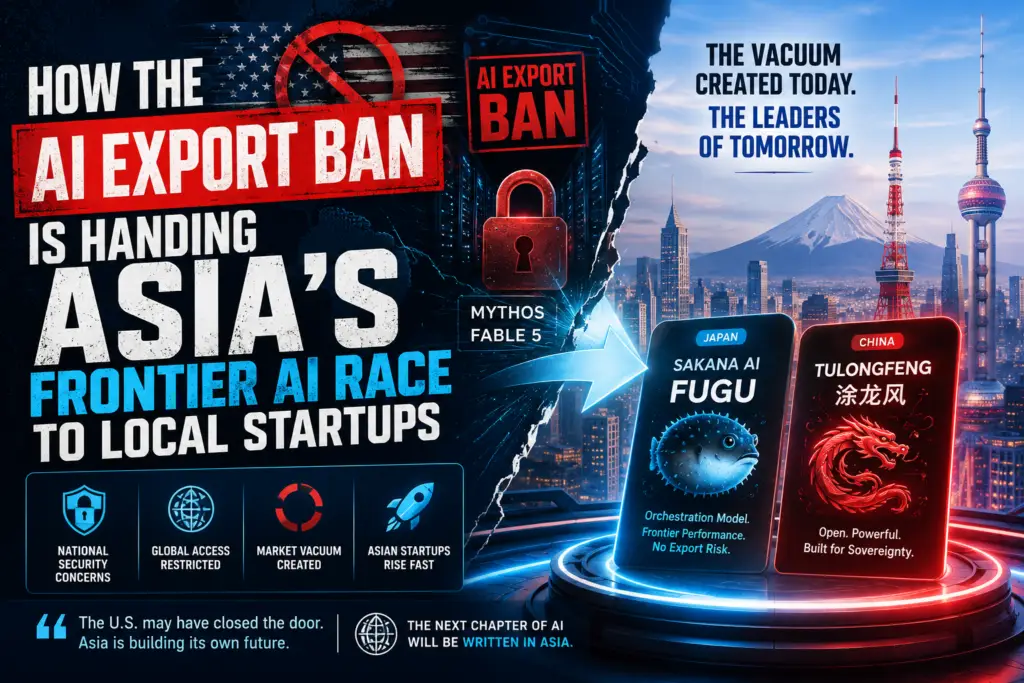
The Anthropic AI export ban — which blocks global access to two of the most powerful AI models ever released — has created a competitive vacuum in Asia that local startups are already moving fast to fill. Within the same week the restriction entered its third week in force, frontier alternatives emerged from Tokyo and Beijing, each actively marketing against the gap U.S. policy just opened.
The urgent question for enterprises, policymakers, and AI strategists is no longer just what happened — it is whether the U.S. can ever claw back a market it has now voluntarily forfeited.
What Is the Anthropic AI Export Ban — and What Got Restricted?
Definition: The AI export ban is a U.S. government order that prohibits Anthropic from making two of its most advanced AI systems — Mythos and Fable 5 — available to users outside the United States. It was imposed by the Trump Administration in June 2026 on national security grounds.
The order took effect rapidly and without a meaningful transition period, immediately cutting off enterprise customers, government agencies, academic researchers, and startups across Asia and beyond from tools they had been using — or preparing to adopt at scale.
Mythos and Fable 5 Explained
What is Anthropic Mythos?
Anthropic Mythos is a frontier-class AI model with a core specialization in cybersecurity: automated vulnerability detection, threat analysis, and high-level security reasoning. It is reportedly so capable in this domain that the U.S. government classified it as a national security concern the moment it reached the public’s awareness. Mythos Preview, the most advanced iteration, has never been publicly accessible — it has been deployed only through a small set of trusted partners under Anthropic’s Project Glasswing.
What is Fable 5?
Fable 5 is a more broadly available version of the Mythos model family, designed for enterprise use cases across industries. Despite being the “restricted” version, Fable 5 is itself a frontier model. Tokyo-based Sakana AI has explicitly positioned its new Fugu model as a direct performance rival to Fable 5 — which tells you something meaningful about the capability tier under discussion.
At the time the ban took effect, Anthropic had reported a run-rate revenue of $47 billion — a figure that makes the economic stakes of losing global market access extremely high, even if the share attributable to Asian enterprise customers has not been publicly disclosed.
Why Washington Acted
The rationale behind the AI export ban comes down to dual-use risk. AI systems that automatically detect software vulnerabilities are genuinely transformative for cybersecurity defenders. They are also extraordinarily dangerous in the hands of sophisticated attackers. A model capable of finding zero-day exploits at machine speed — and doing so across millions of software targets simultaneously — represents a qualitative shift in what offensive cyber operations can accomplish.
From the government’s perspective, allowing any nation-state adversary to access Mythos-level capability through a commercial API is a strategic concession the U.S. cannot afford to make, regardless of the economic cost to Anthropic or its global partners. Whether that risk assessment is proportionate, and whether the order was well-designed to address it, are legitimate policy debates. The fact of the order is not in dispute — and Asia’s AI ecosystem is already adapting to it.
Asian AI Startups Racing to Fill the Void
Two significant product launches in the final week of June 2026 demonstrated exactly how quickly market vacuums get filled in competitive technology sectors. Both companies moved into the space created by the AI export ban within days of its most recent headlines, and both are now leaning into the opportunity with visible confidence.
Sakana AI’s Fugu — Japan’s Sovereignty Hedge
Who is Sakana AI?
Sakana AI is a Tokyo-based startup founded in 2023 by former Google researchers Ren Ito, Llion Jones, and David Ha. The company has built a reputation for efficient generative AI models that perform exceptionally well with smaller datasets and are optimized for Japanese language, cultural nuance, and enterprise context. In late 2025 it raised a $135 million Series B at a $2.65 billion valuation.
What is Fugu?
Fugu — named after the Japanese word for blowfish — is Sakana’s newest frontier model. The company describes it as standing “shoulder-to-shoulder” with both Fable 5 and Mythos Preview in raw performance terms. What makes Fugu architecturally distinctive, however, is its design as an orchestration model: it is built not just to perform tasks itself, but to coordinate and manage other AI models through their APIs — functioning as an intelligent conductor across multi-model agent pipelines.
The research underpinning Fugu was presented at ICLR in the spring of 2026, lending credibility to the company’s claim that the launch timing was “entirely coincidental” with the AI export ban. Whether the timing was planned or fortuitous, Sakana has not been slow to capitalize on it. Its website currently advertises the model as “delivering frontier capability without the risk of export controls” — a value proposition that would have seemed unusual six months ago but now resonates powerfully with enterprise procurement teams across the region.
Sakana’s strategic framing
Co-founder Ren Ito made Sakana’s position explicit at the G7 summit in Evian in June 2026, where AI access and export controls featured prominently on the agenda. His view — echoed in a Project Syndicate op-ed — is that the current disruption is a critical moment, not a permanent realignment. He has urged the U.S. federal government to prioritize access for its closest allies and argued that advanced AI should be developed collectively, not hoarded.
CEO David Ha has articulated a complementary technical thesis: that orchestration across multiple specialized models — what he calls “collective intelligence” — is not only a risk hedge against access disruption, but a genuinely superior architecture for enterprise AI deployment. “Access to top models can disappear overnight,” he wrote on X. A distributed, orchestrated approach is, in his framing, the practical response to a world in which any single provider’s availability is now conditional on geopolitics.
Fugu is targeted primarily at Japanese businesses and government agencies seeking to reduce exposure to the kind of access disruption the AI export ban just demonstrated is real. But Sakana is careful not to declare a permanent break with U.S. AI leadership. Its position is more nuanced: diversify, hedge, and build toward collective intelligence — while U.S. models remain in the mix as partners rather than sole sources.
China’s 360 — Tulongfeng and the Cybersecurity Counter-Move
Where Sakana is measured and diplomatic, China’s 360 has taken a sharper line. The Chinese cybersecurity firm unveiled two AI tools in the same week, framing them explicitly as responses to the asymmetric situation the AI export ban created.
Tulongfeng is an AI system designed to automatically discover software vulnerabilities — exactly the core capability that made Anthropic Mythos a target of the export restriction in the first place. 360 claims it can go head-to-head with Mythos in this domain. If accurate, it means the specific capability the U.S. sought to contain via the AI export ban is now available from a Chinese provider, without any export control friction whatsoever.
Yitianzhen addresses the defensive side of the same problem: it is built to automate cyber defense and incident response, enabling organizations to react to breaches at machine speed rather than human speed.
360’s founder, Zhou Hongyi, framed these tools as a matter of national strategic priority. He warned publicly about what he called “one-way transparency” — a scenario in which some actors can access advanced vulnerability-detection AI while others cannot, creating a structural asymmetry in global cyber power. The implication is pointed: in 360’s view, the AI export ban did not protect anyone — it simply handed advanced offensive and defensive AI capability to actors who are not bound by U.S. export controls.
360 did not respond to a press request for comment on the launches.
Frontier AI Models Head-to-Head: A Capability Comparison
How do the new Asian AI models actually compare to what Anthropic has restricted? Public information is limited, and self-reported benchmarks must be treated with appropriate skepticism. The following table synthesizes what is publicly known as of late June 2026.
| Feature | Anthropic Mythos | Anthropic Fable 5 | Sakana Fugu | 360 Tulongfeng |
|---|---|---|---|---|
| Developer / Origin | Anthropic (USA) | Anthropic (USA) | Sakana AI (Japan) | 360 Security (China) |
| Global Availability | No — AI export ban | No — AI export ban | Yes — unrestricted | Limited (China-first) |
| Primary Specialization | Cybersecurity + frontier general tasks | Frontier enterprise tasks | Agent orchestration, Japanese enterprise | Automated vulnerability discovery |
| Language Optimization | English-primary | English-primary | Japanese-optimized | Chinese-optimized |
| Agent / Orchestration Design | Not a core feature | Not a core feature | Central design feature | Not disclosed |
| Claimed Benchmark Level | Top frontier (classified) | Top frontier | “Shoulder-to-shoulder with Fable 5 & Mythos” | “Matches Mythos” — per 360 |
| Training Methodology | Proprietary | Proprietary | ICLR-published | Undisclosed |
| Export Risk to Users | High — subject to AI export ban | High — subject to AI export ban | None | None (different risk profile) |
| Geopolitical Risk to Users | Policy-dependent | Policy-dependent | Low | High (China-linked) |
Performance claims from Sakana AI and 360 are self-reported and have not been independently verified at the time of writing.
The most consequential column in that table is not capability — it is availability. When two models are positioned as functionally comparable and one is blocked by an AI export ban while the other is freely accessible, every enterprise procurement conversation defaults to the accessible option. Capability parity at the frontier, real or claimed, is sufficient to make the unrestricted model the rational business choice.
The Strategic Stakes — Can U.S. AI Labs Win Asia Back?
The economic framing matters enormously here. Anthropic’s $47 billion run-rate revenue represents extraordinary commercial momentum. But no revenue figure protects a business from the operational consequence of an AI export ban cutting off a substantial portion of its addressable market — especially when competitors are already moving into that space with locally developed, locally controlled alternatives.
The Trust Deficit That Outlasts Any Policy
Even if the AI export ban is lifted tomorrow, the damage to enterprise trust may prove far more durable than the policy itself. CIOs, government technology leads, and national security advisors across Japan, South Korea, Singapore, India, and Southeast Asia have just received a vivid, real-world demonstration of a risk they may have previously treated as theoretical: U.S. AI access is conditional on U.S. policy, and U.S. policy can change without notice.
Local alternatives are not competing with Anthropic purely on model performance. They are competing on reliability of access — a fundamentally different value proposition. A model operating at 95% of Mythos-level capability but available 100% of the time, under domestic legal jurisdiction, from a local provider not subject to foreign export controls, will win enterprise procurement decisions over a model that performs at 100% but can be switched off by executive order.
This is precisely the argument Sakana’s leadership has been articulating — in op-eds, at international summits, and in its own product marketing. It will resonate with procurement officers, government officials, and board-level risk managers in every Asian capital. And once procurement decisions shift toward local frontier AI models, the stickiness of those relationships — built on integration, compliance, local language tuning, and institutional trust — will work against any future reversal.
Collective Intelligence as the Counter-Architecture
CEO David Ha’s “collective intelligence” framing deserves more attention than it has received in the immediate coverage of these model launches. His argument is not just that dependence on a single AI provider is strategically risky. It is that orchestrating across multiple specialized models — the architectural principle behind Fugu — produces better enterprise outcomes than any single dominant system, regardless of capability.
This is a technically credible position. Multi-agent AI architectures are increasingly favored in advanced enterprise deployments because they distribute risk, enable task-level specialization, reduce single points of failure, and allow organizations to swap out individual model layers without rebuilding entire workflows. If Fugu’s orchestration capability delivers meaningfully on this design promise, it is not merely a stopgap for users stranded by the AI export ban. It is a legitimately superior infrastructure choice for certain categories of enterprise workload.
The strategic implication for U.S. AI labs is significant. Winning back the Asian market — if it remains winnable at all — may require more than lifting restrictions and offering a capable model. It may require a fundamentally different product positioning: one that emphasizes openness, interoperability, integration with local models, and alliance-building rather than controlled access to a single proprietary frontier system.
What Enterprise Teams Should Do Right Now
If your organization was relying on Anthropic Mythos, Fable 5, or had planned to integrate either into production workflows, the following framework is a practical starting point:
- Audit your AI dependency stack immediately. Map which production workflows depend on U.S.-based frontier models and quantify the business impact of sudden access disruption. The AI export ban has demonstrated this risk is not hypothetical.
- Evaluate Sakana Fugu for agent orchestration workloads. If your team is building or running multi-model AI pipelines, Fugu’s native orchestration architecture is worth a serious technical evaluation on its own merits — independent of the export situation.
- Approach 360’s tools with careful due diligence. Tulongfeng and Yitianzhen may deliver genuine cybersecurity capability, but sourcing offense-adjacent AI tools from a firm with Chinese state connections introduces geopolitical, compliance, and reputational risk that must be weighed independently.
- Brief your legal and compliance teams on export control exposure. The AI export ban has contractual, data-residency, and liability implications beyond the immediate product access question. Your legal team needs to assess downstream risk across customer contracts and vendor agreements.
- Build a diversified frontier AI model portfolio. The era of safe single-model dependency is effectively over. Enterprises that architect across multiple frontier providers — including regional models optimized for local context — will be substantially more resilient than those betting all their AI infrastructure on one dominant system.
- Monitor the diplomatic and policy track actively. Ren Ito’s presence at the G7 summit in Evian signals that AI access and export controls have entered formal diplomatic discourse. Policy shifts in the next 90 days could materially change the landscape in either direction.
- Do not plan on the AI export ban being temporary. U.S. technology export controls have a well-documented history of becoming structural features of the competitive landscape rather than short-term policy interventions. Build your roadmap for both scenarios.
Frequently Asked Questions
What is the Anthropic AI export ban?
The Anthropic AI export ban is a U.S. government order, enacted in June 2026, that restricts Anthropic from making its Mythos and Fable 5 models accessible to non-U.S. users. The ban was imposed on national security grounds related to the models’ advanced cybersecurity capabilities.
Why were Mythos and Fable 5 targeted by the AI export ban?
Both models were restricted under the AI export ban because of their sophistication in automated vulnerability detection and cybersecurity reasoning — capabilities the U.S. government classified as strategic dual-use assets that could provide unacceptable advantages to adversarial nation-states if accessed via commercial APIs.
What is Sakana Fugu and how does it relate to the export ban?
Sakana Fugu is a frontier AI model launched by Tokyo-based Sakana AI in June 2026. The company describes it as capable of performing at the level of Anthropic’s Fable 5. Crucially, unlike the models subject to the AI export ban, Fugu carries no export restrictions and is being actively marketed as “frontier capability without the risk of export controls.”
How does Tulongfeng differ from Anthropic Mythos?
Tulongfeng, developed by Chinese cybersecurity firm 360, is an AI system focused on automated vulnerability discovery — the same core use case that drove the AI export ban on Mythos. Whereas Mythos is now unavailable outside the U.S., Tulongfeng has no equivalent access restriction and is being positioned as a functional alternative.
Can the U.S. government reverse the AI export ban?
Yes, export control orders can be modified, narrowed, or lifted. However, the competitive and trust dynamics set in motion by the AI export ban are likely to persist even if the policy changes. Local Asian AI alternatives that gain market share during the restriction period will benefit from integration lock-in, local language advantages, and institutional trust built over time — none of which dissolves automatically when a policy is reversed.
What does “AI sovereignty” mean for Asian enterprises?
AI sovereignty refers to a country’s or organization’s ability to access, control, and deploy advanced AI capability through domestic or allied providers — without depending on foreign models that can be restricted by another government’s policy decisions. The AI export ban has made AI sovereignty an urgent operational priority, not just a geopolitical concept, for enterprise technology leaders across Asia.
The Bottom Line
The AI export ban on Anthropic’s Mythos and Fable 5 has accomplished something no competitive product launch could have achieved on its own: it has made AI sovereignty a live operational risk, not a theoretical one, for enterprise buyers across an entire continent. Sakana Fugu and 360’s Tulongfeng are not accidental beneficiaries. They are early, credible signals of a structural shift in where frontier AI capability will be developed, distributed, and trusted.
For U.S. AI labs, the lesson is unambiguous. Revenue of $47 billion means nothing to a customer who can no longer access the product. And for every week the AI export ban remains in force, local alternatives become less of a temporary workaround and more of a permanent infrastructure choice — tuned to local language, optimized for local regulation, and insulated from the geopolitical volatility that just made U.S. AI access feel fragile.
The global AI race is no longer purely a competition over which model is most capable. It is increasingly a competition over which model your government will still allow you to use tomorrow.
SEO Meta Description: The Anthropic AI export ban is reshaping Asia’s AI landscape. Sakana’s Fugu and China’s Tulongfeng are filling the void — here’s what enterprises must know. (154 chars)
Slug: ai-export-ban-asia-frontier-models-anthropic-mythos