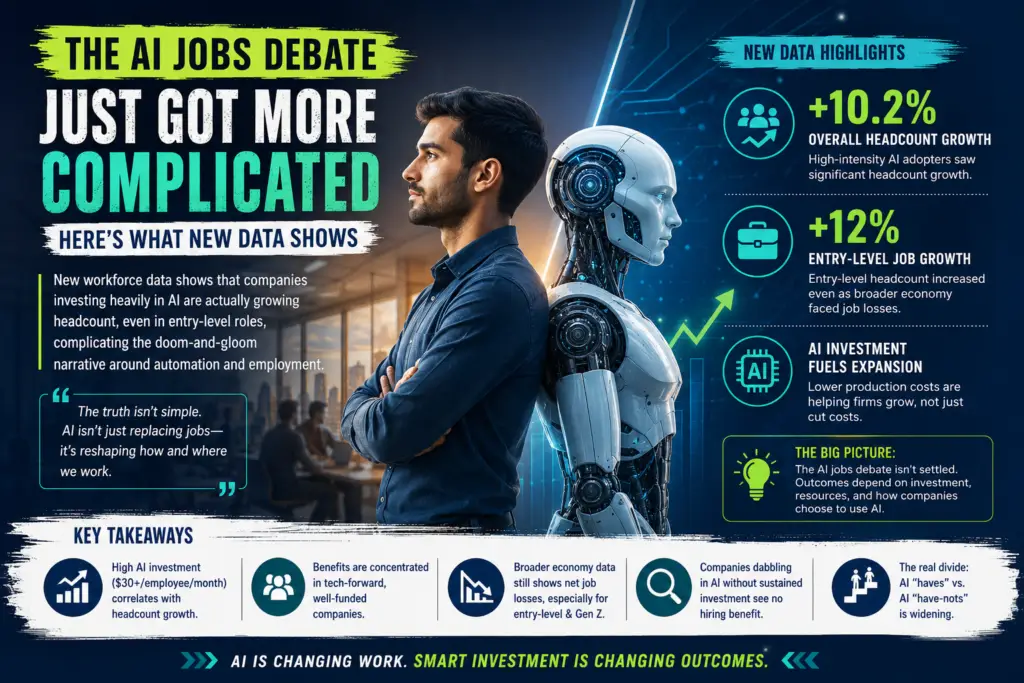
The AI jobs debate is no longer a simple story of robots replacing humans. New workforce data shows that companies investing heavily in AI are actually growing headcount, even in entry-level roles, complicating the doom-and-gloom narrative around automation and employment.
For two years, the AI jobs debate has been framed as a binary: either AI eliminates work, or it doesn’t. A new report from corporate card and spend platform Ramp, built on workforce records from nearly 22,000 companies tracked by Revelio Labs, suggests the truth is far messier than either side wants to admit.
What Is the AI Jobs Debate, Exactly?
The AI jobs debate refers to the ongoing disagreement among economists, tech executives, and labor analysts over whether artificial intelligence is a net job creator or a net job destroyer. On one side, companies cite AI when announcing layoffs — nearly 90,000 job cuts were tied to AI through May 2026 alone. On the other, tech leaders insist AI will generate new categories of work faster than it eliminates old ones.
Until now, most evidence in the AI jobs debate has leaned negative. Goldman Sachs research found that AI has erased roughly 16,000 net jobs per month over the past year, with Gen Z and entry-level workers absorbing the bulk of the impact. Forecasts from BCG suggest up to 15% of U.S. jobs could be eliminated by AI within five years. That backdrop is exactly why the new Ramp-Revelio findings are reshaping the conversation.
The New Data Complicating the AI Jobs Debate
High-Intensity AI Adopters Are Hiring, Not Firing
The report’s central finding adds real nuance to the AI jobs debate: companies it classifies as “high-intensity adopters” — firms spending an average of $30 per employee per month on AI tools in their first three months of adoption — saw overall headcount increase by 10.2%. That growth wasn’t confined to engineering. It showed up across sales, administration, customer service, finance, marketing, and scientist roles, with the information sector (software, internet, and media companies) posting the strongest gains.
Entry-Level Jobs Aren’t Disappearing — In Some Firms
A core anxiety driving the AI jobs debate is the fear that AI will wipe out the junior roles young workers rely on to start their careers. The new data pushes back directly: among high-intensity AI adopters, entry-level headcount rose by 12%, even as Goldman’s broader economy-wide data shows entry-level workers losing ground elsewhere.
The report’s authors offer a plausible explanation: AI lowers the cost of producing core output like code, documentation, and internal tools, which can raise the return on expanding an entire firm rather than shrinking it. In other words, cheaper output sometimes funds more hiring, not less.
AI Job Loss vs. AI Job Growth: Comparison Table
| Factor | AI Job Loss Narrative | AI Job Growth Findings (Ramp/Revelio) |
|---|---|---|
| Headline data point | ~90,000 AI-cited job cuts through May 2026 | High-intensity adopters: +10.2% headcount |
| Entry-level impact | ~16,000 net jobs lost/month (Goldman Sachs) | +12% entry-level headcount among adopters |
| Primary driver | Labor substitution / cost-cutting | Lower production costs fueling firm expansion |
| Who’s affected | Broad economy, all sectors | Tech-forward, often VC-backed firms |
| Forecast horizon | Up to 15% of U.S. jobs at risk over 5 years | Short-term snapshot (first 3 months of adoption) |
Why the AI Jobs Debate Isn’t Settled
Even the report’s authors are careful not to overclaim. As they put it, the paper “does not show that AI universally creates jobs,” but it does counter the claim that AI broadly destroys them. That distinction matters enormously for anyone trying to make sense of the AI jobs debate from a single headline.
The Resource Gap Problem
The data skews toward knowledge-work companies with strong funding and fast growth trajectories already underway, which makes it hard to isolate AI’s true causal effect from companies that were simply expanding regardless. Notably, the report also found that firms which merely buy AI subscriptions or run pilots — without sustained investment — saw no headcount gains at all. That gap points to a widening divide: companies with capital, technical talent, and management bandwidth can convert AI adoption into growth, while resource-constrained firms risk falling behind.
Key Takeaways From the AI Jobs Debate
- High-intensity AI spenders ($30+/employee/month) saw headcount grow 10.2%, including in entry-level roles.
- The positive findings are concentrated in tech-forward, well-funded firms — not the broader economy.
- Goldman Sachs data still shows net job losses overall, especially for entry-level and Gen Z workers.
- Companies that dabble in AI without sustained investment see no hiring benefit.
- The emerging divide between AI “haves” and “have-nots” may be the real story behind the AI jobs debate.
Frequently Asked Questions
Is AI actually creating more jobs than it destroys? Not universally. The data only shows that high-intensity AI adopters — a specific, resource-rich subset of companies — grew headcount faster, not that AI is a net job creator economy-wide.
Are entry-level jobs safe from AI? Only at companies making sustained, heavy AI investments. Across the broader economy, entry-level and Gen Z workers are still bearing the brunt of AI-related job losses, according to separate Goldman Sachs research.
What is a “high-intensity AI adopter”? Per the Ramp-Revelio report, it’s a company spending an average of $30 per employee per month on AI tools during its first three months of adoption.
Why does the AI jobs debate keep producing contradictory data? Because outcomes depend heavily on company size, funding, sector, and the depth of AI investment — a single dataset rarely captures the full economic picture.