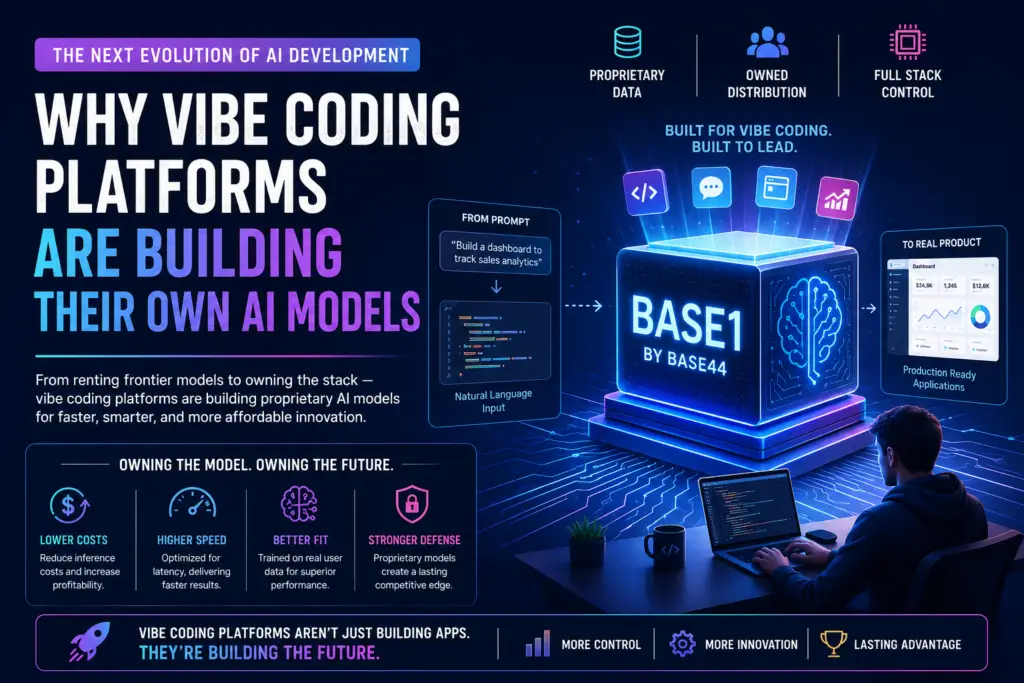
Vibe coding platforms — the natural-language app builders that let anyone describe software into existence — are starting to train and own their own AI models instead of renting them from OpenAI, Anthropic, or Google. The clearest signal yet came this week, when Wix-owned Base44 began rolling out Base1, its in-house large language model, in a direct bet that owning the stack is now the only path to long-term defensibility.
This shift matters because it reframes the entire vibe coding category. For the past two years, most of these tools have been thin, elegant wrappers around someone else’s frontier model. That arrangement worked when frontier labs were happy to subsidize usage and differentiation came from UI polish and workflow design. It stops working once inference costs bite, frontier labs build competing products, and customers start asking what, exactly, they’re paying a premium for.
What Are Vibe Coding Platforms, and Why Does Model Ownership Suddenly Matter?
Definition: Vibe coding platforms are tools that let users build functional software — websites, internal tools, full applications — by describing what they want in plain English rather than writing code line by line. The platform’s underlying AI model interprets intent, generates code, and iterates based on feedback.
Expansion: Until recently, nearly every vibe coding platform sat on top of a third-party frontier model. That’s a fast way to ship a product, but it creates a structural weakness: the platform’s core capability is rented, not owned. Anyone with API access to the same frontier model can theoretically replicate the experience. Model ownership changes that equation because it converts a rented capability into a proprietary asset — one built on the platform’s own usage data, optimized for its specific task (generating working applications), and insulated from a competitor’s pricing or roadmap decisions.
This is precisely the logic Base44 is now acting on. Base44, the vibe coding platform that Wix acquired for $80 million just one year ago, has started rolling out its own AI model to support users in creating apps with natural language. TechCrunch
Inside Base44’s Shift From Frontier Models to Its Own LLM
What Base1 Actually Is
Base44’s first model, called Base1, was developed and trained on a dataset built from tens of millions of real user interactions on the platform. That detail matters more than it might first appear. A frontier model is trained to be broadly competent across every conceivable task; a model trained on real vibe coding sessions is trained on exactly one thing — turning natural-language prompts into working applications — with a volume of task-specific examples that no general-purpose lab is likely to prioritize collecting. TechCrunch
According to founder Maor Shlomo, training and owning the model as part of the company’s full stack allows for far more optimization around latency, cost, and efficiency than buying access to someone else’s frontier model. That’s the core thesis behind why vibe coding platforms are starting to look more like infrastructure companies than thin app layers. TechCrunch
The Cost, Latency, and Margin Argument
Cost pressure is the quiet driver behind this entire trend. Inference costs have become a meaningful part of enterprise buying decisions, and Base44’s choice to develop its own LLM stemmed from multiple factors, with cost reduction likely among the benefits. Shlomo put it directly: the goal is a model that is more aligned with what the company believes is right, more optimized to what users respond well to, and ultimately faster and cheaper for customers than relying on frontier models like Opus. TechCrunchTechCrunch
For Base44’s parent company, the margin story is just as important as the user-facing one. In a press release, the company explained that ownership of the model gives Base44 direct control over compute and inference spend, which is expected to produce a structurally stronger margin profile over time. That’s a notable shift in framing — vibe coding platforms are no longer talking only about user experience; they’re talking about unit economics, the same way infrastructure businesses do. TechCrunch
The Three Pillars of AI Startup Defensibility
Question: What actually makes an AI startup defensible in 2026?
Direct Answer: According to investors tracking the space, defensibility comes down to three interlocking assets — proprietary data, owned distribution, and control over the technology stack. A startup strong in only one or two of these remains vulnerable to a well-funded frontier lab moving into its territory.
Jonathan Userovici, a general partner at VC firm Headline whose portfolio includes AI companies like Mistral AI, identifies data as one of three key ingredients of defensibility for AI startups, alongside distribution and tech stack. TechCrunch
Data
A defensible data advantage isn’t just “we have logs” — it’s a continuously compounding loop. That dataset keeps growing along with the company, but so do its rivals’ datasets, which keeps the bar for differentiation moving. TechCrunch
Distribution
Owning the audience — rather than depending on a marketplace or another company’s platform — means a vibe coding platform controls how new users discover it and how pricing decisions get made, independent of any single model provider’s terms.
Tech Stack
Shlomo is betting that the substantial engineering effort behind Base1 will cement Base44’s position as the only vertically integrated vibe-coding application — in Userovici’s terms, a player that owns its distribution, data, and infrastructure all at once. TechCrunch
Vibe Coding Platforms vs. Frontier-Model-Dependent Tools
| Factor | Owns Its Own Model (e.g., Base44) | Relies on Frontier Models (e.g., Lovable) |
|---|---|---|
| Cost control | Direct control over compute and inference spend | Subject to third-party API pricing |
| Customization | Tuned specifically for app-generation tasks | General-purpose capability, less specialized |
| Defensibility | Harder to replicate; proprietary data moat | Easier for competitors with API access to copy |
| Speed to differentiate | Slower, requires major engineering investment | Faster initial product launch |
| Dependency risk | Lower — not exposed to a single vendor’s roadmap | Higher — vulnerable to pricing or policy changes |
| Margin trajectory | Improves over time as model matures | Compressed by ongoing API costs |
This isn’t a verdict that one approach is universally better — it’s a tradeoff between near-term speed and long-term control. Competitors such as Swedish startup Lovable, which reached unicorn status in its Series A round, continue to rely on external LLMs rather than building their own. Lovable has reported hitting $500 million in annualized revenue, well ahead of Base44’s reported pace, showing that reliance on frontier models hasn’t slowed its growth. TechCrunchTechCrunch
Why Frontier AI Models Are Closing In on Vibe Coding’s Turf
The irony of building a custom LLM for defensibility is that the biggest threat to vibe coding platforms may not be each other — it’s the frontier labs themselves moving downstream into app generation. Cursor and Grok’s parent company xAI now both belong to SpaceX, and Claude Code has become a vibe coding player in its own right. TechCrunch
That convergence gives the largest AI labs a structural advantage that smaller vibe coding platforms can’t easily match: scale. This gives Anthropic and other foundational AI providers access to data and feedback loops they can use to improve models specifically for app creation. Shlomo’s counter-argument is specialization rather than scale: he believes that while models are progressing, they will stay very general in what they can do, leaving room for purpose-built tools. TechCrunchTechCrunch
The Counterargument — Not Every Startup Should Train Its Own Model
Not every voice in the industry agrees that building proprietary models is the right move for every applied AI company. Userovici cautions against underestimating frontier models, pointing to legal tech startup Harvey, which abandoned plans to train its own model. He doesn’t expect applied AI companies to become frontier labs en masse, instead framing Base44’s move within a broader shift in which inference costs have become a meaningful part of the overall equation. TechCrunchTechCrunch
This is an important nuance for anyone evaluating vibe coding platforms as a category: training a custom model is an enormous capital and engineering commitment, and it only pays off at sufficient scale and data volume. Shlomo himself expects that other players will eventually train their own models too — at least those that have reached enough scale and velocity to generate sufficient proprietary data. Scale, in other words, is the prerequisite — not the consequence — of model ownership. TechCrunch
What This Means for Builders, Founders, and Enterprises
For anyone evaluating or building on top of vibe coding platforms today, a few practical implications stand out:
- Enterprise buyers should ask about cost architecture, not just capability. Cost pressure has driven enterprises to demand orchestration and optimization layers that select the right model for each use case, so costs don’t spike while performance stays comparable. TechCrunch
- Revenue growth and headcount don’t always move together. Base44’s parent company recently announced layoffs affecting 20% of its workforce, even as Base44 itself has continued growing in headcount since the acquisition. TechCrunch
- Revenue scale still varies enormously across the category. Base44 has reported passing $100 million in annual recurring revenue a few months prior to this announcement. TechCrunch
- Enterprise adoption is growing but still a minority share. Enterprise customers remain a smaller slice of vibe coding platform users overall, but they represent a disproportionately growing share of platform revenue.
- Watch for consolidation signals. When a frontier lab acquires or absorbs an adjacent coding tool, it’s worth treating that as a competitive signal for the entire vibe coding category, not an isolated deal.
FAQ — Quick Answers on Vibe Coding Platforms and Model Ownership
Q: What is a vibe coding platform?
A: A tool that converts natural-language prompts into working software, letting non-engineers and engineers alike build apps through conversation rather than manual code.
Q: Why are vibe coding platforms building their own AI models instead of using frontier models?
A: Primarily for defensibility, cost control, and task-specific performance — owning the model removes dependency on a third-party vendor’s pricing and roadmap decisions.
Q: Is building a custom LLM realistic for every vibe coding platform?
A: No. It requires significant scale, engineering investment, and proprietary data volume, which is why some well-funded players, like Lovable, continue relying on external frontier models successfully.
Q: Will frontier AI labs eventually dominate vibe coding entirely?
A: It’s contested. Some industry voices expect frontier labs to absorb much of the category through scale and integrated tooling, while others argue specialized vibe coding platforms will retain an edge through narrower, deeper optimization.
Conclusion
The rapid evolution of vibe coding platforms marks one of the biggest shifts in modern software development. What began as AI-powered tools that relied heavily on third-party large language models is now transforming into an ecosystem where companies increasingly invest in proprietary AI models, specialized infrastructure, and unique datasets. This evolution is changing how developers, businesses, and enterprises evaluate vibe coding platforms, moving the conversation beyond convenience to long-term scalability, performance, and competitive advantage.
As demonstrated by recent industry developments, vibe coding platforms are no longer competing solely on user experience or interface design. Instead, they are differentiating themselves through lower inference costs, faster response times, stronger data ownership, and deeper customization. Building an in-house AI model is a significant investment, but it provides greater control over product direction while reducing dependency on external AI providers. For organizations planning long-term AI adoption, these advantages can translate into better reliability, predictable costs, and improved application quality.
However, not every company needs to build its own model. Many successful vibe coding platforms continue to thrive by leveraging frontier AI models while focusing on workflow optimization, customer experience, and rapid feature delivery. The decision ultimately depends on scale, engineering capabilities, proprietary data, and business objectives. Smaller startups may benefit more from partnering with established AI providers, while larger platforms with millions of user interactions can justify the investment in custom AI infrastructure.
Looking ahead, competition among vibe coding platforms is expected to intensify as AI technology becomes more accessible and enterprise adoption accelerates. Organizations evaluating these platforms should consider more than impressive demonstrations or marketing claims. Factors such as model ownership, security, cost efficiency, customization, ecosystem support, and future roadmap will play a much larger role in determining which solutions deliver sustainable value. Companies that successfully combine proprietary technology with exceptional user experiences are likely to emerge as long-term market leaders.
For developers, entrepreneurs, and enterprise decision-makers, this transition presents exciting opportunities. Modern vibe coding platforms are making software creation faster, more accessible, and increasingly intelligent, allowing teams to transform ideas into production-ready applications with minimal manual coding. As these platforms continue to evolve, they will reshape how software is designed, developed, and deployed across industries.
Ultimately, the future of vibe coding platforms will be defined by innovation, specialization, and ownership rather than simply accessing the most powerful general-purpose AI models. Businesses that carefully evaluate the strengths and limitations of different vibe coding platforms will be better positioned to reduce costs, accelerate digital transformation, and gain a lasting competitive advantage. As AI continues to redefine software development, vibe coding platforms are poised to become the foundation of the next generation of intelligent application building, making this an important trend for every technology leader and business to watch closely.