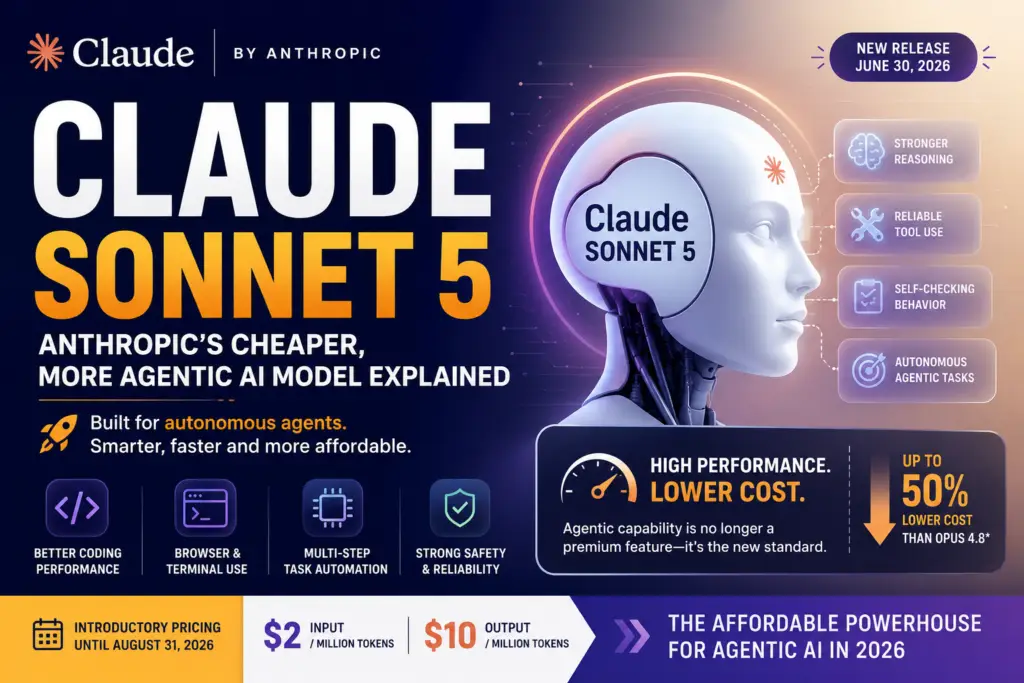
Claude Sonnet 5 is Anthropic’s newest midsize AI model, built to run autonomous, multi-step agent tasks at a fraction of the cost of its flagship Opus model. Launched on June 30, 2026, it now serves as the default model across Anthropic’s free and paid Claude plans, and it signals a broader shift in the AI industry: agentic capability is no longer a premium feature, it’s the baseline expectation at every price point.
If you’re trying to understand what Claude Sonnet 5 actually does, how it stacks up against Opus 4.8 and competing models from OpenAI and Google, and whether it’s the right choice for your workflow, this guide breaks it all down.
What Is Claude Sonnet 5?
Definition: Claude Sonnet 5 is Anthropic’s fifth-generation “Sonnet” tier model — the mid-priced option in Anthropic’s lineup, positioned below the more expensive Opus tier and above the lightweight Haiku tier. It’s designed specifically for agentic work: planning multi-step tasks, operating tools like browsers and terminals, and completing jobs end-to-end without constant human check-ins.
Expansion: What sets Claude Sonnet 5 apart from earlier Sonnet releases isn’t a single new trick — it’s a combination of stronger reasoning, more reliable tool use, and self-checking behavior. Anthropic has described the model as capable of running autonomously at a level that previously required larger, pricier models. In practice, that means Claude Sonnet 5 can be handed a loosely defined job — update records in a CRM, then send follow-up communications, for example — and carry it through to completion rather than stalling partway.
Key Specs at a Glance
- Model tier: Mid-tier (“Sonnet”), positioned between Haiku and Opus
- Release date: June 30, 2026
- Predecessor: Claude Sonnet 4.6 (released February 2026)
- Default status: Default model for Free and Pro plan users
- Primary use case: Agentic automation, coding, tool use, knowledge work
- Model string (API): claude-sonnet-5
Why Anthropic Launched Claude Sonnet 5
The Agentic AI Arms Race
Claude Sonnet 5 didn’t arrive in a vacuum. It follows a pattern that’s now familiar across the foundation model industry: every major lab is racing to prove its models can act as autonomous agents rather than simple chat responders. OpenAI’s recent preview release leaned into splitting work across subagents for longer autonomous runs, while Google’s spring release was framed as a pivot away from conversational chatbots toward tools that plan, build, and iterate on real work with minimal human input.
Claude Sonnet 5 fits squarely into that pattern. Anthropic isn’t claiming to have invented agentic AI with this release — it’s confirming that agentic behavior has become table stakes, and that the real competitive question going forward is which lab can deliver that capability most cheaply and most reliably.
Cost as the New Battleground
This is the part that makes Claude Sonnet 5 genuinely notable: it isn’t just about raw capability, it’s about making high-quality agentic AI affordable enough for everyday, high-volume use. Anthropic’s own framing draws a straight line from “everyone can build agents now” to “the winner is whoever makes agents cheapest to run at scale.”
That’s a meaningful shift for developers and businesses that have been priced out of running large volumes of agentic tasks through top-tier models. Claude Sonnet 5 exists to close that gap.
Claude Sonnet 5 Pricing: How Much Does It Cost?
Pricing is one of the biggest talking points around this release. Claude Sonnet 5 launched with an introductory rate that increases after a set window:
| Pricing Period | Input Cost (per million tokens) | Output Cost (per million tokens) |
|---|---|---|
| Launch – August 31, 2026 | $2 | $10 |
| After August 31, 2026 | $3 | $15 |
Even at the post-August rate, Claude Sonnet 5 remains cheaper than Anthropic’s own Opus 4.8, and cheaper than comparable models from OpenAI and Google’s higher-end offerings. It is, however, still more expensive than Google’s lightweight Gemini 3.5 Flash, which occupies a lower-cost tier by design.
For teams running high-frequency agentic workloads — think automated customer support flows, scheduled data processing, or continuous coding agents — this pricing structure matters more than headline benchmark scores. A model that’s 90% as capable but a fraction of the cost can be the more rational choice for production use.
Claude Sonnet 5 vs Opus 4.8: What’s the Difference?
Question: Should you use Claude Sonnet 5 or Opus 4.8?
Direct answer: Use Claude Sonnet 5 for cost-sensitive, high-volume agentic tasks; use Opus 4.8 when you need the highest possible accuracy on the hardest problems, like nuanced judgment calls or deep multi-source research.
Here’s how the two models compare on the metrics that matter most:
| Factor | Claude Sonnet 5 | Opus 4.8 |
|---|---|---|
| Positioning | Mid-tier, agentic workhorse | Top-tier, highest accuracy |
| Input pricing | $2–$3 per million tokens | Higher (premium tier) |
| Output pricing | $10–$15 per million tokens | Higher (premium tier) |
| Agentic coding benchmark score | 63.2% | 69.2% |
| Knowledge work benchmark | Slightly ahead of Opus 4.8 | Slightly behind Sonnet 5 |
| Best suited for | Everyday automation, coding, tool use at scale | Complex judgment calls, deep research, highest-stakes tasks |
| Safety/misuse resistance | Strong, but below Opus tier | Anthropic’s most misuse-resistant tier |
Interestingly, Claude Sonnet 5 doesn’t lose on every front. On a knowledge-work benchmark, it actually edges out Opus 4.8, even though Opus remains the go-to model for the hardest reasoning and judgment tasks. Anthropic’s own position is that the two models are complementary: developers can dial effort level up or down depending on whether they need maximum accuracy or maximum cost-efficiency.
Key Features and Capabilities
Claude Sonnet 5 brings a handful of concrete improvements over Claude Sonnet 4.6, its immediate predecessor:
- Stronger autonomous planning — breaks multi-step jobs into a workable sequence without needing the user to spell out each step
- Improved tool use — operates browsers, terminals, and connected apps more reliably during long task runs
- Self-checking behavior — reviews and verifies its own output partway through a task without being explicitly asked to
- Better agentic coding performance — jumped from a 58.1% benchmark score under Sonnet 4.6 to 63.2% under Claude Sonnet 5
- Lower hallucination rate — produces fewer fabricated or unsupported claims than its predecessor
- Reduced sycophancy — less prone to simply agreeing with a user’s framing instead of giving an accurate answer
- Cheaper default deployment — now the standard model for Free and Pro plan users, replacing Sonnet 4.6 in that role
Taken together, these changes point toward a model built less for single-turn chat and more for sustained, unsupervised work across many steps.
Real-World Performance: What Early Users Say
Beyond benchmark numbers, early testers have pointed to Claude Sonnet 5’s ability to finish complex, multi-part jobs that previous versions would have left incomplete. One example cited by Anthropic involved a two-part business automation task — updating account records in a CRM system and then sending a related announcement to a list of contacts — which the model completed end-to-end rather than stopping halfway through, a common failure point for earlier agentic models.
That kind of task completion is exactly what separates a genuinely agentic model from a model that merely follows single instructions well. For teams building automation pipelines, the difference between “gets partway there” and “finishes the job” is often the difference between a useful tool and a demo.
Safety Improvements in Claude Sonnet 5
Agentic AI models that operate tools and take autonomous actions carry higher stakes than a simple chatbot, which is why safety behavior is a core part of this release rather than an afterthought.
Compared with Sonnet 4.6, Claude Sonnet 5 shows:
- A lower rate of cooperating with clearly misusive requests
- Better resistance to prompt-injection and hijack attempts during tool use
- More consistent refusal of unsafe requests, without excessive false refusals
- Reduced hallucination and sycophancy rates overall
That said, Claude Sonnet 5 isn’t positioned as Anthropic’s safest or most capability-restricted model. It sits below Opus-tier models on dangerous-capability evaluations, including cybersecurity-related tasks, meaning organizations with the highest-stakes safety requirements may still prefer Opus 4.8 for certain sensitive workloads. This tiered approach — pairing capability level with proportional safety guardrails — reflects a broader industry trend of matching model access to risk profile rather than applying a single safety standard across an entire model lineup.
How Claude Sonnet 5 Compares to GPT-5.6 and Gemini 3.5 Flash
Question: How does Claude Sonnet 5 stack up against competing agentic models from OpenAI and Google?
Direct answer: All three labs are converging on the same idea — cheaper, more autonomous agents — but they’re taking different routes to get there.
- OpenAI’s recent preview model emphasizes splitting a single job across multiple subagents, letting different pieces of a task run in parallel for longer autonomous sessions.
- Google’s lightweight spring release is explicitly positioned as a low-cost, high-speed option, undercutting Claude Sonnet 5 on price while trading off some capability.
- Claude Sonnet 5 sits in between: not the cheapest option on the market, but priced below its own flagship Opus tier and below comparable premium models from other labs, while staying closer to top-tier performance than a budget model would.
The practical takeaway is that no single lab currently “wins” outright on price-to-performance. The right choice depends on whether a workload prioritizes raw speed and rock-bottom cost (favoring lightweight models), maximum reasoning accuracy (favoring flagship models like Opus 4.8), or a balance of both (where Claude Sonnet 5 is explicitly positioned).
Frequently Asked Questions
Is Claude Sonnet 5 free to use?
Yes, in a limited form. Claude Sonnet 5 is now the default model for Anthropic’s Free plan, though usage limits apply. It’s also the default for Pro subscribers and available across every paid subscription tier.
What is the API pricing for Claude Sonnet 5?
At launch, Claude Sonnet 5 costs $2 per million input tokens and $10 per million output tokens. After August 31, 2026, pricing rises to $3 per million input tokens and $15 per million output tokens.
Is Claude Sonnet 5 better than Opus 4.8?
Not universally. Claude Sonnet 5 slightly outperforms Opus 4.8 on certain knowledge-work benchmarks and costs significantly less, but Opus 4.8 still leads on the hardest reasoning and judgment-heavy tasks, as well as on safety-critical evaluations.
What can Claude Sonnet 5 actually do as an agent?
It can plan multi-step tasks, operate tools like browsers and terminals, complete complex jobs end-to-end (such as updating records and sending follow-up communications), and check its own work partway through a task without being explicitly told to.
How does Claude Sonnet 5 compare to Claude Sonnet 4.6?
Claude Sonnet 5 shows measurable gains in agentic coding, tool use, and knowledge work compared to Sonnet 4.6, along with lower hallucination and sycophancy rates and stronger resistance to prompt-injection attacks.
Which businesses are already using Claude Sonnet 5?
Companies building automation and no-code tooling, including workflow-automation and app-building platforms, have cited Claude Sonnet 5’s ability to complete multi-part business tasks and its consistent handling of unsafe requests as early reasons for adoption.
Final Thoughts
Claude Sonnet 5 isn’t a flashy reinvention of what an AI model can do — it’s a recalibration of what a mid-priced AI model should be able to do. By pairing meaningfully improved agentic performance with pricing well below its own flagship tier, Anthropic is betting that the next phase of AI competition will be won on cost-efficiency and reliability, not just raw benchmark scores. For developers and businesses evaluating where to run day-to-day automation, Claude Sonnet 5 is now one of the strongest cost-to-capability options on the market — even if Opus 4.8 remains the go-to choice when accuracy matters more than price.