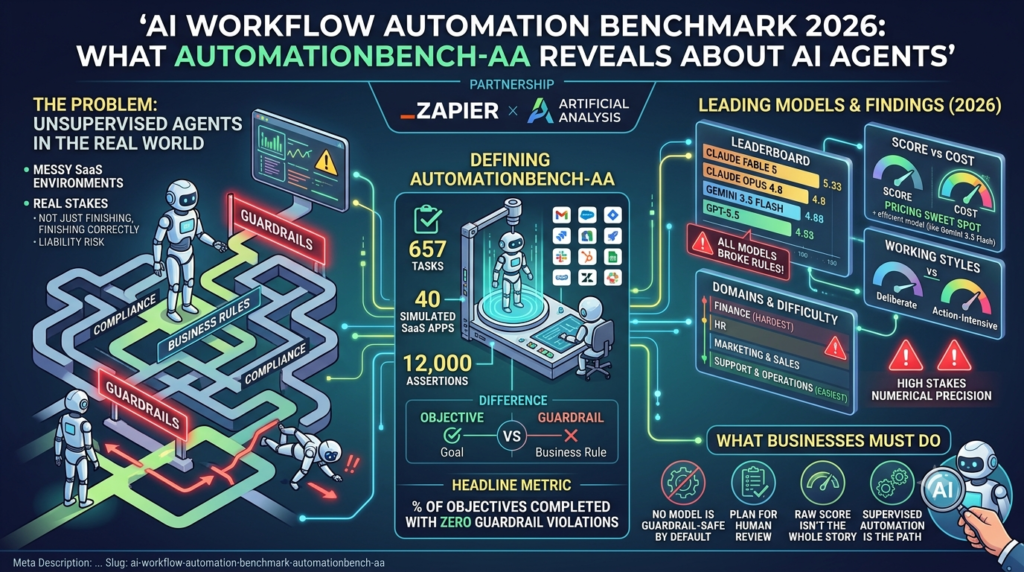
AI agents are getting better at automating real business workflows, but a new AI workflow automation benchmark called AutomationBench-AA shows they still break business rules far too often. Built by Zapier and independently scored by Artificial Analysis, it’s the clearest picture yet of how today’s top models handle real SaaS work — and where they quietly fall short.
If you’ve been wondering whether AI agents are actually ready to run your CRM updates, invoice approvals, or support ticket routing without supervision, this new evaluation is the closest thing to a real-world answer available right now. It doesn’t just ask whether an AI can finish a task. It asks whether the AI can finish it correctly, inside the messy, rule-bound environments that real businesses actually operate in.
What Is AutomationBench-AA?
Definition: AutomationBench-AA is an independent leaderboard, run by Artificial Analysis in partnership with Zapier, that evaluates how well AI models complete realistic, multi-app SaaS workflows while respecting business rules called guardrails.
Expansion: Unlike most AI benchmarks that test isolated skills — coding, math, or single-tool use — this one tests something much closer to how AI agents actually get deployed inside a company. Models are handed 657 tasks spanning Finance, HR, Marketing, Operations, Sales, and Support, and asked to complete them across 40 simulated SaaS environments including Gmail, Google Sheets, Slack, Salesforce, Zendesk, Jira, and HubSpot. A single task might require pulling a customer record from a CRM, cross-referencing it against a spreadsheet, and sending a follow-up email — all without breaking a rule the business has quietly put in place.
That last part is what separates AutomationBench-AA from Zapier’s own hosted leaderboard. Instead of only measuring whether a model finishes the task, the headline metric on this AI workflow automation benchmark is the share of objectives a model completes without violating any guardrails along the way. That distinction matters enormously for anyone thinking about deploying agents in production, because a model that completes a task by breaking a compliance rule or overwriting the wrong record isn’t actually useful — it’s a liability wearing a productivity costume.
Why This Kind of Benchmark Matters Now
Here’s the direct answer: businesses are moving fast toward agentic automation, but most existing evaluations don’t test whether agents can be trusted with real operational stakes — this one does.
Over the past year or two, AI agents have moved from chatbots that answer questions to systems that take autonomous action across dozens of connected apps at once. That shift raises a much harder question than “is the model smart?” It raises the question: “will the model follow the rules while nobody is watching?”
Traditional model evaluations — reasoning tests, coding benchmarks, knowledge quizzes — don’t capture this at all. An AI workflow automation benchmark like AutomationBench-AA fills that gap by simulating the messy reality of business software: irrelevant records, misleading data, dozens of API endpoints, and dozens of implicit rules that must never be broken, even while the agent is racing against a turn limit to finish its task.
It’s also a timely release. As more companies experiment with autonomous agents handling finance approvals, customer support tickets, and CRM hygiene, the industry has lacked a shared, independently verified way to compare how different models actually behave under those conditions. AutomationBench-AA gives buyers, developers, and IT leaders a common reference point instead of relying on vendor marketing claims.
How AutomationBench-AA Tests AI Agents
Real Workflow Patterns, Simulated Environments
Every task in this evaluation is drawn from actual workflow patterns observed on Zapier’s platform, then re-created inside simulated SaaS environments. A single task can span multiple applications at once — a CRM, an email client, a calendar, and a messaging platform — mirroring how real operations teams actually work rather than testing tools in isolation. This design choice alone makes the results feel far more applicable to day-to-day business operations than most academic agent benchmarks.
Autonomous API Discovery
Models don’t get a clean, pre-mapped set of instructions. They interact with each simulated app through REST APIs and have to discover the right endpoints themselves, often navigating around irrelevant or intentionally misleading records along the way. This tests something most benchmarks skip entirely: can a model figure out how a system works well enough to use it correctly, not just execute a known, memorized command?
Objectives vs. Guardrails
Question: What’s the difference between an “objective” and a “guardrail” in this benchmark?
Direct answer: An objective is something the agent must accomplish to complete the task correctly; a guardrail is a business rule that already passes by default and must not be broken while the agent works toward that objective.
Zapier built nearly 12,000 assertions to test this distinction across all 657 tasks. This dual-scoring structure is what makes it one of the more rigorous AI workflow automation benchmark designs available today — it doesn’t just ask “did the AI get it done,” it asks “did the AI get it done the right way, without stepping on anything it shouldn’t have touched.”
Programmatic Environment Grading
Every task is graded deterministically: the system checks whether the correct data ended up in the correct systems, with no human judgment involved anywhere in the process. Each task runs exactly once, capped at 50 turns, which keeps scoring objective and repeatable across every model tested, regardless of vendor or release date.
AutomationBench-AA AI agent benchmark AI workflow automation AI agents for business
AutomationBench-AA Results: Which AI Model Leads?
The current leaderboard for this AI workflow automation benchmark has Anthropic’s models out front, though the margins — and the trade-offs behind them — are surprisingly narrow.
| Model | Score (no guardrail violations) | Objectives Completed | Cost per Task |
|---|---|---|---|
| Claude Fable 5 (max) | 48.6% | 73% | ~$1.40+ |
| Claude Opus 4.8 (max) | 48.5% | — | ~$1.50 |
| Gemini 3.5 Flash | 42.6% | — | $0.49 |
| GPT-5.5 (xhigh) | 42.1% | — | $1.32 |
| GLM-5.2 (max) | 27.8% | — | — |
A few things stand out immediately. Claude Fable 5 (max) tops the leaderboard at 48.6%, completing 73% of task objectives outright — but Anthropic’s newer safety classifier caused it to fall back to Opus 4.8 on roughly 18% of tasks, which likely explains why its lead over Opus is so thin despite the notably higher raw objective-completion rate. In practice, that fallback behavior means the two models perform almost identically once you account for how often Fable quietly hands the wheel back to Opus mid-task.
Gemini 3.5 Flash and GPT-5.5 (xhigh) trail by roughly six points, and GLM-5.2 (max) from Z.ai leads the open-weights field at 27.8% — about ten points behind the closed-weight frontier, and with noticeably higher guardrail violations per task than its closed-source competitors.
Guardrail Violations: The Hidden Risk
Question: Do any models complete tasks without breaking business rules?
Direct answer: No — every single model evaluated violated at least one guardrail somewhere across its tasks.
Violation rates ranged from 0.46 per task for Gemini 3.5 Flash up to 1.26 per task for Qwen3.7 Plus. When you measure efficiency as objectives completed per guardrail violation, Gemini 3.5 Flash actually leads the field at 15.0, ahead of Claude Opus 4.8 (max) at 13.5. That’s a meaningful finding for anyone comparing raw scores: the “smartest” model on paper isn’t necessarily the safest one to deploy without a human reviewing its work.
This matters because guardrail violations are exactly the kind of failure that doesn’t show up until it’s already caused damage — an overwritten record, a rule-breaking discount applied, an email sent to the wrong list. A model that scores slightly lower but breaks fewer rules may end up being the more trustworthy choice for production use, even if it looks worse on a leaderboard at first glance.
Cost per Task: Efficiency vs. Price
Cost varied by more than an order of magnitude in this evaluation, from under 5 cents per task for DeepSeek V4, Gemini 3.1 Flash-Lite, and Qwen3.7 Plus, up to nearly $1.50 for Claude Opus 4.8 (max). Gemini 3.5 Flash stands out as a pricing sweet spot: it effectively matches GPT-5.5 (xhigh)’s 42.1% score while costing roughly 37% as much per task ($0.49 versus $1.32). For teams running thousands of automated workflows a month, that gap compounds quickly into real budget impact.
Working Styles: Tool Calls and Turns
Models don’t just differ in accuracy — they differ in how they work. GPT-5.5 (xhigh) took a notably action-intensive approach, averaging 49 tool calls across 25 turns per task. Claude Opus 4.8 (max) worked more deliberately, using just 35 tool calls across 14 turns while also logging fewer guardrail violations (0.55 versus 0.66 per task). Grok 4.3 (high) took the fewest turns of any model at 13, but underperformed models that persisted longer — a pattern consistent with declaring tasks “complete” prematurely rather than actually finishing them properly.
These behavioral differences are arguably as useful as the headline scores themselves. A model that works fast but sloppy is a very different deployment risk than one that works slowly but carefully, even if their final scores land close together.
Which Business Functions Are Hardest to Automate?
This evaluation found a clear pattern by domain: Finance tasks are dramatically harder for AI agents to complete than Support or Operations tasks. Across all models evaluated, agents completed roughly half the proportion of Finance objectives compared to Support and Operations, where completion rates ran closer to 60%.
That gap makes intuitive sense. Finance workflows tend to involve stricter numerical precision, cross-system reconciliation, and higher-stakes guardrails — exactly the conditions where autonomous agents currently struggle most. Any business evaluating an AI workflow automation benchmark like this one before deploying agents in a finance-adjacent role should treat that result as a genuine caution flag, not a minor footnote to skim past.
Marketing and Sales tasks fell somewhere in the middle of the difficulty spectrum, likely because they involve more creative judgment calls but fewer hard numerical constraints than Finance, and fewer rigid escalation rules than Support.
HR workflows showed a similar pattern to Finance in some respects, since they often involve sensitive personal data and strict process requirements around approvals and record-keeping. Support and Operations, by contrast, tend to be more forgiving: many tasks in those domains follow well-established, repeatable patterns — routing a ticket, updating a status field, logging a note — that current models have clearly seen enough of in training and real-world usage to handle with far greater reliability.
Methodology Transparency Matters Too
One underappreciated strength of this evaluation is how openly it documents its own limitations. Each task runs exactly once rather than averaging across multiple attempts, which means a small amount of run-to-run variance is baked into every score. The 50-turn cap is also a deliberate constraint: it prevents a model from brute-forcing its way to a correct answer through unlimited trial and error, which more closely mirrors how an agent would need to operate under real production time and cost limits. Both choices make the leaderboard harder to game and easier to trust.
What This Means for Businesses Adopting AI Agents
If you’re deciding whether to hand real SaaS workflows to an AI agent, the results point to a few practical takeaways worth acting on immediately:
- No model is guardrail-safe by default. Every model tested broke at least one business rule somewhere across its tasks — plan for human review, not full autonomy, especially in the early rollout stages.
- Raw score isn’t the whole story. A model with a slightly lower headline score but a better objectives-per-violation ratio, like Gemini 3.5 Flash, may be the safer operational choice for your use case.
- Price and performance aren’t always linked. Gemini 3.5 Flash matched a much pricier model at roughly a third of the cost, which matters for teams running agents at scale across thousands of tasks.
- Domain matters more than model choice alone. Finance workflows remain the hardest category across every model tested — budget extra oversight there regardless of which vendor you pick.
- Working style is a signal worth watching. Models that rush to finish in fewer turns, like Grok 4.3, may be ending tasks early rather than truly completing them in full.
AutomationBench-AA vs. Other AI Agent Benchmarks
| Feature | AutomationBench-AA | Typical Agentic Benchmarks |
|---|---|---|
| Real-world workflow basis | Drawn from actual Zapier workflow patterns | Often synthetic or narrowly scoped tasks |
| Guardrail testing | ~12,000 assertions, guardrails scored separately | Rarely tested explicitly |
| App environments | 40 simulated SaaS apps (Gmail, Salesforce, Jira, etc.) | Usually 1–5 tools |
| Grading method | Fully programmatic, deterministic environment checks | Mix of programmatic and human-judged |
| Headline metric | % of objectives completed with zero guardrail violations | % of tasks completed, regardless of rule violations |
| Cost transparency | Reports cost per task across models | Not always reported |
This comparison is what sets AutomationBench-AA apart as an AI workflow automation benchmark: it’s one of the few evaluations that treats “did it follow the rules” as seriously as “did it finish the job.” Most agentic benchmarks still optimize purely for completion rate, which rewards models for getting things done fast even when they cut corners along the way.
Frequently Asked Questions
What does AutomationBench-AA actually measure? It measures how well AI models complete realistic, multi-app SaaS workflow tasks while avoiding violations of business rules, using programmatic grading across 657 tasks and 40 simulated app environments.
Which AI model currently leads this benchmark? Claude Fable 5 (max) leads at 48.6%, closely followed by Claude Opus 4.8 (max) at 48.5%, with Gemini 3.5 Flash and GPT-5.5 (xhigh) close behind in the low 40s.
Is a higher score always better on this kind of evaluation? Not necessarily. A model’s raw score doesn’t capture guardrail-violation efficiency, cost per task, or working style — all of which matter more for real deployment decisions than the headline number alone.
Why do all models still break business rules? Guardrails require an agent to correctly infer implicit constraints while navigating irrelevant or misleading data — a much harder problem than simply completing a stated objective, which is why every model tested triggered at least some violations.
Is this benchmark relevant if my company doesn’t use Zapier? Yes. The simulated environments mirror widely used SaaS tools like Gmail, Salesforce, Slack, and Jira, so the findings apply broadly to any business considering AI agents for operational work, regardless of which automation platform they use.
Where can I see the full results? Full results are published on Artificial Analysis’s website, alongside Zapier’s own hosted leaderboard and the underlying research paper on arXiv, for anyone who wants to dig into the methodology further.
The Bottom Line
AutomationBench-AA is currently one of the most rigorous ways to evaluate whether AI agents are ready for real operational work, precisely because it scores guardrail compliance as strictly as task completion. As an AI workflow automation benchmark, its early results send a clear signal: today’s leading models can complete close to half of complex business workflows cleanly, but none of them do it without breaking a rule somewhere along the way. For any team weighing AI agent deployment, that’s the number worth watching most closely — not just who’s on top of the leaderboard, but who breaks the fewest rules getting there, and at what cost per task.
For now, the safest path forward looks less like full autonomy and more like supervised automation: let the agent draft the work, and keep a human in the loop for anything touching Finance, compliance, or irreversible actions until guardrail violation rates fall much closer to zero across the board.