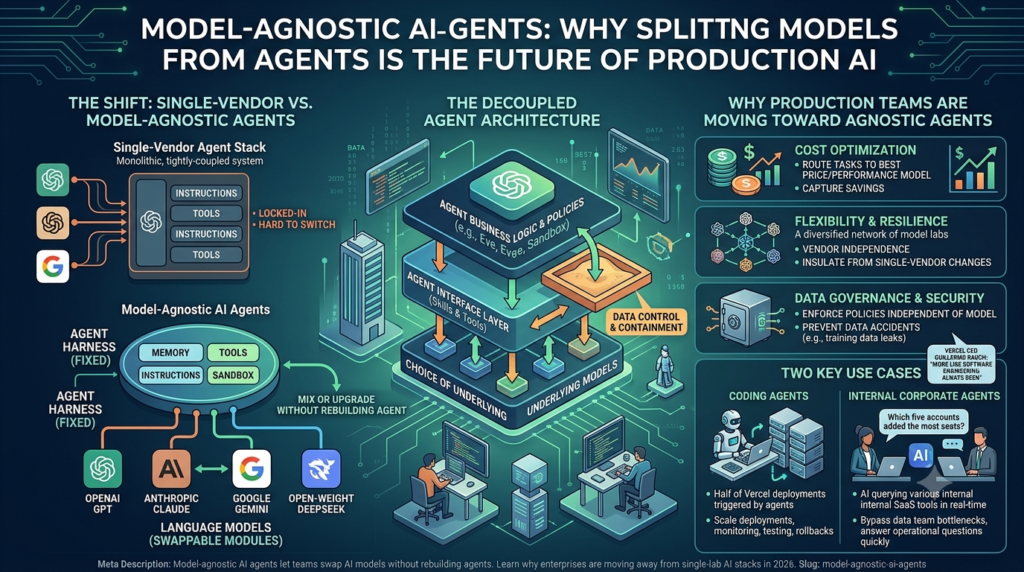
Model-agnostic AI agents are AI systems built so the underlying language model can be swapped, mixed, or upgraded without rebuilding the agent itself. The harness, memory, tools, and sandbox stay fixed while the model powering reasoning becomes a replaceable component — much like swapping a database engine without rewriting the application on top of it.
That distinction sounds technical, but it’s quietly reshaping how companies build and deploy AI in 2026. Vercel CEO Guillermo Rauch made this point directly in a recent TechCrunch interview, arguing that the industry is now deciding whether the model and the agent should be coupled at all, or treated as separate, interchangeable layers of a stack. His answer, unsurprisingly, is that they should be separate — and enterprise buying behavior increasingly agrees with him.
This article breaks down what this approach means, why production teams are moving toward it, the architecture that makes it possible, and how the shift is changing the relationship between AI labs and the infrastructure platforms that sit on top of them.
What Does It Mean to Decouple Models From Agents?
Definition
An agent, in this context, is not the model itself — it’s the combination of instructions, tools, permissions, memory, and guardrails that determine what an AI system is allowed to do and how it does it. Model-agnostic AI agents keep that combination independent of any single large language model. The “brain” running inside the agent can be OpenAI’s GPT family, Anthropic’s Claude, Google’s Gemini, or an open-weight model like DeepSeek, and switching between them requires little to no re-architecture of the agent itself.
Why the Distinction Matters Now
A year ago, most companies picked one AI lab and built everything on top of it. That pattern is breaking down. As production workloads scale, teams are discovering that different models excel at different jobs: some are cheaper per token, some are faster, and some simply perform better on a specific class of task. An agent architecture built around this flexibility lets a company capture those advantages without re-platforming every time a better or cheaper model appears.
There’s also a risk-management angle. Models improve on a near-monthly cadence, and locking an entire agent stack to one vendor means inheriting that vendor’s pricing, latency, and roadmap decisions — whether or not they still make sense for the business a year later. Treating the model as a replaceable component, rather than the foundation everything is welded to, insulates a company from that volatility.
A Useful Analogy: Software Engineering, Not Magic
Rauch’s framing is useful here: this is “more like software engineering has always been.” Developers don’t rebuild an entire application every time they upgrade a database or swap a cloud provider, because good architecture separates concerns into modules with clear interfaces. Applying that same discipline to AI means the agent’s logic is the stable module, and the model is the interchangeable dependency — a shift away from treating each new model release as a reason to start over.
The Two “Killer Apps” That Forced This Architecture Shift
According to Rauch, whose company Vercel processes more than 1 trillion tokens a day through its AI gateway, two use cases have proven durable enough to justify serious infrastructure investment — and both are pushing companies toward this decoupled approach.
1. Coding Agents
Coding agents are the most visible example. Vercel sees roughly 6 million deployments a day, and half of them are triggered by coding agents rather than humans. That volume creates a downstream problem: once software is generated at that scale, someone needs somewhere reliable to deploy it, monitor it, test it, and roll it back if something breaks. The agent that wrote the code and the platform that runs it are two very different jobs, and conflating them creates fragility.
2. Internal Corporate Agents
The second, less visible use case is the internal agent that helps run a company day to day. These agents answer operational questions — “which five accounts added the most seats in the last two weeks?” — that used to require a data team and a multi-quarter dashboard project to answer. The bottleneck was never a lack of creativity, intelligence, or relationship-building skill on the part of the employee asking the question. It was access: the data lived inside SaaS tools that were never designed to be queried by an autonomous system in real time.
Both use cases share a common requirement. The agent needs strict boundaries around what data it can touch, auditability over every action it takes, and the freedom for the company to change which model powers it as better or cheaper options appear. That combination of flexibility and control is exactly the problem this architecture is built to solve.
Model-Agnostic AI Agents vs. Single-Vendor Agent Stacks
The table below compares the two dominant approaches companies are choosing between in 2026.
| Factor | Single-Vendor Agent Stack | Model-Agnostic AI Agents |
|---|---|---|
| Model flexibility | Locked to one lab’s models | Can mix OpenAI, Anthropic, Gemini, or open models |
| Cost optimization | Limited to one vendor’s pricing | Can route tasks to the best price/performance model |
| Migration effort | High — rebuilding required to switch | Low — model swap without rearchitecting the agent |
| Data governance | Often bundled with the vendor’s platform | Enforced independently via sandboxing and policy layers |
| Resilience to model changes | Exposed to a single roadmap | Diversified across multiple providers |
| Auditability | Varies by vendor tooling | Built into the harness, independent of model choice |
| Best fit | Early prototyping, small teams | Production systems at scale |
This comparison mirrors what Rauch described as the current inflection point in the industry: whether the model and the agent are coupled, or treated as separate, swappable building blocks — closer to how software engineering has always worked.
AI agent architecture
enterprise AI infrastructure
multi-model AI systems
AI model routing
How Infrastructure Platforms Are Enabling This Shift
Vercel’s own approach is a useful case study, because it illustrates the two components most companies need in order to run agents this way: an instruction layer and a containment layer.
An Instruction and Skills Framework
Vercel built a framework called Eve, which lets teams define an agent’s instructions and skills in natural language, independent of which model executes them. This is what allows the same agent definition to run on different models without being rewritten each time a company changes providers. The skills and policies live in one place; the model is just whichever engine is plugged in underneath.
A Sandbox for Data Control
The second piece is containment. Vercel Sandbox gives an agent room to operate while applying policy over what data it can access and what data can leave the environment. Rauch pointed to a concrete fear here: a coding assistant installed without the right settings could quietly train on decades of proprietary code — a risk that matters enormously in regulated industries like aerospace, where a single misconfigured developer tool could expose highly sensitive intellectual property. Sandboxing is what makes it safe to grant an agent real autonomy instead of restricting it to a toy environment with no practical use.
Why Both Pieces Are Necessary
Neither component alone solves the problem. An instruction framework without a sandbox gives you flexibility but no safety net. A sandbox without a portable instruction layer gives you safety but ties you back to whatever model you originally built around. It’s the combination — flexible instructions plus enforced containment — that makes this kind of agent architecture practical at enterprise scale rather than just a theoretical ideal.
Why Enterprises Are Choosing Price/Performance Over Brand Loyalty
Enterprise buyers largely picked a single AI lab in 2025 based on brand and early performance benchmarks. In 2026, the calculus has shifted toward measurable production economics. As Rauch put it, when a team is optimizing for production, it starts looking closely at price and performance rather than which lab has the most attention in the press.
That shift shows up clearly in current usage patterns:
- Gemini usage is rising quickly inside production workloads, even though it draws less media attention than competitors, largely due to strong price/performance characteristics.
- Open-weight models such as DeepSeek and GLM-5.2 are gaining real traction as companies look for cheaper inference at scale, without sacrificing too much on quality.
- OpenAI and Anthropic remain default choices for many teams, but are now competing task-by-task rather than winning an exclusive, company-wide commitment the way they often did a year ago.
- Model routing is becoming a standard feature of agent infrastructure, letting teams send different tasks to whichever model performs best — and cheapest — for that specific job.
- Gateway-level metering, tracking tokens, latency, and cost per model, is now treated as core infrastructure rather than an afterthought bolted on later.
This is precisely the environment this kind of agent architecture is designed for: a stack that assumes model choice will change over time, rather than one built around a single provider’s roadmap and pricing decisions.
How Companies Are Implementing This Architecture
For teams considering the shift, the practical rollout tends to follow a similar sequence:
- Separate instructions from execution. Write agent behavior, tools, and skills in a model-independent format rather than embedding them in prompts tuned for one specific model.
- Add a sandbox or containment layer. Define exactly what data an agent can read, write, or export, independent of which model is reasoning inside it.
- Introduce a gateway for routing and metering. Track cost, latency, and quality per model so routing decisions can be based on real production data rather than guesswork.
- Pilot with more than one model. Even a simple A/B test between two providers on the same task reveals meaningful differences in cost and output quality.
- Build in fallback logic. If a primary model has an outage or a price increase, the agent should be able to fail over to an alternative without breaking the underlying workflow.
Teams that skip straight to step four without the earlier groundwork tend to end up with brittle, one-off integrations rather than a durable, reusable architecture.
Risks and Trade-Offs to Consider
This approach isn’t free of complexity. Some trade-offs worth weighing before committing to it:
- Upfront design cost. Writing instructions and tools in a model-independent way takes more initial engineering effort than hard-coding prompts for a single model.
- Inconsistent behavior across models. Different models can interpret the same instructions slightly differently, so teams need evaluation processes to catch regressions when switching providers.
- Operational overhead. Running a gateway, sandbox, and multi-model routing layer adds infrastructure that a single-vendor setup doesn’t require.
- Vendor-specific features. Some labs offer proprietary tools or integrations that don’t translate cleanly across providers, which can limit how “agnostic” an agent truly ends up being.
None of these are reasons to avoid the approach outright, but they’re reasons to plan for it deliberately rather than assume flexibility comes for free.
The Competitive Tension: AI Labs vs. Infrastructure Platforms
There’s an important wrinkle in this story. As AI labs add more capabilities — for example, tools that let a chatbot publish a website directly, without ever leaving the lab’s own product — they start competing directly with the infrastructure platforms that already exist. Rauch’s own read on this is pragmatic: even if a lab’s product nudges users toward hosting their first site inside a chatbot, those same users eventually need production-grade infrastructure, and that’s where platforms built around this kind of flexible, model-independent architecture step back in.
This tension is really the underlying fight referenced in the framing of this entire moment: whether the value in AI accrues to the model itself, or to the layer of infrastructure — deployment, data access, sandboxing, and orchestration — that sits around the model. Companies betting on model-agnostic AI agents are effectively betting that the infrastructure layer, not any single model, is where durable value lives over the long run.
What This Means for Developers and Business Leaders
For developers, the practical implication is that prompt engineering tied tightly to one model’s quirks is a liability, not an asset. Writing instructions in a portable, model-independent way protects the time invested in building an agent.
For business leaders, the implication is procurement flexibility. Instead of negotiating a single, company-wide contract with one AI lab, teams can negotiate smaller, task-specific commitments and shift spend toward whichever provider offers the best economics for a given workload — all without re-signing off on a new agent architecture every time.
Common Questions About This Architecture
Does building agents this way mean using multiple models at once?
Not necessarily. It means the architecture allows multiple models to be used — for different tasks, at different times, or as a fallback — without the agent needing to be redesigned each time. Many teams start with one model and simply keep the option open for later.
Is this harder to build than a single-vendor agent?
There’s more upfront design work, particularly around defining instructions and tools in a model-independent way. But that investment pays off quickly once a team needs to change providers, negotiate pricing, or respond to a new model release — work that would otherwise require a full rebuild.
What role does sandboxing play here?
Sandboxing enforces the boundary between an agent’s freedom to act and a company’s need to control what data the agent can access or expose. It’s what makes it safe to grant an agent real autonomy, regardless of which model is powering its reasoning at any given moment.
Why are enterprises moving away from single-lab commitments?
Primarily cost and flexibility. As AI moves from pilot projects into production, price-per-token and task-specific performance matter more than brand loyalty to a particular lab. Model-agnostic AI agents let teams capture those savings without sacrificing capability.
Is this shift specific to coding agents, or does it apply more broadly?
It applies broadly. Coding agents are the most visible example because of sheer deployment volume, but internal corporate agents — the tools that answer operational and sales questions inside a company — depend on the same underlying architecture to stay flexible and secure.
Will this trend continue, or will companies re-consolidate around one lab?
Current usage data points toward continued diversification rather than consolidation. As price/performance differences between providers persist, and as open-weight models keep improving, the incentive to stay flexible tends to grow rather than shrink.
Key Takeaways
Model-agnostic AI agents are quickly becoming the preferred architecture for organizations that want to build scalable, secure, and future-ready AI systems. Instead of locking an application to a single language model, model-agnostic AI agents separate the intelligence layer from the operational framework, allowing enterprises to switch between AI providers without redesigning workflows. This flexibility reduces vendor lock-in, lowers migration costs, and enables businesses to adopt the latest AI innovations as they emerge. As the AI ecosystem continues to evolve in 2026, companies that invest in model-agnostic AI agents are better positioned to maintain long-term competitiveness while optimizing performance and infrastructure costs.
Another major advantage of model-agnostic AI agents is their ability to support multi-model strategies. Different AI models excel at different tasks—some deliver faster responses, others provide stronger reasoning, while some offer lower operational costs. By using model-agnostic AI agents, organizations can intelligently route workloads to the most suitable model based on performance, latency, or pricing. This dynamic approach maximizes efficiency while ensuring consistent user experiences across applications. Instead of relying on a single vendor’s roadmap, businesses gain the flexibility to choose the best AI model for every use case.
Security and governance are equally important reasons why enterprises are embracing model-agnostic AI agents. Modern AI deployments require strict control over sensitive business data, regulatory compliance, and transparent auditing. A well-designed model-agnostic AI agents framework integrates sandboxing, policy enforcement, permission management, and memory controls independently of the underlying model. This separation allows organizations to strengthen data protection while maintaining the freedom to upgrade or replace AI models without compromising security standards. For industries such as finance, healthcare, aerospace, and government, this architectural approach significantly reduces operational risk.
The rise of model-agnostic AI agents also reflects a broader shift in enterprise purchasing decisions. Organizations are increasingly evaluating AI solutions based on measurable business outcomes rather than brand recognition. Cost-per-token, inference speed, scalability, and overall return on investment now influence AI adoption more than loyalty to a single provider. Because model-agnostic AI agents support seamless model switching, enterprises can continuously optimize their AI stack as new technologies become available. This adaptability helps businesses remain competitive while avoiding expensive migrations or disruptive infrastructure changes.
Ultimately, model-agnostic AI agents represent the future of production AI because they combine flexibility, resilience, security, and cost optimization into a single architecture. Developers benefit from writing reusable agent logic instead of rebuilding applications for every new model release, while business leaders gain greater procurement flexibility and reduced dependency on individual AI vendors. As AI continues to mature, model-agnostic AI agents will serve as the foundation for enterprise-grade automation, intelligent decision-making, and scalable digital transformation. Organizations that adopt this approach today will be better prepared to leverage tomorrow’s AI innovations with minimal disruption, making model-agnostic AI agents one of the most important architectural trends shaping production AI in 2026.