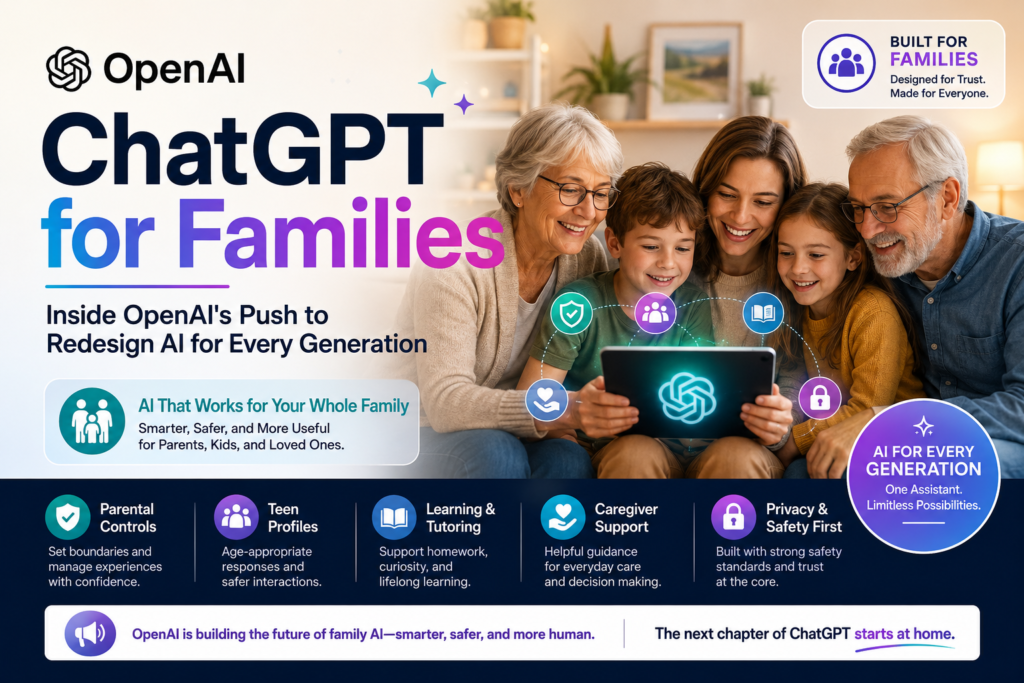
ChatGPT for families is no longer a side feature — it’s becoming a core product strategy. OpenAI is now hiring a dedicated product manager to build experiences specifically for families, caregivers, and older adults, signaling a deliberate shift from an individual productivity tool toward a household technology platform.
If you’ve noticed ChatGPT showing up in more conversations with parents, grandparents, and even skeptical relatives who once dismissed AI as “just for tech people,” you’re not imagining things. The data backs it up, and OpenAI’s latest hiring move confirms the company sees this shift as strategic, not accidental.
Why Is OpenAI Building ChatGPT for Families Now?
The short answer: ChatGPT’s audience has quietly aged up, and OpenAI wants to own that shift before competitors do.
The New Product Manager Role Explained
OpenAI is <cite index=”1-1″>hiring a dedicated product manager in San Francisco to build experiences for families, caregivers, and older adults across its products</cite>. According to the job posting, <cite index=”1-1″>the role calls for experience building products for parents and families, and other trust-sensitive consumer experiences</cite>. This is a meaningful signal. Companies don’t typically create standalone product roles around a demographic unless internal data shows sustained, measurable growth in that segment — and unless leadership expects that growth to continue.
This is precisely the kind of role that turns ChatGPT for families from an incidental use case into a funded, roadmapped priority.
The Data Behind the Shift
The numbers explain why now. Sensor Tower data shared with TechCrunch shows that <cite index=”1-3″>the share of ChatGPT users aged 35 and older globally rose to 31% in the second quarter of 2026, up from 26% a year earlier, while the share of users aged 18 to 24 fell to 29% from 34%</cite>. That’s a substantial generational rebalancing in just twelve months.
The household angle is even sharper in the U.S. market. <cite index=”1-3″>Nearly one in four smartphone users who are parents used ChatGPT during the quarter, up from 16% a year earlier</cite>. That’s not a marginal uptick — it’s a near 50% year-over-year jump in parental adoption, which explains why building dedicated ChatGPT for families experiences suddenly makes commercial sense.
Industry analysts see this as part of a familiar technology adoption curve. Ben Bajarin, CEO of Creative Strategies, noted that <cite index=”1-5″>a dedicated product role focused on families signals OpenAI is beginning to think about its products less as tools for individual productivity and more as technology designed for households — similar to the path Google, Apple, and Meta eventually followed as their platforms became embedded in everyday life, though he added that AI raises the stakes because the assistant does more than mediate content or devices</cite>.
ChatGPT for Families vs. ChatGPT for Individuals: What’s Changing
Definition: ChatGPT for families refers to product experiences — controls, profiles, safeguards, and shared tools — designed for households with multiple users of different ages, rather than a single adult account.
Expansion: Historically, ChatGPT was built around a single-user mental model: one login, one conversation history, one set of preferences. A family-first approach requires rethinking that entire architecture, from account structure to content moderation to how the AI responds when it detects a younger user or a vulnerable adult on the other end.
| Feature Area | Individual-Focused ChatGPT | Emerging ChatGPT for Families |
|---|---|---|
| Account structure | Single adult login | Linked family accounts, teen profiles |
| Content boundaries | Standard content policy | Age-appropriate content controls |
| Oversight | None by default | Parental controls, caregiver visibility |
| Crisis response | Standard safety routing | Trusted Contact alerts for self-harm risk |
| Use case framing | Productivity, coding, writing | Parenting support, tutoring, caregiving, coordination |
| Target audience | Working professionals, students | Parents, caregivers, older adults, teens |
This table captures why ChatGPT for families is a genuinely different product philosophy, not just a marketing label slapped onto the existing app.
The Trust and Safety Challenge Behind ChatGPT for Families
Question: Why is safety central to OpenAI’s family strategy, rather than an afterthought?
Direct answer: Because the same demographic shift that creates opportunity also creates legal, reputational, and regulatory risk — and OpenAI is already facing consequences from moving too slowly on safeguards.
Lawsuits and Growing Scrutiny
OpenAI’s expansion into ChatGPT for families is unfolding against a backdrop of serious legal challenges. The company <cite index=”1-9″>has faced multiple lawsuits from parents alleging that ChatGPT contributed to harm suffered by their children, including cases involving suicide</cite>. Stephen Balkam, CEO of the Family Online Safety Institute, framed the family-focused hiring as <cite index=”1-6″>”safety by redesign,” pointing out that the original product wasn’t built with children in mind, so this move represents a much-needed reaction and response</cite>.
That gap between parental awareness and actual usage is significant. New research from the Family Online Safety Institute, surveying more than 4,000 families across the U.S. and Australia, <cite index=”1-7″>found that while 27% of U.S. parents said their child had used generative AI in the past week, 38% of children reported doing so themselves</cite>. In other words, a large share of AI use by minors is happening without parental knowledge — which is exactly the kind of blind spot a dedicated family product team is meant to close.
Balkam also outlined specific expectations for how AI companies should treat younger users, recommending that <cite index=”1-8″>AI products for younger users include stronger content controls, age-appropriate experiences, parental oversight, and clear reminders that users are interacting with an AI rather than a human</cite>.
Existing Safety Measures OpenAI Has Rolled Out
OpenAI hasn’t started from zero. Over the past year, the company has layered in several protections that now form the foundation of its broader ChatGPT for families push:
- Parental controls for teen accounts, giving guardians visibility and management options
- Safety routing for sensitive conversations, which <cite index=”1-9″>directs conversations showing signs of distress to reasoning models designed to better handle those situations</cite>
- Trusted Contact feature, an <cite index=”1-9″>optional safeguard that can alert a family member or caregiver in cases of potential self-harm</cite>
- Community partnerships, including a workshop with the San Antonio Spurs Community Impact organization and the Positive Coaching Alliance <cite index=”1-11″>focused on exploring AI’s role in learning, coaching, and youth engagement</cite>
Balkam framed this moment as a genuine opportunity for the AI industry to avoid repeating social media’s mistakes, since <cite index=”1-10″>platforms historically treated children much like adults before adding stronger safeguards only after mounting public pressure and regulatory scrutiny</cite>. Building ChatGPT for families proactively, rather than reactively, is the bet OpenAI appears to be making.
How Does ChatGPT for Families Compare to Gemini, Claude, and Copilot?
OpenAI isn’t operating in a vacuum. Every major AI assistant is being pulled toward a broader household audience, but each is starting from a different demographic baseline.
| Assistant | Users 25–34 (global) | Users 45+ (global) | U.S. Parent Reach (Q2) |
|---|---|---|---|
| ChatGPT | 40% | 11% | 24% |
| Gemini | 40% | 12% | 32% |
| Claude | 40% | 14% | 4% |
| Copilot | 33% | 20% | 2% |
A few things stand out from this comparison. <cite index=”1-12″>Users aged 25 to 34 account for 40% of the global app audiences for Claude and Gemini, matching ChatGPT, compared with 33% for Copilot</cite>. Meanwhile, <cite index=”1-12″>Copilot skews notably older, with 20% of its users aged 45 and above, compared with 14% for Claude, 12% for Gemini, and 11% for ChatGPT</cite>.
On the parent-reach front specifically, <cite index=”1-14″>Gemini had the widest reach among U.S. smartphone users who are parents at 32% in Q2, followed by ChatGPT at 24%, Claude at 4%, and Copilot at 2%</cite>. That gap is exactly why ChatGPT for families matters strategically — Google already has a head start with parents through Gemini’s integration across Android, Workspace, and family-linked Google accounts.
Still, momentum favors OpenAI in one important respect. <cite index=”1-13″>While ChatGPT remains relatively underpenetrated among older users, it is adding them faster than its rivals — the share of users aged 45 and above rose three percentage points year-over-year in Q2, compared with a two-point increase for Copilot and declines for both Claude and Gemini</cite>.
What Family-First AI Could Look Like Next
Based on where the industry is heading, analysts expect the next wave of ChatGPT for families features to go well beyond basic parental controls. Bajarin predicts several concrete developments as AI becomes a technology shared across generations within a single household:
- Family subscription plans with shared billing and centralized management
- Child and teen profiles with tailored content boundaries by age
- Caregiver tools built for adult children managing care for aging parents
- Shared household memory, letting the AI retain context relevant to the whole family rather than one user
- AI tutoring features aimed at supporting kids’ schoolwork and learning
- Stronger, layered safety controls that scale with the age and vulnerability of each user
This roadmap reflects a broader pattern in consumer technology: platforms that start as individual tools eventually get re-architected around the household once adoption reaches critical mass. <cite index=”1-15″>Bajarin sees OpenAI’s hiring decision as a signal of exactly where consumer AI is headed</cite>.
Frequently Asked Questions About ChatGPT for Families
Is ChatGPT currently designed for families, or is this a future feature? Today, ChatGPT for families exists mostly through add-on features — parental controls, safety routing, and Trusted Contact alerts — rather than a fully redesigned household product. The new product manager hire suggests a more comprehensive family-first redesign is still ahead.
Why is OpenAI hiring specifically for families instead of expanding existing teams? A dedicated role concentrates ownership of a trust-sensitive, fast-growing user segment. It signals that family-focused product decisions will have a direct advocate inside OpenAI, rather than being handled as a secondary consideration by general product teams.
How does ChatGPT for families address safety concerns for children? Current measures include age-appropriate parental controls for teen accounts, automatic routing of sensitive conversations to safety-tuned models, and an optional Trusted Contact feature that can notify a caregiver if a conversation suggests risk of self-harm.
Which AI assistant currently reaches the most parents in the U.S.? Gemini currently leads U.S. parent reach at 32%, ahead of ChatGPT at 24%, with Claude and Copilot both under 5%. ChatGPT, however, is growing its older-user base faster than any of its three main competitors.
Do parents actually know how much their kids use AI chatbots? Not fully. Survey data shows a real gap between what parents believe and what’s happening: parents report lower weekly AI usage among their children than children report themselves, suggesting many families are underestimating actual exposure.
The Bottom Line
ChatGPT for families represents more than a single hiring decision — it’s a signal that OpenAI is preparing to compete for household trust, not just individual attention. With parental adoption nearly doubling year-over-year and rivals like Gemini already ahead on family reach, the next 12 months will likely bring visible product changes: shared plans, caregiver tools, and safety features built specifically around the reality that AI is no longer just a personal assistant — it’s becoming a household one.