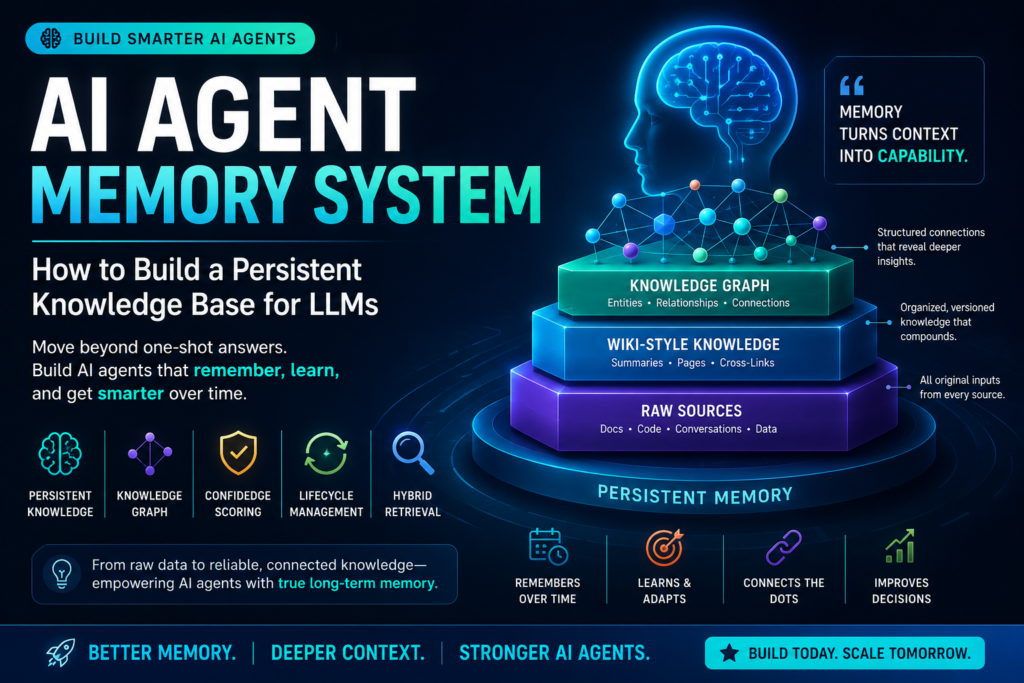
An AI agent memory system is a structured architecture that lets a large language model store, score, connect, and retrieve knowledge across sessions instead of starting from zero every time. Unlike basic retrieval, it treats information as something that compounds — gaining confidence, connections, and context the more it’s used.
If you’ve ever watched an AI coding agent re-explain your own codebase back to you for the tenth time, you already understand the problem this solves.
What Is an AI Agent Memory System?
Definition: An AI agent memory system is a layered architecture — typically raw sources, structured knowledge pages, and a governing schema — that allows an LLM to accumulate, score, and revise what it knows over time, rather than treating every query as a fresh retrieval task.
Expansion: The concept builds on a simple but powerful idea popularized in AI engineering circles: stop re-deriving answers, start compiling them. A standard retrieval pipeline pulls relevant chunks of text and forgets them the moment the session ends. A true AI agent memory system does the opposite — it accumulates. Every session adds to a growing, self-correcting body of knowledge that the next session can build on.
This distinction matters more as AI agents take on longer-horizon work: debugging across weeks, managing ongoing projects, or maintaining institutional knowledge for a team. Without memory, none of that context survives past a single conversation window.
Why RAG Alone Isn’t Enough for an AI Agent Memory System
Retrieval-Augmented Generation (RAG) is often treated as a complete solution, but it was designed to solve a narrower problem: finding relevant text at query time. It wasn’t designed to track how confident the system should be in a claim, whether that claim has since been contradicted, or whether it’s still relevant six months later.
A functional AI agent memory system needs three things RAG doesn’t provide out of the box:
- Temporal awareness — knowing that a claim from last week may outweigh one from six months ago
- Confidence tracking — distinguishing a fact confirmed by three sources from a single unverified observation
- Structural relationships — understanding that two facts are connected, contradictory, or one supersedes the other
Without these, an agent’s “memory” is really just a bigger search index — useful, but static and prone to accumulating stale or conflicting information.
The Core Layers of an AI Agent Memory System
A production-grade AI agent memory system is typically organized into three foundational components: raw sources (the original inputs), wiki-style pages (the compiled knowledge), and a schema document that governs how the two connect. On top of that foundation sit two critical additions that most basic implementations skip: memory lifecycle management and consolidation tiers.
Memory Lifecycle: Confidence, Supersession, and Forgetting
Knowledge isn’t static, and treating every stored fact as equally true forever is one of the fastest ways to degrade an AI agent memory system.
Confidence scoring attaches a score to each fact based on how many sources support it, how recently it was confirmed, and whether anything contradicts it. A claim like “the project uses Redis for caching” should carry metadata: two supporting sources, last confirmed three weeks ago, confidence at roughly 0.85. This turns a flat list of facts into a weighted model the system can reason about with appropriate uncertainty.
Supersession handles contradictions explicitly. When new information updates or overrides an old claim, the old entry isn’t deleted — it’s marked stale and linked to whatever replaced it. This preserves an audit trail while keeping the “live” answer clear.
Forgetting applies a retention curve so that facts which haven’t been accessed or reinforced in months gradually lose priority — not deleted, but deprioritized, similar to how memory consolidation works biologically. Architectural decisions decay slowly; transient details decay fast.
Consolidation Tiers: Working, Episodic, Semantic, Procedural
A well-designed AI agent memory system doesn’t store everything at the same level of compression. Instead, it promotes information through tiers as evidence accumulates:
- Working memory — raw, unprocessed observations from the current session
- Episodic memory — compressed session summaries
- Semantic memory — cross-session facts consolidated from multiple episodes
- Procedural memory — recurring workflows and patterns extracted from repeated semantic facts
Each tier is more compressed and longer-lived than the one beneath it. This is how a system moves from “I noticed this once” to “this is how things reliably work” — a meaningful upgrade over one-shot retrieval.
The Knowledge Graph Layer
Flat pages with simple links get an AI agent memory system partway there, but real reasoning power comes from layering a typed knowledge graph on top.
Entity Extraction and Typed Relationships
Rather than writing unstructured prose, an effective AI agent memory system extracts structured entities from every source: people, projects, libraries, tools, decisions. Each entity gets a type, attributes, and relationships to other entities.
Crucially, not all connections carry equal weight. A generic “relates to” link is far less useful than a typed relationship like “caused,” “depends on,” “contradicts,” or “supersedes” — each with its own confidence score and supporting evidence.
Graph Traversal for Better Queries
When a query like “what breaks if we upgrade this dependency?” comes in, keyword search alone misses indirect connections. Graph traversal starts at the relevant node and walks outward through “depends on” and “uses” edges, surfacing downstream effects that pure text search would never catch. The graph doesn’t replace readable pages — it augments them, handling navigation and discovery while pages handle readability.
Hybrid Search: The Retrieval Layer That Scales
A single index file works fine for a small knowledge base, but most implementations hit a wall somewhere between 100 and 500 documents. Beyond that point, an AI agent memory system needs real hybrid retrieval, combining three complementary methods:
- BM25 — keyword matching with stemming and synonym expansion, which catches exact terminology
- Vector search — semantic similarity via embeddings, which catches conceptually related content even without shared keywords
- Graph traversal — entity-aware relationship walking, which catches structural connections the other two miss
These three streams are typically fused using reciprocal rank fusion, so each method’s strengths compensate for the others’ blind spots. Systems combining all three approaches have reported retrieval accuracy in the low-to-mid 90% range on long-memory benchmarks — a meaningful jump over single-method retrieval.
Automation: From Manual Curation to Event-Driven Memory
Most early-stage AI agent memory system implementations rely on manual triggers — someone has to remember to ingest a source or run a maintenance pass. Mature systems shift this to event-driven hooks:
| Trigger | Automated Action |
|---|---|
| New source added | Auto-ingest, extract entities, update graph and index |
| Session starts | Load relevant context based on recent activity |
| Session ends | Compress session into observations, file insights |
| Query answered well | Check quality score; file back into memory if above threshold |
| New memory written | Check for contradictions with existing knowledge |
| Scheduled interval | Run lint, consolidation, and retention decay passes |
Humans should stay in the loop for direction and curation, but the repetitive bookkeeping — the part that causes most manual knowledge bases to get abandoned — is exactly what automation should absorb.
Quality Control and Self-Healing
Not everything an LLM writes into memory is good by default. Without quality gates, an AI agent memory system accumulates noise as fast as it accumulates knowledge.
Scoring content quality means evaluating whether new entries are well-structured, properly sourced, and consistent with existing knowledge — either through self-evaluation or a second-pass review with a different prompt. Anything below a quality threshold gets flagged rather than silently added.
Self-healing maintenance goes beyond flagging problems to actively fixing them: linking or flagging orphaned pages, marking stale claims, and repairing broken cross-references automatically rather than only when someone remembers to check.
Contradiction resolution takes flagging a step further by proposing which of two conflicting claims is more likely correct, based on source recency, source authority, and the volume of supporting evidence — with a human able to override the default.
AI Agent Memory System vs. Traditional RAG
| Feature | Traditional RAG | AI Agent Memory System |
|---|---|---|
| Knowledge persistence | Retrieved fresh each query, then discarded | Accumulates and compounds across sessions |
| Confidence tracking | None — all chunks treated equally | Weighted scoring based on sources and recency |
| Contradiction handling | Not addressed | Explicit supersession or conflict resolution |
| Structural relationships | Flat text chunks | Typed knowledge graph with relationship edges |
| Retrieval method | Usually vector search only | Hybrid: BM25 + vector + graph traversal |
| Maintenance | None built in | Lint, decay, and self-healing passes |
| Scalability past ~200 docs | Degrades without added infrastructure | Designed to scale via hybrid retrieval |
Privacy, Governance, and Multi-Agent Collaboration
As an AI agent memory system grows — especially in team or multi-agent settings — governance stops being optional.
Filtering on ingest strips sensitive data like API keys, credentials, and personally identifiable information before it ever enters the knowledge base, rather than relying on someone to catch it later.
Audit trails log every operation — ingest, edit, delete, query — with a timestamp and reason, giving teams a way to trace how any given piece of knowledge got there.
Multi-agent scoping separates private knowledge (individual preferences, personal workflow notes) from shared knowledge (project architecture, team decisions), with private observations promoted to shared status only when appropriate. For teams running multiple agents in parallel, lightweight work coordination — who’s working on what, what’s blocked — prevents duplicate effort without requiring a full task-management layer.
Implementation Spectrum: Where to Start
Not every AI agent memory system needs the full architecture on day one. The pattern is modular, and each layer can be added incrementally:
- Minimal viable version: raw sources, wiki pages, an index file, and a basic schema — this alone is functional and worth starting with
- Add lifecycle management: confidence scoring, supersession, and basic retention decay to prevent knowledge rot
- Add structure: entity extraction and a typed knowledge graph to surface connections flat pages miss
- Add automation: event hooks for ingestion, linting, and context injection to reduce manual maintenance
- Add scale infrastructure: hybrid search and consolidation tiers once the knowledge base passes a few hundred documents
- Add collaboration features: shared/private scoping and multi-agent sync for team or multi-agent use cases
Pick an entry point based on actual need rather than building everything upfront — the architecture works at every stage of this spectrum.
Frequently Asked Questions
What is the difference between an AI agent memory system and a vector database? A vector database is one component — typically used for semantic search — inside a broader AI agent memory system. The memory system also includes confidence scoring, structural relationships, lifecycle management, and often keyword and graph-based retrieval alongside vectors.
Does an AI agent memory system replace RAG entirely? No. It extends RAG’s retrieval capability with persistence, scoring, and structure. Hybrid retrieval inside a memory system often still uses vector search as one of its three retrieval methods.
How large can a knowledge base get before performance degrades? Flat index-based approaches tend to struggle somewhere between 100 and 500 documents. Past that point, hybrid search combining keyword, vector, and graph retrieval is generally necessary to maintain accuracy and speed.
Is confidence scoring necessary, or is timestamping enough? Timestamps alone don’t capture how well-supported a claim is. Confidence scoring that accounts for source count, recency, and contradiction status gives a more reliable signal than recency by itself — though some practitioners argue explicit source chains are more verifiable than a single numeric score.
Can a single person maintain an AI agent memory system, or does it require a team? A minimal version is maintainable solo, especially with automation handling ingestion and linting. Multi-agent scoping and collaborative governance features become relevant only once multiple people or agents are contributing to the same knowledge base.
Conclusion
The core promise of an AI agent memory system is straightforward: stop making your AI re-derive the same context every session, and start letting it compile durable, structured knowledge instead. The building blocks — lifecycle management, knowledge graphs, hybrid search, automation, and quality control — aren’t all required on day one. But understanding the full architecture makes it much easier to decide which layer actually solves the problem you have right now, rather than building complexity you don’t yet need.