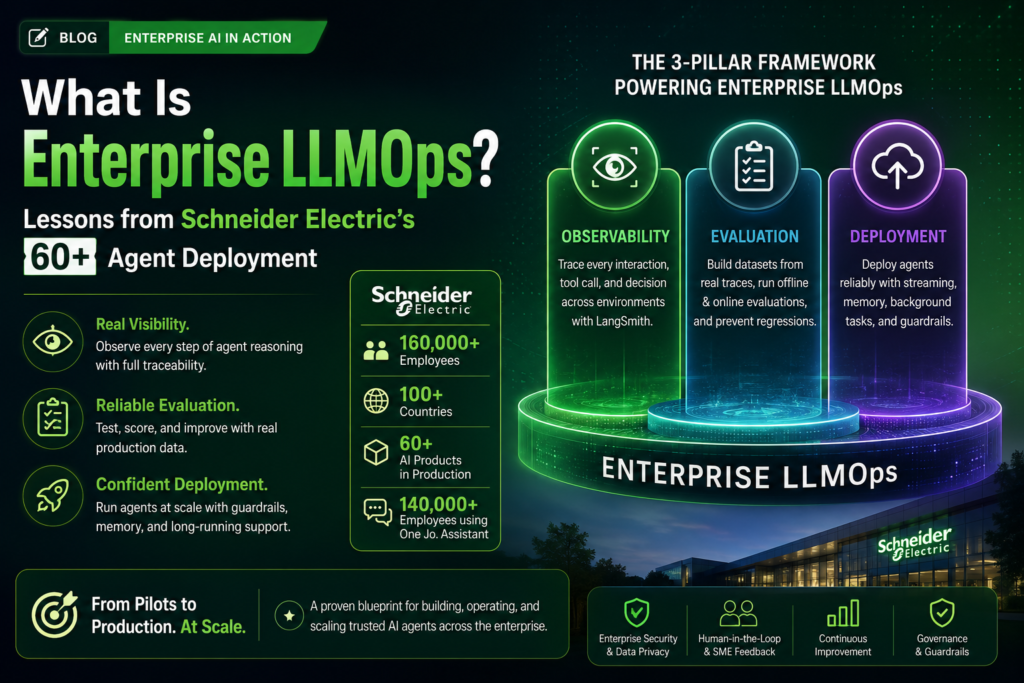
Enterprise LLMOps is the discipline of observing, evaluating, and deploying large language model (LLM) and agentic AI systems reliably at organizational scale. Schneider Electric, a 160,000-employee energy technology company, proves what this looks like in practice: 60+ AI products in production, an internal assistant serving 140,000+ employees across 100+ countries, and a structured maturity framework that governs every AI use case from exploration to full operations.
This isn’t a theoretical framework. It’s a working system built on LangSmith, and it offers one of the clearest public blueprints available for how large organizations should structure their AI operations today. If your organization has moved past a single pilot chatbot and is now juggling a dozen agentic products across different teams, this case study is essentially a checklist of what to get right.
What Is Enterprise LLMOps? (Definition + Expansion)
Enterprise LLMOps refers to the tools, processes, and organizational practices that let large companies build, monitor, evaluate, and ship LLM-powered applications — chatbots, copilots, and autonomous agents — safely and repeatably across many teams and use cases simultaneously.
Where traditional MLOps focused on versioning datasets and monitoring statistical drift for predictive models, this discipline has to account for non-deterministic outputs, multi-step agent reasoning, prompt-level regressions, and human-in-the-loop feedback. It typically rests on three functional pillars:
- Observability — tracing every step of an agent’s reasoning and tool calls so teams can see what’s actually happening in production.
- Evaluation — systematically scoring outputs, offline and online, to decide whether a change is safe to ship.
- Deployment — running agents reliably in production, with support for streaming, memory, and long-running or background tasks.
It becomes non-negotiable once an organization moves past a handful of proof-of-concept chatbots and starts operating dozens of agentic products across different business units, each with its own data sensitivity, compliance requirements, and failure tolerance. At that point, ad hoc monitoring and one-off evaluation scripts stop scaling, and the company needs a shared, repeatable operating model instead.
Why Classical MLOps Fails for LLM and Agentic Systems
Organizations that try to force LLM-based products through their existing MLOps pipelines quickly run into a wall. Traditional MLOps was built around deterministic, single-input/single-output models where drift could be measured with clean statistical metrics. Agentic AI systems break that model in three specific ways:
- Debugging is harder. Application logs alone can’t explain why an agent chose a particular tool or produced a particular answer across a multi-step reasoning chain.
- Measurement is fuzzier. There’s no simple accuracy score for a prompt change the way there was for a classification model’s F1 score.
- Production readiness is ambiguous. Without a structured way to validate agentic behavior, teams can’t confidently say a system is ready to ship.
This is precisely the gap a mature enterprise LLMOps practice is designed to close, and it’s the exact problem Schneider Electric’s AI Platform team set out to solve when their traditional MLOps approaches didn’t translate to the growing portfolio of LLM-based systems running across the company. Without a dedicated discipline for this, teams risk flying blind — unable to debug agent behavior beyond raw logs, unable to precisely measure the effect of a prompt or model change, and unable to validate whether a system is genuinely ready for production.
The Three-Pillar Architecture Behind Enterprise LLMOps
Schneider Electric’s AI Platform team organized their entire practice around three pillars that mirror the agentic product lifecycle: observability, evaluation, and deployment. Each pillar answers a distinct question, and together they form a coherent operating model rather than a loose collection of tools.
Pillar 1 — Observability: “We Can See What’s Happening”
Observability is the foundation every other capability depends on. Schneider Electric runs a self-hosted LangSmith deployment on AWS EKS, sitting behind their corporate security perimeter to satisfy strict data privacy and third-party data egress policies.
The critical architectural decision here wasn’t whether to trace agent activity — it was how to structure workspaces. Rather than isolating each environment (dev, QA, pre-prod, prod) into separate workspaces, Schneider Electric adopted one workspace per AI product, spanning all environments. This single decision unlocks a powerful feedback loop: production traces can be promoted directly into dev datasets for offline evaluation, and subject matter experts (SMEs) can annotate real production traces without switching contexts.
This is a core principle worth internalizing for anyone building out an LLMOps practice: separating environments by workspace looks tidy on paper, but it severs the connection between what happens in production and what gets tested before the next release. Co-locating dev and prod traces in a single workspace keeps that loop intact, and it’s a big part of why datasets, annotations, and experiments stay closely tied to real production behavior rather than drifting into synthetic test cases nobody trusts.
Production example — One Jo. Schneider Electric’s internal AI Assistant serves 160,000 employees across 107 countries. Every conversation is traced through LangSmith while maintaining strict data privacy standards. Production traces are systematically reused to feed regression datasets, letting the team validate each new model or prompt iteration against real-world usage, while the same traces give immediate visibility into performance drift over time.
Pillar 2 — Evaluation: “We Can Decide Whether to Ship”
If observability tells you what’s happening, evaluation tells you whether it’s good enough to ship. Schneider Electric built this pillar on three fronts.
First, an offline evaluation accelerator: standardized Agentic RAG templates on Azure and AWS, paired with a lightweight evaluation CLI built on the LangSmith SDK, so every AI squad uses the same dataset conventions and the same evaluator interfaces. The result is that new teams move quickly from initial setup to a meaningful offline evaluation suite, rather than reinventing the wheel each time.
Second, an internal LLMOps maturity framework, a scoring model that tracks whether a product is instrumented, has an offline evaluation suite, runs online evaluators in production, and feeds user feedback back into the system. This maturity score is integrated directly into Schneider Electric’s AI product lifecycle and used in gate reviews that move a use case from exploration → incubation → industrialization → operations. An automated GitHub workflow queries the LangSmith API on a schedule and generates a consolidated report, giving leadership continuous visibility into adoption and progress without a manual audit.
Third, SME involvement. Even with the right tooling in place, the hardest part of evaluation remains bringing domain expertise into the loop. Schneider Electric mapped their internal SME role to a custom LangSmith role that grants access to annotation queues and datasets, without exposing the full developer-level surface area. Today, about 20% of their AI products include at least one active annotation queue with SME participation, letting domain experts directly review and annotate real examples without needing engineering skills.
Production example — CSM Copilot. Built for 250+ Customer Success Managers who support condition-based maintenance for data centers and buildings, CSM Copilot was designed with SMEs involved from day one — continuously reviewing outputs, providing annotations, and shaping system behavior throughout development. That early involvement translated directly into a high level of quality and strong adoption at first deployment.
Pillar 3 — Deployment: “One Runtime per Product”
For agents that require streaming responses, long-term memory, human-in-the-loop steps, or background processing, Schneider Electric standardized on the LangSmith Deployment reference architecture — an Agent Server backed by Postgres and Redis, running in their AWS and Azure landing zones.
Notably, they deliberately rejected a centralized agent runtime in favor of one dedicated runtime per product, guided by two principles:
- “You build it, you run it.” AI squads get strong foundations and paved paths rather than a shared, one-size-fits-all runtime, keeping full control over latency, cost, and incident response with the team closest to the problem.
- No single point of failure. A shared runtime means one faulty deployment could take down every agent at once. Per-product runtimes isolate failures to a single use case, keeping the overall platform resilient.
This is a deliberate trade-off: more infrastructure to manage and more upgrades to coordinate, in exchange for resilience and team-level autonomy. Every product starts from the same langgraph.json template, cloud-agnostic across AWS and Azure, with an allow-listed base image, integration with the corporate CA bundle, and a custom feedback HTTP route exposed alongside the agent graph — a small but important detail that keeps every deployment consistent even as ownership stays decentralized.
Production example — Specification Document Intelligence. Within Schneider Electric’s Digital Energy division, a document-processing agent analyzes customer quote requests — specifications, building plans, and other PDFs — and automatically adds contextual annotations. Quotation workflows that once took hours or days now complete in an average of just over 15 minutes. This kind of long-running, background processing is exactly what a task-queue deployment model is designed for, allowing reliable execution without impacting real-time system performance elsewhere.
Results: What This Approach Delivered at Scale
The numbers behind Schneider Electric’s program give a useful benchmark for what a mature enterprise LLMOps practice can look like several years into adoption:
- 60+ AI products in active development or production, all built on the same underlying ecosystem.
- Approximately 200 active platform users across engineering and SME communities.
- 140,000+ employees served by a single internal assistant across 100+ countries.
- ~20% of products with active SME-driven annotation queues, a realistic adoption benchmark rather than an idealized 100%.
These figures matter because they show that even a well-resourced, mature program doesn’t achieve universal adoption instantly — capability rollout is gradual, gated, and measured. A 20% SME-annotation coverage rate, for instance, isn’t a shortfall; it’s a realistic snapshot of where a large, multi-division organization actually lands after investing heavily in tooling, training, and cross-team alignment. Leadership teams evaluating their own AI programs against this benchmark should treat gradual, measured expansion as the expected trajectory rather than a sign that adoption has stalled.
Self-Hosted vs. SaaS: Choosing Your Infrastructure Model
One of the most consequential decisions in any LLMOps rollout is whether to self-host your observability and evaluation platform or use a managed SaaS offering. Schneider Electric chose self-hosted deployment for compliance reasons, but they’re candid about the trade-offs involved.
| Factor | Self-Hosted (Schneider Electric’s choice) | SaaS |
|---|---|---|
| Data control | Full control; stays behind corporate perimeter | Data leaves your network |
| Compliance fit | Required for strict data-residency rules | May not satisfy strict internal policies |
| Operational overhead | High — Helm chart upgrades, EKS lifecycle, version pinning | Low — managed by the vendor |
| Time to value | Slower initial setup | Faster initial setup |
| Debugging surface | Includes infrastructure-level issues (e.g., network policy conflicts) | Limited to application-level issues |
| Best fit | Regulated industries, critical infrastructure, strict data egress rules | Teams without hard compliance constraints |
Their own conclusion is worth repeating as a rule of thumb for anyone weighing this decision: self-hosting works well and can be remarkably robust in production, but it comes with a real, ongoing operational cost. If your compliance context allows a SaaS deployment, that’s generally the lower-friction path.
Key Lessons for Building an Enterprise LLMOps Practice
Schneider Electric’s AI Platform team distilled several hard-won lessons from building their program at scale, and they translate well to almost any large organization adopting agentic AI:
- Instrumentation isn’t optional. Teams that skipped trace-level observability early ended up stuck manually debugging non-deterministic regressions later — a far more expensive form of technical debt than instrumenting from day one.
- Favor built-in capabilities over custom frameworks. It’s tempting to build elaborate internal evaluation frameworks. A thin CLI layered on an existing SDK, a custom role mapped onto an existing permission model, and scheduled reports off a public API go a long way with far less ongoing maintenance burden.
- Self-hosting is viable, but budget for the operational tax. Robustness in self-hosted mode doesn’t eliminate the ongoing cost of infrastructure lifecycle management — plan headcount and time for it explicitly.
- Adoption is an organizational problem, not a technology problem. The hardest part isn’t integrating the tooling — it’s aligning many teams around shared practices and standards while the underlying AI landscape keeps shifting under everyone’s feet.
- Choose an ecosystem that lets you mix and match. A platform where open-source components can be used standalone, but still integrate cleanly with the broader observability and deployment layer, avoids locking teams into a single rigid path years down the line.
What Comes Next: Edge AI and AI-Native Engineering
Schneider Electric’s roadmap points to two areas that many enterprise LLMOps teams will need to address soon. First, they’re piloting agent Skills and coding agents to ease adoption of their own tooling across teams, automating maintenance of agentic products running on a per-product deployment model. Second, and more structurally, a growing share of their AI products run at the edge — on hardware devices and gateways in industrial environments where connectivity is limited. Today, cloud-side observability tools cover offline evaluation and dataset management for these systems, while runtime execution and online evaluation happen locally, outside the cloud platform, due to connectivity constraints. Extending consistent tooling to these hybrid, edge-and-cloud agentic systems is described as the next frontier for their program.
Frequently Asked Questions
What is the difference between MLOps and enterprise LLMOps? Traditional MLOps focuses on managing deterministic, statistically measurable models, while this newer discipline addresses the non-deterministic, multi-step, tool-using nature of LLM and agentic systems — requiring trace-level observability and fundamentally different evaluation methods.
Why do companies need a maturity framework for LLMOps adoption? Because at scale — 60+ products, hundreds of users — teams can’t manually verify whether every AI product is properly instrumented, evaluated, and monitored. A maturity framework turns that verification into an automated, reportable process tied directly to product lifecycle gates.
Should an LLMOps platform be self-hosted or SaaS? It depends on compliance requirements. Organizations in regulated industries or those handling critical infrastructure data often need self-hosted deployments to meet data-residency rules, while teams without those constraints generally benefit from the lower operational overhead of a managed SaaS platform.
What role do subject matter experts play in evaluating AI products? SMEs bring domain knowledge into the evaluation loop by annotating real production examples through dedicated, permission-scoped access — without needing engineering skills — which directly improves output quality for complex, domain-specific agents.
Why did Schneider Electric choose one runtime per AI product instead of a centralized runtime? To avoid a single point of failure and preserve team-level ownership over latency, cost, and incident response — a deliberate trade-off between operational simplicity and system resilience within their broader deployment strategy.
The Bottom Line
Enterprise LLMOps isn’t a single tool or dashboard — it’s an operating model spanning observability, evaluation, deployment, and governance, built to survive dozens of teams shipping agentic products at once. Schneider Electric’s approach shows that the technology choices (self-hosted LangSmith, per-product runtimes, SME-accessible annotation queues) matter less on their own than the organizational discipline wrapped around them: a maturity framework tied to real lifecycle gates, a bias toward built-in tooling over custom frameworks, and a clear-eyed acknowledgment that adoption is won team by team, not mandated top-down in a single rollout.