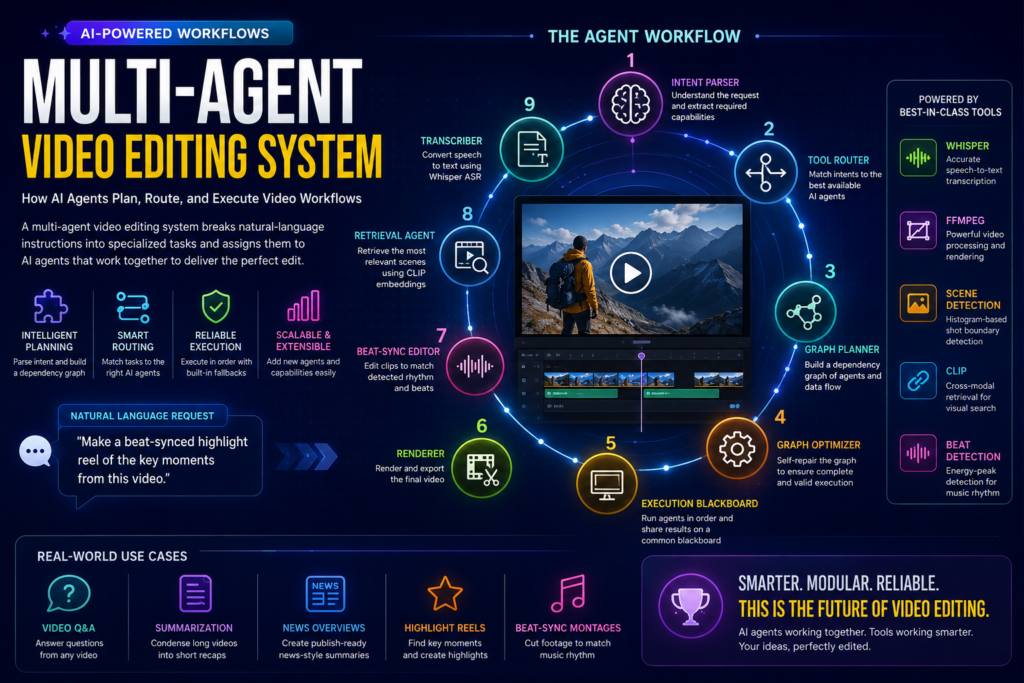
A multi-agent video editing system breaks a natural-language editing request into smaller tasks — transcription, scene detection, retrieval, trimming, rendering — and assigns each task to a specialized AI agent that executes it in the correct order. Instead of one monolithic model trying to “understand and edit” a video in a single pass, the work is decomposed, planned as a graph, and routed to purpose-built tools like Whisper, FFmpeg, and CLIP.
This architecture is becoming the default way developers build practical video AI applications, largely because it mirrors how a human editing team actually works: someone transcribes, someone else finds the right shots, someone else cuts, and someone else renders. A recent open-source reconstruction of the VideoAgent framework makes this pattern concrete, and it’s worth unpacking how each piece fits together — and why this design is likely to become a standard blueprint for agentic media tools.
What Is a Multi-Agent Video Editing System?
Definition: A multi-agent video editing system is an AI architecture in which multiple specialized agents — each responsible for one capability such as transcription, scene detection, or rendering — collaborate through a planned execution graph to fulfill a single natural-language video editing instruction.
Expansion: Rather than asking one large model to output a finished video from a text prompt, the system first interprets intent (what does the user actually want?), then constructs a dependency graph of the agents needed to satisfy that intent, and finally executes that graph in topological order, passing outputs from one agent as inputs to the next. This modularity is what separates a multi-agent video editing system from a single end-to-end model: every stage is inspectable, replaceable, and independently testable.
The practical benefit is reliability. If scene detection fails, you can debug that one agent without touching transcription or rendering. If you want to swap Whisper for another speech-to-text engine, you change one node in the graph — the rest of the multi-agent video editing system stays untouched.
Why Single-Model Video Editing Falls Short
Video editing tasks combine audio processing, visual understanding, temporal reasoning, and file manipulation — domains that no single model handles equally well. A general-purpose multimodal model might describe a video accurately but can’t run FFmpeg trims or align beat timings to a soundtrack.
- Heterogeneous tool requirements: transcription needs ASR, scene detection needs computer vision, rendering needs an encoder — no single model wraps all of these natively.
- Long-horizon dependencies: “make a highlight reel synced to the music” requires rhythm detection before editing, and scene detection before retrieval — an ordering problem, not a generation problem.
- Error localization: when one step fails in an end-to-end model, there’s no way to isolate or repair it. A multi-agent video editing system logs failures per agent.
- Cost and latency control: small, deterministic tools (FFmpeg, histogram-based scene detection) are far cheaper than invoking a large model for every sub-task.
This is exactly the gap that a multi-agent video editing system is designed to close: it treats video editing as an orchestration problem, not a single-shot generation problem.
Core Components of a Multi-Agent Video Editing System
Intent Parser
Question: How does the system know what the user actually wants? Direct answer: An intent parser reads the natural-language instruction and maps it to a fixed set of required capabilities — for example, “question_answering,” “summarization,” “beat_sync_edit,” or “visual_retrieval” — including implicit dependencies the user didn’t state directly (answering a question implicitly requires transcription and audio extraction first).
This step is what turns a vague instruction like “make a fast-cut highlight reel” into a structured requirement set the rest of the system can act on. Well-designed intent parsing in an AI video editing agent should degrade gracefully: if no LLM is available, a deterministic keyword-based parser can still infer reasonable intents from phrases like “beat,” “rhythm,” or “highlight.”
Agent Library
Each agent in the library declares three things: what it needs as input, what it produces as output, and which capability (or “intent”) it covers. A typical agent library for a multi-agent video editing system includes:
| Agent | Inputs | Outputs | Capability |
|---|---|---|---|
| AudioExtractor | video_path | audio_path | audio_extraction |
| Transcriber | audio_path | transcript | transcription |
| SceneDetector | video_path | scenes | scene_detection |
| RetrievalAgent | index, storyboards | retrieved | visual_retrieval |
| BeatSyncEditor | rhythm_points, scenes, video_path | edited_video | beat_sync_edit |
| Renderer | edited_video | final_video | rendering |
Declaring inputs/outputs this explicitly is what makes automated graph planning possible — the planner can trace exactly which agent produces the data another agent needs.
Tool Router
Question: How are agents selected once intents are known? Direct answer: Tool routing matches each required intent to the agent(s) whose declared capabilities cover it, producing a candidate set of agents before any execution graph is built.
Tool routing in AI agents is essentially a lookup step, but it’s an important safeguard: it prevents the planner from considering irrelevant agents and keeps the eventual graph minimal.
Graph Planner
Once candidate agents are selected, a graph planning agent wires them together by matching each agent’s required inputs to another agent’s declared outputs. If Trimmer needs retrieved scenes, the planner links it to whichever agent produces retrieved — in this case, RetrievalAgent. The result is a directed graph where nodes are agents and edges represent data dependencies.
Textual-Gradient Optimizer
Initial graphs are often incomplete — an agent might be selected without its dependencies also being selected. A textual-gradient optimizer repairs this iteratively: it detects uncovered intents or unmet inputs, inserts the missing producer agents, and re-checks the graph until it’s both acyclic (executable) and semantically complete (covers all required intents). This self-repair loop is one of the more novel ideas in modern multi-agent video editing system design — it treats graph construction as an optimization problem with measurable loss terms rather than a one-shot plan.
Execution Blackboard
Finally, the graph runs in topological order, with every agent reading from and writing to a shared blackboard of intermediate results (transcript, scenes, clips, final video). This shared-state pattern keeps the pipeline transparent — you can inspect the blackboard at any point to see exactly what data has been produced so far.
How Intent Parsing Works in Practice
Q: What happens if a user asks a question about a video instead of requesting an edit? A: The intent parser recognizes question-style phrasing and automatically adds transcription and audio_extraction as implicit prerequisites, even though the user never mentioned transcripts — because answering the question requires text to search first.
Q: Can intent parsing work without a large language model? A: Yes. A deterministic fallback using keyword matching (e.g., detecting “summar,” “beat,” or “highlight” in the instruction) can approximate intent parsing when no LLM API key is configured, which keeps a multi-agent video editing system runnable offline or at zero API cost.
Q: Why does intent parsing matter more in a multi-agent video editing system than in a single-model approach? A: Because every downstream agent depends on getting the right set of capabilities selected — an under-specified intent set produces an incomplete graph, while an over-specified one wastes compute running unnecessary agents.
Graph Planning and Textual-Gradient Optimization
Graph planning in a multi-agent video editing system is measured, not assumed. Three metrics typically govern whether a plan is “good enough” to execute:
- τ (tau) — structural validity: is the graph acyclic and topologically sortable?
- κ (kappa) — intent coverage: what fraction of required capabilities does the current agent set actually cover?
- χ (chi) — data-flow compatibility: do the wired edges actually match producer outputs to consumer inputs correctly?
When any of these fall short, the optimizer emits a small set of natural-language “edits” — inserting a missing agent, connecting an unsatisfied input — and reruns the assessment. This loop typically converges within a handful of rounds, at which point the graph is locked in and passed to execution. This measured approach to graph planning is what allows a multi-agent video editing system to self-correct instead of failing silently when a dependency is missing.
Tool Routing: Connecting Agents to Real Tools
Tool routing in AI agents only matters if the agents are backed by real, working tools. In a practical multi-agent video editing system, that typically means:
- FFmpeg for audio extraction, trimming, scaling, concatenation, and final rendering
- Whisper for time-stamped transcription, with graceful fallback to a pre-scripted transcript when the model is unavailable
- Histogram-based scene detection for lightweight shot-boundary detection without a heavy vision model
- CLIP-style embeddings for cross-modal retrieval, matching text storyboard queries to the closest visual scenes
- Energy-peak beat detection for rhythm points used in beat-synced editing
Every one of these tools is deterministic and inspectable, which is a deliberate design choice: a multi-agent video editing system should degrade to rule-based fallbacks rather than fail outright when an ML dependency (like Whisper or a CLIP encoder) isn’t installed.
Traditional Editing Pipeline vs. Multi-Agent Video Editing System
| Aspect | Traditional Scripted Pipeline | Multi-Agent Video Editing System |
|---|---|---|
| Task ordering | Hardcoded, fixed sequence | Dynamically planned from a dependency graph |
| Handling new instructions | Requires new code/scripts | Reroutes existing agents via intent parsing |
| Failure isolation | Often fails silently mid-script | Errors are caught and logged per agent |
| Extensibility | Add new features by editing the pipeline | Add a new agent with declared inputs/outputs |
| Missing dependency handling | Manual debugging | Self-repaired via graph optimization |
| Suitability for natural-language input | Poor — needs pre-defined flags/modes | Native — intent parser maps language to agents |
The comparison makes the value proposition clear: a multi-agent video editing system trades a small amount of upfront architectural complexity for a large gain in flexibility and maintainability, especially as the number of supported editing behaviors grows.
Step-by-Step: Building a Minimal Multi-Agent Video Editing System
If you’re prototyping your own version, the build order matters. Here’s a practical sequence:
- Define your intent vocabulary — a fixed list of capabilities (transcription, scene_detection, rendering, etc.) that every agent and every parsed instruction will reference.
- Build the agent registry — for each agent, declare a description, required inputs, produced outputs, and the capability it satisfies.
- Write the intent parser — start with a deterministic keyword-based version before adding an LLM-based parser, so the system degrades gracefully.
- Implement tool routing — a simple set-intersection between required intents and each agent’s capabilities.
- Implement graph construction — wire agent outputs to the inputs of agents that need them, using their declared names.
- Add the optimizer loop — check for missing intents or unmet inputs, insert producer agents, and repeat until the graph is complete and acyclic.
- Wire in real tools — connect FFmpeg, an ASR engine, and an embedding model, each with a safe fallback path.
- Execute via a shared blackboard — run agents in topological order, writing every output back to a shared state dictionary that subsequent agents read from.
Following this order means you always have a runnable (if minimal) multi-agent video editing system at each step, rather than a large all-or-nothing build.
Real-World Use Cases
A well-built multi-agent video editing system isn’t limited to one editing style. The same architecture supports:
- Video Q&A — answering questions grounded strictly in a transcript, useful for meeting recordings or lecture archives
- Automatic summarization — condensing long-form video into a short recap without manual review
- News-style overviews — rewriting transcript content into a colloquial, publish-ready summary
- Highlight reels — retrieving the most relevant scenes for a topic and assembling them automatically
- Beat-synced montages — cutting footage to match detected rhythm points in a soundtrack, a task that’s difficult to script by hand but well-suited to agent orchestration
Because intent parsing determines which agents run, adding a new use case is often just a matter of adding new phrases to recognize and, if needed, one new terminal agent — not rebuilding the pipeline.
Common Pitfalls and How to Avoid Them
- Skipping implicit dependencies: Forgetting that “answering a question” implicitly requires transcription leads to broken graphs. Always model implicit intents explicitly in the parser.
- No fallback for missing ML models: A multi-agent video editing system that hard-fails when Whisper or CLIP isn’t installed is fragile. Build deterministic fallbacks for every ML-dependent agent.
- Under-specifying agent outputs: If two agents produce differently named outputs for the same logical data, the graph planner can’t wire them together automatically. Standardize naming across the agent library.
- Ignoring cycle detection: Without checking topological sortability, a misconfigured graph can silently loop or deadlock. Always validate acyclicity before execution.
- Treating the optimizer as optional: Skipping the repair loop means malformed graphs reach execution. Even a simple one-pass “insert missing producers” check meaningfully improves reliability.
FAQ
What makes a system “multi-agent” rather than just “multi-step”? A multi-step script follows one hardcoded order. A multi-agent video editing system dynamically decides which steps (agents) are needed and in what order, based on parsed intent — the sequence isn’t fixed in advance.
Do I need a large language model to build one? No. Intent parsing, graph planning, and tool routing in AI agents can all run on deterministic, rule-based logic. An LLM improves flexibility and language understanding but isn’t required for a functional multi-agent video editing system.
How does the system handle a request it wasn’t explicitly designed for? As long as the intent parser can map the instruction to existing capabilities in the agent library, the graph planner will assemble a valid execution path — even for instruction phrasing the developer never anticipated.
Is this architecture only useful for video? No — the same intent-parsing, graph-planning, and tool-routing pattern applies to any domain with heterogeneous tools and ordered dependencies, such as document processing or data analysis pipelines. Video editing is simply a clear, visual example of a multi-agent video editing system in action.
Conclusion
A multi-agent video editing system succeeds where single-model approaches struggle because it treats editing as an orchestration problem: parse intent, route tools, plan a dependency graph, repair that graph automatically, and execute it step by step against real tools like FFmpeg and Whisper. The result is a pipeline that’s debuggable, extensible, and capable of handling natural-language instructions it was never explicitly programmed for. As agentic AI tooling matures, this planner-plus-specialized-agents pattern is likely to become the default blueprint not just for video, but for any workflow that mixes multiple tools, models, and ordered dependencies.