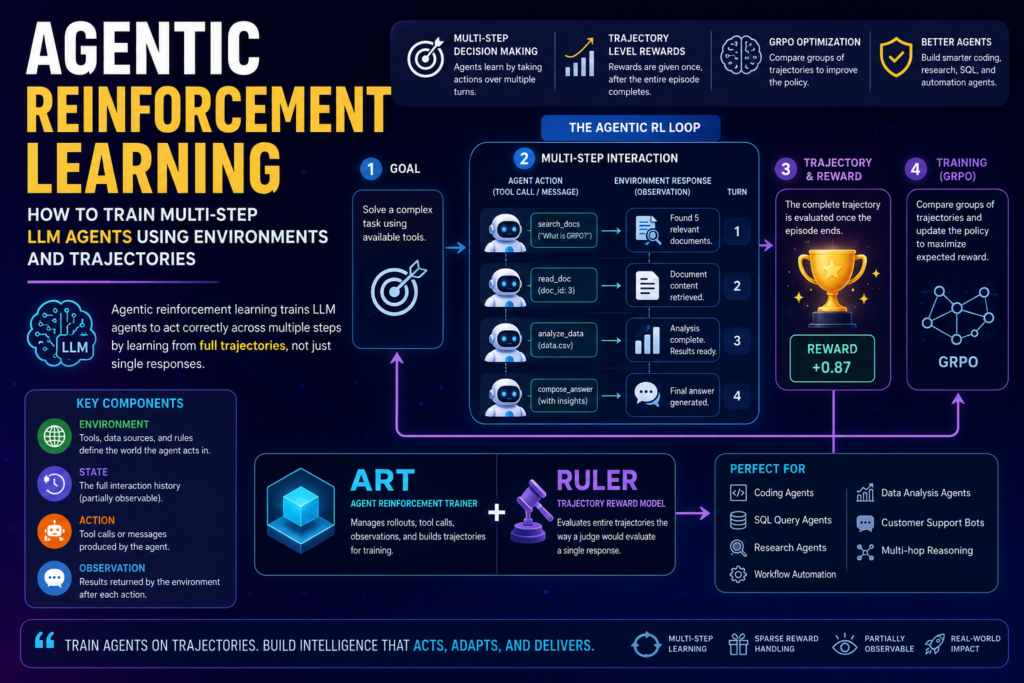
Agentic reinforcement learning is the branch of RL that trains LLM-based agents to act correctly across multiple steps — calling tools, reading results, and adjusting behavior — rather than just producing a single good response. Unlike standard RLHF or RLVR, where the model is judged on one output at a time, agentic reinforcement learning scores an entire multi-step trajectory and updates the policy based on which full sequences of actions led to better outcomes.
If you’ve trained a chatbot with reinforcement learning before, you already understand rewards, policies, and optimization. What changes in agentic reinforcement learning is the unit being optimized: instead of a single completion, you’re now optimizing an entire chain of decisions an agent makes while pursuing a goal. This shift touches everything — how you define the environment, how you structure training data, and how the reward signal reaches the model.
This guide breaks down exactly how agentic reinforcement learning works: what an RL environment looks like for an LLM agent, how trajectories become training data, how the GRPO training objective adapts to multi-step settings, and how frameworks like OpenPipe’s ART (Agent Reinforcement Trainer) with its RULER reward function put this all into practice.
What Is Agentic Reinforcement Learning?
Agentic reinforcement learning (agentic RL) is a training approach where an LLM agent learns a policy by repeatedly acting inside an environment across multiple steps, receiving a reward only after the full episode — or trajectory — concludes.
In traditional RL for language models (like RLHF or RLVR), the setup is simple: one prompt goes in, one completion comes out, and a reward is attached to that single response. Agentic reinforcement learning expands this. An agent receives a goal, takes an action (usually a tool call or a message), observes the result, and repeats this cycle — sometimes for dozens of steps — before arriving at a final answer that gets scored.
This distinction matters because most real-world AI agent use cases (coding assistants, research agents, customer support bots, SQL query agents) don’t produce value from a single output. They produce value from a sequence of correct decisions. Agentic reinforcement learning is what allows these systems to actually improve at that sequence, rather than just getting better at isolated responses.
Why Standard RL Judging Isn’t Enough for Agents
Single-response reward models compare individual completions to each other. But an agent doesn’t produce one completion — it produces a chain of tool calls, observations, and intermediate reasoning steps before reaching a result. Scoring only the final answer while ignoring the path taken to get there leaves two problems unresolved:
- No defined space for the agent to act in. Multi-step agents need tools, a notion of state, and a clear rule for when an episode should end.
- No clear training unit. If an agent acts eight times before finishing, what exactly counts as one training sample?
Agentic reinforcement learning solves both by formalizing the environment the agent operates in and the trajectory as the object being optimized.
The Building Blocks of an Agentic RL Environment
An RL environment for an LLM agent is the world the agent operates in — the source of tool results, state changes, and eventually, reward. To function correctly, an agentic RL environment needs to define a small set of consistent elements the agent can rely on every episode.
State, Action, Observation, and Reward for LLM Agents
Agentic reinforcement learning reuses classic RL vocabulary but maps it onto language-model behavior:
- Action: One model output — typically a tool call or a natural-language message.
- Observation: What comes back after the action, usually a tool result.
- State: Everything the agent has seen so far — for an LLM agent, this is the full interaction history.
- Reward: A score for the episode, which usually arrives only once, at the very end.
An episode under agentic reinforcement learning unfolds as a loop: the agent receives a goal, observes its situation, acts, receives an observation back from the environment, and repeats — until it produces a final answer or hits a turn limit.
Why Agentic RL Is a Partially Observable Problem
A subtlety worth understanding: the agent never sees the environment’s full internal state — only what tools return to it. A SQL agent, for example, sees returned rows, not the underlying database’s complete state. This is what makes agentic reinforcement learning a partially observable Markov decision process (POMDP) rather than a fully observable one. The interaction history becomes the agent’s best available summary of a world it can’t fully see, which is exactly why the “state” in agentic RL is defined as history rather than ground truth.
Trajectories: The Real Training Unit in Agentic RL
A trajectory is the complete record of one agent episode under agentic reinforcement learning — the goal, every action taken, every observation received, and the final answer, all bundled as a single unit that gets scored and trained on.
This is the central shift that separates agentic reinforcement learning from single-turn RL. Instead of scoring a response, you score a trajectory. Instead of comparing completions, GRPO-style optimizers compare groups of trajectories against each other.
The training objective in agentic reinforcement learning is stated over these whole trajectories, with the goal of maximizing the expected reward across all trajectories a policy could generate. In plain terms:
- The policy generates a trajectory by acting in the environment turn by turn.
- A reward function scores that full trajectory once it’s complete.
- Training nudges the policy toward the parameters that produce higher-reward trajectories on average, and away from those that produce lower-reward ones.
This is the same underlying intuition that drives all policy-gradient methods: make good sequences more likely, make bad sequences less likely. What’s different in agentic reinforcement learning is simply the object being judged — a full multi-step trajectory instead of a single response.
Turns vs. Tokens: What’s Actually Being Optimized
It helps to separate two units that are easy to conflate in agentic reinforcement learning:
- Turns are the unit of interaction — one full model output in the episode, which might span hundreds of tokens.
- Tokens are the unit of optimization — the level at which the underlying policy-gradient loss is actually computed.
You can think in terms of turns when reasoning about an agent’s behavior, while the optimizer itself still operates at the token level underneath.
GRPO in Agentic RL: What Changes and What Doesn’t
GRPO (Group Relative Policy Optimization) doesn’t need to change its core mechanics to support agentic reinforcement learning — it just needs a different kind of object flowing into it. In single-turn RL, GRPO normalizes scores across a group of completions. In agentic reinforcement learning, it normalizes scores across a group of full trajectories.
This is a meaningful simplification: agentic reinforcement learning doesn’t require inventing a new optimizer. It requires redefining what gets grouped, scored, and compared — while GRPO’s relative scoring mechanism, which already proved more reliable than absolute scoring in earlier single-turn setups, carries over unchanged.
Training Multi-Step Agents with ART and RULER
Putting agentic reinforcement learning into practice requires tooling that can manage multi-step rollouts, not just single completions. OpenPipe’s ART (Agent Reinforcement Trainer) framework is built for exactly this — it handles the mechanics of running an agent through an environment across multiple turns, collecting the resulting trajectory, and feeding it into the training loop.
Paired with ART is RULER, a reward function designed to score these multi-step trajectories the way a judge model would score a single response in earlier RL setups — but applied to the entire sequence of actions an agent took, not just its final output.
Why This Combination Matters for Agentic RL
- ART manages the rollout mechanics — running the agent, capturing tool calls and observations, and assembling them into a trajectory.
- RULER supplies the reward signal — evaluating full trajectories so that GRPO has something meaningful to optimize against.
- Together, they close the two gaps that single-turn RL setups leave open: where the agent acts, and how multi-step interactions become trainable data.
This combination reflects a broader pattern in agentic reinforcement learning tooling: separate the environment and rollout logic from the reward logic, so either piece can be swapped or improved independently.
Agentic RL vs. Traditional RLHF/RLVR: A Side-by-Side Comparison
| Aspect | Traditional RLHF / RLVR | Agentic Reinforcement Learning |
|---|---|---|
| Training unit | Single response/completion | Full multi-step trajectory |
| Reward timing | Immediately after one output | Once, after the entire episode ends |
| State definition | The prompt itself | Full interaction history (partially observable) |
| Action type | Text generation only | Tool calls, messages, or both |
| Observability | Fully observable | Partially observable (POMDP) |
| Optimizer | GRPO / PPO on completions | GRPO / PPO on grouped trajectories |
| Typical use case | Chatbots, single-turn QA | Coding agents, research agents, SQL agents, task automation |
| Reward source examples | Answer-key verifiers, judge models | Trajectory-level judges (e.g., RULER) |
The core takeaway: agentic reinforcement learning isn’t a different algorithm — it’s the same optimization philosophy applied to a fundamentally larger, sparser, and more structured training unit.
Common Challenges in Agentic RL Training
Anyone implementing agentic reinforcement learning runs into a recurring set of obstacles. Being aware of these ahead of time makes environment design and reward-function choices much easier:
- Sparse rewards: Since the reward typically arrives only at the end of a trajectory, the model gets far less frequent feedback than in single-turn RL.
- Partial observability: The agent can’t see the environment’s true internal state, only what tools choose to return — this can introduce noisy or misleading signals if tool outputs are inconsistent.
- Long-horizon credit assignment: With many turns per trajectory, it’s harder to determine which specific action caused a good or bad outcome.
- Environment design overhead: Defining consistent tools, state transitions, and termination rules for an agentic RL environment takes real engineering effort before any training can begin.
- Reward function reliability: Trajectory-level judges like RULER need to reliably compare full episodes, not just isolated outputs, which is a harder judging task than single-response comparison.
Frequently Asked Questions About Agentic Reinforcement Learning
Q: How is agentic reinforcement learning different from RLHF? A: RLHF typically scores a single model response using human or AI preference judgments. Agentic reinforcement learning scores an entire multi-step trajectory — every action and observation an agent produces before reaching a final answer — and trains the policy on that full sequence.
Q: What is a trajectory in agentic RL? A: A trajectory is the complete record of one agent episode: the initial goal, every action taken, every observation received from the environment, and the final answer, treated as a single scorable unit for training.
Q: Why is agentic RL considered a partially observable problem? A: Because the agent only sees what its tools return to it — not the environment’s actual internal state. This makes the interaction history, rather than ground truth, the effective “state” the policy conditions on.
Q: Does GRPO need to change to support agentic reinforcement learning? A: No. GRPO’s core mechanic — normalizing scores within a group — stays the same. What changes is the object being grouped and scored: full trajectories instead of single completions.
Q: What do ART and RULER do in agentic RL training? A: ART manages the rollout process — running the agent through the environment and assembling the resulting trajectory. RULER scores that trajectory, supplying the reward signal that GRPO uses to update the policy.
Q: What kinds of tasks benefit most from agentic reinforcement learning? A: Tasks requiring multiple dependent steps, such as coding agents, SQL query agents, multi-hop research agents, and workflow automation agents, benefit most, since their success depends on the full sequence of actions, not a single output.
Key Takeaways
- Agentic reinforcement learning trains LLM agents on full multi-step trajectories rather than single responses.
- The environment for agentic RL must define state (interaction history), actions (tool calls or messages), observations (tool results), and a sparse, trajectory-level reward.
- Agentic RL settings are partially observable — the agent never sees the environment’s full internal state.
- GRPO’s optimization mechanics don’t change for agentic reinforcement learning; only the object being scored does — trajectories instead of completions.
- Frameworks like ART handle rollout mechanics, while reward functions like RULER score full trajectories, together closing the gap between single-turn RL and true multi-step agent training.