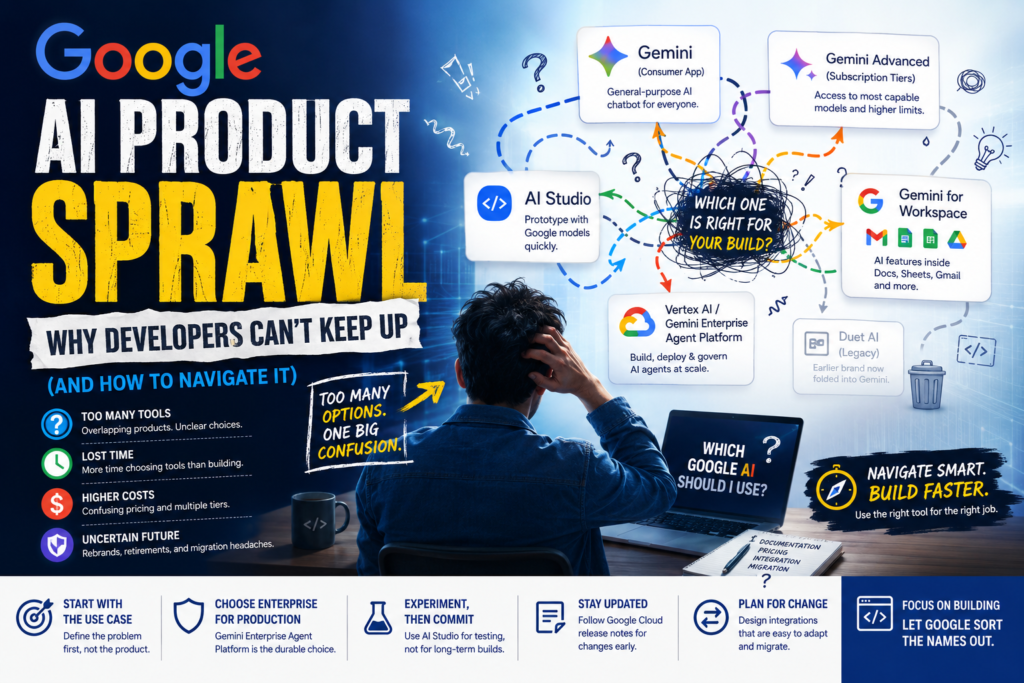
Google AI product sprawl refers to the growing number of overlapping, confusingly branded AI tools — Gemini, AI Studio, Vertex AI, Gemini Enterprise, and the now-retired Duet AI — that Google has shipped without a clear system for choosing between them. The practical result is that developers spend more time figuring out which Google AI product to use than actually building with it, and that confusion has quietly become one of Google’s biggest liabilities in the AI race.
This isn’t a minor branding nitpick. When a company with Google’s engineering depth and infrastructure still leaves developers guessing whether they need Gemini, Gemini Advanced, Vertex AI, or the Gemini Enterprise Agent Platform, it signals a deeper strategic problem: too many teams shipping too many products without a unifying product architecture. Below, we break down why this happened, how it affects developers day to day, how it compares to leaner competitors, and how to make sense of Google’s AI stack in its current state.
What Is Google AI Product Sprawl?
Google AI product sprawl is the pattern of releasing multiple AI products, sub-brands, and pricing tiers that solve similar problems, often without clear boundaries between them. It shows up as duplicate functionality across products, inconsistent naming conventions, and overlapping subscription plans that force users to research before they can even start building.
The expansion happened gradually. What began as a single conversational AI experiment grew into a family of consumer apps, developer platforms, enterprise suites, and embedded assistants scattered across Search, Workspace, Android, and Google Cloud. Each of these arms of the company built and named its own AI tooling somewhat independently, and the cumulative effect is a product map that reads more like an org chart than a coherent user journey. A developer who wants to build an AI feature today has to first answer a non-technical question: which Google product is actually meant for this?
Why Has Google’s AI Portfolio Grown So Complex?
Understanding the roots of Google AI product sprawl helps explain why it’s proven so hard to untangle — and why simply renaming a few products won’t fully solve it.
Google’s Financial Cushion Fuels Experimentation
Google’s advertising, cloud, and search businesses generate enough revenue to insulate its AI division from the pressure of making every single product succeed. That freedom to experiment at scale is something few competitors can match. OpenAI, for example, has quietly shelved high-profile projects like its Atlas browser and paused development on parts of its Sora video model when they didn’t gain traction. Anthropic has taken the opposite approach entirely, staying narrowly focused on a small set of developer-first tools rather than building a sprawling consumer and enterprise portfolio. Google’s financial slack means it doesn’t face the same forcing function to kill underperforming products quickly — so they tend to pile up instead.
Brand Strategy Multiplies Product Names
Large organizations often create sub-brands to target different audiences: consumers, developers, and enterprise buyers. Google has applied this logic aggressively to its AI lineup, resulting in tiered names like Gemini, Gemini Advanced, Gemini for Google Workspace, and Gemini Enterprise — each aimed at a slightly different buyer, but all sharing enough surface-level similarity to blur together. What’s meant to be audience segmentation ends up reading as duplication to anyone outside Google’s internal org chart.
Rapid Technology Evolution Outpaces Naming
AI capabilities are evolving faster than most companies can rationalize their product lines. A tool that starts as a narrow chatbot experiment can expand into an entire family of products within a year as new use cases emerge. Google’s pace of shipping has outrun its pace of consolidating, which is a big part of why Google AI product sprawl keeps growing even as the company publicly acknowledges the problem.
How Google AI Product Sprawl Affects Developers
How does Google’s AI product sprawl actually affect developers day to day? It adds friction before a single line of code gets written — developers have to spend time evaluating overlapping tools, comparing pricing tiers, and guessing which product Google intends to support long-term, instead of building.
This friction shows up in several concrete ways:
- Redundant tooling — Similar capabilities (chat, code generation, agent orchestration) exist across Gemini, AI Studio, and Vertex AI, with no obvious default choice.
- Inconsistent pricing models — Free tiers, subscription tiers, and enterprise licensing coexist for products that solve nearly identical problems, making cost comparisons tedious.
- Unclear longevity signals — Because Google has a well-documented history of discontinuing products, developers hesitate to build on tools that might get folded into another brand within a year.
- Fragmented documentation — Different product teams maintain separate docs, SDKs, and support channels, so switching between tools means relearning conventions instead of reusing knowledge.
- Migration overhead — When Google consolidates or rebrands a product (as it did when Vertex AI’s developer platform became the Gemini Enterprise Agent Platform), developers who built on the earlier name often have to update integrations and retrain internal teams.
The net effect is that Google AI product sprawl functions like a hidden tax on developer time — not because any single product is poorly engineered, but because the decision layer above the products is unclear.
Google vs. OpenAI vs. Anthropic: Comparing AI Product Strategies
One of the clearest ways to understand Google AI product sprawl is to compare it against the far narrower portfolios of its two closest competitors.
| Factor | OpenAI | Anthropic | |
|---|---|---|---|
| Core consumer product | Multiple (Gemini, Gemini Advanced, Assistant legacy) | Single (ChatGPT) | Single (Claude) |
| Developer platform | Vertex AI / Gemini Enterprise Agent Platform, AI Studio | OpenAI API / Platform | Claude API / Claude Platform |
| Enterprise offering | Gemini for Workspace, Gemini Enterprise | ChatGPT Enterprise | Claude for Enterprise |
| Product naming consistency | Low — multiple overlapping sub-brands | Moderate — mostly unified under one name | High — consistently branded around Claude |
| Financial pressure to consolidate | Low, due to diversified revenue | Higher, given narrower revenue base | Highest, given tight focus on developer tooling |
| History of discontinued AI products | Extensive | Some (e.g., paused browser and video projects) | Minimal, by design |
This comparison isn’t about which company has the strongest underlying models — it’s about product architecture. Google’s diversified business gives it room to run more experiments simultaneously, but that same freedom is what produces Google AI product sprawl in the first place. A company with fewer product bets, like Anthropic, has less to untangle because it never let the portfolio expand that far.
Mapping Google’s Key AI Products Today
To make Google’s current AI lineup easier to navigate, here’s a framed breakdown of the major products developers are likely to encounter, and what each one is generally intended for:
- Gemini (consumer app) — Google’s general-purpose AI chatbot for everyday consumer use, roughly comparable to ChatGPT.
- Gemini Advanced / subscription tiers — Paid access to more capable model versions and expanded usage limits within the consumer app.
- AI Studio — A lighter-weight interface aimed at developers who want to prototype with Google’s models without committing to the full Cloud stack, though it has historically mixed consumer and developer use cases in ways that add confusion.
- Vertex AI / Gemini Enterprise Agent Platform — Google Cloud’s enterprise-grade developer platform for building, deploying, and governing AI applications and agents at scale.
- Gemini for Google Workspace — AI features embedded directly into Docs, Sheets, Gmail, and other Workspace apps for productivity use cases.
- Duet AI (legacy) — An earlier developer- and Workspace-focused AI brand that has since been folded into the broader Gemini naming convention.
Each of these products has a legitimate reason to exist. The issue isn’t that any individual tool is redundant on paper — it’s that Google hasn’t made the decision tree between them obvious to someone approaching the ecosystem from the outside.
Is Google Trying to Fix Its AI Product Sprawl?
Is Google actively working to reduce its AI product sprawl? Yes — Google has begun consolidating its enterprise AI tooling, most notably by rebranding and expanding Vertex AI’s developer platform into the Gemini Enterprise Agent Platform, a move aimed at giving businesses a single system for building, deploying, and governing AI agents rather than juggling separate tools for each stage.
Google Cloud leadership has framed this shift as a response to how enterprise AI usage itself is changing: companies are moving from building individual AI agents to managing hundreds or thousands of them at once, which requires a more unified platform rather than a patchwork of point solutions. That’s a meaningful step toward addressing Google AI product sprawl at the enterprise layer, though it doesn’t yet resolve the parallel confusion on the consumer and prosumer side, where Gemini, Gemini Advanced, and AI Studio still overlap in ways that aren’t fully reconciled.
Whether this consolidation trend continues across the rest of Google’s AI portfolio — or whether new sub-brands emerge to replace the ones being retired — remains an open question. Google’s own history of launching and later discontinuing consumer products, from messaging apps to earlier AI assistants, suggests that Google AI product sprawl is likely to keep evolving rather than disappearing outright.
How Developers Can Navigate Google’s AI Product Sprawl
Until Google fully consolidates its AI portfolio, developers can reduce the friction of Google AI product sprawl with a few practical habits:
- Start from the use case, not the brand name. Decide whether you need a consumer-facing chatbot, a Workspace productivity feature, or an enterprise agent platform before comparing specific product names.
- Default to the enterprise-grade platform for production work. For anything customer-facing or business-critical, the Gemini Enterprise Agent Platform (formerly Vertex AI’s developer platform) is generally the more durable choice than lighter prototyping tools.
- Treat AI Studio as a sandbox, not a production dependency. It’s useful for quick experimentation, but its mixed consumer/developer positioning makes it a riskier long-term foundation.
- Track Google Cloud’s release notes, not just product pages. Because rebrands happen with some regularity, release notes tend to surface consolidation changes before marketing pages catch up.
- Budget migration time into any Google AI integration. Given the company’s track record, assume product names and feature boundaries may shift, and design integrations that are easier to swap out later.
Following this approach won’t eliminate Google AI product sprawl, but it does insulate a development team from the worst of the churn while Google continues sorting out its own internal product strategy.
Frequently Asked Questions
What is the main cause of Google AI product sprawl? The main cause is a combination of Google’s financial ability to fund many parallel AI experiments and its tendency to create sub-brands for different audiences, which together produce overlapping products without a clear decision hierarchy for users.
Is Google AI product sprawl unique to AI, or has Google done this before? It’s not unique. Google has a long-documented history of launching and later discontinuing overlapping products in messaging, video, and productivity software, and its AI lineup is following a similar pattern at a faster pace.
Should developers avoid building on Google’s AI platforms because of this confusion? Not necessarily. The underlying models and infrastructure are competitive, but developers should choose enterprise-grade platforms like the Gemini Enterprise Agent Platform for production work and stay alert to naming and consolidation changes over time.
How does Google’s AI product sprawl compare to OpenAI and Anthropic? Both OpenAI and Anthropic maintain far narrower product portfolios — largely a single consumer product and a single developer platform each — which reduces the kind of overlapping, redundant tooling that characterizes Google’s AI lineup.
Key Takeaways
Google AI product sprawl is less a technology problem than a product architecture problem: Google has the models, the infrastructure, and the financial runway to compete at the highest level, but its overlapping product names and inconsistent tiers make it harder for developers to know where to start. Google’s recent move to consolidate its enterprise tooling into the Gemini Enterprise Agent Platform shows the company is aware of the issue and starting to address it, but until the rest of the portfolio follows suit, developers are best served by choosing use-case-appropriate tools, favoring the enterprise platform for production work, and building integrations that can adapt as Google continues to reorganize its AI lineup.