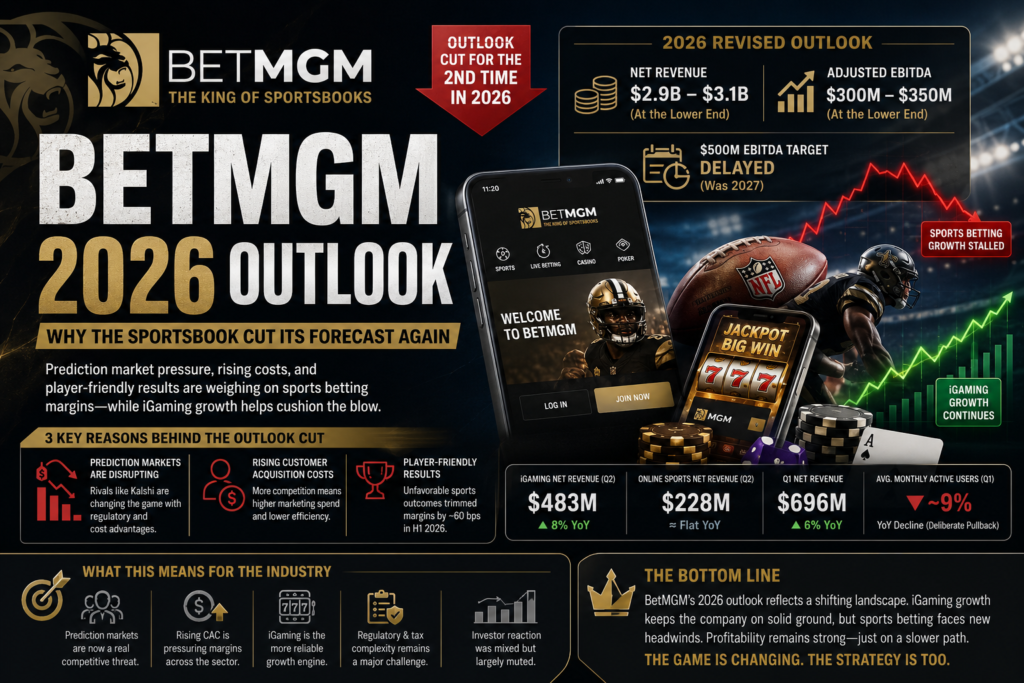
BetMGM lowered its BetMGM 2026 outlook for the second time this year, now guiding toward the low end of its $2.9 billion–$3.1 billion revenue range and pushing back its $500 million profit target. The culprit: prediction-market rivals like Kalshi, rising customer acquisition costs, and a run of player-friendly sports results that squeezed margins.
If you’re trying to understand what changed, why it changed, and what it signals for the broader online betting industry, this breakdown covers all of it — from the numbers themselves to what they mean for competitors, investors, and bettors.
What Happened: BetMGM Cuts Its 2026 Outlook Again
On July 28, 2026, BetMGM — the joint venture between Entain and MGM Resorts — confirmed that full-year net revenue and adjusted core profit will land near the bottom of its existing guidance bands. The company had already trimmed its full-year revenue range from $3.1–$3.2 billion down to $2.9–$3.1 billion earlier in the year. This latest update doesn’t cut the range further, but it does confirm that results will track toward the lower end of that already-reduced band.
Definition: A BetMGM 2026 outlook downgrade means the company now expects to generate less revenue and profit than it originally projected for the calendar year, based on year-to-date performance and updated expectations for the second half.
Expansion: This isn’t just a paper adjustment. It reflects real competitive and operational pressure — new entrants changing the customer acquisition math, bettors winning more than the house typically expects, and a $500 million adjusted EBITDA target for 2027 that BetMGM no longer expects to hit on schedule.
Q2 and First-Half 2026 Performance
BetMGM’s second-quarter business update, released the same day, showed continued growth but at a slower pace than the company had hoped for:
- iGaming net revenue reached $483 million, up 8% year-over-year
- Online sports net revenue came in at $228 million, roughly flat compared to the prior year
- The company reiterated it remains “on track” to deliver full-year guidance — just at the lower end of the range
That combination — strong iGaming, stalled sports betting — is the core story behind the revised BetMGM 2026 outlook.
Why BetMGM Lowered Its 2026 Outlook
Three forces are converging on BetMGM’s sports betting business at once, and each one independently would pressure margins. Together, they explain why the company issued its second downgrade of the year.
1. Prediction Markets Are Reshaping the Competitive Landscape
Question: What are prediction markets, and why are they hurting sportsbooks?
Direct answer: Prediction markets, such as Kalshi, let users trade on the outcome of events — including sports — through a regulatory structure that positions them as financial exchanges rather than gambling products. That framing has allowed them to expand quickly in states where traditional sports betting is restricted or heavily taxed, and it’s forced established operators like FanDuel, DraftKings, and Fanatics to launch competing prediction-style products of their own.
For BetMGM, this shift matters in two ways. First, it adds new venues competing for the same bettor attention and marketing dollars, which pushes up the cost of acquiring each customer. Second, prediction markets sidestep some of the licensing and tax structures that traditional sportsbooks operate under, giving them a structural cost advantage in certain markets. Executives at the company have explicitly named this competitive dynamic as a factor behind the revised BetMGM 2026 outlook and the delayed profit target.
2. Player-Friendly Results Squeezed Sportsbook Margins
Sportsbooks are built around a statistical edge — the house expects to keep a certain percentage of every dollar wagered over time. When favorites win more often than the models predict, or bettors land on high-value parlays and outcomes at an unusually high rate, that edge shrinks temporarily. That’s what happened for BetMGM in the first half of 2026.
Company leadership described the pattern as unfavorable results that dragged on sports betting margin by roughly 60 basis points, spread fairly evenly across the first and second halves of the year rather than concentrated in a single bad month. This is a normal, cyclical risk in the sports betting business — it isn’t a structural problem the way rising competition is — but it still shows up directly in the numbers behind the BetMGM 2026 outlook.
3. Customer Acquisition Costs Are Climbing
Definition + Expansion: Customer acquisition cost (CAC) is what a sportsbook spends — in promotions, advertising, and bonuses — to convert a new user into an active, wagering customer. As more operators compete for the same pool of bettors, and as prediction-market platforms enter the fight for attention, CAC rises across the board. BetMGM has responded by pulling back on less-efficient online sports betting marketing and reallocating that spend toward higher-return channels, including its faster-growing iGaming segment.
That reallocation is a deliberate strategic choice, not just a defensive one — but it also means online sports betting growth will likely stay muted in the near term, which is baked into the current BetMGM 2026 outlook.
BetMGM 2026 Outlook: Old vs. Revised Guidance
The table below lays out how BetMGM’s targets have shifted over the course of 2026.
| Metric | Original 2026 Guidance | Revised 2026 Guidance | Change |
|---|---|---|---|
| Full-Year Net Revenue | $3.1B – $3.2B | $2.9B – $3.1B | Lowered |
| Adjusted EBITDA | $300M – $350M | $300M – $350M | Range unchanged, expected at low end |
| Q1 Net Revenue | — | $696M (+6% YoY) | Actual result |
| Q2 iGaming Net Revenue | — | $483M (+8% YoY) | Actual result |
| Q2 Online Sports Net Revenue | — | $228M (flat YoY) | Actual result |
| $500M EBITDA Target | 2027 | Delayed | Pushed back |
| Average Monthly Active Users (Q1) | — | Down ~9% YoY | Deliberate pullback |
This side-by-side view is the clearest way to understand the BetMGM 2026 outlook: the revenue ceiling came down once, the profit range stayed intact but shifted toward its floor, and the long-term profitability milestone slipped to a later date.
How BetMGM’s iGaming Business Is Offsetting Sports Betting Weakness
While online sports betting has stalled, BetMGM’s iGaming division — online casino games like slots and table games — continues to outperform. iGaming revenue grew 9% year-over-year in the first quarter and 8% in the second, consistently outpacing sports betting growth throughout 2026.
Question: Why is iGaming growing faster than sports betting for BetMGM?
Direct answer: iGaming revenue is driven by higher net gaming revenue per active player, exclusive content partnerships, and new market launches — including a July 2026 debut in Alberta — none of which carry the same exposure to unpredictable sports outcomes or the intensifying prediction-market competition that’s weighing on the sportsbook side of the business.
Because iGaming is a larger and steadier contributor to the mix, it’s cushioning the overall BetMGM 2026 outlook even as online sports betting treads water. Momentum from the Borgata brand refresh and a strong 2026 World Cup betting period are also expected to help second-half performance, according to the company’s own guidance commentary.
What This Means for the Broader Sports Betting Industry
BetMGM isn’t operating in isolation, and its guidance cut is a useful signal for anyone tracking the health of the U.S. online gambling market as a whole.
Key takeaways for the industry:
- Prediction markets are now a real competitive category, not a niche experiment — traditional operators are already building rival products in response.
- Customer acquisition costs are rising industry-wide, which squeezes margins for every sportsbook, not just BetMGM.
- iGaming is increasingly the more reliable growth engine compared to online sports betting, a pattern likely to influence how competitors allocate marketing budgets.
- Regulatory and tax complexity across states continues to add cost and uncertainty for licensed operators, a pressure prediction-market platforms are currently less exposed to.
- Investor reactions were mixed but muted — Entain shares dipped before recovering, while MGM Resorts traded slightly lower, suggesting the market had partly priced in a cautious guidance update.
For competitors like FanDuel, DraftKings, and Fanatics, the BetMGM 2026 outlook is effectively an early warning: the same prediction-market pressure and rising CAC trends are industry-wide, not company-specific.
Frequently Asked Questions About BetMGM’s 2026 Outlook
Did BetMGM cut its full-year revenue guidance again?
No — the $2.9 billion to $3.1 billion revenue range from the earlier cut stayed the same. What changed in this update is that BetMGM now expects results to land near the bottom of that range rather than the middle or top.
Why did BetMGM delay its $500 million profit target?
BetMGM pushed back its goal of reaching $500 million in adjusted EBITDA by 2027, citing intensifying competition — particularly from prediction-market platforms — along with added regulatory complexity across the states where it operates.
Is BetMGM still profitable despite the lower 2026 outlook?
Yes. Adjusted EBITDA guidance of $300 million to $350 million remains intact, and the company continues to generate positive cash flow. The revised BetMGM 2026 outlook reflects slower growth, not a loss-making business.
How are prediction markets like Kalshi affecting sportsbooks?
Prediction markets compete for the same bettor attention as sportsbooks but often operate under a different regulatory structure, which can give them a cost advantage. This has pushed traditional operators, including BetMGM, to raise marketing spend and, in some cases, launch competing prediction-style products.
What is driving BetMGM’s iGaming growth?
Higher net gaming revenue per active player, exclusive content deals, and new market launches — such as the July 2026 entry into Alberta — are the main drivers, alongside a brand refresh at BetMGM’s Borgata property.
The Bottom Line
The revised BetMGM 2026 outlook tells a two-part story: a resilient, growing iGaming business offset by a sports betting segment under real competitive pressure from prediction markets, rising acquisition costs, and a stretch of player-friendly results. None of this threatens BetMGM’s core profitability — EBITDA guidance is intact — but it does mark a clear shift in how much growth investors should expect from online sports betting specifically, both from BetMGM and likely from its closest competitors, over the rest of 2026.