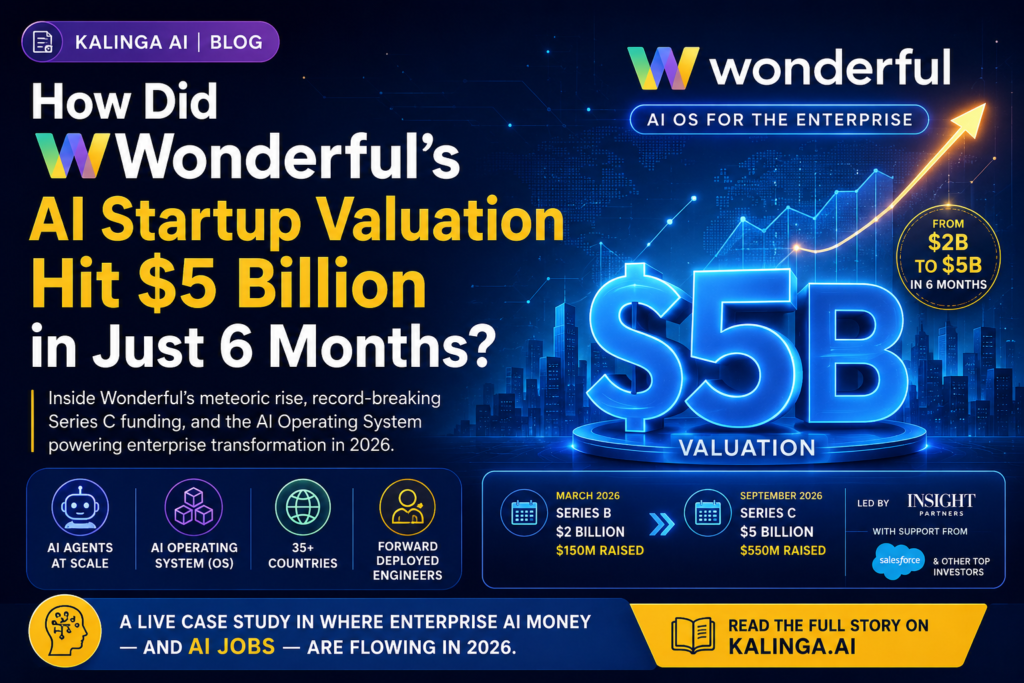
Imagine your company was worth $2 billion in March, and by September, without a single acquisition or IPO, it’s worth $5 billion. That’s not a hypothetical; it’s exactly what happened to Wonderful, an Israeli-Dutch enterprise AI startup that just closed a $550 million Series C funding round, pushing its Wonderful AI valuation to $5 billion in under six months. The short answer: investor demand for “AI Operating System” platforms, tools that connect AI agents to a company’s real workflows and data, is currently outpacing almost every other category in enterprise tech, and Wonderful has positioned itself right at the center of that demand.
For students, freshers, and young professionals in Odisha and across India watching the AI job market evolve, this story is worth more than a passing scroll. It’s a live case study in where enterprise AI money, and enterprise AI jobs, are actually flowing in 2026.
What Is Wonderful AI and Why Is Everyone Talking About It?
Wonderful is an enterprise AI company founded in early 2025 that builds software to help large organizations deploy and manage AI agents across their operations. Wonderful started out building a customer service AI agent platform, custom-built for non-English-speaking markets, and grew fast enough that it now operates in more than 35 countries.
The reason Wonderful keeps making headlines isn’t just its product, it’s the speed of its rise. Most enterprise software startups take years to reach unicorn status. Wonderful went from a $2 billion valuation in March 2026 to a $5 billion valuation by September 2026, a jump investors and journalists alike are calling one of the fastest scale-ups in enterprise AI this year.
Why does this matter to you? Because Wonderful’s growth is a direct signal of where enterprise budgets, and hiring, are headed: not toward “chatbots,” but toward AI systems embedded deep inside how companies actually operate.
Wonderful’s Funding Timeline: From $2B to $5B in Six Months
To understand how unusual this Wonderful AI valuation jump is, it helps to lay out the timeline plainly.
| Milestone | Date | Valuation | Round Size | Lead Investor |
| Series B | March 2026 | $2 billion | $150 million | Insight Partners |
| Series C | September 2026 | $5 billion | $550 million | Insight Partners |
Insight Partners led both rounds, with existing backers Index Ventures, IVP, Vine Ventures, 9Yards, and Bessemer Venture Partners all returning to participate again in the Series C. Notably, Salesforce joined as an investor in this round for the first time, a signal that established enterprise software giants see Wonderful less as a competitor and more as infrastructure worth backing.
That’s a 2.5x valuation increase in roughly six months, on top of a round that was already more than triple the size of its previous raise ($550 million versus $150 million). Very few enterprise AI companies have matched that pace this year.
What Is the “Wonderful AI OS” and How Does It Work?
Wonderful AI OS is the company’s core platform, an “AI operating system” designed to coordinate AI agents, workflows, and applications with a company’s existing data, tools, and integrations, working across any AI model rather than locking customers into one. Think of it less like a single AI chatbot and more like the control layer that lets dozens of different AI agents and tools talk to each other and to a company’s existing software stack.
This is a meaningful shift from where Wonderful started. The company’s original product was a customer service AI agent, useful, but narrow. The Wonderful AI OS broadens that into something enterprises can build on long-term, rather than a point solution they might outgrow.
Why did Wonderful pivot from customer service AI to a full AI operating system? Because enterprise customers increasingly want one coordinating layer for all their AI tools, not a separate vendor for every function, and platforms that offer that flexibility currently attract far more investor and customer interest than single-purpose AI products.
Wonderful CTO and co-founder Roey Lalazar explained the philosophy behind this design: customers can adopt whichever parts of the platform fit their needs, integrate them with what they already have, choose the best underlying model for each task, and keep ownership of everything they build on top of it.
Why Forward Deployed Engineers Are Central to Wonderful’s Strategy
Forward Deployed Engineer (FDE) is a technical role where an engineer embeds directly inside a client company, sometimes physically on-site, to build, customize, and deploy AI or software systems tailored to that business’s specific workflows. Rather than shipping generic software and walking away, an FDE stays hands-on through implementation, troubleshooting, and adoption, closer to a specialist consultant than a typical product engineer.
Wonderful has leaned on forward deployed engineers since its earliest days, using them to embed its AI technology directly into client systems and workflows. This is exactly the strategy the company plans to double down on with its new funding: expanding its FDE teams is one of the three explicit uses it named for the $550 million raise, alongside faster product development and meeting rising customer demand.
Is demand for forward deployed engineers actually growing, or is this just Wonderful’s strategy? It’s an industry-wide trend, not just a Wonderful bet. Executive search firm Christian & Timbers projects demand for FDEs to surge by 2,100% by the end of 2026, and the firm’s research suggests only around 2,000 engineers in the entire United States currently have the specific mix of sector knowledge and applied AI experience to reliably deliver measurable ROI on enterprise AI projects, even though tens of thousands of people already hold FDE-type job titles.
That gap between “people with the job title” and “people who can actually deliver results” is exactly why companies like Wonderful are racing to build and expand FDE teams rather than just hiring more generic software engineers.
Who Is Investing in Wonderful, and Why Does It Matter?
The investor lineup in Wonderful’s Series C tells its own story about how seriously the market is treating this company:
- Insight Partners, returned to lead the round for the second consecutive raise, having also led the March 2026 Series B.
- Index Ventures, IVP, Vine Ventures, 9Yards, and Bessemer Venture Partners, all existing investors who chose to participate again rather than sit this round out.
- Salesforce, investing in Wonderful for the first time, a notable move given Salesforce’s own enterprise AI ambitions with its Agentforce platform.
A repeat lead investor plus a first-time strategic investor like Salesforce is generally read by the startup world as a strong confidence signal, it suggests both financial investors and an established enterprise software player see long-term staying power in what Wonderful is building, not just short-term hype.
Wonderful vs. Other Enterprise AI Deployment Approaches
Enterprises adopting AI generally choose between a few different models for getting it implemented. Here’s how Wonderful’s approach compares to the alternatives:
| Approach | How It Works | Best For | Trade-off |
| Wonderful AI OS + FDEs | Platform connects agents/workflows to existing data; engineers embed on-site to implement | Enterprises wanting a flexible, model-agnostic AI layer | Requires ongoing platform + FDE relationship |
| Traditional SaaS AI tools | Off-the-shelf software with limited customization | Smaller teams, simple use cases | Less tailored to complex, legacy systems |
| In-house AI teams | Company hires its own engineers to build everything internally | Large enterprises with big tech budgets | Slow to build; talent (like FDEs) is scarce and expensive |
| General IT consulting firms | Broad consultants advise on AI strategy without deep embedded implementation | Early-stage AI strategy and planning | Often lacks the hands-on technical depth of a dedicated FDE |
The common thread across the industry right now, one Wonderful has bet its entire growth strategy on, is that advice alone doesn’t satisfy enterprise clients anymore; they want hands-on, embedded technical execution that produces measurable results.
What This Means for AI Careers in India
For readers in Odisha and elsewhere in India tracking where AI hiring is headed, Wonderful’s growth (and the broader FDE hiring wave behind it) points toward a few concrete skills worth building now:
- Systems integration skills, understanding how to connect AI models to real business tools (CRMs, databases, internal software), not just prompt-engineering in isolation.
- Client-facing technical communication, FDE roles blend engineering with consulting, so being able to explain technical decisions to non-technical stakeholders is a genuine differentiator.
- Cross-model fluency, platforms like Wonderful AI OS are explicitly designed to work with multiple AI models, so familiarity with more than one major LLM ecosystem is increasingly valuable.
- Domain expertise in a specific industry, the Christian & Timbers research specifically flags “sector know-how” as one of the rarest and most valuable traits among top-tier FDEs, alongside hands-on applied AI experience.
- Production-level AI deployment experience, moving a model from a demo into a live business workflow is a different skill set than building the model itself, and it’s the one currently in short supply.
Given that only an estimated 2,000 engineers in the U.S. currently meet the bar for “elite” FDE-level delivery, there’s a real opportunity for early-career professionals globally, including in India’s growing tech hubs, to build toward this skill set before the market gets crowded.
FAQ
What is Wonderful’s current valuation?
Wonderful is currently valued at $5 billion, following a $550 million Series C funding round announced in September 2026.
How much funding has Wonderful raised in total recently?
Wonderful raised $150 million in its March 2026 Series B (at a $2 billion valuation) and $550 million in its September 2026 Series C (at a $5 billion valuation), a combined $700 million across the two most recent rounds.
What does Wonderful actually build?
Wonderful builds an enterprise AI platform called Wonderful AI OS, which coordinates AI agents, workflows, and applications with a company’s existing data and systems, working across multiple AI models. It originally built customer service AI agents before expanding into this broader platform.
Who led Wonderful’s Series C funding round?
Insight Partners led the round, with Index Ventures, IVP, Vine Ventures, 9Yards, and Bessemer Venture Partners returning as investors. Salesforce invested in Wonderful for the first time in this round.
What is a forward deployed engineer, and why does it matter for this story?
A forward deployed engineer (FDE) is a technical specialist who embeds inside a client company to build and deploy AI systems tailored to that business. Wonderful plans to use part of its new funding specifically to expand its FDE teams, reflecting an industry-wide surge in demand for this role.
Is Wonderful the same as Wonderful AI OS?
Wonderful is the company; Wonderful AI OS is the name of its core platform product, which the company has positioned as an “AI operating system” for enterprises.
Ready to Build These Skills Yourself?
Stories like Wonderful’s $5 billion rise aren’t just funding news, they’re a preview of the AI implementation skills enterprises will pay for next. If you’re a student or young professional in Odisha looking to build practical, job-ready AI skills, explore Kalinga.ai’s hands-on AI training and workshops to get started.