What is happening with Tata Chemicals Kenya operations?
When a major industrial operation faces a government-ordered suspension, the next question is simple: what happens now? Tata Chemicals is trying to answer that question through a new joint technical review process with the Kenyan government.
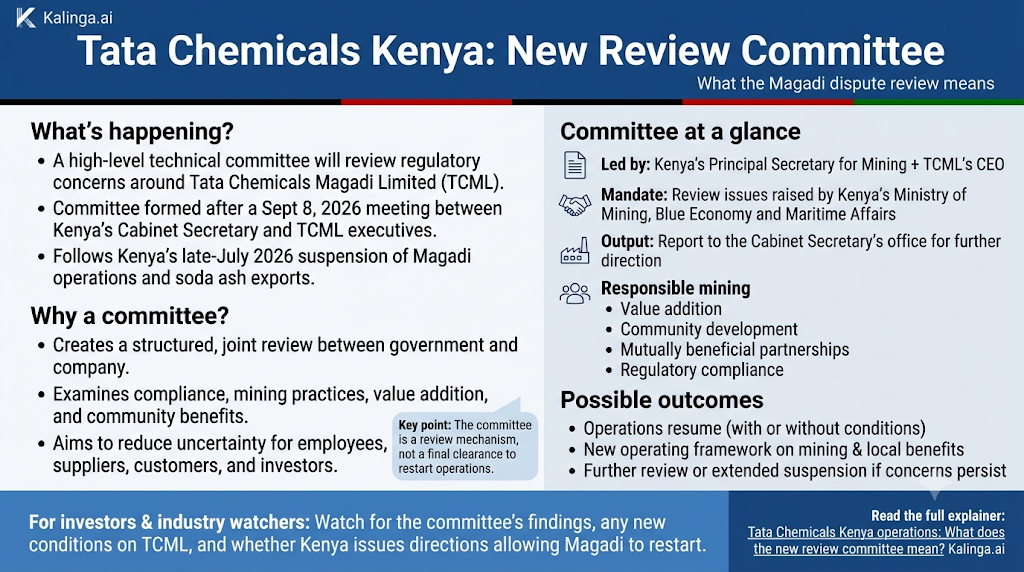
Tata Chemicals has announced that a high-level technical committee will be established with Kenyan authorities to review regulatory concerns involving its subsidiary, Tata Chemicals Magadi Limited (TCML). The committee will examine issues raised by Kenya’s Ministry of Mining, Blue Economy and Maritime Affairs and submit its findings to the office of the Cabinet Secretary.
The development could become an important step toward resolving the dispute that previously resulted in the suspension of TCML’s operations and a halt to soda ash exports from its Magadi facility.
The announcement followed a meeting on September 8, 2026, between Kenya’s Cabinet Secretary and TCML executives, which Tata Chemicals described as a “fruitful engagement.”
In other words, the situation has moved from a direct regulatory confrontation toward a structured review involving both sides.
Why has Tata Chemicals set up a high-level committee?
The immediate purpose of the committee is to create a formal mechanism for Kenya and Tata Chemicals to examine the regulatory concerns surrounding TCML.
Rather than relying only on individual discussions between government officials and company executives, the proposed committee will conduct a detailed technical review and prepare a report for further consideration.
What will the technical committee review?
The committee will review the issues raised by Kenya’s Ministry of Mining, Blue Economy and Maritime Affairs.
According to Tata Chemicals, the committee is also expected to work toward establishing a framework covering:
- Responsible mining practices
- Value addition
- Community development
- Mutually beneficial partnerships
- Regulatory concerns related to TCML’s operations
The objective is therefore broader than simply deciding whether the factory should restart.
The discussions could also determine how Tata Chemicals’ Kenyan business can operate in a way that addresses government expectations around economic and community benefits.
Who will lead the committee?
The committee will be jointly led by Kenya’s Principal Secretary for Mining and TCML’s chief executive officer.
That joint leadership is significant because it puts government representatives and the company’s local operating leadership into the same review mechanism.
The committee will eventually submit its report to the office of the Cabinet Secretary, who will consider the findings and provide further direction.
Question: Does the committee mean Tata Chemicals’ operations have already been cleared to resume?
No. The committee represents a review and engagement process, not an announced final clearance to restart operations. The Kenyan government will consider the committee’s findings before further directions are issued.
Why did Kenya suspend Tata Chemicals’ operations?
The current committee process follows a regulatory dispute that escalated during 2026.
Kenyan authorities had raised concerns about TCML’s operations and the benefits generated for Kenya. The dispute became more serious after Kenyan President William Ruto said he had ordered Tata Chemicals to stop its operations in the country.
Ruto argued that the company’s presence had not adequately benefited Kenya and said the government planned to bring in two companies to take over the operations.
In late July 2026, the Kenyan government ordered TCML to suspend operations at the Magadi Soda factory and also halted exports of soda ash.
That decision put the future of Tata Chemicals’ Kenyan business under considerable uncertainty.
However, Tata Chemicals maintained that it had complied with applicable regulatory requirements and continued engaging with Kenyan authorities.
What is Tata Chemicals Magadi?
Tata Chemicals Magadi is Tata Chemicals’ Kenyan subsidiary that operates the Magadi soda ash business.
Soda ash, also known as sodium carbonate, is an industrial chemical used in several manufacturing applications. Because it is an industrial input rather than a consumer product that people typically encounter directly, disruptions to its production can have consequences across industrial supply chains.
Tata Chemicals acquired the Magadi plant in 2005. The company has described the business as an integral part of its operations.
The facility is therefore not a new or experimental investment for Tata Chemicals. It represents a long-standing part of the company’s international business portfolio.
Why is soda ash important?
Soda ash has applications across industries such as glass manufacturing and chemical production. Its industrial importance means that a prolonged disruption can affect not only the producer but also customers and supply chains dependent on the material.
For Tata Chemicals, the Magadi operation also represents an established international asset with a long operating history.
That makes the current dispute more significant than a temporary disagreement over a single regulatory filing.
What regulatory issues are being reviewed?
The exact details of every regulatory concern have not been publicly resolved through the committee announcement. What is clear is that Kenya’s Ministry of Mining, Blue Economy and Maritime Affairs has raised issues that it wants TCML to address.
Tata Chemicals has previously stated that TCML submitted the required information, reports and documentation to the Kenyan government on August 11, 2026.
The company said it was fully compliant with applicable regulatory requirements and was awaiting the ministry’s review of those submissions and further directions.
The new committee could therefore provide a structured way to examine those submissions alongside the government’s concerns.
Definition + Expansion
Regulatory review is a formal examination by government authorities to determine whether an organisation’s activities comply with applicable laws, rules, permits and regulatory expectations.
In the Tata Chemicals case, the review is particularly important because the dispute involves an operating industrial facility and government expectations around mining, value creation and community development. A technical committee gives both sides a mechanism to examine these issues in detail before a final direction is made.
How could the committee help resolve the Tata Chemicals Kenya dispute?
A dispute involving a multinational company and a national government can become difficult when economic, regulatory and political considerations overlap.
A technical committee can help separate those issues and create a process for evidence-based discussions.
For Tata Chemicals, the committee provides an opportunity to explain its compliance position and address the concerns raised by Kenyan authorities.
For Kenya, the process provides a way to evaluate whether the Magadi operation meets the government’s expectations for responsible resource development and economic participation.
Question: Why is a joint technical review useful?
Because it gives both parties a structured forum to examine the same issues before a final decision is made. Instead of relying solely on public statements, the committee can review documentation, technical matters and regulatory concerns and then submit its conclusions to the relevant government authority.
The approach could also reduce uncertainty for employees, suppliers, customers and other stakeholders connected to the Magadi operation.
What are the possible outcomes for Tata Chemicals?
The committee’s findings could influence the next stage of Tata Chemicals’ Kenya operations, but the final outcome cannot yet be assumed.
Several broad possibilities exist.
| Possible outcome | What it could mean |
| Operations resume | TCML could potentially restart activities after regulatory concerns are addressed and government approval is provided |
| Operations resume with conditions | Kenya could require additional compliance measures, reporting or commitments |
| Further review | Authorities could seek more information before making a final decision |
| Restructured operating framework | Tata Chemicals and Kenya could establish new arrangements around mining, value addition or community development |
| Continued suspension | If concerns remain unresolved, restrictions could continue |
These are potential scenarios, not announced decisions.
The committee’s report and the Kenyan government’s subsequent direction will be important in determining which path emerges.
Why responsible mining and community benefits matter
One of the most important aspects of the latest development is that the proposed committee is not focused only on regulatory compliance.
Tata Chemicals said the committee will also work toward a sustainable framework involving responsible mining, value addition, community development and mutually beneficial partnerships.
That language reflects a broader issue facing mining and natural-resource businesses around the world.
A company may comply with technical regulations, but governments and local communities can also expect resource extraction to generate visible economic and social benefits.
What does “value addition” mean?
Value addition means increasing the economic value created from a resource or business activity before it leaves the country or reaches the next stage of the supply chain.
For a mining-related operation, this can involve local employment, supporting domestic suppliers, developing processing capabilities, building local skills or creating other economic activity around the resource.
In the Kenyan context, the committee’s proposed framework suggests that the future relationship between Tata Chemicals and the government could involve discussions about how the Magadi operation contributes to the country’s broader economic objectives.
What does the Kenya dispute mean for Tata Chemicals?
The Tata Chemicals Kenya operations issue matters because it introduces uncertainty around an established overseas business.
The immediate operational impact is clear: the government previously ordered TCML to suspend activity at the Magadi Soda factory and halted soda ash exports.
The longer-term impact depends on how quickly the regulatory disagreement can be resolved.
For investors and industry observers, the committee is therefore an important development because it indicates that discussions between the company and Kenyan authorities are continuing.
Tata Chemicals’ share price was reported at ₹604.70 on the BSE at 10:33 a.m. on September 9, 2026, down ₹2.65, or 0.44%, at the time of the report.
A single trading-session movement should not, however, be treated as evidence that investors have reached a definitive conclusion about the Kenya dispute.
Why does this matter to investors?
Investors generally pay attention to overseas operations because regulatory decisions can influence production, exports, costs, asset utilisation and future investment requirements.
The committee could eventually reduce some of that uncertainty if it leads to a clear regulatory framework.
Until then, the key issue is not simply whether the Magadi facility returns to operation, but under what conditions it might operate in the future.
What does this mean for Kenya?
The dispute is also important from Kenya’s perspective.
The Magadi operation is connected to the country’s mining and industrial economy, while soda ash exports connect the facility to international markets.
Kenya’s government has made clear that it wants the country’s natural resources and industrial activities to provide stronger benefits domestically.
The new committee’s mandate reflects that objective by including community development and value addition alongside regulatory review.
For Kenya, a successful resolution could potentially combine continued industrial activity with stronger expectations around local economic benefits.
That would be particularly important if the government and Tata Chemicals can agree on a sustainable operating model rather than simply resolving the immediate suspension.
Why the Tata Chemicals Magadi dispute matters beyond one factory
At first glance, the issue may look like a disagreement between one company and one government.
But the underlying questions are much broader.
International businesses operating in resource-intensive sectors increasingly have to balance several priorities simultaneously:
- Regulatory compliance
- Government policy
- Local community expectations
- Environmental and mining responsibilities
- Employment and economic development
- Export interests
- Long-term investment
- Corporate governance
The Tata Chemicals case illustrates how these priorities can collide.
For Indian companies operating internationally, it also highlights an important lesson: owning an overseas asset is only one part of the equation; maintaining a workable relationship with the host government and local stakeholders is equally important.
How has Tata Chemicals responded to the dispute?
Tata Chemicals has maintained that TCML submitted the required information, reports and documentation to the Kenyan government.
The company said the submissions were made on August 11, 2026, and that TCML was fully compliant with applicable regulatory requirements.
It also said it was waiting for the ministry to review its submissions and provide further directions.
Earlier, after the government action, Tata Chemicals said it respected the authority of the Kenyan government and remained committed to resolving outstanding matters through constructive engagement and appropriate legal and regulatory channels.
The latest committee announcement is consistent with that engagement approach.
The September 8 meeting between Kenya’s Cabinet Secretary and TCML executives, described by Tata Chemicals as a “fruitful engagement,” appears to have helped move the process toward a formal technical review.
What happens next for Tata Chemicals Kenya operations?
The next major milestone is the work of the newly proposed technical committee.
Its role will be to conduct a detailed review of the concerns raised by Kenya’s Ministry of Mining, Blue Economy and Maritime Affairs.
The committee will then submit a report to the office of the Cabinet Secretary.
The government’s subsequent consideration of that report will be critical.
Question: What should observers watch next?
The most important signals will be the committee’s findings, any additional regulatory requirements imposed on TCML, and whether Kenya provides directions that allow the Magadi operation to resume.
Other developments worth watching include any new framework covering responsible mining, community development, value addition and partnerships.
For now, the situation remains unresolved, but the creation of a joint committee represents a move toward structured negotiations rather than an immediate escalation.
Tata Chemicals Kenya operations: Key takeaways
The latest development can be reduced to five important points:
- A high-level technical committee will review regulatory concerns involving Tata Chemicals Magadi Limited.
- The committee will be jointly led by Kenya’s Principal Secretary for Mining and TCML’s CEO.
- The review follows the Kenyan government’s earlier decision to suspend Magadi operations and halt soda ash exports.
- Tata Chemicals says TCML submitted required documents on August 11, 2026 and considers itself compliant with applicable regulatory requirements.
- The committee will look beyond compliance and work toward a framework involving responsible mining, value addition, community development and mutually beneficial partnerships.
The most important point is that the committee is a review mechanism, not a final decision on the future of the Magadi operation.
FAQ: Tata Chemicals Kenya operations
What is happening with Tata Chemicals Kenya operations?
Tata Chemicals is working with the Kenyan government to establish a high-level technical committee to review regulatory issues involving its subsidiary, Tata Chemicals Magadi Limited. The committee will examine concerns raised by Kenya’s Ministry of Mining, Blue Economy and Maritime Affairs and submit a report for further government consideration.
Why did Kenya suspend Tata Chemicals Magadi operations?
The Kenyan government ordered Tata Chemicals Magadi Limited to suspend operations at its Magadi Soda factory in late July 2026 and halted soda ash exports. The dispute involved regulatory concerns and government expectations that the company’s presence should provide greater benefits to Kenya.
What is Tata Chemicals Magadi Limited?
Tata Chemicals Magadi Limited is Tata Chemicals’ Kenyan subsidiary that operates the Magadi soda ash business. Tata Chemicals acquired the Magadi plant in 2005 and has described the business as an integral part of its operations.
Who will lead the Tata Chemicals Kenya review committee?
The proposed technical committee will be jointly led by Kenya’s Principal Secretary for Mining and the chief executive officer of Tata Chemicals Magadi Limited. The committee will review issues raised by the Ministry of Mining, Blue Economy and Maritime Affairs.
Has Tata Chemicals been cleared to restart its Kenya operations?
No final restart clearance has been announced. The committee will review the regulatory concerns and submit its report to the office of Kenya’s Cabinet Secretary, after which further government directions will be considered.
What could happen to Tata Chemicals’ Kenya business next?
The outcome could include a return to operations, potentially with additional conditions or a revised operating framework. The company and Kenyan authorities could also agree on measures covering responsible mining, value addition and community development, but the final outcome will depend on the government’s consideration of the committee’s findings.
Conclusion
The latest move gives Tata Chemicals Kenya operations a potentially important path toward resolution after months of regulatory uncertainty. The real test will be whether the technical committee can help Tata Chemicals and Kenya agree on a framework that addresses compliance while also meeting expectations around responsible mining and local economic benefits.
For more explainers on major Indian companies, global business developments and technology-driven industries, explore Kalinga.ai’s latest business and industry coverage.