Could a cGAS Immune False Alarm Drive Rapid Aging?
What if damaged DNA is only half the problem,and the immune system’s reaction to that damage is what makes tissues deteriorate faster?
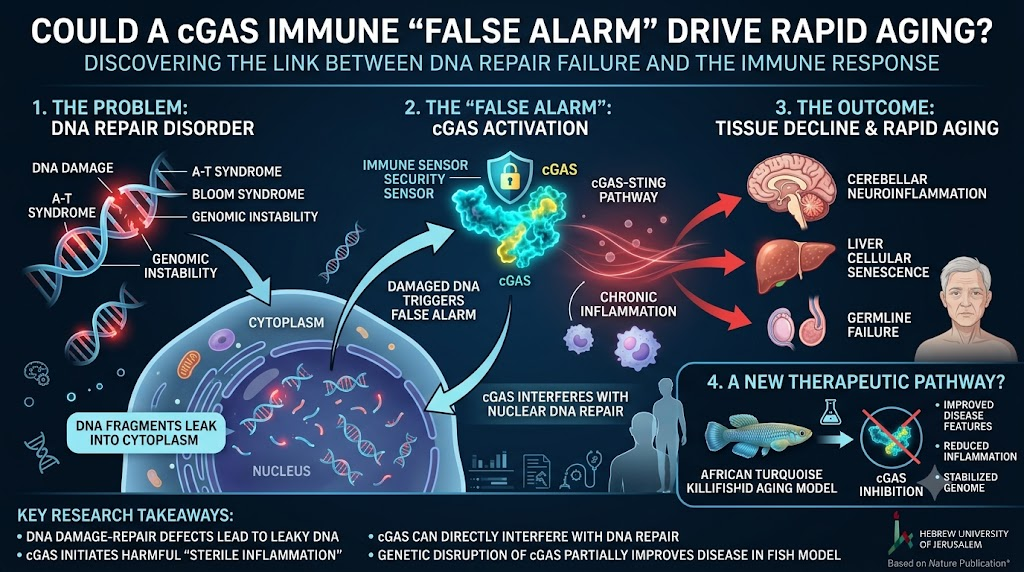
A new study from the Hebrew University of Jerusalem suggests that rapid aging associated with certain DNA damage-repair disorders may be amplified by an immune sensor called cGAS. When damaged DNA fragments escape into the cell’s cytoplasm, cGAS can mistake them for foreign genetic material, triggering inflammation; researchers also found evidence that cGAS can affect DNA repair and genome stability through functions inside the nucleus.
The finding does not mean that scientists have discovered a general cure for aging. Instead, it reveals a potentially important mechanism in rare disorders such as ataxia-telangiectasia (A-T) and Bloom syndrome, where DNA repair is defective and genomic instability contributes to disease.
That distinction matters because the researchers were studying a specific biological context: severe DNA damage and repair defects. The work raises a new therapeutic possibility, but it remains preclinical research rather than a treatment available to patients.
Why DNA Damage May Not Be the Whole Story
Our cells experience DNA damage constantly.
Some damage occurs naturally as cells divide or as molecules inside the cell react with DNA. Cells therefore have sophisticated DNA damage repair (DDR) systems that identify damaged genetic material and repair it before it causes lasting problems.
When those systems fail because of genetic mutations, however, damaged DNA can accumulate.
This can contribute to genomic instability,the condition in which the cell’s genetic material becomes increasingly vulnerable to abnormalities. In severe DNA repair disorders, that instability can contribute to problems involving the nervous system, reproduction, tissue maintenance and cancer risk.
For a long time, one straightforward explanation was that accumulated DNA damage itself drives degeneration.
The new study suggests another layer.
Definition + Expansion: What is DNA damage repair?
DNA damage repair is the collection of cellular mechanisms that detect and fix injuries or abnormalities in DNA.
These systems protect the genome from mutations and structural damage that could interfere with normal cell function. When DNA repair genes are defective, as in disorders such as A-T and Bloom syndrome, damaged DNA can accumulate and create genomic instability.
But according to the Hebrew University research, the consequences may extend beyond the damaged DNA itself.
Broken or misplaced DNA fragments can also activate the body’s innate immune system.
Question → Direct Answer: Can DNA damage trigger an immune response?
Yes. When DNA fragments escape into the cytoplasm,the fluid-filled area surrounding the nucleus,they can activate innate immune sensors such as cGAS. In DNA repair disorders, persistent activation of this pathway can contribute to chronic inflammation and other forms of tissue damage.
That creates a surprising connection between two systems that are usually discussed separately: genome maintenance and immunity.
What Is cGAS and Why Does It Matter?
The immune system needs ways to recognize invading pathogens quickly.
Viruses are particularly important because some viruses introduce DNA into cells. The protein cGAS, short for cyclic GMP-AMP synthase, acts as an intracellular DNA sensor.
When cGAS encounters DNA in the cytoplasm, it can initiate signaling through the cGAS-STING pathway, an innate immune pathway that helps cells respond to threats.
Normally, this is useful.
The problem arises when the DNA being detected does not belong to a virus.
If a cell’s own damaged DNA leaks out of the nucleus, cGAS may respond to it as though the cell were under attack.
The immune system’s “false alarm”
Think about a building’s fire alarm.
Its job is simple: detect signs of danger and trigger an emergency response.
But if the sensor becomes activated by steam rather than fire, the alarm can become a problem itself.
The cGAS mechanism is more complicated biologically, but the analogy captures the central idea. The researchers found that in DNA damage-repair disorders, self-derived DNA can activate an immune pathway that normally helps detect foreign genetic material.
That can produce what researchers describe as sterile inflammation.
Sterile inflammation means inflammation that occurs without an active infection. Instead of responding to bacteria or viruses, the immune system is reacting to signals generated by damaged or stressed cells.
Question → Direct Answer: Why would cGAS react to the body’s own DNA?
cGAS detects DNA in the cytoplasm rather than simply determining whether that DNA is “self” or “foreign.” When damaged cellular DNA enters the cytoplasm, it can therefore activate the same innate immune machinery used to detect some infections.
In a healthy cell, DNA normally remains compartmentalized inside the nucleus or mitochondria. DNA repair defects can disrupt that separation.
How DNA Damage Can Create a Feedback Loop
The researchers’ findings suggest that cGAS may do more than respond to damaged DNA.
It may also help worsen the underlying problem.
According to the study, cGAS has a dual role in the response to genomic instability. Its well-known cytoplasmic function can promote inflammatory signaling, while nuclear cGAS functions can influence DNA repair and chromatin,the material made of DNA and associated proteins.
That creates the possibility of a feedback loop:
DNA repair failure → DNA damage → DNA fragments escape → cGAS activation → inflammation and cellular disruption → additional genome instability
The researchers’ experiments support the idea that cGAS can act as a context-dependent amplifier of DNA damage-repair pathology.
This is different from saying that cGAS initially causes the DNA repair disorder.
The underlying genetic defect still matters.
Instead, the research suggests that once extensive DNA damage is present, the immune response may make the resulting tissue degeneration worse.
Why the distinction is important
Imagine a machine with a broken safety system.
The original mechanical defect is the first problem. But if the machine’s emergency response repeatedly activates in the wrong way, that response could create additional damage.
The study proposes something conceptually similar at the cellular level.
The DNA repair defect creates the initial stress, while cGAS may amplify its consequences.
Question → Direct Answer: Is cGAS the original cause of these DNA repair disorders?
No. The disorders studied are caused by defects in genes involved in maintaining or repairing DNA. The research suggests that cGAS can amplify the resulting pathology rather than being the original genetic cause.
That distinction is especially important when interpreting the findings as a possible treatment strategy.
What Happened When Researchers Reduced cGAS Activity?
To investigate whether cGAS was merely associated with disease or actually contributed to it, the researchers used genetic models.
They studied ataxia-telangiectasia and Bloom syndrome in the African turquoise killifish, a short-lived vertebrate that has become a useful model for studying aging and age-related disease.
When the researchers disrupted cGAS in the A-T model, they observed improvements in several disease-associated features.
The published study reports partial improvements in:
- Germline failure
- Liver cellular senescence
- Cerebellar neuroinflammation
- Micronuclei associated with genome instability
- Telomere integrity
- Heterochromatin organization
The breadth of these effects is what makes the research particularly interesting.
The researchers were not simply observing a reduction in one inflammation marker.
They found changes across multiple biological systems and cellular indicators of genome instability.
A surprising result
One of the more unexpected findings was that reducing cGAS activity also improved some markers of genome stability.
The study reports fewer micronuclei, improved telomere integrity and restoration of an H3K9me3-marked heterochromatin landscape in the A-T model. These findings were consistent with cGAS having nuclear functions that affect DNA repair and chromatin, rather than acting only through the conventional inflammatory cGAS-STING pathway.
This matters because it changes the possible interpretation of cGAS.
It may not simply be an immune alarm reacting to DNA damage.
In certain disease conditions, it may also influence the machinery responsible for maintaining the genome.
Why the African Turquoise Killifish Matters
You might reasonably ask why researchers studying human diseases would use a small fish.
The answer is speed.
The African turquoise killifish has an unusually short lifespan compared with many commonly used vertebrate research models. The Hebrew University describes the species as a platform for rapidly studying vertebrate aging and age-related diseases
That makes it possible to observe biological changes associated with aging and disease over a much shorter experimental timeframe.
Researchers can also create genetic models of specific disorders and examine how those mutations affect tissues over the animal’s relatively short life.
What can the model tell us?
A killifish model can help researchers test whether a biological mechanism has causal effects in a living vertebrate.
In this case, the researchers could introduce DNA repair-related genetic changes and then manipulate cGAS activity to see whether disease-associated features changed.
That is stronger evidence than simply finding that cGAS levels correlate with aging.
However, a fish model is still a model.
Biological mechanisms can differ between species, and a result observed after genetic disruption in killifish does not automatically translate into a safe and effective treatment for humans.
Question → Direct Answer: Does the killifish study prove that blocking cGAS will treat human rapid-aging disorders?
No. It provides preclinical evidence that cGAS contributes to pathology in specific animal models of DNA repair disorders. Human studies would be needed to establish whether cGAS-targeting treatments are safe and effective in patients.
That is one of the most important takeaways from the research.
Could cGAS Become a Treatment Target?
The study raises the possibility of using cGAS inhibition as a future strategy for DNA damage-repair disorders.
The basic idea is relatively straightforward.
If excessive cGAS activity helps turn DNA damage into chronic inflammation and additional genomic instability, then reducing cGAS activity might interrupt part of that damaging response.
The study’s authors say their findings support pharmacological cGAS inhibition as a potential strategy in DNA damage-repair syndromes characterized by chronic DNA damage.
But there is a major catch.
cGAS is not a “bad” protein
cGAS exists for a reason.
It is an important component of innate immunity and helps cells detect potentially dangerous DNA.
Completely shutting down the pathway could therefore interfere with antiviral defense.
The research itself highlights this context dependence. In the A-T model, cGAS disruption improved several pathological features. But cGAS loss in an otherwise healthy background worsened pathology and genomic instability, emphasizing that cGAS also has important normal functions.
This means a future medicine would ideally need to control pathological cGAS activity without eliminating its protective functions.
That is much harder than simply switching a gene off.
The Treatment Challenge: Protecting Immunity While Reducing Damage
This is where the research becomes more nuanced than the headline “immune system causes rapid aging.”
The immune response is not inherently harmful.
Inflammation is an essential part of defending the body and responding to injury. Problems arise when an inflammatory pathway remains active when it should not.
The same biological mechanism can therefore be beneficial in one context and harmful in another.
| Biological situation | cGAS role | Potential effect |
| Normal immune surveillance | Detects misplaced DNA | Supports innate immune defense |
| Viral infection | Helps activate immune signaling | Can help fight infection |
| DNA repair disorder | Detects leaked self-DNA | May contribute to chronic inflammation |
| Chronic genomic instability | Can influence nuclear processes | May amplify genome instability |
| Experimental cGAS disruption in A-T model | Reduces cGAS activity | Improved several disease-associated features |
| Complete loss in healthy background | Removes normal cGAS functions | Can worsen genomic instability |
The comparison illustrates why context matters.
A future cGAS-targeting therapy would need to be carefully designed around dose, timing, tissue targeting and the underlying disease.
Question → Direct Answer: Why can’t scientists simply switch off cGAS?
Because cGAS has normal protective functions, particularly in innate immune defense. The study suggests that reducing pathological cGAS activity in DNA repair disorders could be useful, but completely eliminating the pathway could create new problems.
This is a common challenge in biomedical research: a protein can be both protective and harmful depending on when, where and how strongly it operates.
Does This Explain Normal Human Aging?
Not by itself.
This distinction is essential.
The study investigates DNA damage-repair syndromes, including A-T and Bloom syndrome, rather than proving that cGAS is the master switch responsible for ordinary human aging.
The researchers found a mechanism that can contribute to degeneration when genomic instability is already severe.
That is different from demonstrating that the same pathway determines how a healthy person ages over decades.
The Hebrew University describes Harel’s broader research program as investigating vertebrate aging and age-related disease using the African turquoise killifish
But the specific 2026 cGAS study is focused on the relationship between DNA repair defects, genomic instability and organismal pathology.
Rapid aging versus normal aging
The distinction can be summarized simply:
- Normal aging involves many interacting biological processes over time.
- Rapid aging syndromes can result from specific genetic defects that disrupt essential cellular processes.
- DNA repair disorders can produce unusually high genomic instability.
- cGAS activation may amplify some consequences of that instability.
- The study does not establish that cGAS causes normal aging in humans.
That last point prevents an exciting discovery from being overstated.
The research could eventually contribute to understanding broader aging biology, but more evidence is required before that connection can be established.
What This Study Changes About DNA Damage
One of the most interesting conceptual changes is the idea that damage and response are separate parts of disease biology.
If a cell accumulates damaged DNA, researchers naturally focus on the damaged molecules themselves.
But the cell also senses that damage.
It launches signaling pathways.
Those pathways can alter inflammation, metabolism, cell division, tissue repair and other processes.
In this case, the immune response may become part of the disease mechanism.
The new model
A simplified view of the older model would be:
DNA repair defect → damaged DNA → cellular dysfunction → tissue degeneration
The study suggests a more complex model:
DNA repair defect → damaged DNA → leaked DNA → cGAS activation → chronic inflammatory signaling + nuclear effects → greater tissue dysfunction
That second pathway does not replace the first.
It adds another layer.
The research describes cGAS as a context-dependent amplifier of DNA damage-repair pathology, acting through both canonical inflammatory signaling and noncanonical nuclear mechanisms affecting genome stability.
That could influence how researchers think about therapeutic targets.
Instead of trying to repair every piece of damaged DNA directly, one possible strategy could be to reduce the harmful biological response generated by persistent damage.
What the Study Does , and Does Not , Prove
Scientific breakthroughs can become misleading when preliminary findings are converted into claims that go beyond the evidence.
Here is the clearest way to separate the findings from the possibilities.
What the research demonstrates
The researchers found that:
- Genetic models of A-T and Bloom syndrome can be studied in African turquoise killifish.
- DNA repair defects activate pathways associated with genomic instability and innate immune sensing.
- cGAS contributes to disease-associated pathology in the A-T model.
- Disrupting cGAS partially improved several tissue and cellular abnormalities.
- cGAS appears to have functions beyond conventional immune signaling, including effects associated with DNA repair and chromatin.
- The findings support investigation of cGAS inhibition as a potential treatment strategy for some DNA repair disorders.
What remains unknown
The research does not yet establish that:
- cGAS inhibition can treat human A-T or Bloom syndrome.
- cGAS inhibition can reverse normal human aging.
- cGAS is the primary cause of aging.
- a cGAS-targeting drug would be safe for long-term use.
- reducing cGAS activity would have the same effects in humans as it did in the animal model.
This distinction is especially important because cGAS is part of normal immune defense.
Why This Could Matter Beyond Rare Genetic Disorders
Although the immediate research concerns rare DNA repair syndromes, its biological implications may extend into other areas of research.
Genomic instability and chronic inflammation are not unique to rare genetic disorders. Both appear in many diseases and biological processes.
The question is whether the cGAS mechanism observed in these severe DNA repair models also plays a meaningful role in other conditions.
That remains an area for future research rather than a conclusion of this study.
The researchers’ findings are particularly interesting because they connect three major areas of biology:
DNA repair + immune signaling + aging-related tissue decline
Each field has traditionally been studied through its own lens.
Research like this shows why biology often refuses to stay inside neat categories.
A DNA repair defect can activate an immune sensor. That immune sensor can influence genome stability. And the resulting interaction can affect tissues associated with aging and degeneration.
Why This Research Matters for Future Medicine
The most promising idea here is not “scientists found a way to stop aging.”
It is more precise:
Scientists identified an immune pathway that appears to amplify tissue degeneration in specific DNA damage-repair disorders, and reducing that pathway improved disease-associated features in an animal model.
That is still an important finding.
Rare genetic disorders can be particularly difficult to treat because correcting the original genetic defect throughout the body may be extremely challenging.
If some of the disease’s damage comes from a secondary inflammatory response, then that response could provide another therapeutic target.
The approach would not necessarily need to repair every DNA lesion.
Instead, it could potentially reduce the downstream consequences of persistent genomic damage.
For patients with severe DNA repair disorders, that could eventually represent a complementary therapeutic strategy,but only if future research confirms the mechanism in humans and identifies a safe way to modulate it.
FAQ: cGAS, DNA Damage and Rapid Aging
What is cGAS?
cGAS is an innate immune sensor that detects DNA in the cell’s cytoplasm and helps activate immune signaling. Its normal role includes detecting DNA associated with infections, but it can also respond to the body’s own DNA when damaged DNA leaks into the cytoplasm.
How can DNA damage cause inflammation?
When DNA repair is defective, fragments of damaged DNA can escape into the cytoplasm. cGAS can detect these fragments and activate innate immune signaling, potentially producing persistent sterile inflammation when the damage continues.
What DNA repair disorders were studied?
The researchers modeled ataxia-telangiectasia (A-T) and Bloom syndrome, two disorders associated with defects in DNA damage repair and genomic instability. In the A-T model, reducing cGAS activity improved several disease-associated features.
Did blocking cGAS reverse aging?
The study did not demonstrate a reversal of normal human aging. Researchers found that genetically reducing cGAS activity improved several pathological and cellular features in an A-T killifish model, including germline failure, liver senescence and cerebellar neuroinflammation. Primary Keyword
- rapid aging
Secondary Keywords
- cGAS
- DNA damage
- DNA repair disorders
- chronic inflammation
LSI / Long-Tail Keywords
- cGAS and rapid aging
- how DNA damage causes aging
- immune response to damaged DNA
- cGAS inhibition for DNA repair disorders
Meta Title
Rapid Aging: Ultimate cGAS DNA Damage Guide 2026
Could cGAS inhibition become a treatment?
Possibly, but it is still an experimental idea. The researchers’ findings support investigating pharmacological cGAS inhibition for DNA repair disorders involving chronic DNA damage, while also showing that cGAS has essential normal functions that must be preserved.
Does this mean scientists have found the cause of aging?
No. The study identifies a mechanism that can amplify pathology in specific DNA repair disorders. It does not establish cGAS as the single cause of normal human aging or prove that targeting cGAS would extend human lifespan.
The Bigger Picture
The Hebrew University research offers a useful reminder that biological damage does not happen in isolation.
A mutation can disrupt DNA repair. Damaged DNA can escape its normal compartment. An immune sensor can mistake that DNA for a threat. Persistent signaling can then contribute to inflammation and further cellular dysfunction.
In this study, cGAS appears to sit at the intersection of genome instability and immune response.
That makes it an intriguing research target,but also a complicated one.
The next step is not to shut down the immune sensor completely. It is to understand how researchers might selectively control its harmful activity while preserving the protection it provides under normal conditions.
For now, the strongest conclusion is also the most scientifically useful: in certain DNA repair disorders, the body’s response to DNA damage may be an important part of the disease, not merely a consequence of it.
As scientists continue exploring the connection between DNA repair, immunity and aging biology, this “false alarm” mechanism could provide a new way to think about,and potentially treat,some severe forms of degeneration. keep exploring kalinga.ai for more.