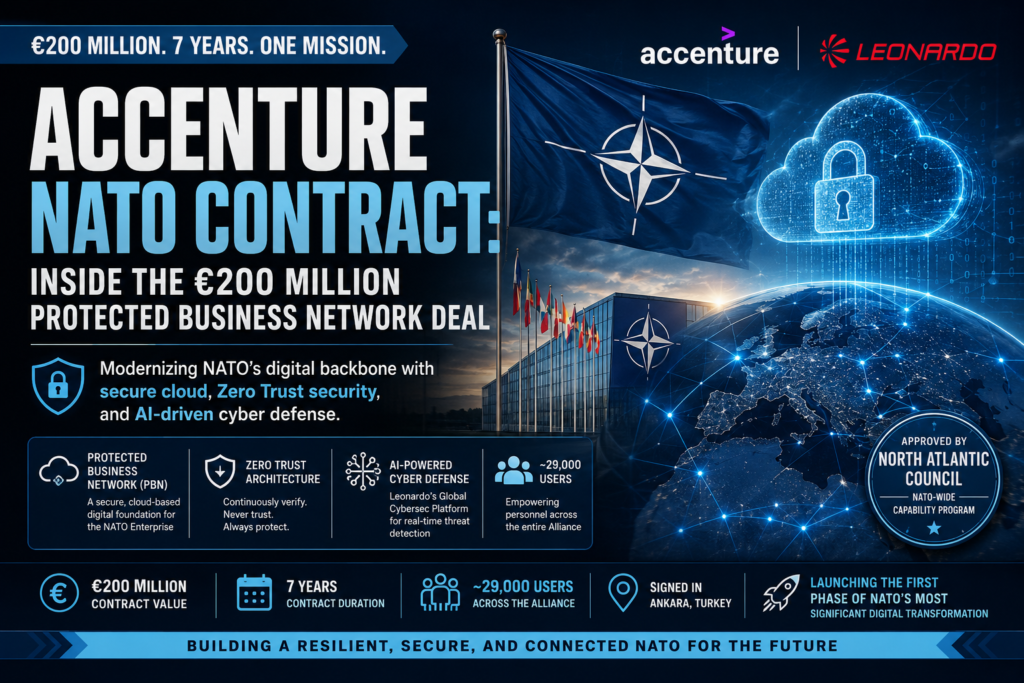
NATO has awarded Accenture a multi-million euro contract to modernize its digital backbone, and the deal is worth roughly €200 million over seven years. The Accenture NATO contract puts the consulting giant, working alongside Italian defense firm Leonardo, at the center of one of the Alliance’s most significant technology overhauls in decades.
Signed at the NATO Summit Defense Industry Forum in Ankara, Turkey, this agreement isn’t just another government IT deal. It signals how defense alliances are rethinking secure cloud computing, cyber resilience, and classified data operations in an era defined by AI-driven threats. Here’s everything you need to know about the contract, what it covers, and why it matters.
What Is the Accenture NATO Contract?
The Accenture NATO contract refers to a multi-million euro agreement between Accenture and the NATO Communications and Information Agency (NCIA) for the Protected Business Network (PBN) program. Accenture and Leonardo will design, implement, and operate the core PBN platform across a multi-cloud environment provided by NCIA, supporting the progressive deployment and long-term adoption of secure cloud services to approximately 29,000 users across the Alliance.
In simple terms, this is NATO’s plan to replace decades-old, siloed IT systems with a single, standardized, cloud-based digital enterprise, one built specifically to support classified military and political operations.
The Protected Business Network establishes the foundation for classified digital operations across the NATO Enterprise, ensuring decisionmakers and military personnel across domains can communicate, coordinate, and access critical data in a modern, standardized, and scalable cloud environment that is more resilient to external attack and disruption. That last part, resilience to attack, is the whole point. NATO isn’t just digitizing paperwork; it’s hardening the infrastructure that underpins Alliance-wide decision-making.
Who Signed the Agreement?
The deal was signed by NCIA General Manager Dr. Dylan Browne and Olivier Girard, EMEA Defense Industry lead at Accenture. The signing took place alongside a wave of other defense-industry announcements at the Ankara summit, underscoring how central digital transformation has become to NATO’s broader security agenda.
Why NATO Chose Accenture and Leonardo
NATO didn’t hand this contract to just anyone. The Accenture NATO contract reflects a deliberate pairing: a global technology consultancy with deep cloud and AI capabilities (Accenture) alongside a European defense contractor with specialized cybersecurity infrastructure (Leonardo).
Definition + Expansion: A prime-subcontractor defense technology partnership like this combines commercial-scale cloud engineering with military-grade security certification. Accenture brings global delivery capacity and enterprise cloud expertise; Leonardo brings NATO-trusted defense credentials and proprietary cyber-defense technology.
Leonardo will implement a Zero Trust Architecture secured by its proprietary Global Cybersec Platform, an AI multi-agentic platform for cyber defense, to guarantee world-class resiliency. That combination, Accenture’s scale and Leonardo’s defense-grade security stack, appears to be exactly what tipped the decision in their favor.
Accenture’s own leadership framed the win in strategic terms. Mauro Macchi, CEO for EMEA at Accenture, described NATO’s ambition to become a digitally enabled Alliance as one of the most consequential transformation programs of the era, requiring a trusted partner willing to take accountability for outcomes. Leonardo’s CEO echoed that sentiment, tying the project directly to operational readiness amid rising geopolitical tension.
Inside the Protected Business Network (PBN) Program
Question: What problem is the PBN program actually solving?
Direct Answer: It replaces NATO’s fragmented, legacy IT systems with one standardized, cloud-based operating model that’s faster to update, easier to secure, and scalable across the entire Alliance.
The PBN program will replace legacy approaches and strengthen the agility and security of NATO’s digital infrastructure by introducing a common cloud operating model, standardized engineering practices, and a secure environment in which new digital services can be developed, deployed, and maintained more rapidly, providing the foundation for future capabilities.
That’s a mouthful, but the practical translation is straightforward: NATO wants to move at startup speed while operating at classified-military-grade security. The Accenture NATO contract is the vehicle for making that happen.
Zero Trust Architecture and Cyber Defense
Security is the non-negotiable core of this deal. Rather than relying on perimeter-based defenses (the old assumption that anything “inside” the network is safe), NATO’s new infrastructure will run on Zero Trust principles, meaning every user, device, and data request is continuously verified.
Leonardo will implement a Zero Trust Architecture secured by its Global Cybersec Platform as part of the security framework, giving NATO an AI-assisted layer of continuous threat detection rather than a static firewall model. This matters because classified networks are constant targets for state-sponsored cyberattacks, and a breach at this level could compromise operational planning across dozens of member states. StreetInsider
Scale, Timeline, and Rollout
- Contract value: Approximately €200 million StreetInsider
- Duration: Seven years
- Users supported: Approximately 29,000 users across the Alliance
- Signing location: NATO Summit Defense Industry Forum, Ankara, Turkey
- Approval body: Approved by the North Atlantic Council as a NATO-wide capability program MarketScreener
- Program phase: This agreement launches the first implementation phase of one of NATO’s most significant digital transformation programs
This is a phased rollout, not a single deployment event. Expect incremental expansion of cloud services, user onboarding, and legacy-system decommissioning over the next several years rather than a single “go-live” moment.
Accenture NATO Contract vs. Previous NATO Digital Programs
How does the Protected Business Network compare to the way NATO has historically approached digital infrastructure? Here’s a side-by-side breakdown.
| Feature | Legacy NATO IT Approach | Protected Business Network (Accenture NATO Contract) |
|---|---|---|
| Architecture | Siloed, on-premises systems | Standardized, multi-cloud environment |
| Security model | Perimeter-based defense | Zero Trust Architecture with AI-driven monitoring |
| Deployment speed | Slow, custom builds per unit/agency | Standardized engineering practices for rapid deployment |
| Scale | Fragmented across NATO bodies | Approximately 29,000 users across the Alliance |
| Vendor model | Multiple disconnected contracts | Unified prime partnership (Accenture + Leonardo) |
| Resilience | Vulnerable to legacy exploits | Designed to be more resilient to external attack and disruption |
The shift is less about adding new tools and more about consolidating NATO’s digital footprint into something that can actually be defended and upgraded at scale.
What the Deal Means for Accenture’s Business
For Accenture, the Accenture NATO contract is more than prestige, it’s a foothold in a high-trust, recurring-revenue category: government-grade cybersecurity and defense-cloud infrastructure.
The contract marks a significant foothold in government-grade cyber defense, a segment that offers recurring, long-term revenue visibility. That’s notable because Accenture has faced recent headwinds. In the latest quarter, new orders contracted by 2%, while geopolitical pressures in the Middle East cost the company around $100 million. Against that backdrop, a seven-year, government-backed contract offers a stabilizing counterweight. Ad Hoc NewsAd Hoc News
Definition + Expansion: “Recurring-revenue visibility” in consulting means a client relationship structured around multi-year deliverables rather than one-off projects, giving the vendor predictable income and deeper account penetration over time. For a firm navigating order softness elsewhere, that predictability carries outsized strategic value.
Company scale context: Accenture employs approximately 799,000 people and generated approximately $70 billion in revenue in fiscal year 2025, and the firm serves approximately 9,000 clients globally through its Reinvention Services model spanning cybersecurity, cloud, AI, and data. Investing.com Canada
The Bigger Picture: Accenture’s Recent Strategic Moves
The Accenture NATO contract didn’t happen in isolation, it’s part of a broader push by Accenture into AI-driven, security-heavy enterprise offerings.
- Accenture launched Accenture Edge, a new business unit targeting mid-market companies with annual revenues between $300 million and $3 billion, built in collaboration with Google Cloud. Investing.com Canada
- Accenture and ServiceNow introduced a joint offering to automate migration from legacy cybersecurity systems to the ServiceNow AI Platform. Investing.com Canada
- The Accenture Edge offering delivers pre-configured AI tools built on Gemini Enterprise and the Agentic Data Cloud, designed to deploy within weeks rather than months. Ad Hoc News
- Accenture has deployed a $2 billion share buyback program and maintained a quarterly dividend of $1.63 per share to shore up investor confidence. Ad Hoc News
Taken together, the NATO win, the Google Cloud partnership, and the ServiceNow tie-up all point in the same direction: Accenture is positioning itself as the go-to integrator for organizations that need enterprise-grade AI and cybersecurity infrastructure, whether that’s a mid-market company or a 32-nation military alliance.
FAQs About the Accenture NATO Contract
Q: How much is the Accenture NATO contract worth?
A: The contract is worth approximately €200 million over seven years. StreetInsider
Q: Who is Accenture partnering with on this deal?
A: Accenture is working with Leonardo, the Italian defense and aerospace company, to deliver the contract.
Q: What is the Protected Business Network (PBN)?
A: It’s a NATO-wide capability program that establishes the foundation for classified digital operations across the NATO Enterprise, replacing legacy IT with a modern, standardized cloud environment.
Q: How many people will the new system support?
A: The platform is expected to support approximately 29,000 users across the Alliance.
Q: Where was the contract signed?
A: It was signed at the NATO Summit Defense Industry Forum in Ankara, Turkey.
Q: What security model does the new infrastructure use?
A: Leonardo will implement a Zero Trust Architecture secured by its proprietary Global Cybersec Platform, an AI multi-agentic platform for cyber defense.
Key Takeaways
- The Accenture NATO contract is a €200 million, seven-year agreement to modernize NATO’s classified digital infrastructure. StreetInsider
- It centers on the Protected Business Network (PBN), a NATO-wide cloud and cybersecurity capability program.
- Accenture is partnering with Leonardo, which will handle Zero Trust security via its AI-driven Global Cybersec Platform.
- The system will eventually support ~29,000 users across the Alliance.
- For Accenture, the deal strengthens its position in government-grade cybersecurity at a time when its core consulting business faces order softness.
- The contract fits a broader pattern of Accenture doubling down on AI and security partnerships, alongside moves like Accenture Edge with Google Cloud and its ServiceNow collaboration.