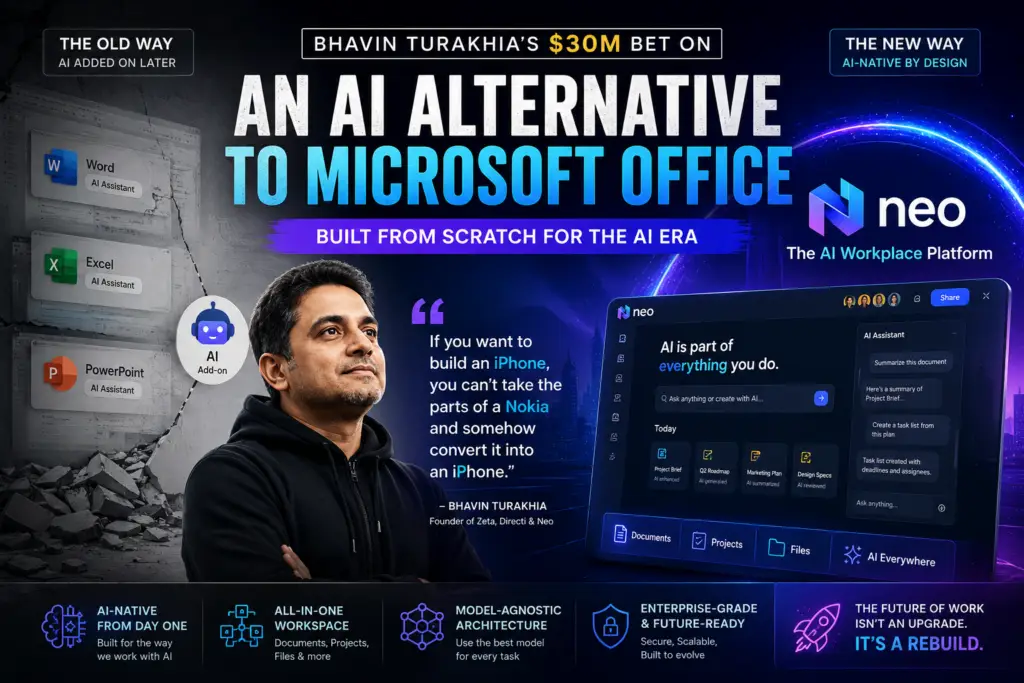
Bhavin Turakhia, the Indian entrepreneur behind Zeta and Directi, is spending $30 million of his own money to build Neo — a new AI alternative to Microsoft Office designed from scratch for the AI era rather than retrofitted with chatbots. The bet reflects a growing belief among enterprise founders that generative AI requires workplace software to be rebuilt, not just upgraded.
If you’ve ever felt like the “AI features” bolted onto Word, Excel, or Google Docs feel more like add-ons than a genuine rethink of how work gets done, you’re not alone. Turakhia’s new company, Neo, is built entirely around that frustration — and it’s one of the clearest signals yet that the productivity software category is entering a period of real disruption.
Who Is Bhavin Turakhia, and Why Is He Building an AI Alternative to Microsoft Office?
Bhavin Turakhia is a 46-year-old serial entrepreneur based in Bengaluru, India, with a two-decade history of founding enterprise technology companies — including Directi, Radix, Titan, and the banking software company Zeta. Neo is his fifth major venture, and it’s his most direct challenge yet to the dominance of Microsoft Office and Google Workspace.
What makes Turakhia’s approach notable isn’t just the product — it’s how he’s funding it. Rather than raising a large seed round from venture capitalists, he’s self-funding Neo with $30 million of his own capital, continuing a pattern he’s used across his previous companies.
A Track Record of Bootstrapped Bets
Turakhia has repeatedly used his own money to get companies off the ground before bringing in outside investors. This self-funded approach gives him control over product direction in the earliest, most experimental phase of a company’s life — which he considers essential when building something as structurally different as an AI-native alternative to Microsoft Office.
His reasoning is straightforward: he believes AI represents a technology shift on the scale of the smartphone, and that half-measures won’t cut it.
“If you want to build an iPhone, you can’t take the parts of a Nokia and somehow convert it into an iPhone.”
That single line captures the philosophy behind Neo — and it’s worth unpacking, because it explains why Turakhia thinks most existing productivity software can’t simply be patched with AI features.
What Is Neo? Inside the AI Alternative to Microsoft Office
Neo is an enterprise work platform that combines project management, document creation, file storage, and AI into a single unified product, rather than treating AI as a separate assistant employees have to consciously turn to. It was launched internally in April 2026 and has been used across Turakhia’s own companies, including Zeta, before any external rollout.
Unlike traditional office suites where AI shows up as a chat sidebar or an autocomplete feature, Neo is positioned as an AI workplace platform where AI is embedded into the core workflow — writing, planning, organizing, and collaborating all happen with AI as an active participant rather than a bolted-on tool.
Core Features
Based on Turakhia’s public comments, Neo’s platform brings together:
- Document creation and editing — a Word/Docs-style writing environment built around AI assistance from the ground up
- Project management — task and workflow tracking integrated directly with documents and files
- File storage — a unified home for enterprise content, replacing the need to juggle separate storage tools
- Embedded AI — AI woven into daily actions rather than accessed through a single chatbot window
- Model-agnostic architecture — the ability to switch between different AI models rather than being locked into one provider
Model-Agnostic Architecture Explained
One of Neo’s more technical — but strategically important — design choices is being model-agnostic. Turakhia has structured Neo so enterprises aren’t locked into a single AI provider. As new models from Anthropic, OpenAI, Google, or others improve, Neo can, in principle, plug in the best-performing model for a given task rather than being tethered to whichever provider it originally launched with.
This matters because the AI model landscape changes quickly. A workplace platform tied to one model risks becoming outdated as competitors leapfrog each other on capability. By staying model-agnostic, Neo is betting on flexibility as a long-term competitive advantage — a strategy increasingly common among enterprise AI software companies wary of vendor lock-in.
Why Legacy Office Software Can’t Simply Bolt On AI
Turakhia’s central argument is that workplace software designed before generative AI existed cannot simply be upgraded with AI features — it has to be rebuilt from the architecture up. This is the core thesis behind why Neo exists at all, and it’s a direct challenge to how Microsoft, Google, and Salesforce have approached AI so far: layering assistants and copilots on top of decades-old product architecture.
The iPhone/Nokia Analogy
Turakhia’s comparison to the iPhone and Nokia is deliberate. Nokia’s hardware and software were engineered around physical keypads and limited processing power; no amount of software updates could turn that architecture into a touchscreen smartphone. The iPhone required starting over.
Turakhia argues the same logic applies to office software. Microsoft Word, Excel, and PowerPoint — and their Google Workspace equivalents — were engineered around a pre-AI model of work: humans manually creating and editing content, with software as a passive tool. Adding a chatbot to that architecture, he argues, doesn’t fundamentally change how the software works. It just adds a feature.
This is the philosophical foundation for building an entirely new AI alternative to Microsoft Office rather than competing feature-by-feature with Copilot or Gemini.
How Neo Compares to Microsoft 365, Google Workspace, and Other AI Productivity Tools
To understand where Neo fits in the market, it helps to compare it directly against the incumbents it’s positioning itself against.
| Feature | Neo | Microsoft 365 (Copilot) | Google Workspace (Gemini) |
|---|---|---|---|
| Architecture | Built AI-native from scratch (2026) | Legacy suite (1990s) with AI layered on | Legacy suite (2006) with AI layered on |
| AI integration | Embedded throughout core workflow | Added via Copilot assistant/sidebar | Added via Gemini assistant/sidebar |
| AI model flexibility | Model-agnostic, switchable | Primarily OpenAI-based | Primarily Google’s own models |
| Core modules | Docs, project management, file storage, AI in one product | Word, Excel, PowerPoint, Teams (separate apps) | Docs, Sheets, Slides, Drive (separate apps) |
| Company stage | Early-stage startup (~45 employees) | Mature global incumbent | Mature global incumbent |
| Target customer | Mid-sized businesses, knowledge workers | Enterprises of all sizes | Enterprises of all sizes |
| Funding model | $30M self-funded by founder | Backed by Microsoft’s balance sheet | Backed by Alphabet’s balance sheet |
This comparison highlights the fundamental tension in the market: incumbents have distribution, brand trust, and massive existing user bases, while a challenger like Neo has the advantage of starting with a clean architectural slate built specifically as an AI alternative to Microsoft Office rather than a retrofit.
Neo’s Rollout Plan and Target Market
Neo isn’t launching broadly just yet. Turakhia has taken a deliberately staged approach, testing the product internally before opening it up to paying customers.
Timeline and Team Growth
Here’s how Neo’s development and rollout have progressed so far:
- April 2026 — Neo launched internally and began use across Turakhia’s own companies, including Zeta
- Development time — The initial platform was built in roughly three months, with AI used extensively throughout the engineering process
- Estimated time savings — Turakhia estimates the same build would have taken more than a year with a much larger team before generative AI tools existed
- Current team size — About 45 employees, including 18 engineers
- Projected team size — Expected to grow to around 100 employees by the end of 2026, with most new hires in AI and software engineering
- Initial rollout target — Mid-sized businesses, starting with knowledge workers in technology, consulting, and professional services
This phased approach — internal use first, then a targeted rollout to mid-market companies — is a common playbook for enterprise AI software companies trying to prove reliability before competing head-on with Microsoft Office and Google Workspace for large enterprise contracts.
The Broader Race to Build the AI Alternative to Microsoft Office
Neo isn’t operating in isolation. It’s part of a broader wave of founders betting personal capital and reputation on the idea that AI-native software will outcompete AI-retrofitted software.
Other Bootstrapped AI Bets: Chamath Palihapitiya’s 8090
Turakhia isn’t the only high-profile entrepreneur self-funding an enterprise AI company before seeking outside capital. Investor Chamath Palihapitiya initially launched his enterprise AI coding venture, 8090, using his own money before raising a $135 million Series A round and taking on the CEO role himself. The parallel suggests a pattern: well-capitalized founders are choosing to prove out AI-native products privately before exposing them to the pressures — and dilution — of early institutional funding.
Big Tech’s Response: Microsoft, Google, and Salesforce
Meanwhile, the incumbents aren’t standing still. Microsoft, Google, and Salesforce are all embedding AI deeply into their existing workplace software — Copilot across Microsoft 365, Gemini across Google Workspace, and Agentforce across Salesforce’s ecosystem. At the same time, AI labs like Anthropic and OpenAI, along with productivity-focused startups like Notion and Superhuman, are all racing to reshape how businesses work day to day.
This creates a three-way competitive dynamic:
- Legacy incumbents retrofitting massive, entrenched products with AI capabilities
- AI labs building general-purpose assistants that can plug into any workflow
- AI-native challengers like Neo building entirely new products from the ground up
Each approach has real trade-offs, and it’s not yet clear which model will win the broader productivity software market.
Can a Startup Really Challenge Microsoft Office and Google Workspace?
Yes — at least on Turakhia’s terms, because enterprise software has historically never been a winner-takes-all market. Turakhia doesn’t need to unseat Microsoft or Google outright to build a large, successful business.
Neo AI workplace platform Bhavin Turakhia Neo AI productivity software AI-native office suite
Market Share Math
Turakhia has been explicit about how he thinks about the opportunity: even a small slice of the massive global enterprise software spending pool would represent a substantial company by his own standards.
“Even if we end up with 2% to 5% market share, that’s larger than anything I’ve built so far,” he said.
Given that Microsoft Office and Google Workspace collectively serve hundreds of millions of business users worldwide, a 2–5% share of enterprise AI productivity spending would still translate into a sizeable, sustainable company — without needing to dethrone either giant. This framing is important context for anyone trying to evaluate whether a challenger like Neo is a realistic long-term threat or simply a niche alternative.
What This Means for Businesses Evaluating AI Productivity Tools
For companies currently deciding between sticking with Microsoft 365 or Google Workspace versus exploring newer AI-native platforms, Neo’s emergence adds a genuine third option to watch — particularly for mid-sized businesses that aren’t as deeply locked into enterprise contracts as large corporations.
A few practical takeaways:
- Architecture matters more than feature lists. A platform built AI-native from day one may handle AI-driven workflows more coherently than a legacy suite with AI features added on top.
- Model flexibility reduces long-term risk. A model-agnostic AI platform like Neo avoids locking a business into one AI provider’s roadmap and pricing.
- Early-stage products carry early-stage risk. With around 45 employees and a rollout still in its early stages, Neo doesn’t yet have the reliability track record of Microsoft or Google at enterprise scale.
- Consolidation could reduce tool sprawl. Combining documents, project management, and file storage into one AI-native product could reduce the number of separate SaaS tools a business needs to manage.
Businesses evaluating any AI alternative to Microsoft Office — Neo included — should weigh the appeal of a rebuilt, AI-first architecture against the operational maturity and proven reliability of established incumbents.
Frequently Asked Questions About Neo and the AI Alternative to Microsoft Office
What is Neo?
Neo is an enterprise productivity platform created from the ground up as an AI Alternative to Microsoft Office. It combines document creation, project management, file storage, and built-in AI into a single unified workspace. Unlike traditional office suites that add AI as an extra feature, Neo embeds AI into every workflow, helping teams write, organize, collaborate, and automate tasks more efficiently. This AI-first architecture makes Neo a compelling AI Alternative to Microsoft Office for modern businesses looking to improve productivity.
Who founded Neo?
Neo was founded by Bhavin Turakhia, a renowned Indian entrepreneur known for building successful technology companies including Directi, Radix, Titan, and the banking software company Zeta. With Neo, Turakhia aims to create a true AI Alternative to Microsoft Office that is designed specifically for the era of generative AI instead of relying on legacy software architecture.
How much has Bhavin Turakhia invested in Neo?
Bhavin Turakhia has personally invested $30 million into Neo without raising an initial venture capital round. His self-funded approach gives the company the freedom to innovate rapidly while building a next-generation AI Alternative to Microsoft Office focused on long-term product development rather than short-term investor expectations.
Is Neo available to the public?
Not completely. Neo has been used internally across Turakhia’s companies, including Zeta, since April 2026. The company plans a phased rollout for mid-sized businesses in technology, consulting, and professional services. As adoption expands, Neo could become one of the most closely watched AI Alternative to Microsoft Office platforms in the enterprise software market.
What does “model-agnostic” mean?
Neo’s model-agnostic architecture allows businesses to switch between different AI models instead of depending on a single provider. This flexibility enables organizations to adopt the best-performing AI technology as it evolves, making Neo a future-ready AI Alternative to Microsoft Office for enterprises that want to avoid vendor lock-in.
How is Neo different from Microsoft Copilot or Google Gemini?
Microsoft Copilot and Google Gemini enhance existing productivity suites by adding AI assistants to established applications. Neo follows a different strategy by rebuilding workplace software around AI from day one. This AI-native design allows it to function as a complete AI Alternative to Microsoft Office, where intelligence is integrated into every task rather than accessed through a separate chatbot or sidebar.
How large is Neo’s team?
As of mid-2026, Neo has approximately 45 employees, including 18 software engineers, with plans to expand to around 100 employees by the end of the year. The growing engineering team reflects the company’s ambition to establish Neo as a leading AI Alternative to Microsoft Office for businesses embracing AI-driven productivity.
Final Thoughts
The emergence of AI Alternative to Microsoft Office platforms like Neo signals a much bigger shift than simply adding another productivity app to the market. Instead of treating artificial intelligence as a feature layered onto decades-old software, Neo embraces the idea that the future of work requires an entirely new foundation. This AI-first philosophy is what differentiates Neo from traditional office suites and positions it as a compelling AI Alternative to Microsoft Office for organizations looking beyond incremental upgrades.
Bhavin Turakhia’s willingness to invest $30 million of his own capital demonstrates strong conviction that the next generation of enterprise productivity software will be built around AI rather than adapted to it. Whether Neo ultimately becomes the leading AI Alternative to Microsoft Office or inspires other innovators to rethink workplace software, its launch has already intensified the conversation around AI-native productivity platforms.
One of Neo’s biggest advantages as an AI Alternative to Microsoft Office is its unified architecture. Instead of forcing users to switch between multiple applications for documents, projects, file management, and AI assistance, Neo combines these capabilities into a single intelligent workspace. This streamlined experience has the potential to reduce context switching, improve collaboration, and help teams complete work faster without relying on numerous disconnected tools.
Another significant strength is Neo’s model-agnostic approach. As AI technology evolves rapidly, businesses increasingly want the flexibility to adopt the best-performing models without being locked into a single provider. By supporting multiple AI models, Neo offers a level of adaptability that many organizations may find attractive when evaluating an AI Alternative to Microsoft Office for long-term digital transformation.
Of course, every emerging platform also faces challenges. Microsoft and Google have decades of enterprise trust, global infrastructure, mature ecosystems, and millions of loyal customers. Any AI Alternative to Microsoft Office must prove not only that it offers smarter AI capabilities but also that it can deliver enterprise-grade security, reliability, scalability, compliance, and seamless collaboration at a global scale. These are areas where established incumbents still possess considerable advantages.
For businesses, the key takeaway is not necessarily to replace Microsoft 365 or Google Workspace immediately. Instead, decision-makers should monitor how AI-native platforms evolve over the next few years. If Neo continues delivering on its vision, it could become a serious AI Alternative to Microsoft Office for startups, mid-sized businesses, consulting firms, and knowledge-driven organizations seeking a more integrated AI-powered workflow.
Ultimately, the competition between AI-native platforms and legacy productivity suites will benefit customers the most. Greater innovation will lead to better workflows, more intelligent automation, increased flexibility, and faster software evolution. Whether Neo captures a significant share of the market or simply pushes incumbents to innovate more aggressively, its arrival marks an important milestone in enterprise software.
As organizations increasingly evaluate every productivity investment through the lens of artificial intelligence, the demand for a true AI Alternative to Microsoft Office is likely to grow. Neo may still be in its early stages, but it represents a bold vision of how modern work could evolve when AI is treated as the core operating system rather than an optional assistant. For IT leaders, business owners, and technology enthusiasts alike, Neo is undoubtedly one of the most promising AI Alternative to Microsoft Office platforms worth watching throughout 2026 and beyond.