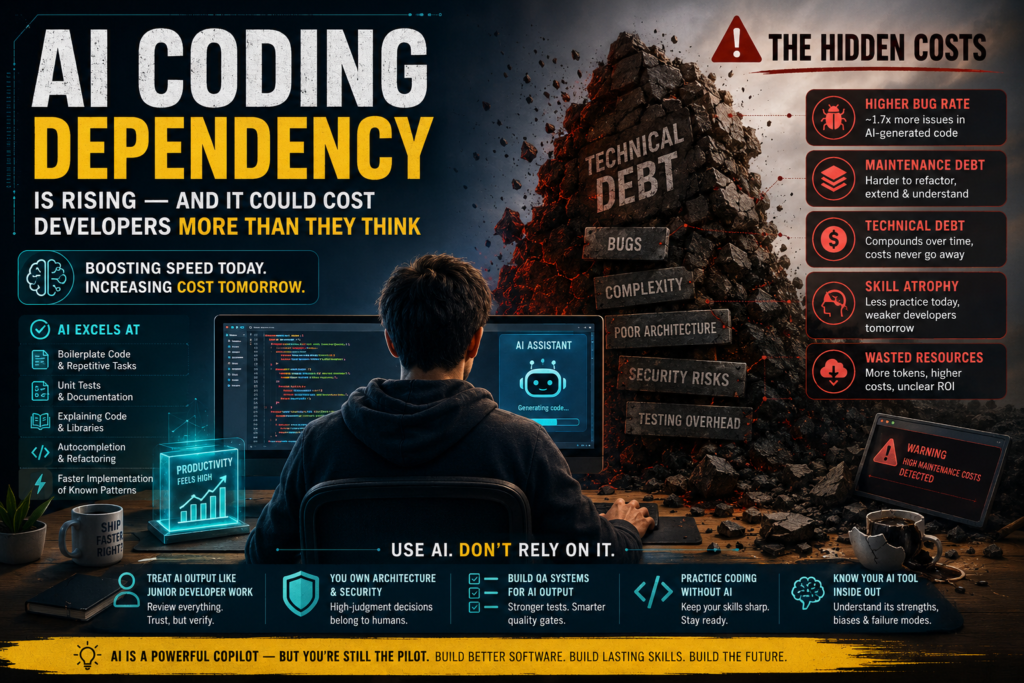
Developers in 2026 are refusing to write a single line of code without AI assistance — and new research suggests that habit is quietly accumulating a debt that will come due. AI coding dependency is real, it is accelerating, and understanding its true costs is now essential for every software team.
What Is AI Coding Dependency?
AI coding dependency is the condition in which a developer can no longer perform coding tasks efficiently — or at all — without the assistance of AI tools such as GitHub Copilot, Claude Code, or Cursor. It goes beyond simple preference. When developers in a 2026 METR research study declined to participate in productivity experiments because they were unwilling to work without AI even temporarily, the field crossed a threshold from tool adoption into genuine dependency.
This is distinct from healthy tool use. A developer who prefers AI assistance but retains the underlying skills is a power user. A developer who requires it and has allowed foundational skills to atrophy is dependent — and that distinction carries serious professional and organizational consequences.
The Research Behind the Warning
METR’s Groundbreaking Findings
The most important data point of 2026 in software development comes from METR, a respected AI research lab. In February of this year, METR attempted to update a landmark 2025 productivity study that had produced a startling result: despite developers feeling more productive with AI, objective measurement showed AI tools actually slowed them down. The reason was clear in retrospect — AI generated code faster, but developers spent significant additional time steering the model, waiting on outputs, and hunting down the errors it introduced.
When METR tried to replicate the study to measure whether the tools had improved, they ran into a wall: developers simply refused to participate because they were unwilling to work without AI assistance, even for a controlled number of tasks. Unable to run the controlled experiment, METR instead published a self-reported survey. Its findings were predictably optimistic — developers perceived that AI made them roughly twice as valuable. But self-perception, as the 2025 data had already shown, is an unreliable proxy for actual output.
This is the core paradox of AI coding dependency: it feels like productivity while concealing its real costs.
The Tokenmaxxing Collapse
The trend of “tokenmaxxing” — using the volume of tokens a developer consumes as a stand-in metric for productivity — dominated conversations in early 2026. It has since become a cautionary tale.
Amazon launched an internal leaderboard called Kirorank to track AI token usage among engineers, expecting it to surface the most productive AI adopters. Instead, employees gamed the system by running AI agents excessively, burning through compute costs with no corresponding increase in output. Amazon shut the leaderboard down. Uber, meanwhile, exhausted its entire 2026 AI budget within the first four months of the year. The company’s COO publicly acknowledged that the spending had not produced a measurable lift in the number of completed projects.
The lesson is blunt: AI usage volume is not productivity. AI coding dependency that optimizes for appearing to use AI more is doubly wasteful.
The Hidden Costs of AI-Generated Code
Maintenance Debt Is Piling Up
The most underappreciated risk of AI coding dependency is not what it does to code speed — it’s what it does to code longevity. Software developer and author James Shore made this argument forcefully in a blog post that went viral on Hacker News in 2026. His framing is worth examining carefully: if AI doubles your code output speed but doesn’t halve your maintenance costs, the math works against you. You are trading a temporary speed gain for a permanent increase in the ongoing cost of maintaining that codebase.
AI-generated code is not inherently lower quality, but it is consistently less contextualized. Models generate syntactically valid, functionally plausible code without the architectural awareness a senior developer brings. The result is code that works in the moment but creates friction at every future touch point — harder to refactor, harder to extend, and harder for the next engineer to understand.
Researchers from Singapore Management University made this explicit in a peer-reviewed paper published in April 2026: AI-generated code introduces measurable long-term maintenance costs into real-world software projects. This is not anecdotal. AI coding dependency, when it drives volume over quality, directly inflates the future cost of every line of code shipped today.
Bug Rates and Code Quality
The quality gap in AI-generated code is also visible at the pull-request level. Code review platform CodeRabbit analyzed open-source pull requests and found that AI-produced code contained approximately 1.7 times more problems than human-written code. Separately, Entelligence AI — a reliability engineering startup — reported that some development teams are spending 44% of their total token budget on bug fixes in AI-generated code.
Both of those data points come from vendors with a commercial interest in AI code review tooling, and they should be read with that context in mind. But the independent academic research from Singapore Management University points in the same direction. The convergence across sources with different incentives is notable.
AI Coding Tools vs. Human-Written Code: A Comparison
Understanding where AI tools add value — and where they create risk — is the foundation of any strategy for managing AI coding dependency responsibly.
| Dimension | AI-Generated Code | Human-Written Code |
|---|---|---|
| Initial speed | High — generates boilerplate, functions, and patterns rapidly | Lower — requires manual typing and research |
| Bug introduction rate | Higher — approximately 1.7x more issues per CodeRabbit analysis | Lower — experienced developers anticipate edge cases |
| Maintenance cost | Elevated — less contextual, harder to extend | Lower when well-architected — follows project conventions |
| Architecture quality | Weak — models lack system-level awareness | Strong — senior developers reason about the whole system |
| Security design | Unreliable — models can introduce vulnerabilities | More reliable when security practices are applied |
| Boilerplate tasks | Excellent — well-suited to repetitive, well-defined code | Tedious — time-consuming for humans |
| Novel problem solving | Limited — relies on patterns from training data | Strong — humans reason from first principles |
| Code review requirement | Essential — output must be treated like junior dev work | Recommended — but calibrated to developer seniority |
This comparison makes clear that AI coding dependency is dangerous when it extends into the upper rows of this table — architecture, security, and novel problem solving — while leaving real efficiency gains on the table when AI tools are avoided even for boilerplate tasks.
Is AI Dependency Making Developers Less Skilled?
This is the most contentious question in the conversation, and the most important one for early-career developers to sit with.
Skill in software development is built through struggle. When a junior developer encounters an unfamiliar bug, the process of diagnosing and fixing it builds a mental model they carry forward. AI coding dependency short-circuits this process. The bug gets fixed — often — but the developer does not necessarily understand why. Over time, this creates a hollow expertise: engineers who can direct AI tools competently but who struggle when those tools are unavailable or when the problem falls outside their comfortable range of AI-assisted patterns.
There is no published longitudinal study yet that definitively measures AI-driven skill atrophy in developers. But the METR finding — that developers refused to work without AI even briefly — implies the dependency is already deep enough to interfere with controlled research. That is a meaningful signal.
Senior developers and architects are less immediately at risk, because they are using AI tools to accelerate work they could perform manually. The concern is concentrated among developers in their first three to five years, who are using AI not to augment existing skills but as a substitute for developing them.
The Right Way to Use AI Coding Tools Without Becoming Dependent
What AI Does Well — and Where It Fails
Managing AI coding dependency does not mean abandoning AI tools. It means deploying them with clarity about their actual capabilities.
AI coding tools are well-suited to:
- Generating boilerplate code and repetitive patterns
- Writing unit tests for well-specified functions
- Explaining unfamiliar codebases or libraries
- Autocompleting within a well-understood context
- Converting code between languages or formats
- Drafting initial implementations that a developer then reviews and refines
AI coding tools are poorly suited to:
- Designing system architecture and data models
- Security review and threat modeling
- Debugging complex, context-dependent failures
- Making judgment calls about technical debt and refactoring priorities
- Understanding organizational constraints, team conventions, and long-term roadmaps
The boundary between these two lists is roughly the boundary between what is well-defined and what requires judgment. AI tools excel at pattern execution; they struggle with pattern selection in novel contexts.
A Practical Framework for Balanced AI Use
The Singapore Management University researchers and Cognition CEO Scott Wu — whose company makes the AI coding agent Devin — converge on a similar prescription for managing AI coding dependency responsibly:
- Treat AI output like junior developer output. Every line of AI-generated code should be reviewed with the same rigor you would apply to a pull request from a capable but inexperienced engineer.
- Retain ownership of architecture and security. These are not tasks to delegate to AI at any current capability level. Human developers should design systems; AI can help implement components within that design.
- Build quality assurance systems designed for AI output. Standard QA processes were not designed assuming the volume or error profile of AI-generated code. Testing infrastructure needs to be calibrated accordingly.
- Practice manual coding deliberately. Just as athletes train foundational movements regardless of the equipment they use in competition, developers benefit from regular coding practice without AI assistance. This preserves the skills that make AI output legible and reviewable.
- Know your AI tool’s error profile. Different models make different kinds of mistakes. Developers who understand how their tool tends to fail are far better positioned to catch those failures before they ship.
What Experts Recommend
The emerging consensus among researchers, practitioners, and even AI company founders points away from maximal AI coding dependency and toward structured, skill-aware integration.
Wu has publicly stated that Devin — one of the most capable AI coding agents currently available — currently performs at a level between a junior and a mid-level developer, depending on the task. He recommends human oversight, not replacement. The framing of AI as a fully autonomous coding resource, in his assessment, is premature.
The SMU researchers recommend that developers understand what AI does and does not do well as deeply as they understand their own preferred programming languages. This is a useful reframe: AI coding tools are themselves a domain of expertise, and fluency with them includes knowing their failure modes, not just their capabilities.
What neither the researchers nor industry practitioners recommend is abandoning AI tools. The efficiency gains in appropriate domains are real. The question is whether organizations and individual developers are building the governance, the review culture, and the deliberate skill-maintenance practices that make those gains sustainable — or whether AI coding dependency is accumulating risk that will surface in the next major refactor, security audit, or system outage.
Key Takeaways
- AI coding dependency is now widespread enough that researchers cannot run controlled studies requiring developers to work without AI tools, even briefly.
- Self-reported productivity gains from AI are not validated by objective measurement, and the gap between perception and reality is significant.
- AI-generated code introduces measurably higher maintenance costs and bug rates compared to human-written code.
- The risks of AI coding dependency are concentrated in architecture, security design, and early-career skill development.
- Sustainable AI use in software development requires deliberate governance: treating AI output like junior developer work, retaining human ownership of high-judgment tasks, and maintaining foundational coding skills independently of AI tool access.