AI content moderation is no longer just a social media problem — it is now the invisible force shaping everything a large language model tells you. With startups like Forum AI entering the field to audit major AI systems for bias and missing context, the question of who decides what AI says is finally getting the scrutiny it deserves.
What Is AI Content Moderation — And Why Does It Matter Now?
Definition: AI content moderation refers to the automated and semi-automated systems used to filter, evaluate, score, and shape the information that AI models surface, generate, or refuse to generate in response to user prompts.
For years, content moderation meant flagging hate speech on Facebook or removing violent videos from YouTube. That problem was hard enough. But something more consequential has happened: the moderation layer has moved inside the model itself.
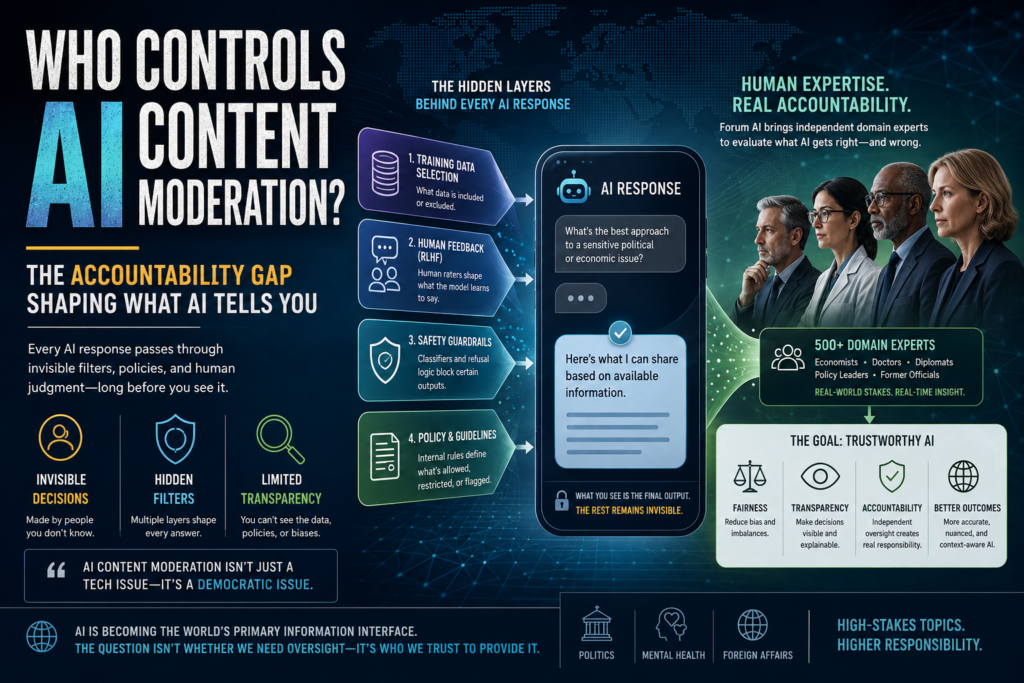
When you ask ChatGPT, Gemini, or Claude a politically sensitive question, an economic question, or a question about mental health, the answer you receive has already passed through multiple invisible filters — training data choices, reinforcement learning from human feedback (RLHF), policy documents, and safety classifiers. AI content moderation, in the LLM era, is not a cleanup crew. It is built into the foundation.
This shift matters enormously because:
- Scale is unprecedented. Social media platforms moderated billions of posts per day. AI models now handle billions of queries, each generating a unique authoritative-sounding response.
- Attribution disappears. On a news site, you can see who wrote an article and check their credentials. Inside an AI model’s training data, that chain of attribution is broken.
- The stakes are higher than ever. Users increasingly treat AI responses as ground truth, not as one perspective among many.
The Silicon Valley Disconnect: Forum AI’s Core Argument
In October 2025, Campbell Brown — a former CNN anchor and the ex-head of news and global media partnerships at Meta — co-founded Forum AI with a $3 million seed round. The company’s mission cuts straight to the heart of the AI content moderation crisis.
Brown’s core argument, echoed in conversations with investors and media outlets, is blunt: the conversation happening inside Silicon Valley about AI moderation is completely different from the one consumers are having. Tech companies are discussing model performance, benchmark scores, and alignment techniques. Consumers are asking a simpler, more urgent question: Can I trust what this AI is telling me?
Forum AI is not building another chatbot. It is building an evaluation layer — a system that assesses how major AI models perform on complex, nuanced topics where getting the tone, balance, and context right is critical but where traditional data labeling methods fall short.
Campbell Brown and the Expert Gap in AI Training
Brown’s insight is rooted in her years watching how platforms like Meta handle contested information. The problem she identified is not that AI companies are malicious. It is that the people making judgment calls about sensitive content often lack the domain expertise those topics demand.
Forum AI’s answer is a network of more than 500 curated domain experts — former cabinet secretaries, economists, healthcare professionals, and foreign policy specialists — who evaluate AI systems’ handling of specific topics for a monthly subscription fee. These are people with real-world stakes in getting the answer right, not anonymous data labelers working against a volume quota.
The Transparency Problem: Attribution Disappears
One of the sharpest lines in Brown’s critique applies directly to AI content moderation: when it comes to how large language models are trained or what data is used, the lack of transparency means users cannot know who the people are behind the model’s worldview — their credentials, their biases, or their blind spots — because attribution disappears into the training pipeline.
This is not a minor footnote. The Stanford HAI 2026 AI Index Report found that AI companies are sharing less about how their models are built and tested, not more. The AI transparency index dropped from 58 to 40 points in a single year, even as deployment accelerated across every industry. AI content moderation decisions are being made at massive scale, with less public accountability than ever before.
How AI Models Are Currently Trained to Handle Sensitive Topics
Understanding the stakes of AI content moderation requires understanding how it works in practice. Most frontier AI models use a layered approach:
- Pre-training data filtering — Curators or automated classifiers remove certain content categories from the raw training corpus before a model ever sees it.
- Reinforcement Learning from Human Feedback (RLHF) — Human raters score model outputs, and the model is trained to produce responses those raters prefer. The demographics, training, and instructions given to those raters shape what the model learns to say.
- System-level guardrails — Operators add safety classifiers and refusal logic on top of the base model to block certain outputs at runtime.
- Policy documents — Companies write internal guidelines about how models should handle categories like election integrity, medical advice, and mental health.
Each of these layers involves human judgment calls that are rarely made public.
Politics, Mental Health, and Foreign Affairs — The High-Stakes Trio
Forum AI specifically targets three topic categories that existing AI content moderation systems handle poorly:
Politics — AI models trained predominantly on Western, English-language data encode political assumptions that may not generalize across cultures or democratic systems. Research from the Cambridge Forum on AI Law and Governance found that AI moderation algorithms disproportionately restrict free expression in the Global South, where cultural and linguistic diversity clashes with Western-centric AI frameworks.
Mental health — AI companies are facing mounting legal and reputational pressure after chatbots have been accused of nudging teenagers and vulnerable users toward self-harm. Safety guardrails have proven inadequate, and the stakes of getting AI content moderation wrong here are literally life-and-death.
Foreign affairs — Geopolitical topics require not just factual accuracy but contextual sensitivity. An AI model trained on mainstream media may systematically miss regional dynamics, historical grievances, or minority perspectives that a genuine foreign policy expert would immediately flag.
Forum AI vs. Traditional AI Safety Approaches
How does Forum AI’s approach to AI content moderation compare to what already exists? The differences are significant:
| Feature | Internal AI Safety Teams | Traditional Fact-Checkers | Forum AI Model |
|---|---|---|---|
| Independence | None — employed by the AI company | Partial — often contracted by platforms | High — operates as a third party |
| Domain expertise | Generalist engineers and policy staff | Journalists and researchers | 500+ specialists (economists, doctors, diplomats) |
| Transparency | Minimal public disclosure | Variable | Aims for public evaluation reports |
| Real-time capability | Limited | Slow (days to weeks) | Experts provide real-time analysis on breaking news |
| Scope | One company’s model | Platform-level content | Cross-model comparison and evaluation |
| Business model | Cost center | Contract-based | Monthly subscription for AI companies |
The key differentiator is independence. When an AI company’s own team is responsible for AI content moderation, there is an inherent conflict of interest. Forum AI bets that AI developers will pay for credible outside evaluation precisely because the reputational and regulatory risks of getting it wrong are growing fast.
What Good AI Content Governance Actually Looks Like
The Forum AI launch is one signal of a broader shift. Here is what emerging best practice in AI content moderation looks like:
The Role of Domain Experts
The problem with data labelers is not their intentions — it is their context. A general contractor asked to evaluate whether a model’s answer about mortgage processing is accurate can memorize a rubric. But only an economist who has watched historical market cycles can tell you whether that answer is dangerously incomplete.
Good AI content governance inserts genuine domain expertise into the evaluation loop. This is not about gatekeeping; it is about calibration. A model trained on vast data but evaluated by generalists will have confident blind spots. A model evaluated by specialists will at least know where it does not know.
Forum AI’s approach mirrors what Meta attempted with its Oversight Board — an independent body of human rights experts from around the world convened to investigate how Meta’s content policies are enforced by AI algorithms. The key lesson from that experiment: independent oversight bodies work better when they have teeth, resources, and genuine authority rather than advisory status.
Regulatory Pressure Is Building
AI content moderation is no longer just an internal company concern. Regulators are moving:
- The EU’s AI Act requires tech companies to create risk management systems that explicitly address possible bias in high-risk AI applications.
- The EU’s Digital Services Act (DSA) obligates major platforms to review most notifications of illegal hate speech within 24 hours.
- The U.S. has no comprehensive federal AI law yet, but the FTC and sector-specific regulators are increasingly eyeing AI companies’ information practices.
The pattern mirrors what happened with social media content moderation: industry self-regulation dominates until a series of high-profile failures creates political will for external rules. With AI content moderation, the failure cases are already accumulating.
What This Means for Consumers, Publishers, and Brands
Three groups have the most to gain — or lose — from how the AI content moderation debate resolves:
Consumers need to understand that every AI response they receive reflects choices made by people they have never met, using criteria they cannot inspect, based on training data they cannot audit. The good news is that Forum AI and companies like it are making the evaluation layer visible for the first time. The bad news is that the market for AI accountability is still nascent.
Publishers face a related but distinct problem. As AI agents increasingly browse and summarize the web on users’ behalf, the traffic economics of content creation are being disrupted. If an AI model references a health article without attribution, the publisher loses both the reader and the accountability chain that made the original article trustworthy. AI content moderation must eventually grapple with provenance — not just what information is surfaced, but where it came from and whether it is being fairly represented.
Brands and enterprises using AI-powered tools face liability exposure. The Stanford HAI 2026 AI Index found that AI models are now scoring between 60% and 90% on evaluations in tax, mortgage processing, corporate finance, and legal reasoning — areas where a wrong answer carries real financial and legal consequences. AI content moderation failures in these contexts are not abstract; they are actionable errors.
Key takeaways for each group:
- Consumers: Ask what a model is not telling you, not just what it says. Seek sources that maintain attribution.
- Publishers: Treat AI provenance and citation as a business model issue, not just a credit issue.
- Brands: Audit the AI tools you deploy for sector-specific accuracy, not just general benchmark performance.
Frequently Asked Questions About AI Content Moderation
What is the difference between AI content moderation and AI safety? AI safety is a broad field encompassing everything from preventing existential risks to avoiding harmful outputs. AI content moderation is a narrower, more operational concept: the specific systems and policies used to shape what an AI model will and will not say on a given topic. They overlap — good content moderation is a component of AI safety — but moderation is more policy-driven and evaluable.
Who is responsible for AI content moderation right now? Primarily, the AI companies themselves. Each company has internal teams that set policies, train models, and review outputs. Third-party evaluators like Forum AI represent an emerging alternative. Regulators are beginning to assert authority in specific sectors and jurisdictions, particularly the EU, but comprehensive external oversight does not yet exist in most markets.
Can AI content moderation be unbiased? No system of moderation — human or automated — is perfectly neutral. The goal is not eliminating bias but making it visible, measurable, and correctable. This requires transparency about training data, evaluation criteria, and the people making judgment calls. Forum AI’s approach of using named, credentialed domain experts is one meaningful step toward accountability.
Why do AI models sometimes refuse to answer questions? AI models use classifier systems layered on top of the base model to decline certain categories of requests. These classifiers are tuned based on the company’s content policies, legal exposure, and reputational risk calculations. Over-refusal (refusing benign queries because they superficially resemble harmful ones) is itself a form of AI content moderation failure, one that forum AI and similar evaluators track.
What is the EU AI Act’s impact on AI content moderation? The EU AI Act classifies certain AI applications as “high-risk” and requires companies deploying them to implement risk management systems, including bias audits. This creates legal incentive for third-party AI content moderation evaluation, since companies need documented evidence that they have assessed and addressed bias — not just internal assurances.
The Bottom Line
AI content moderation has quietly become one of the most consequential policy questions of the digital era. Every time a user asks an AI model about health, politics, economics, or world events, they are interacting with a set of choices made by engineers, policy writers, and data labelers whose names, credentials, and biases are invisible by design.
Campbell Brown and Forum AI are betting that this opacity is unsustainable — and the regulatory trajectory suggests they are right. As AI becomes the primary information interface for millions of people, the question of who controls AI content moderation shifts from a niche technical debate to a fundamental democratic one.
The standards for AI content moderation accountability are being written right now. Whether they are written by the companies themselves, by independent evaluators, by regulators, or by some combination of all three will determine whether the AI era produces a more informed public — or a more manipulable one.