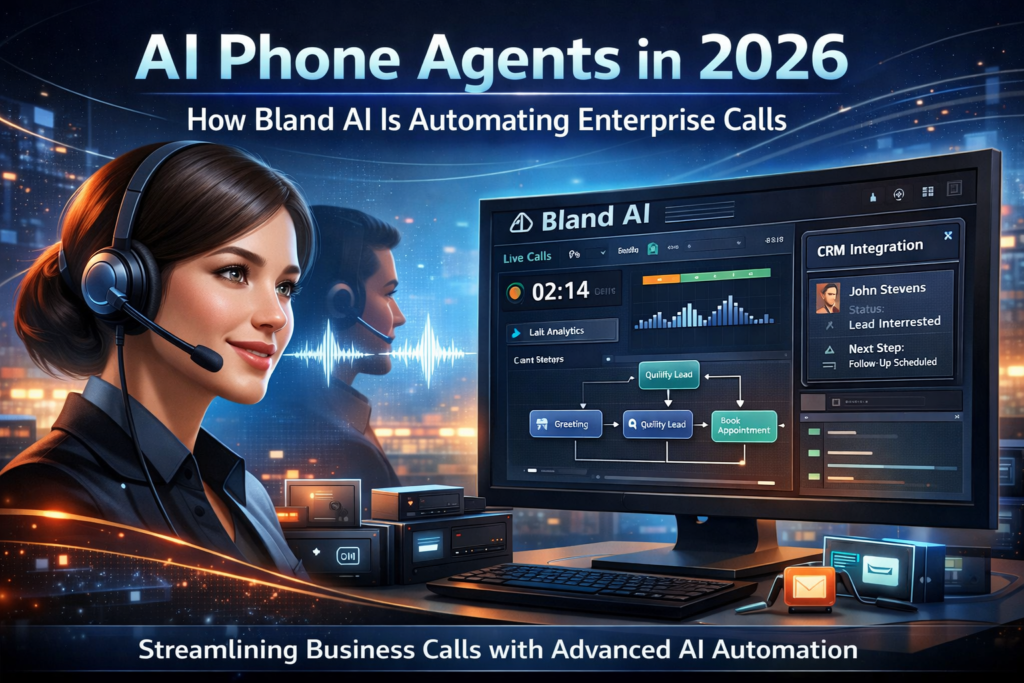
AI phone agents are no longer a futuristic concept — they are actively replacing human call center staff for millions of interactions every day. If your business handles high volumes of inbound or outbound calls and you’re looking for a scalable, cost-efficient solution, this guide breaks down everything you need to know about Bland AI, one of the most developer-forward AI phone agent platforms on the market.
What Is an AI Phone Agent?
Definition: An AI phone agent is a software-powered voice system that conducts real-time telephone conversations using natural language processing (NLP), text-to-speech (TTS), and large language model (LLM) technology — all without human involvement.
Unlike legacy interactive voice response (IVR) systems that force callers through rigid menu trees, modern AI phone agents understand conversational intent, handle interruptions gracefully, adapt to unexpected inputs, and carry context across multiple turns of dialogue.
They are used for:
- Inbound customer support — answering FAQs, resolving issues, routing complex cases
- Outbound sales and lead qualification — calling prospects at scale
- Appointment scheduling and reminders — healthcare, real estate, service industries
- Collections and follow-ups — financial services and e-commerce
AI-powered phone agent interactions are growing rapidly, projected to rise from just 1.6% of customer phone interactions in 2022 to over 10% by 2025. Synthflow For businesses that rely on the telephone as a primary channel, that inflection point makes choosing the right platform a mission-critical decision.
What Is Bland AI?
Founded in 2023 and backed by Y Combinator, Bland AI is a platform that allows businesses to automate phone calls using ultra-realistic voice agents. LeadAdvisors Headquartered in San Francisco, the company has grown quickly into one of the most well-funded pure-play AI phone agent vendors in the market.
Bland AI has raised a total of $65 million in funding, including a $40 million Series B round led by Emergence Capital in January 2025. Cognigy
The platform’s founding philosophy, as articulated by CEO Isaiah Granet, is direct: humans cannot work 24/7, manage millions of simultaneous calls, or be trained to a brand’s exact standards — but AI can, at a fraction of the cost. Customers like Better.com and Sears are creating custom AI agents, configuring and personalizing how they should react, deploying them to answer or send phone calls, extracting information for detailed analytics, and passing relevant data back into existing systems. Business Wire
How Bland AI Works: A Technical Breakdown
Bland AI is built on a proprietary orchestration framework and an edge delivery network optimized for low-latency voice interactions. Here’s how its core components function:
Conversational Pathways: Your Call Logic Engine
Pathways are Bland AI’s flowchart-style scripts. Each “node” represents a question, condition, or action; arrows define how the agent hops around based on the caller’s replies. You can test pathways inside the dashboard or dispatch real calls from the command line — think of it as a programmable IVR on steroids. Techpresso
Each node can contain prompts, conditional logic, and external integrations. This architecture gives technical teams surgical control over every branch of a conversation, from a basic FAQ response to a complex multi-step qualification flow.
Voice Cloning and Caller Memory
Bland AI offers beta access to voice cloning. Record a short sample, upload it, and spin up an agent that sounds like your CEO — or your favorite radio host. Techpresso
Memory is equally impressive. Bland’s Memory feature links callers by phone number (or a custom ID) and stores metadata, summaries, and campaign tags. When that caller rings again — two minutes or two months later — the agent can greet them by name, recall prior issues, and continue the conversation seamlessly. Techpresso
This persistent context is a major differentiator for AI phone agents in high-touch verticals like financial services and healthcare, where call history continuity drives customer satisfaction.
Webhooks and Real-Time Integrations
Need to push a lead into HubSpot mid-call? Pull an order status from Shopify? Drop in a Webhook node. It fires an HTTP request, waits for the response, parses JSON, and routes the dialogue based on what comes back — and you can even have the bot “fill the silence” while the request processes. Techpresso
This makes Bland AI’s AI phone agents genuinely action-capable, not just conversational. They can read from and write to external systems in real time, transforming a phone call into a fully automated business workflow.
Bland AI Key Features at a Glance
| Feature | Details |
|---|---|
| Conversational Pathways | Node-based visual call flow builder |
| Voice Library | Pre-built voices (multiple genders/tones) + voice cloning (beta) |
| Memory | Persistent caller context via phone number or custom ID |
| Webhooks | Mid-call API calls to external CRMs, databases, and services |
| Multilingual Support | Available as an add-on; English-first by default |
| Telephony Integration | Twilio, SIP, native Bland numbers |
| Analytics | Real-time call monitoring, transcripts, data extraction |
| Security | SOC 2 Type II and HIPAA certified |
| Scaling | Thousands of simultaneous calls; dedicated enterprise clusters |
| Knowledge Base | Auto-detection of unanswered questions to improve agents over time |
Who Should Use Bland AI?
Ideal Use Cases
Bland AI is purpose-built for teams that need scale, customization, and API control. It excels in the following scenarios:
- Enterprise sales teams running high-volume outbound calling campaigns
- Healthcare providers using automated patient outreach, appointment reminders, and intake calls (HIPAA-compliant out of the box)
- Financial services firms managing collections, follow-ups, or account verification
- Customer support operations handling routine tier-1 inquiries at scale
Thanks to major advances in speech technology, not only do AI phone agents sound normal when speaking, but their time to respond is as quick as a human’s would be in a normal conversation. Bland AI This naturalness is what makes the technology viable for high-stakes customer interactions.
Who Should Look Elsewhere
Small businesses or operations teams looking for an out-of-the-box solution may find the setup and pricing structure overwhelming without developer support. Teams wanting multi-channel automation — like email follow-ups or CRM syncing — may find other tools cover those needs more efficiently. Lindy
If you don’t have an engineering team capable of working with REST APIs and building conversational pathways, Bland AI’s learning curve may outpace its benefits.
Bland AI Pricing: What You’ll Actually Pay
Bland AI uses a usage-based pricing model. Here’s what enterprise buyers need to understand:
- Base call rate: $0.09 per minute for outbound calls
- Call transfers: $0.025 per minute (when using Bland’s telephony)
- Voicemail detection: $0.09 per minute
- Failed calls: $0.015 minimum fee per attempt
- SMS: $0.02 per message (inbound and outbound)
Key features such as voice cloning, multilingual support, and GPT prompt handling are charged separately and not included in the base pricing. For many enterprises, Bland AI’s minimum expected spend is $150k+ per year, making it less practical for startups and small businesses seeking more budget-friendly options. Dograh AI
What this means in practice: A company running 100,000 minutes of AI phone agent calls per month would spend approximately $9,000/month at baseline — before add-ons. Enterprises with complex flows that use GPT-4, voice cloning, and multilingual support will see that number rise significantly.
There is no publicly listed pricing page with tiered plans. Pricing is not visible unless you book a demo, which frustrates teams comparing tools against a defined budget. Lindy
Bland AI vs. Competitors: Head-to-Head Comparison
How does Bland AI stack up against the main alternatives in the AI phone agent and voice automation space?
| Platform | Best For | Pricing Model | No-Code Builder | Multilingual | Key Differentiator |
|---|---|---|---|---|---|
| Bland AI | Enterprise / Developer | $0.09/min + add-ons | Partial (Zapier/Make) | Add-on | API depth, SOC2/HIPAA, voice cloning |
| Synthflow | SMB / Mid-market | $0.08/min (all-in) | Yes (drag-and-drop) | Included | Transparent pricing, GPT-4 included |
| Vapi | Developers | Usage-based | No | Yes | Open model choice, ultra-low latency |
| Retell AI | Mid-market | Usage-based | Limited | Yes | Fast deployment, good default voices |
| Lindy | Non-technical teams | Fixed tiers | Yes | Yes | Multi-channel (calls + email + CRM) |
| Cognigy | Large Enterprise | Custom | Yes | Yes | Omnichannel, voice + chat + messaging |
Synthflow’s transparent rates include everything in the cost of your subscription, including a turbo-charged GPT-4 LLM — making it cheaper than Bland for teams that don’t need enterprise-level customization. Synthflow
Bland’s true competitive moat is its infrastructure depth and compliance posture. For regulated industries that need HIPAA certification, dedicated compute clusters, and webhook-driven workflows baked into every call, no competitor matches its technical surface area.
Bland AI Pros and Cons
Pros
- Natural-sounding voice output with extremely low perceived latency during calls
- API-first architecture gives developers full control over every conversation element
- SOC 2 Type II and HIPAA certified — essential for healthcare and finance
- Persistent caller memory enables personalized repeat interactions
- Scales to thousands of simultaneous AI phone agent calls with dedicated enterprise clusters
- Webhook mid-call actions connect calls to live business data in real time
- AI agents improve with every interaction, identifying knowledge gaps and continuously updating their responses Bland AI
Cons
- No true no-code builder — setup requires engineering resources
- Latency of approximately 800ms can affect the naturalness of some conversations LeadAdvisors
- English-only voices by default — multilingual support requires additional fees
- Opaque pricing — no public plan comparison page; demo required for quotes
- High minimum spend makes it inaccessible to smaller businesses
- Mixed customer support reviews — community-driven model lacks structured onboarding
The Future of AI Phone Agents: Where Is This Heading?
The AI phone agent market is at an inflection point. Bland’s team believes that over the next several years, customers will actually prefer to speak to an AI agent because of how efficient and pleasant they are. Bland AI That’s a bold prediction — but the underlying trends support it.
Several forces are accelerating adoption:
1. Voice models are getting dramatically better. The gap between AI-generated and human voice continues to narrow. Real-time interruption handling, emotional tone matching, and sub-second response latency are now table stakes for leading platforms.
2. The cost equation is shifting. Human call center agents cost $25–$65/hour fully loaded in most markets. An AI phone agent running at $0.09/minute costs roughly $5.40/hour for continuous active call time — with zero downtime, no turnover, and instant scaling.
3. Regulatory pressure is creating moats. As HIPAA, GDPR, and financial compliance requirements tighten around AI voice systems, platforms with built-in compliance certifications (like Bland’s SOC 2 / HIPAA stack) will widen their advantage over generic LLM wrappers.
4. Multi-modal is the next frontier. Bland’s platform handles voice, webchat, and SMS use cases with its conversational AI agents. Bland AI The platforms that unify voice with digital channels will own the enterprise contact center of the future.
Is Bland AI Right for Your Business?
Here’s a quick decision framework:
Choose Bland AI if:
- You have an in-house engineering team comfortable with REST APIs
- You need enterprise-grade security (SOC 2, HIPAA)
- Your use case requires complex multi-step conversation logic and mid-call integrations
- You’re operating at scale (tens of thousands of call minutes per month)
Consider alternatives if:
- You need a no-code setup that non-technical staff can manage
- Budget transparency is critical and you need fixed monthly pricing
- You need omnichannel support (voice + email + CRM) from a single platform
- You’re a startup or SMB with under $10k/month in expected call spend
Conclusion
AI phone agents represent one of the highest-ROI automation opportunities available to enterprises today — and Bland AI is one of the most technically capable platforms in the space. Its combination of low-latency voice, deep API control, conversational pathway architecture, and enterprise compliance certifications makes it a serious choice for organizations that are ready to operationalize voice AI at scale.
The trade-off is real: Bland AI demands engineering investment, carries opaque pricing, and is not designed for non-technical buyers. But for the right team with the right use case, deploying AI phone agents through Bland can eliminate call center bottlenecks, reduce support costs dramatically, and deliver consistent, on-brand customer experiences 24 hours a day.
The question is no longer whether AI phone agents will reshape enterprise communication. The question is whether your organization will lead that shift — or spend the next three years catching up.
Frequently Asked Questions (FAQs) About AI Phone Agents
1. What are AI phone agents and how do they work?
AI phone agents are advanced voice-based systems that use artificial intelligence to handle real-time phone conversations without human intervention. These AI phone agents rely on technologies like natural language processing (NLP), text-to-speech (TTS), and large language models (LLMs) to understand and respond to callers.
Unlike traditional IVR systems, AI phone agents can interpret intent, manage interruptions, and provide contextual responses. When a customer calls, AI phone agents analyze speech input, process it through AI models, and generate human-like responses instantly. This makes AI phone agents far more dynamic and effective than older call automation systems.
2. How are AI phone agents different from traditional call center systems?
AI phone agents are significantly more advanced than traditional call center systems or IVR solutions. While legacy systems rely on rigid menu-based navigation, AI phone agents enable natural, conversational interactions.
AI phone agents can understand complex queries, adapt responses in real time, and even remember past interactions. Traditional systems often frustrate users with limited options, whereas AI phone agents provide personalized, fluid conversations. This makes AI phone agents ideal for modern businesses looking to enhance customer experience and reduce friction.
3. What are the main benefits of using AI phone agents for businesses?
AI phone agents offer several powerful benefits for businesses of all sizes. First, AI phone agents drastically reduce operational costs by minimizing the need for large human call center teams. Second, AI phone agents operate 24/7, ensuring no missed calls or opportunities.
Additionally, AI phone agents improve scalability, allowing businesses to handle thousands of calls simultaneously. AI phone agents also provide consistent responses, eliminating human errors and variability. With real-time analytics and data collection, AI phone agents help businesses make better decisions and continuously optimize performance.
4. Are AI phone agents suitable for small businesses?
AI phone agents can be highly beneficial for small businesses, but the suitability depends on the platform and budget. Some AI phone agents platforms are designed for enterprise-level usage, requiring technical expertise and higher investment.
However, newer solutions are making AI phone agents more accessible to small and medium businesses. These AI phone agents platforms offer simplified interfaces, lower pricing tiers, and quick deployment options. For small businesses looking to automate customer support or lead qualification, AI phone agents can be a game-changing investment.
5. Can AI phone agents replace human call center agents completely?
AI phone agents can handle a large percentage of routine and repetitive calls, but they may not completely replace human agents in every scenario. AI phone agents excel at tasks like answering FAQs, booking appointments, and qualifying leads.
However, complex or emotionally sensitive situations may still require human intervention. The most effective approach is a hybrid model, where AI phone agents handle initial interactions and escalate complex cases to human agents. This combination ensures efficiency while maintaining a human touch when needed.
6. How secure are AI phone agents for handling sensitive data?
AI phone agents can be highly secure when implemented correctly. Many AI phone agents platforms offer enterprise-grade security features such as data encryption, secure APIs, and compliance certifications like SOC 2 and HIPAA.
AI phone agents used in industries like healthcare and finance are specifically designed to meet strict regulatory requirements. Businesses must ensure they choose trusted vendors and follow best practices to maintain data privacy and security when deploying AI phone agents.
7. What industries benefit the most from AI phone agents?
AI phone agents are transforming multiple industries by automating communication at scale. Healthcare providers use AI phone agents for appointment scheduling and patient follow-ups. Financial institutions rely on AI phone agents for collections and account verification.
E-commerce companies leverage AI phone agents for customer support and order tracking, while real estate firms use AI phone agents for lead qualification. Any industry that handles high volumes of phone interactions can benefit from AI phone agents.
8. How much do AI phone agents cost?
The cost of AI phone agents varies depending on the platform, features, and usage volume. Most AI phone agents operate on a usage-based pricing model, typically charging per minute of call time.
Basic AI phone agents solutions may cost a few cents per minute, while advanced enterprise-grade AI phone agents with voice cloning, integrations, and analytics can be more expensive. Businesses should evaluate their call volume and feature requirements to estimate the total cost of implementing AI phone agents.
9. How do AI phone agents improve customer experience?
AI phone agents significantly enhance customer experience by providing fast, accurate, and personalized responses. Customers no longer have to wait in long queues, as AI phone agents can handle multiple calls simultaneously.
AI phone agents also reduce frustration by understanding natural language instead of forcing users through rigid menus. With memory capabilities, AI phone agents can recall previous interactions and deliver a more personalized experience, improving customer satisfaction and loyalty.
10. What is the future of AI phone agents in business communication?
The future of AI phone agents is extremely promising as technology continues to evolve. AI phone agents are becoming more human-like in voice, tone, and responsiveness, making them increasingly acceptable to customers.
In the coming years, AI phone agents will integrate more deeply with CRM systems, marketing tools, and omnichannel platforms. Businesses will rely on AI phone agents not just for support, but also for sales, engagement, and customer retention. As adoption grows, AI phone agents will become a standard component of modern business communication.