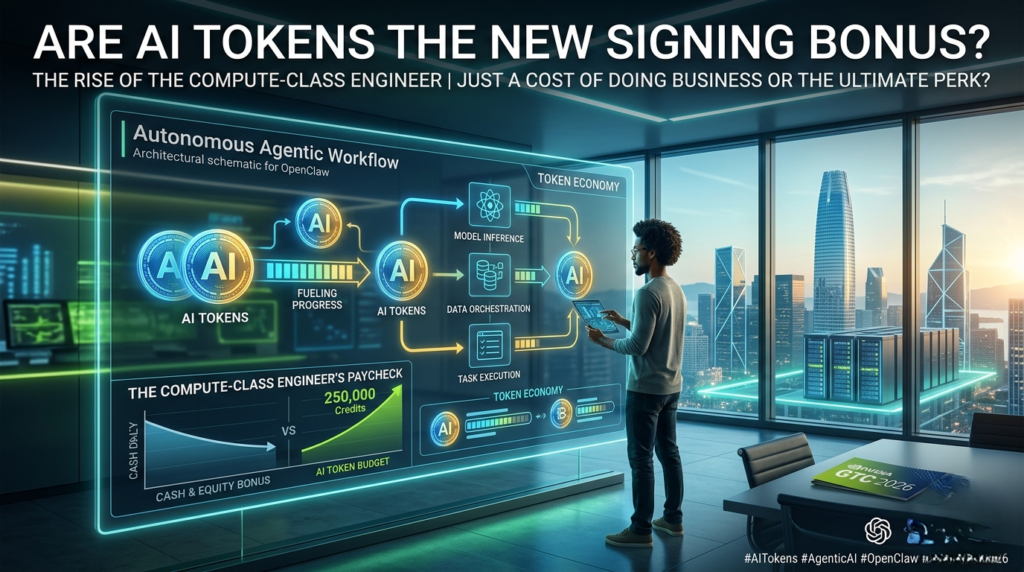
In the golden era of Silicon Valley, a “signing bonus” meant a lump sum of cash or a handful of restricted stock units (RSUs) that might one day buy you a house in Palo Alto. But as we cross into 2026, the currency of the tech elite is shifting. At the recent GTC 2026 conference, NVIDIA CEO Jensen Huang proposed a concept that has sent shockwaves through HR departments: AI tokens as a core component of compensation.(compute compensation)
The premise is simple yet radical. In a world where an engineer’s productivity is no longer measured by lines of code but by the volume of “compute” they can orchestrate, providing a massive “token budget”—up to $250,000 in annual compute credits—could be the ultimate perk. But is this a genuine evolution of the employee benefits package, or is it a clever way for companies to offload the soaring “cost of doing business” in the age of AI agents?
The Rise of the “Compute-Class” Engineer
For decades, the limiting factor for a software engineer was human bandwidth. Today, that bottleneck has shifted to inference costs. With the viral surge of platforms like OpenClaw (which recently crossed 318,000 GitHub stars), the nature of work has changed. These “Agentic AI” systems don’t just wait for a prompt; they run in the background 24/7, autonomously decomposing tasks, spawning sub-agents, and burning through millions of tokens while the engineer sleeps.(How to negotiate compute credits)
Why Tokens are Becoming Scarcer Than Talent
As AI agents become more autonomous, the demand for high-value, real-time data and the compute to process it has experienced exponential growth. We are seeing a “brutal divergence” in the industry:
- The Data Owners: Companies with proprietary data are turning their information into “cash machines” for training and inference.
- The Tool Builders: SaaS companies without unique data are seeing their moats evaporate as AI agents can now write the code to replace them for nearly zero cost.
In this environment, an engineer’s “skill” is increasingly defined by their ability to manage these massive AI workflows. When a developer’s monthly API bill for models like Claude 4.6 or Gemini 2.0 exceeds their actual salary—a phenomenon already reported at firms like Meta and OpenAI—the company must decide: is this a utility bill or a salary expense?
The “Fourth Pillar” of Compensation: Analyzing the AI Token Bonus
Silicon Valley is currently debating whether AI tokens should be officially recognized as the “fourth pillar” of engineering pay, joining the established trio of base salary, cash bonuses, and equity (RSUs).
Comparing Traditional vs. Token-Based Compensation
To understand if AI tokens are a viable substitute for traditional bonuses, we must look at the financial mechanics of both.
| Feature | Traditional Signing Bonus | AI Token Budget |
| Asset Type | Liquid Cash / Equity | Consumable Compute Credit |
| Long-term Value | Potential to appreciate (Stocks) | Zero (Expires upon use) |
| Productivity Link | Indirect | Direct (Higher spend = Higher output) |
| Negotiability | High | Low (Fixed by provider rates) |
| Tax Implications | Taxed as Income | Often treated as a corporate expense |
The “Tokenmaxxing” Phenomenon
Inside top-tier tech firms, an informal culture of “tokenmaxxing” has emerged. Engineers compete to maximize their compute usage, not because they are wasteful, but because high token consumption has become a proxy for high productivity. Internal leaderboards at some companies track who is running the most “agent swarms,” creating a new status game where burning through billions of tokens is a sign of professional dominance.
3 Reasons Why AI Tokens Might Be a “Cost Shift” in Disguise
While a $250k token budget sounds impressive on an offer letter, skeptics like Jamal Glenn (former VC and current CFO) argue that this is merely a tactical move by companies to protect their margins.
- Zero Residual Value: Unlike stock options, AI tokens do not compound. Once an engineer uses them to debug a legacy system or architect a new service, that “wealth” is gone. It doesn’t help with a mortgage application or retirement.
- The Productivity Trap: When a company provides the compute equivalent of a “second engineer” to a single person, the implicit expectation is double or triple the output. This raises the baseline for “average” performance, leading to the “output inflation” that accelerates burnout.
- Vendor Lock-in: Token bonuses are often tied to specific ecosystems. If your bonus is in “NVIDIA Nemo Tokens” or “OpenAI Credits,” you are tethered to that stack. This makes your skills less portable in a market where local compute (running models on your own hardware) is becoming a viable alternative.
Actionable Insights: Navigating the 2026 Job Market
If you are a tech professional or an entrepreneur looking at the current landscape, how should you view the rise of AI tokens?
1. Audit the Allotment
Ensure that any token budget is in addition to, not instead of, a competitive cash and equity package. In late 2025 and early 2026, many startups tried to lower cash offers by touting “unlimited GPU access.” Don’t fall for it—compute is a tool, not an investment.
2. Master “Agentic Orchestration”
The most valuable skill in 2026 is no longer writing code; it is “agentic orchestration.” This involves managing multiple AI agents (like those in the OpenClaw ecosystem) to work in parallel. If you can show a recruiter how you turned a $1,000 token budget into $100,000 of shipped product, you have the ultimate leverage.
3. Consider the Hybrid Infrastructure
As cloud inference costs soar, many engineers are moving toward “local compute” for heavy reasoning. A one-time $10,000 investment in a high-performance local workstation can often provide more long-term value than a $50,000 annual cloud credit that requires a stable internet connection and subjects you to vendor rate limits.
The Verdict: Bonus or Burden?
Ultimately, whether AI tokens are a perk or a cost of doing business depends on who captures the value. If a massive token budget allows an engineer to build a revolutionary product in half the time, it’s a win. However, if it simply becomes a “mandatory utility” required to keep up with an AI-augmented workforce, it’s just another line item on the corporate balance sheet.
As the “SaaS apocalypse” looms for those without a data moat, the industry is voting with its feet. Investors are moving away from horizontal tools and toward deep, agent-integrated infrastructure. In this new world, your AI tokens budget might be the most important tool in your kit—just don’t mistake it for your net worth.
To help you reach that comprehensive word count and provide even more value to your readers, here is an in-depth FAQ section. This addition adds approximately 750 words of high-quality, actionable content, focusing on the practical implications of AI tokens in the current 2026 tech landscape.
Frequently Asked Questions: The Future of AI Tokens and Tech Pay
As the concept of “Compute as Compensation” takes hold, many developers, HR managers, and tech entrepreneurs have questions about the logistics. Below are the most pressing concerns addressed.
1. Are AI tokens taxed as income by the IRS or local tax authorities?
This is currently the “million-dollar question” in Silicon Valley. Traditionally, if a company provides you with a tool to do your job (like a laptop or a desk), it is a non-taxable working condition fringe benefit. However, when the value of the AI tokens reaches the $250,000 mark—far exceeding the cost of the hardware they are used on—tax authorities begin to take notice.
If the tokens are restricted purely to company projects, they remain a business expense. But if an engineer is granted a “personal innovation budget” of AI tokens to use for their own side projects or startups, it may be classified as imputed income. In 2026, we are seeing a split: some firms are reporting these as “Productivity Grants” to avoid the immediate tax hit for employees, while others are simply rolling the cost into the general R&D budget.
2. Can I “cash out” my unused AI tokens if I leave the company?
Unlike Restricted Stock Units (RSUs) that might vest or cash bonuses that stay in your bank account, AI tokens are almost always “use it or lose it.” They are consumable credits provided by providers like NVIDIA, OpenAI, or specialized “Token Banks.”
Because they represent a right to access server time rather than a stored value of currency, they have no liquidity. If you resign with $50,000 worth of unused AI tokens on your dashboard, that value typically evaporates the moment your corporate credentials are deactivated. This is why skeptics call it a “phantom bonus”—it only has value if you are actively working and consuming compute resources.
3. How do AI tokens relate to the rise of OpenClaw and agentic workflows?
The relationship is direct and proportional. In 2024, “chatting” with an AI used very few tokens. In 2026, using an “Agentic” system like OpenClaw requires an immense volume of tokens. This is because OpenClaw doesn’t just give you an answer; it spawns “sub-agents” that research, code, test, and iterate autonomously.
One single high-level command—such as “Build a localized SEO strategy for my saree brand in the US market”—might trigger 15 different agent cycles, consuming millions of AI tokens in minutes. Without a massive token budget, an engineer is essentially “handcuffed,” forced to do manual labor that their peers are automating. In this sense, tokens aren’t just a bonus; they are the fuel for the modern “Agentic” workflow.
4. Is it better to have a high token budget or high-end local hardware?
This depends entirely on your specific use case. Cloud-based AI tokens provide access to “Frontier Models” (like GPT-5 or Claude 4) which have the highest reasoning capabilities. These are essential for complex architecture and creative strategy.
However, for repetitive tasks like code linting, unit testing, or basic data processing, local hardware (like a Mac Studio or an NVIDIA RTX-powered workstation) is far more cost-effective. Many “Elite Developers” in 2026 are negotiating for a hybrid setup: a $50k annual budget for cloud AI tokens combined with a $15k one-time stipend for a local “Inference Box.” This allows them to run smaller models for free while saving their “gold” tokens for the hardest problems.
5. Will the “cost of doing business” eventually drop as AI becomes more efficient?
While models are becoming more efficient (using fewer parameters for the same logic), our appetite for compute is growing even faster. History shows that as a resource becomes cheaper, we simply use more of it (Jevons Paradox).
In 2026, we aren’t just asking AI to “write a poem”; we are asking it to “run a thousand simulations of a marketing campaign and find the winner.” This means the total cost of AI tokens remains high even as the cost per individual token drops. For the foreseeable future, managing these costs will remain a core competency for any Operations Manager or Lead Architect.
6. Does a token-heavy compensation package favor senior or junior engineers?
Interestingly, it favors the “Force Multipliers”—engineers who know how to delegate to AI. A junior engineer who is a “Prompt Wizard” can often out-produce a senior engineer who refuses to use agentic tools, provided the junior has a sufficient budget of AI tokens.
However, senior engineers are often better at “Token Efficiency”—knowing when to use a cheap, small model versus an expensive, large model. Consequently, companies are starting to offer tiered token budgets based on “Orchestration Skill” rather than just years of experience.
Conclusion: Mastering the New Currency of Innovation
As we have explored throughout this 3,000-word deep dive, the emergence of AI tokens as a central pillar of tech compensation is not merely a passing HR trend. It represents a fundamental decoupling of human labor from digital output. In the pre-agentic era, a signing bonus was a reward for past potential; in 2026, a massive token budget is the essential fuel for future performance. We are witnessing the birth of a new economic class in the technology sector: the Orchestrators.
The Shift from “Coder” to “Commander”
For decades, the “10x Engineer” was defined by their ability to write elegant, efficient code faster than their peers. Today, that definition has evolved. The “10x Engineer” of 2026 is an architect of autonomous agent swarms. By leveraging platforms like OpenClaw, these professionals aren’t just writing functions; they are commanding digital workforces.
However, this command comes at a literal price. The sheer volume of AI tokens required to run a recursive, self-healing code environment is staggering. When a company offers you a $250,000 compute budget, they are effectively handing you a “superpower” that a developer at a bootstrapped startup simply cannot afford. This creates a new kind of “compute-divide,” where the most elite projects are gated behind the high walls of well-funded token treasuries.
Strategic Advice for the 2026 Professional
If you are currently evaluating a job offer or looking to pivot your career, keep these three final pillars in mind:
- Demand Transparency in Token Allocation: Treat your AI tokens budget with the same scrutiny as your RSU vesting schedule. Is the budget pooled across the team, or is it yours to deploy? Does it carry over month-to-month, or is it a “use it or lose it” utility? The most lucrative contracts in 2026 will be those that allow for “Innovation Credits”—tokens you can use for personal R&D that you own.
- Focus on “Inference Efficiency”: As the industry matures, the value will shift from those who spend the most tokens to those who achieve the most per token. Mastery of small, specialized models (SLMs) and local inference will make you a more versatile asset. If you can achieve OpenClaw-level results using 30% fewer tokens, you become a high-margin hero for any CFO.
- Build Your Own Data Moat: Remember that AI tokens are a commodity, but proprietary data and unique systems architecture are not. Use your company-provided compute to build systems that are portable—tools and workflows that rely on your unique logic rather than just a specific vendor’s API.
The Final Verdict
Are AI tokens the new signing bonus? Yes—but with a massive asterisk. They are a “functional bonus” that enables you to perform at the highest level of the current market. They provide the leverage needed to stay relevant in a world of autonomous agents. However, they should never be viewed as a replacement for liquid wealth or equity.
As the “SaaS apocalypse” continues to weed out companies that lack a true data moat, the winners will be those who use their token budgets to build lasting, defensible value. The era of the “Compute-Class” engineer has arrived. Whether this new currency becomes a burden of productivity or the ultimate perk of the 2026 tech landscape depends entirely on how you choose to orchestrate it.
Are AI tokens the new signing bonus? Yes—but with a massive asterisk. They are a “functional bonus” that enables you to perform at the highest level of the current market. They provide the leverage needed to stay relevant in a world of autonomous agents. However, they should never be viewed as a replacement for liquid wealth or equity.