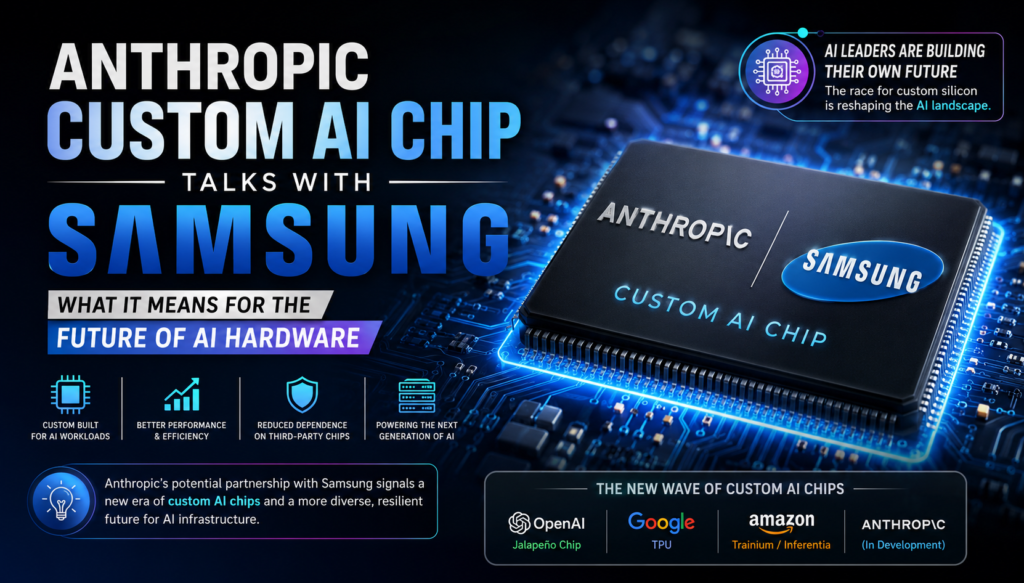
Anthropic is in early discussions with Samsung to develop a custom AI chip, according to a July 2026 report from The Information. The move would make Anthropic the latest major AI lab to pursue its own silicon, following a similar path already taken by OpenAI, Google, and Amazon in a market long dominated by Nvidia. Anthropic Custom AI Chip
If you’re trying to understand what this partnership actually involves, why it matters, and how it stacks up against rival chip programs, this guide breaks down everything currently known — and the strategic logic behind it.
What Is Happening Between Anthropic and Samsung?
Anthropic and Samsung are reportedly exploring a collaboration to manufacture a new custom AI chip, though no final decisions have been made about the chip’s purpose, architecture, or power specifications.
The Original Reuters Report
The idea that Anthropic might build its own silicon isn’t brand new. Back in April 2026, Reuters first reported that Anthropic was weighing the development of its own AI chips as a way to reduce its exposure to ongoing chip shortages. At the time, this was described as an idea the company was “toying with” rather than a confirmed plan — a hedge against supply constraints rather than a fully greenlit hardware division.
What The Information’s Report Adds
The story moved from speculation to something more concrete on July 2, 2026, when The Information reported that Anthropic was actively in talks with Samsung about manufacturing the chip. Crucially, the report notes that Anthropic has not yet decided:
- What the custom AI chip will actually be used for (training, inference, or both)
- How it will fit into existing server and data center infrastructure
- How powerful the final chip needs to be
When TechCrunch reached out for comment, Anthropic didn’t confirm or deny the Samsung talks directly. Instead, the company reiterated that a diversified hardware stack — spanning chips from Google, Amazon, and Nvidia — will remain “pivotal” to its compute strategy going forward. On the specific question of a Samsung partnership, Anthropic said it had nothing further to add.
In short: this is a real, active conversation — but it’s still exploratory. There’s no confirmed chip design, timeline, or deployment plan yet.
Why Would Anthropic Want a Custom AI Chip?
Anthropic wants a custom AI chip primarily to reduce its dependence on a single hardware supplier and to gain more control over the cost and availability of the compute that powers its Claude models.
Chip Shortages Are a Business Risk, Not Just an Inconvenience
Training and running frontier AI models requires enormous amounts of specialized compute. Nvidia’s GPUs remain the industry’s gold standard, but that dominance comes with a catch: when Nvidia supply tightens, every AI lab racing to scale its models feels it. A custom AI chip gives a company like Anthropic a hedge — a fallback option it controls directly rather than one it has to negotiate or wait for.
Diversification Is Already Anthropic’s Stated Strategy
This is the part worth paying close attention to. Anthropic’s own comment to TechCrunch emphasized that it already uses chips from three different providers — Google, Amazon, and Nvidia — and that this diversified approach will remain central to its compute strategy. A potential Samsung-built chip would simply be the next extension of a strategy Anthropic is already pursuing, not a dramatic pivot.
Why Now?
Timing matters here. Anthropic’s talks with Samsung come about a week after its most direct competitor, OpenAI, unveiled its own custom chip — a strong signal that the entire frontier AI industry has reached a point where owning part of the hardware stack is no longer optional for staying competitive.
How Does Anthropic’s Chip Compare to OpenAI’s Jalapeño?
OpenAI has already moved from talk to product: on June 24, 2026, OpenAI and Broadcom unveiled “Jalapeño,” a custom-built inference processor designed specifically for large language model workloads. Anthropic, by contrast, is still at the exploratory conversation stage with Samsung.
| Factor | Anthropic (Samsung talks) | OpenAI (Jalapeño / Broadcom) |
|---|---|---|
| Status | Early, exploratory discussions | Chip unveiled and named |
| Manufacturing partner | Samsung (reported, unconfirmed) | Broadcom (confirmed) |
| Chip purpose | Undecided — training, inference, or both | Purpose-built for LLM inference only |
| Design timeline | Not yet defined | Design to tape-out in ~9 months |
| Deployment target | Not yet defined | Initial deployment by late 2026 |
| Claimed advantage | N/A — too early to say | Substantially better performance-per-watt vs. current hardware |
| Existing hardware mix | Google, Amazon, Nvidia chips | Primarily Nvidia and AMD accelerators |
The key distinction is maturity. OpenAI’s Jalapeño already has a name, a manufacturing partner, engineering samples running real workloads, and a stated 2026 deployment window. Anthropic’s Samsung conversation, by comparison, is still at the “figuring out what we even want to build” stage — closer to where OpenAI’s chip ambitions were over a year before Jalapeño’s unveiling.
Samsung’s Growing Role in the AI Chip Market
Samsung is uniquely positioned to become an AI chip manufacturing hub because it already plays multiple roles in the AI hardware ecosystem — as an Nvidia manufacturing partner, a potential Google collaborator, and now a possible custom silicon partner for Anthropic.
Samsung’s Existing Nvidia Relationship
Samsung isn’t a newcomer to AI hardware. The company already acts as a major Nvidia manufacturing partner, producing chips that Nvidia needs to train and run its own AI models. That relationship runs in both directions — Samsung, in turn, relies on Nvidia’s software to manufacture its own chips. The two companies are also jointly building an AI chip factory in South Korea, deepening a relationship that already spans manufacturing and software.
Samsung and Google Talks
Samsung has reportedly held separate discussions with Google about partnering on Google’s next-generation AI chip efforts as well. Combined with the Nvidia factory partnership and the newly reported Anthropic conversation, a pattern emerges: Samsung is positioning itself as a go-to foundry option for AI labs that want to reduce reliance on Taiwan Semiconductor Manufacturing Company (TSMC) — especially as TSMC’s advanced-node capacity becomes increasingly constrained by demand.
What This Means for the Broader AI Chip Market
The push toward custom AI silicon isn’t limited to Anthropic and OpenAI — it’s becoming the default strategy for every major AI lab and cloud provider with the resources to pursue it.
Here’s a snapshot of who’s already building their own chips:
- Google — Custom Tensor Processing Units (TPUs), offered as part of its cloud computing stack
- Amazon — Trainium and Inferentia chips, built for AWS machine learning workloads
- OpenAI — Jalapeño, a purpose-built inference processor developed with Broadcom
- Microsoft — Maia, its own AI accelerator line
- Anthropic — Exploratory custom AI chip talks with Samsung (unconfirmed design)
The common thread across all of these efforts is control. Nvidia remains, in the article’s own words, “the undisputed leader of the chip industry” — but that leadership position is exactly what’s motivating competitors and customers alike to build alternatives. A custom AI chip lets a company tailor hardware to its own specific workloads (training vs. inference, particular model architectures, latency requirements) in ways that general-purpose GPUs can’t always match efficiently.
Why Inference Chips Specifically Matter Right Now
It’s worth noting that OpenAI’s Jalapeño is explicitly an inference chip, not a training chip — designed to run already-built models rather than train new ones from scratch. That distinction matters because inference is where AI companies increasingly spend the bulk of their compute budget: it’s the cost of actually serving answers to the hundreds of millions of people using tools like ChatGPT and Claude every day. Even modest efficiency gains at inference scale can translate into meaningful cost savings — which helps explain why so much of the current custom AI chip race is focused there first, ahead of the more complex challenge of custom training silicon.
Frequently Asked Questions
Is Anthropic definitely building a chip with Samsung?
No. As of July 2026, the relationship is described as early-stage discussions, not a signed deal or confirmed chip design. Anthropic has publicly declined to confirm details, and The Information’s report notes that even basic decisions — like whether the chip is for training or inference — haven’t been made yet.
Why doesn’t Anthropic just keep using Nvidia?
Anthropic already uses Nvidia chips and has said Nvidia will remain part of its hardware stack going forward. The goal of a custom AI chip isn’t to replace Nvidia entirely, but to diversify supply and reduce the business risk that comes from depending heavily on one vendor during a period of tight chip supply.
How is this different from what OpenAI just announced?
OpenAI’s chip, Jalapeño, is a confirmed, named product built with Broadcom, already running test workloads, and scheduled for deployment by late 2026. Anthropic’s Samsung talks are exploratory and don’t yet include a defined chip design, purpose, or timeline.
Does Samsung have experience building AI chips for other companies?
Yes. Samsung already manufactures chips for Nvidia, is building an AI chip factory with Nvidia in South Korea, and has held separate talks with Google about its next-generation AI chip. A partnership with Anthropic would extend a pattern Samsung has already established with other major AI players.
Why are so many AI companies building custom chips right now?
Rising demand for AI compute has outpaced supply, and Nvidia’s GPUs — while dominant — are subject to allocation constraints that can slow down a company’s ability to train and serve models. A custom AI chip gives a company more predictable access to compute tailored to its own workloads, rather than competing for general-purpose GPU allocation alongside every other AI company in the market.
The Bottom Line
The Anthropic Custom AI Chip initiative may still be in its early stages, but it already represents one of the most significant developments in the rapidly evolving AI hardware industry. While Anthropic has not officially confirmed a manufacturing partnership with Samsung or revealed technical specifications, the reported discussions signal a broader industry shift toward custom silicon. For companies building frontier AI models, relying exclusively on third-party hardware is no longer a sustainable long-term strategy. Instead, organizations are increasingly seeking greater control over the infrastructure that powers their artificial intelligence systems, making the Anthropic Custom AI Chip a development worth watching closely.
The growing interest in the Anthropic Custom AI Chip reflects a fundamental change in how leading AI companies think about compute. Until recently, purchasing high-performance GPUs from Nvidia was enough to train and deploy advanced AI models. However, explosive demand for AI infrastructure has created supply bottlenecks, increased hardware costs, and intensified competition for access to cutting-edge chips. As a result, companies like Anthropic are exploring ways to secure their own long-term computing capacity. A successful Anthropic Custom AI Chip could provide greater efficiency, better workload optimization, and reduced dependence on external suppliers.
Another reason the Anthropic Custom AI Chip has attracted widespread attention is the growing trend of AI companies designing purpose-built processors instead of relying solely on general-purpose accelerators. OpenAI has already introduced its Jalapeño inference processor, Google continues to expand its TPU ecosystem, Amazon has invested heavily in Trainium and Inferentia, and Microsoft is developing its Maia accelerator family. Against this competitive backdrop, the Anthropic Custom AI Chip would place Anthropic among the industry’s most ambitious innovators, reinforcing its commitment to building a complete AI ecosystem rather than simply creating advanced language models.
Samsung’s reported involvement makes the Anthropic Custom AI Chip even more noteworthy. As one of the world’s leading semiconductor manufacturers, Samsung possesses the expertise, fabrication capabilities, and global supply chain required to manufacture advanced AI processors. Although no agreement has been finalized, the possibility of Samsung producing the Anthropic Custom AI Chip demonstrates how major semiconductor companies are becoming strategic partners for AI laboratories seeking alternatives to traditional hardware suppliers. This partnership could strengthen Samsung’s position as a preferred manufacturing partner for next-generation AI chips while helping Anthropic diversify its infrastructure strategy.
The potential benefits of the Anthropic Custom AI Chip extend well beyond hardware ownership. Custom silicon enables organizations to optimize processors specifically for their own machine learning workloads. Whether the focus is training massive foundation models, serving billions of inference requests, or improving energy efficiency, a purpose-built processor can outperform generic hardware in targeted scenarios. If successfully developed, the Anthropic Custom AI Chip could reduce operational costs, improve latency, increase performance per watt, and enable Anthropic to scale Claude and future AI models more efficiently than ever before.
However, it’s equally important to recognize that the Anthropic Custom AI Chip remains an exploratory project rather than a finished product. Current reports indicate that Anthropic has not yet finalized the chip’s architecture, manufacturing timeline, intended workloads, or deployment schedule. Unlike OpenAI’s Jalapeño processor, which has already been unveiled and tested, the Anthropic Custom AI Chip is still progressing through early strategic discussions. Readers should therefore view current reports as an indication of future direction rather than confirmation of a commercial product.
Even if the Anthropic Custom AI Chip never reaches production exactly as envisioned today, the conversations themselves reveal an important reality about the future of artificial intelligence. Success in AI will increasingly depend not only on better algorithms but also on better infrastructure. Companies that can design optimized hardware, secure reliable manufacturing partners, and control their computing resources will gain meaningful competitive advantages in both cost and performance. This explains why custom silicon has become a strategic priority across the AI industry.
Looking ahead, the Anthropic Custom AI Chip could become a defining milestone in the evolution of enterprise AI infrastructure. As AI models continue to grow larger and demand more computational power, efficient hardware will become just as valuable as innovative software. Organizations capable of integrating proprietary chips with advanced AI models will likely deliver faster services, lower operational expenses, and improved scalability. Whether Anthropic ultimately manufactures a training processor, an inference accelerator, or a hybrid solution, its investment in custom hardware reflects where the industry is heading.
Ultimately, the Anthropic Custom AI Chip is about much more than one company or one semiconductor project. It symbolizes the next phase of AI competition, where hardware innovation stands alongside model quality, data, and software engineering as a key differentiator. As the race for AI leadership accelerates, partnerships between AI labs and semiconductor manufacturers will become increasingly common, reshaping the future of artificial intelligence infrastructure worldwide.
For businesses, developers, investors, and technology enthusiasts, the Anthropic Custom AI Chip is a story worth following closely. Even before a single chip reaches production, it highlights the strategic importance of owning critical AI infrastructure and reducing reliance on limited GPU supply. As new details emerge over the coming months, the Anthropic Custom AI Chip could evolve from an exploratory initiative into one of the most influential AI hardware projects of 2026, helping define how future AI systems are built, deployed, and scaled across the global technology landscape.
Final Thoughts
The Anthropic Custom AI Chip story is about much more than a potential partnership between Anthropic and Samsung—it reflects a broader transformation taking place across the artificial intelligence industry. As AI models become larger, more sophisticated, and more computationally demanding, access to reliable, high-performance hardware has become a strategic advantage rather than just a technical requirement. The reported discussions surrounding the Anthropic Custom AI Chip demonstrate how leading AI companies are looking beyond software innovation and investing in purpose-built infrastructure that can deliver greater efficiency, lower operating costs, and long-term scalability.
Although the Anthropic Custom AI Chip has not yet been officially confirmed or detailed, the reported talks are significant because they align with a growing industry trend. Companies such as OpenAI, Google, Amazon, and Microsoft have already committed substantial resources to developing proprietary AI processors, recognizing that customized silicon can offer performance and cost benefits that general-purpose hardware cannot always provide. If the Anthropic Custom AI Chip moves from concept to production, it could strengthen Anthropic’s competitive position while reducing its dependence on limited GPU availability and improving the performance of future Claude models.
The partnership with Samsung, if finalized, would also highlight the increasing importance of semiconductor manufacturers in shaping the future of AI. Samsung’s advanced fabrication capabilities and experience in producing cutting-edge chips make it a logical partner for ambitious AI hardware projects. A successful Anthropic Custom AI Chip could demonstrate how collaborations between AI laboratories and semiconductor companies will define the next generation of AI infrastructure, enabling faster innovation and more resilient supply chains.
Ultimately, the Anthropic Custom AI Chip is a development that deserves close attention from developers, enterprises, investors, and technology enthusiasts alike. Whether the project results in a training accelerator, an inference processor, or a hybrid architecture, it represents the industry’s shift toward vertically integrated AI ecosystems. As competition intensifies and demand for AI computing continues to rise, the Anthropic Custom AI Chip could become one of the defining milestones in the evolution of AI hardware, influencing how future AI systems are built, deployed, and scaled across the global technology landscape.