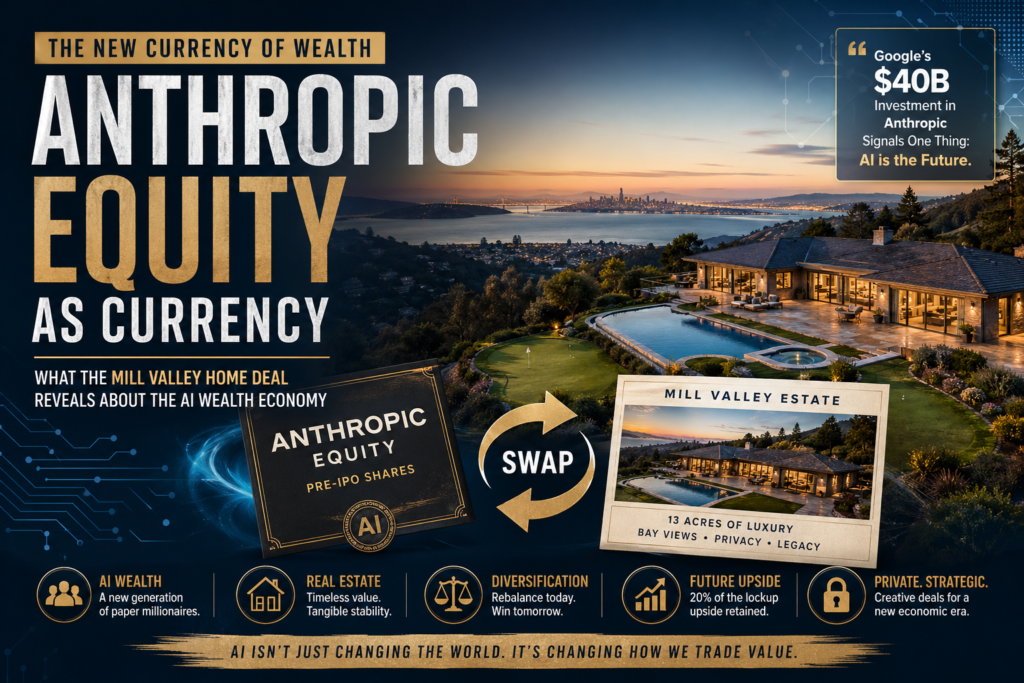
The Bay Area real estate market just got a new form of currency: Anthropic equity. A Mill Valley homeowner is offering his 13-acre estate not for cash, but for pre-IPO shares in the AI company valued at over $60 billion — and it signals something profound about where wealth is concentrating in 2026.
What Is the Anthropic Equity Home Deal?
Definition: The Anthropic equity home deal is a private real estate transaction proposed by Miami-based investment banker Storm Duncan, in which he offers to exchange his Bay Area property — a four-bedroom, five-bathroom ranch estate at 114 Inez Place in Mill Valley, California — for shares of Anthropic, the AI safety company behind the Claude family of models.
Duncan purchased the property in 2019 for $4.75 million. The compound sits on roughly 13 acres in Marin County’s Strawberry neighborhood, featuring an infinity pool, hot tub, a putting green, and sweeping panoramic views of San Francisco Bay, Mount Tamalpais, and the city skyline. It is currently occupied by a “high-profile VC,” according to Duncan, though he declined to name the tenant.
Rather than listing the home traditionally, Duncan created a LinkedIn page for the property — proposing an equity-for-real-estate swap. He is asking interested parties to email him directly to discuss specifics, noting that the transaction would be entirely private and would not require the buyer to sell their shares outright.
Why Would Anyone Swap a House for AI Startup Equity?
This isn’t a gimmick. It’s a calculated portfolio strategy rooted in a simple asymmetry of exposure.
The Diversification Logic
Duncan explained his reasoning plainly: he is over-concentrated in real estate and under-concentrated in AI assets — specifically Anthropic equity — “relative to the importance of AI in the future.” His ideal counterparty is a young Anthropic employee sitting on significant pre-IPO stock but lacking the liquid wealth or diversification that real estate provides.
In Duncan’s framing, a junior Anthropic engineer earning a software salary might have the majority of their net worth locked up in unvested or restricted company stock. They are the mirror image of Duncan: over-concentrated in AI startup equity and under-concentrated in physical, income-producing assets. This deal is designed to fix both portfolios simultaneously.
Why Anthropic Specifically?
Anthropic has become one of the most valuable private AI companies in the world. In April 2026, Google announced an investment of up to $40 billion in the company — a staggering commitment that further validates Anthropic’s position at the center of the AI arms race. Amazon has also made significant multi-billion dollar investments. With such institutional backing and no IPO yet on the horizon, Anthropic equity is among the most coveted — and illiquid — assets in Silicon Valley.
That illiquidity is precisely the problem this deal attempts to solve. Duncan has indicated that the buyer would not need to sell their shares outright. Instead, he proposed a structure where the homebuyer retains 20% of the upside value of the shares exchanged for the duration of the lockup period — a creative mechanism that lets both parties participate in future appreciation.
The New Bay Area Housing Market: Where AI Equity Is the Currency
This deal didn’t emerge in a vacuum. It is a symptom of a broader economic shift reshaping the Bay Area housing market, where the primary barrier to homeownership for tech workers is no longer income — it is liquidity.
Many of the highest-earning individuals in San Francisco, Marin County, and the South Bay are “paper millionaires”: engineers, researchers, and product managers at companies like Anthropic, OpenAI, and xAI who hold significant equity stakes but cannot access that wealth until a liquidity event (typically an IPO or acquisition) occurs.
Traditional mortgage underwriting doesn’t account for unvested RSUs or pre-IPO stock options. Banks want salary and liquid assets. This creates a paradox: a person holding $10 million in Anthropic equity on paper might struggle to qualify for a conventional mortgage on a $4 million home in Mill Valley.
Duncan’s deal short-circuits that problem. By accepting Anthropic equity directly as consideration, he effectively creates a private marketplace for an asset class that has no public exchange.
Pre-IPO Equity vs. Cash: How Do They Compare?
| Factor | Cash Purchase | Anthropic Equity Swap |
|---|---|---|
| Liquidity for buyer | Requires selling liquid assets | No forced liquidation of stock |
| Seller’s exposure | Immediate cash, no upside | Gains AI asset exposure |
| Valuation certainty | Fixed at closing price | Subject to future equity value |
| Tax implications | Standard capital gains | Complex — consult a tax advisor |
| Transaction speed | Standard escrow timeline | Negotiated, private timeline |
| Regulatory complexity | Standard real estate law | Securities law considerations |
| Upside participation | None after sale | Buyer retains 20% of lockup upside |
The trade-off is clear: the buyer gains liquidity without selling their most valuable asset, while the seller gains AI sector exposure without buying on the open market. Both parties are betting on the same outcome — that Anthropic equity will be worth substantially more at IPO than it is today.
What This Means for AI Employees and Startup Equity Holders
If you are an employee at a pre-IPO AI company, this story is worth paying attention to — not because you should rush to trade your stock for real estate, but because it illustrates a rapidly maturing ecosystem of creative liquidity solutions.
The Liquidity Problem of Pre-IPO Stock
Pre-IPO employees face a structural challenge: their compensation is heavily weighted toward equity, but that equity has no market. Secondary markets like Forge Global, Nasdaq Private Market, and EquityZen exist, but they are restricted, often require company approval, and frequently involve meaningful discounts to the most recent 409A valuation.
This deal proposes a different model: peer-to-peer, private, negotiated — with the real estate itself serving as the settlement asset. It is unconventional, but it is not unprecedented. In previous tech cycles, similar informal arrangements emerged around Google, Facebook, and early Uber equity.
What makes the current moment different is the magnitude. Anthropic’s valuation trajectory and the sheer size of Google’s investment signal that the company’s equity could appreciate significantly before any IPO. That creates a strong incentive for holders to find creative ways to access value without triggering a taxable sale.
Key considerations for any AI employee thinking about a similar arrangement:
- Securities law compliance: Trading pre-IPO shares is subject to strict regulations. Any transaction involving Anthropic equity would need to comply with applicable securities laws and likely require company consent.
- Tax consequences: Exchanging equity for real estate is a taxable event. The fair market value of the property received would likely be treated as proceeds from a sale of the shares, triggering capital gains tax.
- Valuation risk: If Anthropic’s valuation declines before a liquidity event, the employee who traded equity for real estate may feel they got the better deal. If Anthropic IPOs at a much higher valuation, the opposite is true.
- Lock-up provisions: Most employee equity agreements include lock-up periods and right-of-first-refusal clauses that may restrict transfers.
Is Trading Real Estate for Startup Equity a Smart Move?
From Duncan’s perspective, this is a portfolio rebalancing exercise. From the potential buyer’s perspective, it is a question of conviction, risk tolerance, and tax planning.
Risks to Consider
The primary risk for the seller (Duncan) is concentration: by accepting Anthropic equity, he is making a high-conviction bet on a single private company at a lofty valuation. If Anthropic faces regulatory headwinds, loses key AI talent, or fails to monetize at expected rates, his newly acquired Anthropic equity could lose value while the real estate he gave up continues to appreciate.
For the buyer, the risk is simpler: they are trading a liquid asset (the potential to sell stock to a secondary buyer or at IPO) for an illiquid one (a 13-acre estate in Marin County). Real estate is not liquid. If they need cash after the transaction, they would need to sell or refinance the property.
Potential Upside
On the upside, Duncan’s thesis is compelling. Bay Area real estate — especially large, unique properties in Marin County with dramatic views — has historically held value well over long time horizons. For a young Anthropic employee sitting on millions in unvested shares and renting an apartment in San Francisco, owning a 13-acre estate outright (mortgage-free, if the equity swap covers the full value) could be transformative for their long-term financial stability.
Meanwhile, Duncan gains exposure to Anthropic equity at what he believes is an advantageous point in the company’s trajectory — before a public listing that could generate significant returns.
The Broader Trend: AI Wealth Reshaping Bay Area Real Estate
Duncan’s proposal may be unusual, but it reflects a structural reality: AI wealth is becoming the dominant economic force in the Bay Area, and real estate markets are adapting to accommodate it.
We are already seeing the effects in property prices. Neighborhoods close to AI company campuses — SoMa and Mission Bay in San Francisco, parts of Palo Alto and Menlo Park, and now Marin County suburbs accessible to the city — are experiencing sustained demand pressure from high-earning tech workers who arrived during the AI boom of the early 2020s.
The next evolution may be exactly what Duncan is proposing: a semi-formal secondary market for AI equity, collateralized by real property, negotiated peer-to-peer, and structured to give both parties economic participation in future upside. It is, in essence, a bespoke financial instrument — a private equity swap dressed up as a real estate transaction.
Whether Duncan finds a buyer remains to be seen. He told the San Francisco Standard that he was already in conversations with Anthropic shareholders. Given the size and quality of the property — and the compelling logic of the trade for the right counterparty — it would not be surprising if a deal gets done quietly, far from public markets.
Key Takeaways
- A Mill Valley homeowner is offering to swap a 13-acre Bay Area estate for Anthropic equity, in what he calls a “diversification play.”
- The deal targets Anthropic employees who are over-concentrated in pre-IPO stock and want real estate exposure without a forced liquidation.
- Anthropic equity has become one of the most coveted illiquid assets in tech, fueled by Google’s $40 billion investment commitment and the company’s leading position in AI safety research.
- The transaction would be private, structured so the buyer retains 20% of the upside on the shares during the lockup period.
- The deal reflects a broader trend: AI wealth is creating a new class of Bay Area “paper millionaires” who need creative liquidity solutions, and real estate is becoming an informal clearinghouse for pre-IPO AI equity.
- Anyone considering a similar arrangement should consult legal and tax advisors, as pre-IPO equity transfers are subject to complex securities law and significant tax consequences.