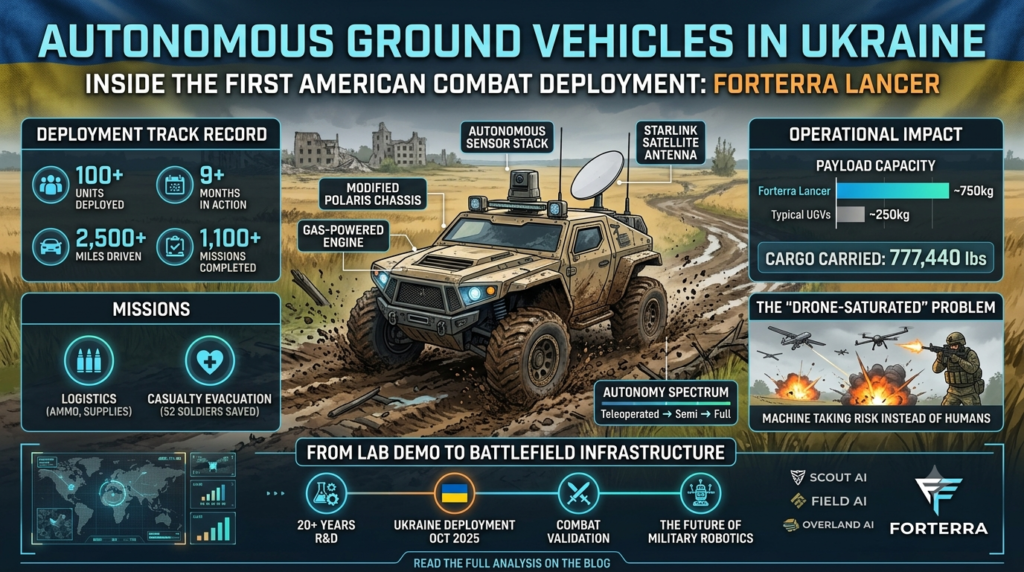
Autonomous ground vehicles have officially entered modern combat. Forterra, a US defense-tech company, has confirmed that more than 100 of its self-driving Lancer units have operated in Ukraine for the past nine months — the largest known battlefield deployment of this technology by any American defense company to date.
This isn’t a lab demo or a Pentagon press release full of hypotheticals. It’s more than 2,500 miles of real driving, over 1,100 completed missions, and dozens of soldiers pulled off the battlefield alive because a machine — not a human — made the run. For anyone tracking the future of warfare, robotics, or defense-tech investment, this is the moment unmanned ground systems stopped being a research project and started being infrastructure.
In this article, we’ll break down what these machines are, how they’re performing under fire, how they compare to aerial drones, who else is racing to build them, and what their battlefield record means for the future of military robotics.
What Are Autonomous Ground Vehicles?
Autonomous ground vehicles, often called uncrewed ground vehicles (UGVs) in a military context, are unmanned land-based platforms capable of navigating terrain, carrying cargo, or performing tasks with reduced or no direct human control.
Unlike aerial drones, which operate in open airspace, ground-based robotic systems have to contend with mud, minefields, obstacles, and constantly shifting terrain — problems that make full autonomy dramatically harder to achieve. That complexity is exactly why the Ukraine deployment matters: it’s a real-world stress test of technology that, until now, existed mostly in demos and controlled trials.
In practice, today’s military-grade unmanned vehicles fall into a spectrum:
- Teleoperated systems — a human remotely drives or supervises the platform in real time
- Semi-autonomous systems — the vehicle handles navigation and route-following, but humans intervene for decision-making
- Fully autonomous systems — the platform perceives, decides, and acts with minimal human input, even in unpredictable environments
Most of the machines currently fighting in Ukraine sit in the first two categories — a detail that turns out to be central to the whole story, and one worth returning to below.
Meet the Forterra Lancer: America’s First Combat-Tested Autonomous Ground Vehicle
Forterra’s Lancer is built on a modified Polaris all-terrain vehicle chassis and outfitted with a custom sensor and compute stack designed for autonomous navigation. It’s gas-powered rather than battery-powered, which gives it a meaningful edge in range and payload compared with alternatives already used by Ukrainian forces.
Specs and Capabilities
Ukraine has been building its own uncrewed ground vehicles for logistics and casualty evacuation, but those domestic systems are typically battery-powered and limited to roughly 250 kilograms of cargo per trip. The Lancer, by contrast, is rated to carry up to 750 kilograms — three times the payload — while also supporting a Starlink satellite antenna for connectivity in contested or degraded network environments.
That single modification, adding satellite connectivity, reportedly shifted Ukrainian soldiers’ opinion of these machines from skeptical to essential, since it let the platforms function reliably outside the reach of conventional battlefield networks. Forterra’s own leadership has described this kind of field adaptation as the difference between a vehicle built for a Pentagon spec sheet and one built for the muddy, improvisational reality of an active front line.
Deployment Numbers: The Data So Far
Since arriving in Ukraine last October, Forterra’s fleet has compiled a real operational track record — not projections, but logged missions:
| Metric | Figure |
|---|---|
| Vehicles deployed | 100+ |
| Time in active conflict zones | ~9 months |
| Total distance driven | 2,500+ miles |
| Missions completed | 1,100+ |
| Cargo carried | 777,440 lbs |
| Casualty evacuations | 52 |
| Typical payload capacity | 750 kg |
| Comparable Ukrainian UGVs’ payload | ~250 kg |
These numbers represent sustained operations in an active war zone, including losses. Some Lancer units have been destroyed, particularly when they became stuck in deep mud and were subsequently targeted by Russian forces at leisure.
Why Ukraine Needs Ground Robotics Now
The Drone-Saturated Battlefield Problem
Aerial drones have dominated headlines from the war in Ukraine, and for good reason — they’ve reshaped how ground forces move, hide, and survive. But that dominance has a dark side: constant aerial surveillance has created sprawling no-go zones where any movement can draw fire from first-person-view drones, loitering munitions, artillery, or mortars. As one US Army sergeant major involved in developing autonomous vehicle tactics put it, there’s simply nowhere left to hide once you’re spotted from above.
That reality has pushed Ukrainian military strategists toward ground-based autonomy as a complementary solution. If soldiers can’t safely walk or drive supplies to the front line themselves, machines can absorb that risk instead — moving ammunition, food, and equipment forward, and moving wounded soldiers back, without putting another human body in the kill zone.
The Limits of Existing Ukrainian UGVs
Ukraine already fields its own domestically built uncrewed ground vehicles for logistics and evacuation missions. They work — but they’re constrained. Most rely on battery power, which limits both range and payload, capping useful cargo at around 250 kilograms per trip. For units trying to resupply an entire position or extract several casualties at once, that ceiling matters enormously.
This is precisely the capability gap that gas-powered autonomous ground vehicles like the Lancer are designed to close, offering roughly triple the carrying capacity along with longer effective range and satellite-linked connectivity that doesn’t depend on local infrastructure.
How Are Autonomous Ground Vehicles Performing in Real Combat?
Q: Are these vehicles actually driving themselves in Ukraine, or are soldiers controlling them? A: Mostly, soldiers are still controlling them. Despite the label, most missions currently rely on teleoperation rather than full autonomy — partly because the platforms are too valuable to risk losing, and partly because current AI systems aren’t yet reliable enough to independently react to sudden enemy contact.
Teleoperation vs. Full Autonomy
Today’s systems can already navigate diverse and difficult terrain on their own. What they can’t yet do reliably is respond to an unfolding threat — identifying an ambush, adjusting a route in real time to avoid enemy fire, or making split-second tactical decisions the way a trained human operator would. That gap between “can drive itself” and “can think for itself under fire” is the current frontier of ground robotics research, and it’s the reason full autonomy remains a work in progress rather than a finished product.
Forterra’s approach to closing that gap combines classical robotics techniques — the same navigation algorithms that underpin self-driving cars — with newer generative AI models capable of more generalized reasoning about unfamiliar surroundings. One of the biggest obstacles is data: battlefield behaviors like navigating a minefield or operating a weapon system simply don’t exist in any open-source training dataset, so much of that knowledge has to be built from scratch through direct field observation.
Lessons Learned in the Field
Nine months of real combat exposure has forced rapid iteration on the underlying technology. Engineers have had to solve problems that rarely show up on a test range, including:
- Electronic warfare resilience — keeping vehicles operational despite jamming and signal interference
- Remote software updates — pushing fixes and improvements to platforms already deployed in the field
- Terrain adaptability — improving navigation in mud, rubble, and unpredictable ground conditions
- Survivability — reducing the odds of a vehicle getting stranded and becoming a target
This kind of ground truth, gathered directly from frontline operators, is difficult to replicate in a lab or a pitch deck. According to Forterra’s chief innovation officer, who personally visited a Ukrainian unit’s operations center, the real value comes from seeing exactly where the manual steps still are — where data has to be re-entered by hand, and where automation could genuinely relieve pressure on the people doing the work in real time.
Autonomous Ground Vehicles vs. Aerial Drones: A Side-by-Side Comparison
Aerial drones and ground-based platforms solve different problems, and understanding the distinction explains why militaries want both rather than choosing one over the other.
| Factor | Autonomous Ground Vehicles | Aerial Drones |
|---|---|---|
| Primary role | Logistics, resupply, casualty evacuation | Surveillance, strikes, reconnaissance |
| Payload capacity | High (up to 750 kg for Lancer-class platforms) | Low to moderate |
| Operating environment | Ground terrain, mud, roads, minefields | Open airspace |
| Visibility to enemy | Lower profile, harder to detect at distance | Highly visible via radar and optics once airborne |
| Autonomy maturity | Emerging; mostly teleoperated in combat today | More mature; widely autonomous in navigation |
| Cost per unit | Higher (vehicle-grade hardware and sensors) | Often lower, especially for expendable FPV drones |
| Key vulnerability | Getting stuck in terrain, targeted while immobile | Jamming, short flight time, limited payload |
The takeaway: aerial drones created the surveillance-heavy, high-risk environment that ground forces now operate in, and ground-based robotic platforms are emerging as the tool built specifically to survive and function inside that environment.
Who Else Is Building Military Autonomous Ground Vehicles?
Forterra isn’t alone in this race. A growing group of defense-tech startups is competing to solve the same problem — building unmanned platforms and the AI models needed to make them smarter and less dependent on human operators.
- Scout AI — raised $100 million to train foundation models and build a suite of autonomous platforms, including UGVs, for military use
- Field AI — currently trialing uncrewed ground vehicles with the US military
- Overland AI — also trialing UGV platforms as part of broader Army and Marine Corps modernization efforts
- Forterra — has raised more than $500 million in venture funding from investors including XYZ Venture Capital and Moore Strategic Partners, and has spent roughly two decades working on this technology, positioning it well for future national security contracts
This competitive landscape signals that ground robotics is no longer a niche research bet — they’re becoming a defense-tech category with real capital, real contracts, and real combat data behind them. Forterra’s field experience has already helped it secure production work alongside prime contractor Oshkosh Defense for a US Marine Corps program, underscoring how battlefield validation is starting to translate directly into government business.
What separates the leaders in this space isn’t just hardware — it’s the ability to translate messy, unpredictable combat data into better software. A vehicle that performs flawlessly on a Nevada test track can still fail in a Ukrainian field once mud, jamming, and unpredictable enemy behavior enter the equation. Investors backing this sector are increasingly betting on companies that can close that gap fastest, since combat-validated data is far harder to replicate than a well-funded lab.
Challenges Facing Autonomous Ground Vehicles in Ukraine
Even with a strong operational record, these platforms face real, unresolved obstacles before they can scale further:
They’re still too valuable to lose freely. Unlike cheap, expendable aerial drones, high-capability ground vehicles represent a significant investment, which limits how aggressively commanders are willing to deploy them.
Cost remains a sticking point. Ukrainian forces have been direct about this: attrition is a fact of the battlefield, and every lost vehicle needs to be replaced. That has created explicit pressure on manufacturers to bring prices down without sacrificing capability — one soldier who has worked with the vehicles put it bluntly, saying the units are needed badly and simply have to get cheaper.
Autonomy still has blind spots. Reacting to an active, unfolding enemy threat — rather than just navigating terrain — remains one of the hardest unsolved problems in the field. Soldiers on the ground have noted that the systems still can’t respond live to enemy contact the way a human operator can.
Terrain can still defeat the mission. Mud, deep ruts, and unpredictable ground conditions have caused losses when vehicles became immobilized and were subsequently targeted at leisure by Russian forces.
None of these challenges are disqualifying, but they explain why fully autonomous decision-making — machines acting tactically without any human in the loop — is still a future milestone rather than a present reality for the platforms deployed today.
What’s Next for Autonomous Ground Vehicles in Modern Warfare?
The trajectory is fairly clear: these platforms are moving from experimental status to essential battlefield infrastructure, but the fully autonomous version of that vision is still being built. Expect near-term progress to focus on three areas: cheaper hardware to reduce the cost of attrition, better real-time threat response so vehicles can react to enemy contact rather than just navigate around it, and tighter integration between classical robotics navigation and generative AI reasoning.
US military leaders appear convinced the underlying capability is already proven. Ground autonomy is achievable now, according to Army officials who have watched the Ukraine deployment unfold — and Ukraine has become the proving ground where that claim is being tested under fire, not in a lab. As more companies enter the space and combat data accumulates, the gap between teleoperated logistics vehicles and genuinely autonomous combat-support platforms is likely to narrow faster than it has at any point in the technology’s roughly twenty-year development history.
For defense planners, investors, and technologists alike, the lesson from Ukraine is straightforward: these platforms work well enough today to save lives and move critical supplies, even while the harder problem of battlefield decision-making autonomy remains unsolved.
Frequently Asked Questions
What are these ground robots used for in Ukraine? Primarily logistics — moving ammunition, supplies, and equipment to front-line positions — and casualty evacuation, transporting wounded soldiers out of combat zones without exposing additional personnel to risk.
Are these vehicles fully self-driving in combat? Not yet in most cases. While they can navigate terrain autonomously, current deployments in Ukraine rely heavily on teleoperation, since the technology can’t yet reliably respond to sudden enemy contact on its own.
How much can the Forterra Lancer carry? Up to 750 kilograms per trip — roughly three times the payload of comparable battery-powered uncrewed ground vehicles already used by Ukrainian forces.
Why does ground robotics matter if aerial drones already exist? Aerial drones and ground platforms solve different problems. Drones excel at surveillance and strikes, but their dominance has made ground movement extremely dangerous. Autonomous ground vehicles are designed specifically to move supplies and personnel safely within that drone-saturated environment.
What companies besides Forterra are building military UGVs? Scout AI, Field AI, and Overland AI are among the notable competitors currently developing or trialing unmanned ground platforms for military applications.
How long have these vehicles been deployed in Ukraine? Forterra’s Lancer units arrived in Ukraine last October, giving the fleet roughly nine months of continuous, documented combat operations as of mid-2026.
Final Takeaway
This technology has moved decisively out of the testing phase. Nine months of sustained combat use, thousands of miles driven, and dozens of lives saved through casualty evacuation missions represent hard evidence that this technology works — even if full autonomy is still a work in progress. As militaries and startups race to close the remaining gaps in cost, resilience, and real-time decision-making, Ukraine has become the place where the next generation of autonomous ground vehicles is being built, tested, and proven under the most demanding conditions imaginable.