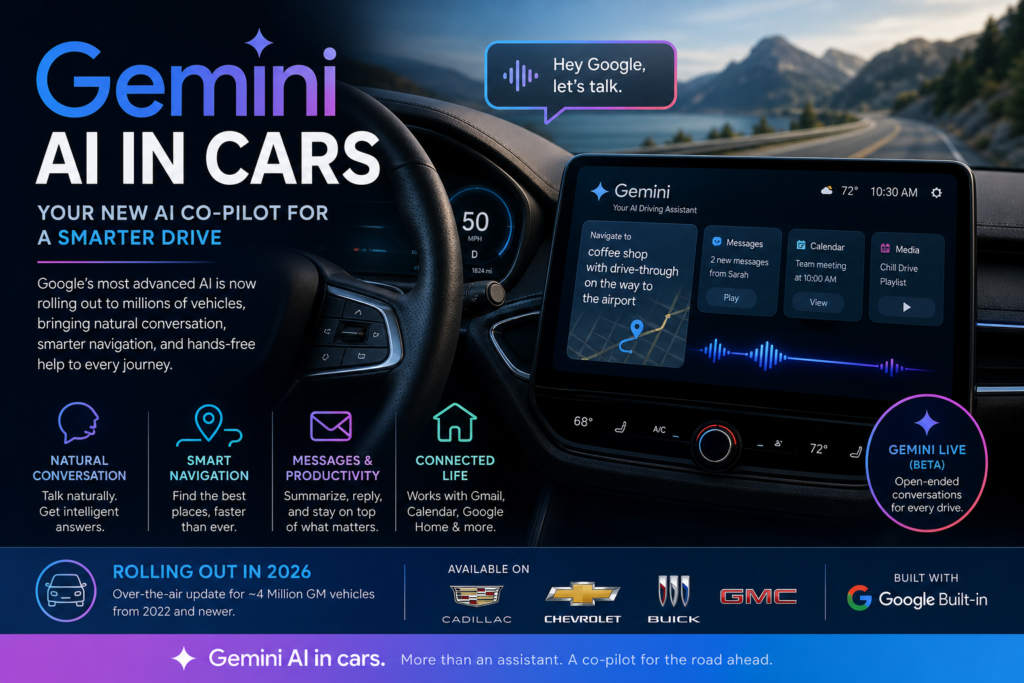
Google just made your car dramatically smarter. In late April 2026, Google announced that Gemini AI in cars is rolling out to vehicles with Google Built-in — replacing Google Assistant with a far more capable, conversational AI engine that can reason, plan routes, summarize messages, and hold natural dialogue, all hands-free.
If you drive a GM vehicle from 2022 or newer, or own any car with the Google Built-in platform, this upgrade is coming directly to your dashboard — no hardware purchase required.
What Is Gemini AI in Cars?
Definition: Gemini AI in cars refers to the integration of Google’s Gemini large language model into the in-vehicle infotainment system, replacing the older, command-based Google Assistant with a conversational, context-aware AI that understands natural speech and can complete multi-step tasks.
Unlike its predecessor, which required precise voice commands (“Navigate to Starbucks on Main Street”), Gemini allows drivers to speak in ordinary language: “I want to grab coffee somewhere with a drive-through on my way to the airport.” The system interprets intent, pulls data from Google Maps, and handles follow-up questions — all without the driver touching a screen.
This marks a fundamental shift in how humans interact with vehicles. Rather than issuing instructions to a machine, drivers now have something closer to a knowledgeable co-pilot that listens, understands context, and responds intelligently.
Which Vehicles Are Getting Gemini AI?
General Motors: ~4 Million Cars Across Four Brands
The most concrete rollout announced so far is through General Motors. Beginning in 2026, approximately 4 million GM vehicles from model year 2022 and newer will receive Gemini AI in cars via over-the-air software updates. The brands included are:
- Cadillac
- Chevrolet
- Buick
- GMC
This is significant because it means millions of existing car owners — not just new buyers — will gain access to next-generation AI without visiting a dealership or paying an upgrade fee.
Cars with Google Built-In: A Broader Platform Play
Google’s own announcement was deliberately broader than just GM. The company announced that Gemini AI in cars is coming to all vehicles running the Google Built-in platform, a suite first launched in 2020 that is embedded across dozens of makes and models globally.
This framing suggests the rollout extends well beyond GM — encompassing any automaker that has partnered with Google to embed its services natively into the infotainment stack.
Do You Need a New Car?
No. This is one of the most consumer-friendly aspects of the announcement. Compatible existing vehicles will receive Gemini through software updates, delivered automatically when owners are signed into their Google accounts in supported cars. When the update is available, drivers will see a prompt asking if they want to upgrade.
What Can Gemini AI Do Behind the Wheel?
This is where Gemini AI in cars most clearly separates itself from every prior automotive voice assistant. The capabilities fall into three broad categories:
Navigation and Discovery
Gemini can understand complex, multi-condition requests and cross-reference real-time data from Google Maps. For example:
Q: Can I ask Gemini to find a restaurant with specific requirements along my route?
A: Yes. You can say something like, “Find me a highly rated sit-down Mexican restaurant with outdoor seating within five minutes of my route.” Gemini processes the intent, consults Maps data, and returns relevant results. You can then ask follow-up questions about parking, hours, menu options, or dietary accommodations — all in conversation, without rephrasing from scratch.
In-Cabin Task Management
Gemini handles a wide range of hands-free operational tasks, including:
- Adjusting climate controls (“Turn on the heated seats, it’s getting cold”)
- Controlling media playback and making music recommendations
- Retrieving vehicle diagnostics and owner’s manual information
- Reading and summarizing incoming messages (SMS, email via Gmail)
- Drafting and sending hands-free replies
Communication and Productivity
With future integration planned for Gmail, Google Calendar, and Google Home, Gemini is evolving toward a true productivity layer for drivers. You could, in theory, ask it to read your meeting agenda for the day, suggest a departure time based on traffic, and send a message to your next appointment — all from the driver’s seat.
Gemini AI in Cars vs. Google Assistant: What’s the Real Difference?
The upgrade from Google Assistant to Gemini AI in cars is not cosmetic. The underlying architecture, capability set, and interaction model are fundamentally different.
| Feature | Google Assistant (Old) | Gemini AI (New) |
|---|---|---|
| Interaction style | Command-based, rigid phrasing | Natural conversation, flexible phrasing |
| Context retention | Limited; each query is largely standalone | Remembers context across a conversation turn |
| Multi-step queries | Requires re-stating intent each step | Handles follow-up questions fluidly |
| Data integration | Basic Maps and Search | Deep Maps, Gmail, Calendar, Google Home |
| Restaurant/POI search | Basic results | Filters by rating, outdoor seating, dietary needs, parking |
| Message handling | Read-only for most cases | Reads, summarizes, and helps draft replies |
| Open-ended conversation | Not supported | Supported via Gemini Live (beta) |
| Deployment method | Pre-installed | OTA software update for eligible vehicles |
The practical upshot: Google Assistant was a voice remote control. Gemini AI in cars is a reasoning partner.
Gemini Live: The Open-Ended Conversation Mode
Definition: Gemini Live is a beta feature within the automotive Gemini experience that enables unstructured, open-ended real-time conversation — going beyond task completion into genuine dialogue.
How does Gemini Live work in a vehicle?
Drivers activate it by saying “Hey Google, let’s talk” or by tapping the in-screen microphone button. Once active, the conversation is no longer task-bound. Drivers can use Gemini Live to:
- Brainstorm ideas for a presentation during a commute
- Learn about a topic they’re curious about (history, science, current events)
- Have a general conversation to stay engaged on long highway stretches
- Think through a decision out loud and get a reasoned response
This feature is currently in beta, meaning its availability may be limited to certain regions or vehicle configurations at launch. However, it signals Google’s intent: Gemini AI in cars isn’t just a utility tool — it’s designed to be genuinely engaging company for drivers.
Privacy, Safety, and What Drivers Should Know
Any AI assistant embedded in a vehicle with access to your messages, calendar, location history, and voice raises reasonable questions. Here is what drivers should understand:
Who can access Gemini in my car?
Gemini activates using your Google account. The prompt to enable it appears when a signed-in user is detected in a compatible vehicle. Drivers who do not sign in, or who decline the upgrade, will continue using the existing system.
Is it safe to use while driving?
Google has designed the interface around voice-first, hands-free interaction specifically to reduce distraction. Steering wheel controls and the in-car microphone provide two ways to activate and respond without touching the screen. However, as with any voice assistant, the quality of attention you give the road remains the driver’s responsibility.
What happens to my data?
Google has not published a vehicle-specific data policy distinct from its general services terms as of this writing. Drivers concerned about data use should review Google’s standard account privacy controls, which govern what is stored and for how long.
Will it work outside the US?
The initial rollout is US-only, in English. Google has confirmed plans to expand Gemini AI in cars to additional languages and regions in coming months, though specific timelines have not been announced.
What Comes Next for Google Gemini Automotive?
The April 2026 announcement is a foundation, not a ceiling. Google has signaled several directions for future development:
Deeper App Ecosystem Integration
Planned expansions include tighter integration with Gmail (read and respond to emails), Google Calendar (proactive scheduling and reminders while driving), and Google Home (controlling smart home devices from the car — imagine turning on your HVAC before you arrive home).
More Automakers, More Regions
Because the rollout is platform-based rather than model-specific, any manufacturer running Google Built-in is a candidate to receive the Gemini upgrade. This opens the door to a much wider automotive ecosystem spanning Europe, Asia-Pacific, and beyond as language support expands.
Personalization Over Time
Large language model assistants improve with usage context. As Gemini learns your preferred routes, music tastes, communication habits, and recurring tasks, future versions could proactively surface suggestions rather than waiting to be asked — the difference between a reactive assistant and a predictive co-pilot.
The Competitive Landscape
Gemini AI in cars enters a market where competitors are also moving fast. Amazon’s Alexa Auto, Apple’s CarPlay with Siri, and various automaker-proprietary systems are all racing toward conversational AI. What distinguishes Google’s approach is the depth of ecosystem integration — Maps, Search, Gmail, and Calendar are services most drivers already rely on daily, giving Gemini a contextual richness that standalone voice assistants cannot easily replicate.
Key Takeaways: Gemini AI in Cars at a Glance
- Gemini AI in cars replaces Google Assistant on the Google Built-in platform with a conversational, context-aware AI.
- Approximately 4 million GM vehicles (Cadillac, Chevrolet, Buick, GMC) from model year 2022+ are in the first confirmed rollout.
- Compatible existing vehicles receive the upgrade via over-the-air software update — no new car required.
- Core capabilities include natural-language navigation, in-cabin controls, message summarization, and music recommendations.
- Gemini Live (beta) enables open-ended conversation while driving.
- Future updates will deepen integration with Gmail, Google Calendar, and Google Home.
- The rollout begins in the US in English, with global expansion planned.
Why Gemini AI in Cars Is a Turning Point for Automotive Tech
The arrival of Gemini AI in cars is not simply a feature update — it represents the maturation of in-vehicle AI from voice command systems into genuine reasoning assistants. For millions of drivers, the daily commute is about to become more connected, more productive, and more conversational.
What makes this moment notable is the delivery method: most of these improvements arrive silently, over the air, to cars people already own. No dealership visit. No hardware upgrade. No extra cost. That accessibility is arguably as important as the technology itself.
For automotive manufacturers, this is also a signal. Automakers who partner with platform-level AI providers like Google gain a perpetually evolving capability stack rather than a static feature set. As Gemini improves, so does every compatible vehicle — a flywheel effect that benefits drivers and automakers alike.
The road ahead for Gemini AI in cars is genuinely exciting. And for millions of drivers, it begins with a simple software update.