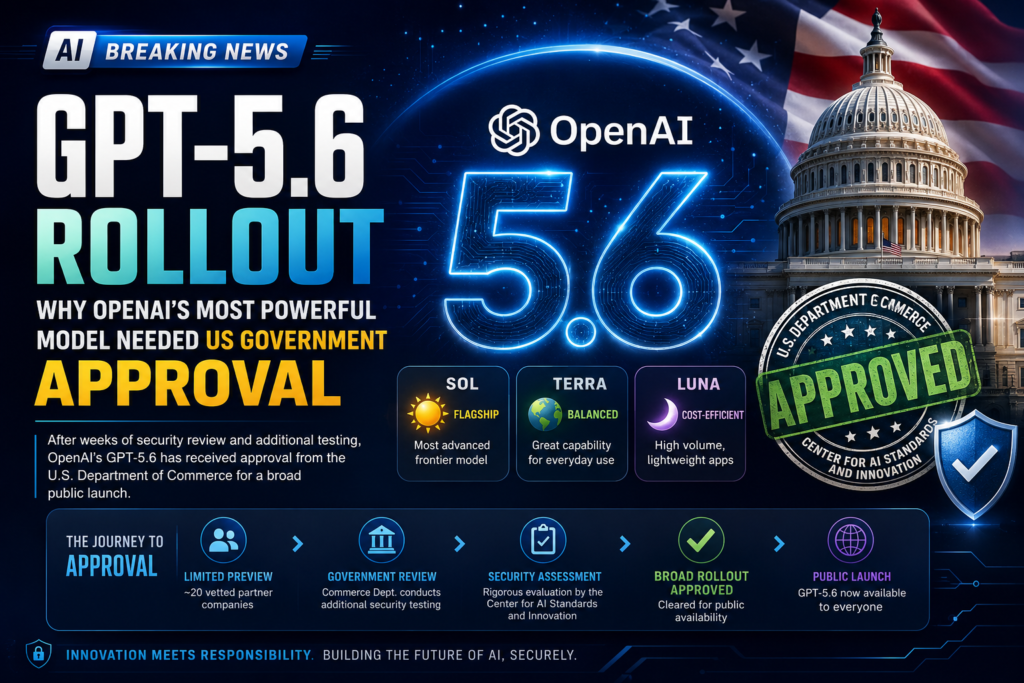
The GPT-5.6 rollout is moving from a restricted, government-monitored preview to a broad public launch after the U.S. Department of Commerce approved wider access following weeks of additional testing. In short: OpenAI can now release GPT-5.6 to the general public, but only after clearing a new federal review process built for the most capable “frontier” AI models.
If you’ve been tracking AI policy, model releases, or just wondering why your favorite AI tool suddenly got more capable this week, this guide breaks down exactly what happened, why it happened, and what it means going forward.
What Is GPT-5.6?
GPT-5.6 is OpenAI’s newest and most capable model family, positioned as a meaningful capability jump over prior GPT-5 versions. Rather than shipping a single model, OpenAI structured the GPT-5.6 rollout around three tiers designed for different budgets and use cases.
GPT-5.6 Sol, Terra, and Luna
- Sol — OpenAI’s flagship, most advanced model in the family, aimed at frontier-level reasoning and complex tasks.
- Terra — A mid-tier model that balances capability and cost for everyday business and developer use.
- Luna — The most cost-efficient option, built for high-volume, lightweight applications.
This tiered approach mirrors a broader industry pattern: ship one top-tier “flagship” model alongside smaller, cheaper siblings so the launch of GPT-5.6 can serve enterprise customers and budget-conscious developers at the same time.
Why Was the GPT-5.6 Rollout Delayed in the First Place?
Direct answer: OpenAI delayed the full public launch of GPT-5.6 last month at the request of the U.S. government, which cited national security concerns that a model this capable could be misused — particularly around advanced cyber capabilities.
Instead of a normal public release, OpenAI initially limited access to a small group of vetted partners. Their identities were shared with federal authorities, and the model was made available as a limited preview to roughly 20 companies whose participation had been individually approved by the government. OpenAI said at the time it expected to expand that list gradually while it worked toward a broader release.
The “Covered Frontier Model” Framework
The restrictions tie back to a voluntary oversight framework tied to an executive order signed by President Trump. Under this framework, AI developers can be asked to offer “covered frontier models” — the industry’s most capable systems — to the U.S. government for review, for up to 30 days, before releasing them to trusted partners or the public.
The stated rationale is straightforward:
- Increasingly capable models could meaningfully accelerate sophisticated cyberattacks, especially against sectors that depend on complex, interconnected, and often outdated technology systems.
- Regulators want to screen for potential misuse by military or intelligence actors in countries such as China and Russia before a model reaches a global audience.
- The government wants a repeatable evaluation process rather than one-off negotiations with each AI lab.
OpenAI has been public about not loving the arrangement. The company has said it doesn’t view government-approved staggered releases as ideal or sustainable long-term, but framed cooperation as the fastest realistic path to a full GPT-5.6 rollout, while it works with the administration to shape a permanent review framework for future frontier releases.
The Broader Push Toward Frontier AI Oversight
To understand why a single model launch required federal sign-off, it helps to zoom out. Governments worldwide have spent the past two years debating how to handle AI systems capable of both enormous economic value and serious misuse potential. The United States’ answer, at least for now, is a voluntary pre-release testing arrangement rather than binding legislation.
What counts as a “covered frontier model”? In practice, it’s a model that crosses a capability threshold significant enough to draw government interest — typically the newest, most advanced release from a leading lab, rather than incremental updates or smaller open-source models. GPT-5.6 Sol qualified because it represented a meaningful jump in reasoning and technical capability over earlier GPT-5 releases.
Why cybersecurity specifically? Officials have repeatedly pointed to the risk that highly capable models could dramatically accelerate sophisticated cyberattacks. Much of the world’s critical infrastructure — power grids, financial systems, healthcare networks — runs on complex, interconnected, and often decades-old technology. A model that can rapidly find and chain together vulnerabilities in that kind of environment is treated as a materially different risk than a chatbot that writes marketing copy.
Is the United States acting alone? No. Chinese authorities have reportedly held their own meetings with major domestic tech firms about restricting overseas access to China’s most advanced AI models, including systems that haven’t been released yet. That suggests both governments view frontier-model capability as something to actively manage rather than release without review, even though their specific mechanisms differ.
This context matters because the rollout of GPT-5.6 isn’t happening in isolation. It’s the first highly visible test of a policy framework that regulators, labs, and competitors will all be watching closely as a template for what comes next.
OpenAI GPT-5.6 GPT-5.6 government approval Frontier AI models AI regulation 2026 GPT-5.6 rollout
What Changed: US Approval for the Broad GPT-5.6 Rollout
According to Axios, which first reported the development, the U.S. Department of Commerce has now approved a wide launch of GPT-5.6 after additional testing conducted by the Commerce Department’s Center for AI Standards and Innovation. OpenAI technical staff reportedly remained in Washington throughout the review process to answer questions in real time, and the company said it planned to make the model publicly available shortly after clearance.
This approval matters for a few reasons:
- It signals that the government’s frontier-model review process can move from restricted preview to full public release within roughly a month, rather than dragging on indefinitely.
- It suggests OpenAI isn’t being treated as a special case — other frontier labs are going through comparable scrutiny.
- It gives the industry an early, real-world example of how the “covered frontier model” framework actually plays out in practice, rather than just how it reads on paper.
GPT-5.6 Rollout Timeline
| Stage | What Happened | Approximate Timing |
|---|---|---|
| Initial development complete | OpenAI finishes GPT-5.6 (Sol, Terra, Luna) and prepares for launch | Late spring 2026 |
| Government request to delay | OpenAI voluntarily delays full launch at the U.S. government’s request | Early June 2026 |
| Limited preview | Access restricted to ~20 government-approved partner companies | Mid-to-late June 2026 |
| Additional federal testing | Commerce Department’s AI standards center conducts extended review | Late June–early July 2026 |
| Broad rollout approved | Department of Commerce clears a wide public launch | Early July 2026 |
| Public availability | GPT-5.6 becomes available to the general public | Following the approval |
Risks and Criticisms of the Review Process
Not everyone is fully comfortable with how the government review shaped the rollout of GPT-5.6, even among people who agree that frontier models deserve scrutiny.
Does staggered access create an unfair advantage? Critics have pointed out that limiting initial access to roughly 20 government-approved partners effectively hands those companies a head start over competitors who have to wait for the broader release. That’s a meaningful business consequence, even if the security rationale is sound.
Can any model truly be made safe from misuse? Anthropic has been candid on this point, stating publicly that it’s “probably impossible” to make any AI model fully robust to jailbreak attempts, and flagging the risk that a universal jailbreak could someday unlock an entire class of harmful behaviors across a model. That’s a sobering admission from a company directly involved in this same review process, and it underscores that government testing can reduce risk without eliminating it entirely.
Is a 30-day review actually enough time? The executive order framework allows for up to 30 days of government testing before a covered frontier model reaches trusted partners. Whether that window is sufficient to catch subtle risks in an increasingly capable system is an open question that researchers, not just regulators, will likely keep debating as future frontier models go through the same process.
Does this slow down American AI competitiveness? OpenAI has been explicit that it doesn’t view the current staggered approach as ideal or sustainable, even while cooperating with it. The company’s public position is that it’s working with the administration to build a faster, repeatable process specifically so that future frontier launches don’t face the same multi-week uncertainty this one did.
How the GPT-5.6 Rollout Compares to Anthropic’s Model Review
OpenAI isn’t the only company navigating this new oversight process. Anthropic’s newest models, Fable and Mythos, were also temporarily suspended under the same national-security review framework before access was restored. Comparing the two situations helps clarify how the framework is actually being applied across the industry.
| Factor | GPT-5.6 (OpenAI) | Fable / Mythos (Anthropic) |
|---|---|---|
| Reason cited | National security concerns over misuse potential | Export-control compliance concerns |
| Initial access | ~20 vetted partner companies | Suspended entirely for a period |
| Review body | Commerce Department’s Center for AI Standards and Innovation | U.S. Department of Commerce export-control review |
| Outcome | Broad rollout approved after additional testing | Access restored after controls were lifted |
| Approximate duration of restriction | About one month | Under three weeks |
The pattern across both cases: a temporary hold, a defined government review, and eventual clearance for wider availability. That consistency is itself a signal — the GPT-5.6 rollout delay wasn’t a one-off dispute between OpenAI and regulators, but an early application of a process that’s now being applied industry-wide.
What This Means for Businesses and Developers
If you build products on top of frontier AI models, the GPT-5.6 rollout situation has practical implications beyond the news cycle. Product teams that assumed a same-day release for the newest flagship model now have a real-world example showing that assumption can no longer be taken for granted. Planning cycles, launch marketing, and vendor negotiations built around a frontier model’s announced release date may need extra buffer room until the government’s review process becomes faster and more predictable.
- Expect staggered access for future frontier models. The most capable new releases from major labs may now go through a preview period with government-approved partners before general availability.
- Build contingency time into your roadmap. If a product launch depends on a not-yet-released frontier model, a multi-week review window is now a realistic possibility, not an edge case.
- Watch for a standardized review process. OpenAI has said it’s working with the administration on a repeatable framework, which could mean future model releases follow a more predictable, faster timeline than this first cycle.
- Security capability is now a review criterion. Regulators have specifically flagged advanced cyber capabilities as a concern, so expect labs to publish more detail on safeguards and red-teaming results alongside major releases.
- Competitive dynamics are shifting quickly. Other companies, including xAI with its Grok 4.5 model, have also been moving to make leading models publicly available, so the competitive landscape around frontier AI access is evolving in parallel with the regulatory one.
Frequently Asked Questions
Is GPT-5.6 publicly available now? GPT-5.6 has received U.S. government approval for a broad rollout, and OpenAI has said it plans to move quickly to public availability following that clearance.
Why did the government get involved in an AI model launch? The review stems from a voluntary framework tied to a presidential executive order, under which developers can be asked to offer their most capable “covered frontier models” to the government for testing before wide release, largely due to national security concerns.
What are GPT-5.6 Sol, Terra, and Luna? They’re the three tiers of the GPT-5.6 family: Sol is the flagship high-capability model, Terra is a mid-tier option, and Luna is the most cost-efficient model for lighter workloads.
Did other AI companies face similar restrictions? Yes. Anthropic’s Fable and Mythos models were also temporarily suspended under a related Commerce Department review before access was restored, indicating this is a broader industry trend rather than a single-company issue.
How long did the GPT-5.6 rollout delay last? Roughly a month passed between OpenAI’s initial decision to delay the launch and the Commerce Department’s approval of a broad public rollout.
Will future frontier model launches face the same review? Likely yes, at least in the near term. OpenAI has indicated it’s working with regulators to build a repeatable evaluation process for future frontier model releases, which suggests staggered rollouts could become a standard part of how the most capable AI models reach the public.
Who conducted the government testing on GPT-5.6? The additional testing was reportedly carried out by the Commerce Department’s Center for AI Standards and Innovation, with OpenAI’s own technical staff remaining in Washington throughout the process to respond to questions as they came up.
Does government approval mean GPT-5.6 is completely safe? No single review can guarantee that. Government testing is designed to reduce specific, identified risks — particularly around cybersecurity misuse — before wide release, not to certify that a model is incapable of ever being misused. Even companies going through this same process have acknowledged that no frontier model can be made fully resistant to determined jailbreak attempts.
How does this affect ordinary ChatGPT users? Most everyday users likely won’t notice the regulatory process directly. Once the broad rollout is approved, GPT-5.6 becomes available the way any major model upgrade would, through OpenAI’s standard consumer and developer products, spanning the Sol, Terra, and Luna tiers.
Glossary: Key Terms in the GPT-5.6 Rollout Story
- Frontier model — An AI system at or near the current cutting edge of capability, generally the newest flagship release from a leading lab.
- Covered frontier model — A frontier model that meets the threshold requiring government pre-release testing under the executive order framework.
- Vetted partner — A company approved by the government to access a restricted preview of a covered frontier model before public launch.
- Center for AI Standards and Innovation — The Commerce Department unit reported to have conducted the additional testing behind the GPT-5.6 approval.
- Universal jailbreak — A theoretical exploit capable of bypassing a model’s safety training across an entire category of harmful behavior, a risk regulators are specifically trying to screen for.
The Bottom Line
The GPT-5.6 rollout represents far more than another AI model launch—it marks the beginning of a new era where groundbreaking artificial intelligence releases are increasingly shaped by regulatory oversight alongside technological innovation. The GPT-5.6 rollout demonstrates that frontier AI models are no longer evaluated solely on performance benchmarks, reasoning capabilities, or commercial demand. Instead, governments are becoming active participants in determining when and how the world’s most advanced AI systems reach businesses, developers, and everyday users.
For OpenAI, the GPT-5.6 rollout proved that cooperation with regulators can delay a launch but also create a structured pathway toward broader public availability. After weeks of additional security testing and government review, the approval process ultimately allowed OpenAI to move from a limited preview involving vetted partners to a wider public release. That transition shows how future frontier AI launches may follow a similar sequence of restricted access, independent evaluation, and phased deployment rather than immediate worldwide availability.
For developers and enterprises, the GPT-5.6 rollout offers an important planning lesson. Organizations building products around next-generation AI should no longer assume that flagship models will become instantly available after announcement. Instead, product roadmaps, software releases, enterprise integrations, and customer expectations should include contingency plans for potential regulatory reviews. The GPT-5.6 rollout illustrates that government oversight can temporarily affect release schedules without preventing innovation altogether.
The broader industry should also pay close attention to what the GPT-5.6 rollout signals about international AI competition. As the United States introduces structured reviews for frontier AI systems and other countries consider similar oversight frameworks, AI development is becoming both a technological race and a policy challenge. Future releases from OpenAI, Anthropic, Google DeepMind, xAI, and other leading labs may all operate under comparable review processes designed to balance innovation with national security concerns.
Ultimately, the GPT-5.6 rollout is not simply a story about a delayed product launch—it is a milestone in the evolution of AI governance. It highlights how governments, AI companies, businesses, and developers must increasingly work together to ensure that the most capable AI models are introduced responsibly. While reviews and temporary delays may become a standard part of releasing frontier AI systems, they also create greater confidence that powerful technologies have undergone meaningful evaluation before reaching millions of users. As AI capabilities continue to accelerate throughout 2026 and beyond, the GPT-5.6 rollout will likely be remembered as one of the first major examples of how advanced AI innovation and government oversight successfully converged, establishing a framework that could shape the future of every major frontier AI release.