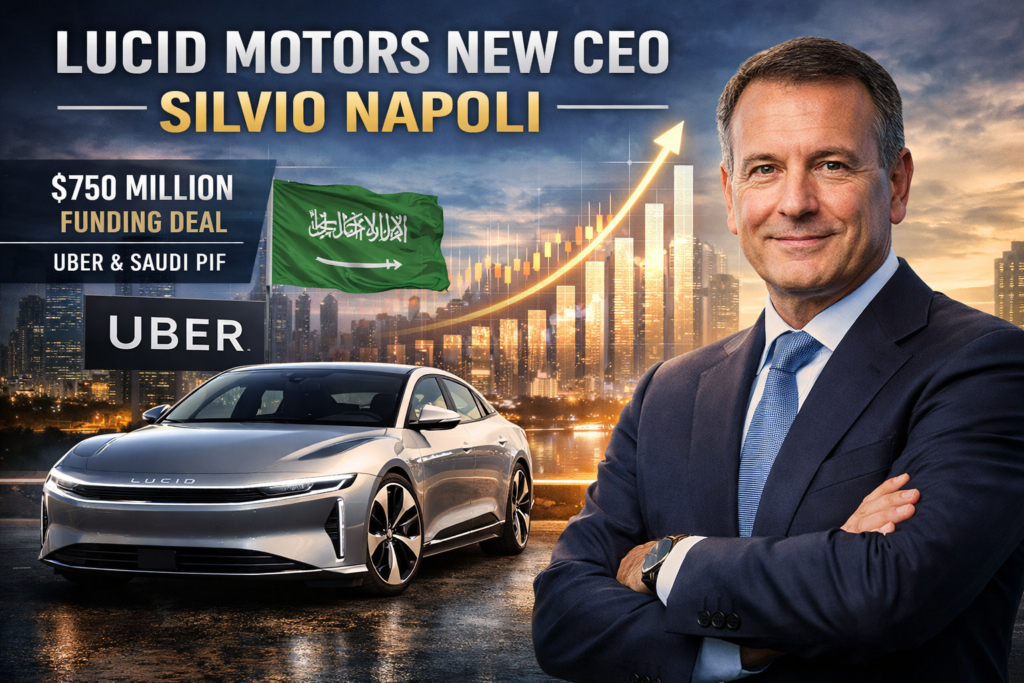
Lucid Motors finally has a new permanent leader — and a massive cash injection to match. On April 14, 2026, the company named Silvio Napoli as its Lucid Motors new CEO, simultaneously announcing $750 million in fresh funding from Uber and Saudi Arabia’s Public Investment Fund (PIF). Here is everything you need to know about what this means for the luxury EV maker’s future.
What Happened? A Quick Summary
After more than a year of leadership uncertainty, Lucid Motors closed three major deals on the same day:
- New CEO appointment: Silvio Napoli, a veteran industrial executive from elevator giant Schindler Group, was named as Lucid Motors new CEO and will join the board of directors.
- Uber doubles down: Uber committed an additional $200 million, agreeing to purchase 25,000 more robotaxi-ready versions of Lucid’s upcoming mid-size vehicle.
- Saudi PIF reinvests: Lucid’s majority owner, the Saudi Arabian Public Investment Fund, is purchasing another $550 million in Lucid shares.
These announcements arrive at what may be the most pivotal year in the company’s history — a year when Lucid must prove its business model can scale.
Who Is Silvio Napoli? Lucid’s New CEO Explained
Definition: Silvio Napoli is a Swiss-based industrial executive who spent several decades in senior leadership roles at Schindler Group, the Swiss multinational known for manufacturing elevators and escalators. He is now Lucid Motors’ new CEO and board member.
From Elevators to Electric Vehicles
Napoli’s background is not rooted in the automotive industry, which makes his appointment a deliberate strategic choice rather than a conventional hire. Schindler Group is one of the world’s largest mobility infrastructure companies — a business that demands precision engineering, complex global supply chains, and long-horizon capital discipline. These are exactly the muscles Lucid needs to flex as it moves from a premium niche player to a volume EV manufacturer.
Napoli will not immediately assume the role on U.S. soil. Per a regulatory filing, he still needs to receive U.S. work authorization. Until that clearance arrives — expected “in the coming weeks” — he will serve as executive director of Lucid’s board under a Swiss employment agreement. Interim CEO Marc Winterhoff will then return to his role as chief operating officer.
Why an Industrial Executive, Not a Car Guy?
This is a deliberate move toward operational maturity. Lucid Motors new CEO doesn’t need to be a car person; the company already has world-class engineers. What it needs is a leader who has managed global manufacturing scale, cost discipline, and shareholder expectations simultaneously — exactly the profile Napoli brings.
His compensation package reflects the scale of the ask: a $1.5 million base salary, a $1 million relocation allowance, a near $10 million stock grant, and a performance-based equity package worth potentially tens of millions of dollars.
The $750 Million Funding Infusion: Breaking It Down
The funding announcement has two distinct components — a strategic partnership deepening and a shareholder vote of confidence.
| Investor | New Commitment | Total Committed | Vehicle Orders |
|---|---|---|---|
| Uber | $200 million | $500 million | Min. 35,000 vehicles |
| Saudi PIF | $550 million | Multiple billions since 2018 | Majority equity stake |
| Combined new capital | $750 million | — | — |
Uber Deepens Its Robotaxi Bet
Uber’s investment is not merely financial — it is a supply chain pre-commitment. The ride-hail giant’s $200 million brings its total invested capital in Lucid to $500 million and locks in a minimum order of 35,000 vehicles. The agreement specifically targets Lucid’s upcoming mid-size platform, which is designed to produce vehicles priced around $50,000 — a far more accessible price point than the Air sedan.
The timing is deliberate. Just one day before this announcement, Uber and its autonomous vehicle partner Nuro began testing modified Lucid Gravity SUVs for a premium robotaxi service in San Francisco. Lucid’s vehicles are being validated in real-world robotaxi operations before the ink even dries on the latest investment round.
Notably, the new deal restructures the original Gravity SUV order — reducing the minimum Gravity commitment to 10,000 units while pivoting the bulk of future orders toward the mid-size platform. That is a subtle but important signal: the most commercially interesting part of the Uber-Lucid relationship has shifted to the more affordable vehicle tier.
Saudi PIF Doubles Down Again
The $550 million from Saudi Arabia’s Public Investment Fund continues a pattern of Kingdom-level commitment that dates to 2018, when PIF’s initial investment effectively saved Lucid from collapse. Since then, PIF has remained the company’s majority owner and has provided multiple capital injections to sustain operations through years of heavy R&D spending and slow revenue ramp-up.
This latest investment is not a rescue — it is a reinforcement. The PIF is doubling down at a moment when Lucid is transitioning from a one-model company to a multi-platform EV brand. The implicit message: the Saudis believe the mid-size platform rollout is the inflection point.
Why This Moment Is Critical for Lucid Motors
The CEO Void: 14+ Months Without Permanent Leadership
Lucid Motors has been without a permanent CEO since February 2025, when founder and long-time chief Peter Rawlinson abruptly resigned. Chief Operating Officer Marc Winterhoff stepped in as interim CEO and was reportedly a candidate for the permanent role himself. His tenure, however, coincided with a string of quality issues during the Gravity SUV launch — including a recall of over 4,000 Gravity SUVs in April 2026 for improperly welded seat belts.
Leadership voids at growth-stage companies carry an outsized cost. They slow strategic decisions, add uncertainty for investors, and make it harder to attract executive talent below the CEO level. The appointment of Lucid Motors new CEO closes that chapter, even if the transition period extends a few more weeks.
The Gravity SUV Struggles and the Mid-Size Pivot
The Gravity SUV was supposed to be Lucid’s volume driver after the Air sedan failed to capture a large market. Early results have been mixed. In February 2026, Lucid laid off 12% of its workforce in a cost-cutting move aimed at preserving cash on the road to profitability. The company has also recently reduced contractor headcount at its Arizona factory to improve cost efficiency.
The mid-size platform, expected to produce vehicles in the $50,000 range, is the real commercial bet. Three vehicles are planned on this architecture. It is the platform Uber is most excited about — and the one that Lucid Motors new CEO will be most responsible for bringing to market at scale and on budget.
Lucid Motors vs. EV Peers: Leadership and Funding Context
How does Lucid’s situation compare to competitors navigating similar inflection points?
| Company | CEO Status | Recent Funding | Key Challenge |
|---|---|---|---|
| Lucid Motors | New CEO (Napoli, April 2026) | $750M (Uber + PIF) | Scaling mid-size platform, reaching profitability |
| Rivian | Established leadership (R.J. Scaringe) | Amazon partnership anchor | Production cost reduction |
| Canoo | Multiple CEO changes | Limited institutional backing | Survival / restructuring |
| Fisker | Filed for bankruptcy (2024) | Failed to secure consistent funding | Ceased operations |
| Tesla | Stable (Elon Musk) | Profitable, self-funding | Brand perception, China competition |
The comparison underscores something important: leadership stability and sovereign-backed patient capital are the two factors most strongly correlated with EV startup survival. Lucid now has both — at least on paper.
What This Means for Lucid’s Robotaxi Strategy
What is Lucid’s robotaxi strategy? Lucid is partnering with Uber and Nuro to supply robotaxi-ready vehicles — initially modified Gravity SUVs, and eventually units from the mid-size platform — for autonomous ride-hail services in U.S. cities.
This is a meaningful strategic diversification. Consumer EV sales require massive dealer networks, brand recognition, and sustained marketing spend. Robotaxi fleet sales operate on a B2B model — fewer customers, larger contracts, and more predictable volume. For a company still building its brand, fleet contracts provide a financial floor that retail sales cannot.
The Uber-Nuro San Francisco pilot is critical validation. If premium robotaxi riders respond positively to Lucid vehicles — to the range, the interior quality, the ride experience — it de-risks the larger commercial rollout and strengthens Lucid’s negotiating position for future fleet contracts beyond Uber.
Lucid Motors new CEO will inherit a robotaxi roadmap that is already in motion. The challenge is not vision — it is operational execution: hitting production timelines, managing quality at scale, and delivering unit economics that make the Uber partnership profitable for both sides.
Key Questions Still Unanswered
The announcements are largely positive, but several open questions will define Lucid’s trajectory in the next 12–18 months:
- When will Lucid Motors new CEO formally take the role in the U.S.? The work authorization timeline is vague — “coming weeks” could mean two weeks or eight.
- Can the mid-size platform launch on schedule? The Gravity SUV experienced early quality issues; investors will scrutinize whether the $50,000 vehicle avoids similar stumbles.
- What is the path to profitability? Lucid has yet to report a profitable quarter. The layoffs and contractor reductions suggest management is intensely focused on cost, but a timeline remains unclear.
- Is Marc Winterhoff staying? Winterhoff was passed over for the permanent CEO role despite his desire for it. His decision to stay or leave as COO has real organizational implications.
- How does PIF’s continued involvement affect governance? Sovereign-backed majority ownership provides capital stability but can complicate governance independence and public market perceptions.
What Investors and EV Watchers Should Monitor
Here is a focused checklist of near-term developments that will signal whether Lucid’s new chapter is gaining traction:
- U.S. work authorization approval for Napoli — watch regulatory filings for the formal CEO transition date.
- Mid-size platform development milestones — any production or timing updates from the Arizona factory.
- Uber-Nuro San Francisco robotaxi service launch — whether and when it opens to the public, and early user reception.
- Q1/Q2 2026 earnings reports — delivery numbers for the Gravity SUV and any guidance on the mid-size program.
- Lucid Motors new CEO’s first public statements — his operational priorities and tone will signal whether a strategic pivot is coming or continuity is the plan.
- PIF equity position changes — any further Saudi investments (or reductions) would carry significant signaling value.
The Bottom Line
Lucid Motors new CEO appointment marks the end of a protracted leadership vacuum and the beginning of what could be the most important operational chapter in the company’s history. Silvio Napoli brings industrial-scale management experience to a company that has world-class technology but has struggled to match it with world-class execution. The simultaneous $750 million funding round from Uber and Saudi PIF demonstrates that Lucid’s two most important backers remain committed to seeing the mid-size platform succeed.
The hard work starts now. Lucid has the capital, it has the technology, and it now has a permanent leader. Whether that combination is enough to build a sustainable EV business — and not just a well-funded one — is the question that 2026 will begin to answer.
Frequently Asked Questions (FAQ)
1. Who is the new CEO of Lucid Motors in 2026?
The lucid motors new ceo in 2026 is Silvio Napoli, a seasoned industrial executive with decades of leadership experience at Schindler Group. His appointment marks a major shift in Lucid’s leadership strategy, focusing more on operational efficiency and global scaling rather than purely automotive innovation. The decision to bring in Silvio Napoli as the lucid motors new ceo reflects the company’s urgent need to strengthen manufacturing processes, cost management, and long-term profitability.
2. Why did Lucid Motors appoint a new CEO?
Lucid Motors appointed a new CEO to address a prolonged leadership gap and operational challenges. The company had been without a permanent leader for over a year, which created uncertainty among investors and slowed strategic decisions. By appointing Silvio Napoli as the lucid motors new ceo, the company aims to stabilize leadership, improve execution, and accelerate its transition into a scalable EV business. This move is also aligned with the company’s broader growth strategy in 2026.
3. What experience does Silvio Napoli bring as Lucid Motors new CEO?
Silvio Napoli brings extensive experience in managing global operations, supply chains, and large-scale industrial businesses. As the lucid motors new ceo, his background is particularly valuable because Lucid is transitioning from a niche EV maker to a mass-production company. His leadership style emphasizes efficiency, discipline, and long-term planning, all of which are critical for Lucid’s success in the competitive EV market.
4. How does the $750 million funding impact Lucid Motors?
The $750 million funding significantly strengthens Lucid’s financial position. With the lucid motors new ceo stepping in at the same time, this funding provides the resources needed to scale production, invest in new platforms, and improve operational efficiency. The investment from Uber and Saudi PIF also signals strong confidence in the company’s future, giving the lucid motors new ceo a solid foundation to execute growth strategies.
5. What role does Uber play in Lucid Motors’ future?
Uber plays a strategic role in Lucid’s expansion, especially in the robotaxi segment. As part of the funding deal, Uber has committed to purchasing thousands of vehicles, making it a key partner. The lucid motors new ceo will likely focus on strengthening this partnership, ensuring that Lucid can deliver vehicles at scale while maintaining quality. This collaboration opens new revenue streams beyond traditional consumer EV sales.
6. What is Lucid Motors’ robotaxi strategy?
Lucid Motors is entering the robotaxi market through partnerships with companies like Uber and autonomous technology firms. The lucid motors new ceo inherits a strategy focused on supplying high-quality EVs for autonomous ride-hailing services. This approach allows Lucid to diversify its business model, reduce dependency on retail sales, and secure large fleet contracts that provide stable revenue.
7. What challenges will the Lucid Motors new CEO face?
The lucid motors new ceo faces several critical challenges, including scaling production, reducing costs, and achieving profitability. Additionally, the company must overcome past issues such as product recalls and delayed launches. Managing investor expectations and maintaining strong partnerships with stakeholders like Uber and Saudi PIF will also be key responsibilities for the lucid motors new ceo.
8. How important is the mid-size platform for Lucid Motors?
The mid-size platform is crucial for Lucid’s future growth. Unlike its premium models, this platform targets a broader market with more affordable pricing. The success of this initiative will largely depend on the execution capabilities of the lucid motors new ceo. If launched successfully, it could significantly increase sales volume and help the company move closer to profitability.
9. How does Saudi PIF influence Lucid Motors?
Saudi Arabia’s Public Investment Fund (PIF) is the majority shareholder in Lucid Motors and plays a significant role in its strategic direction. The continued investment from PIF demonstrates strong confidence in the company’s vision. For the lucid motors new ceo, maintaining a positive relationship with PIF is essential, as their financial backing is critical for long-term growth and stability.
10. Is Lucid Motors profitable in 2026?
As of 2026, Lucid Motors has not yet achieved consistent profitability. However, with the appointment of the lucid motors new ceo and the recent funding injection, the company is taking steps toward improving its financial performance. Cost-cutting measures, increased production efficiency, and new revenue streams are all part of the strategy to reach profitability.
11. How does Lucid compare to other EV companies?
Lucid Motors operates in a highly competitive market alongside companies like Tesla and Rivian. While it is known for its advanced technology and luxury vehicles, it has struggled with scaling production. The appointment of the lucid motors new ceo is a strategic move to address these challenges and position the company as a strong competitor in the EV industry.
12. What should investors watch after the new CEO appointment?
Investors should closely monitor several key developments, including production milestones, financial performance, and updates on the mid-size platform. The first few decisions and public statements from the lucid motors new ceo will also provide insights into the company’s future direction. Additionally, progress in partnerships and new funding rounds will be important indicators of success.
13. When will Silvio Napoli fully take over as CEO?
Silvio Napoli’s transition into the role of lucid motors new ceo depends on regulatory approvals, including U.S. work authorization. While he has already been announced as the new leader, the full transition is expected to happen within a few weeks. During this period, he will work closely with the existing leadership team to ensure a smooth handover.
14. What does this leadership change mean for Lucid’s future?
The appointment of the lucid motors new ceo signals a shift toward operational excellence and disciplined growth. It indicates that Lucid is moving beyond its startup phase and focusing on becoming a sustainable, large-scale EV manufacturer. This leadership change, combined with strong financial backing, positions the company for a potentially transformative phase in 2026 and beyond.
15. Can Lucid Motors succeed with its new CEO?
Lucid Motors has the technology, funding, and partnerships needed for success. The key question is execution. The lucid motors new ceo brings the experience required to manage complex operations and scale the business effectively. If he can address production challenges and deliver on strategic goals, Lucid has a strong chance of becoming a major player in the EV market.