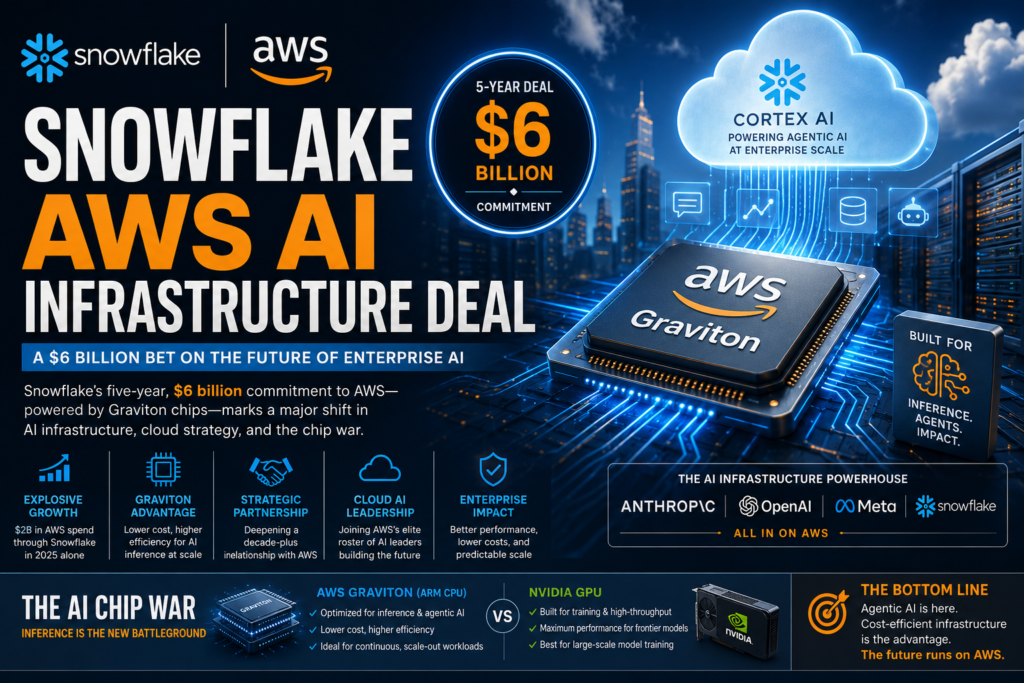
The Snowflake AWS AI infrastructure deal — a $6 billion, five-year commitment announced on May 27, 2026 — is not just a procurement story. It is a signal flare about where enterprise AI is heading, who is winning the cloud chip war, and why the old Nvidia-dominant hardware playbook is being rewritten at speed.
If you manage data, cloud budgets, or AI strategy at an enterprise scale, this deal directly affects your options — and your costs — over the next three to five years.
What Is the Snowflake–AWS $6 Billion Deal?
Definition: The Snowflake AWS AI infrastructure deal is a five-year, $6 billion spending commitment in which Snowflake will purchase compute, storage, and AI chip resources — specifically Amazon’s ARM-based Graviton processors — from Amazon Web Services to power its growing portfolio of AI and agentic applications.
Why it matters at a glance:
- Snowflake has generated approximately $7 billion in total revenue through the AWS Marketplace since its founding in 2012. This single new contract nearly matches that entire 14-year figure.
- Customer spending on AWS via Snowflake’s platform doubled in 2025 alone, reaching $2 billion for the calendar year — a clear indicator of accelerating AI-driven demand.
- The deal includes expanded access to AWS Graviton chips, which are purpose-built for the inference, orchestration, and workflow execution demands of agentic AI — not just training.
This is the Snowflake AWS AI infrastructure deal in its most distilled form: a decade-plus relationship scaling up dramatically because AI workloads have fundamentally changed what cloud infrastructure needs to do.
Why Snowflake Chose AWS Graviton Over Nvidia
Question: Why would a data company with a longstanding Nvidia partnership commit billions to AWS’s proprietary CPU architecture?
Direct Answer: Because agentic AI workloads — the task-executing, tool-chaining AI agents now central to enterprise automation — do not require the same GPU-heavy compute as model training. They require fast, cost-efficient, reliable inference at scale. That is exactly where Graviton excels.
Snowflake’s AI product, Cortex AI, is the demand engine behind this shift. Cortex AI gives enterprises a governed, in-platform way to query data using natural language, build AI-powered pipelines, and deploy agentic workflows without moving sensitive data out of Snowflake’s environment. As Cortex AI adoption has grown, so has the need for scalable, affordable inference infrastructure — and AWS Graviton delivers on both dimensions.
Amazon passes the cost savings from Graviton’s efficiency directly to customers. That pricing advantage has been powerful enough to attract multi-billion-dollar commitments from companies like Meta, which signed a deal for millions of Graviton chips after already committing $10 billion to Google Cloud. The Snowflake AWS AI infrastructure deal follows the same economic logic: lower cost per inference at enterprise scale is a strategic moat, not just a line-item saving.
The Business Case: How AI Infrastructure Deals Are Reshaping Cloud
The Snowflake AWS AI infrastructure deal does not exist in isolation. It is part of a structural shift in how hyperscalers are locking in enterprise relationships — and how enterprises are choosing their AI compute partners for the rest of the decade.
From $1.2B to $6B — Snowflake’s Growing AWS Commitment
Snowflake’s spending commitment to AWS has scaled in direct proportion to AI adoption across its customer base:
- 2020 (IPO): $1.2 billion commitment
- 2023: $2.5 billion commitment
- 2026: $6 billion commitment
Each step up in commitment reflects not just growth in Snowflake’s customer count, but a compounding increase in compute intensity per customer as AI features move from experimental to production-grade. The Snowflake AWS AI infrastructure deal is, in that sense, a lagging indicator of what enterprises are already doing with AI in their data stacks.
AWS has now assembled a roster of landmark AI infrastructure commitments that includes Anthropic (more than $100 billion), OpenAI, Meta, and now Snowflake. The pattern is consistent: companies building AI products and platforms are making long-term infrastructure bets on specific cloud providers, and they are choosing AWS at a rate that suggests its Graviton chip ecosystem is becoming the preferred substrate for agentic AI.
The Cortex AI Effect: What’s Driving Demand
Snowflake’s Cortex AI is the internal engine behind the Snowflake AWS AI infrastructure deal’s scale. Here is how the demand loop works:
- Enterprises adopt Cortex AI for natural language querying, AI-powered data pipelines, and agent-based automation.
- Cortex AI workloads generate sustained inference demand — not one-time training runs.
- That sustained inference demand requires scalable, cost-effective chip infrastructure.
- AWS Graviton satisfies that requirement at better economics than Nvidia GPUs for inference-heavy tasks.
- Snowflake commits more spend to AWS, locking in capacity and pricing.
The result is a flywheel: better AI tools drive more usage, more usage drives more infrastructure spend, and more infrastructure spend drives deeper platform integration between Snowflake and AWS. Enterprises building on top of Snowflake’s platform inherit the benefits — and the architecture constraints — of that flywheel.
AWS Graviton vs. Nvidia — What Enterprises Need to Know
The Snowflake AWS AI infrastructure deal is, in part, a vote for ARM-based CPU architecture over Nvidia’s GPU dominance for specific AI workload categories. Understanding the distinction helps enterprises make better infrastructure decisions.
| Dimension | AWS Graviton (ARM CPU) | Nvidia GPU (e.g., H100, B200) |
|---|---|---|
| Primary Use Case | Inference, agentic orchestration, data processing | Model training, large-scale inference |
| Cost Profile | Lower cost per compute hour; savings passed to customers | Higher cost; premium pricing for AI-optimized variants |
| Energy Efficiency | High (ARM architecture advantage) | Improving, but higher thermal and power demands |
| Availability | AWS-managed supply; multi-year commitments ensure access | Subject to global supply constraints and allocation queues |
| Ecosystem Lock-in | Deep AWS integration; optimal within AWS environment | Portable across cloud providers and on-premise |
| Best Fit | Production AI inference, continuous agentic workloads | Frontier model training, high-throughput batch inference |
| Enterprise Adoption Signal | Snowflake, Meta (millions of chips), growing roster | OpenAI, Anthropic (training infrastructure) |
The strategic implication is not that Graviton replaces Nvidia — it is that different phases of the AI lifecycle require different hardware, and enterprises should design their infrastructure strategy accordingly. Training happens on GPUs. Continuous, cost-sensitive agentic inference increasingly happens on Graviton and equivalent ARM chips.
What This Means for the AI Chip War
The Snowflake AWS AI infrastructure deal is a competitive strike as much as it is a procurement agreement. It puts direct pressure on Nvidia by demonstrating that some of the most significant AI spending decisions are now being made in favor of cloud-native CPU architectures for production workloads.
The signal is deliberate. AWS has been building Graviton since 2018, and it now powers a meaningful share of inference workloads across the cloud. Google has its own TPU and Axion ARM chip. Microsoft launched its Maia AI chip in January 2026. Every major cloud provider now competes directly with Nvidia for the inference layer of enterprise AI — and for the long-term spending commitments that come with it.
Nvidia’s Response: The Vera CPU
Nvidia CEO Jensen Huang has responded to the competitive pressure by expanding Nvidia’s own ambitions. At Computex 2026, Huang unveiled Vera, a new AI-specific CPU designed to compete directly with ARM-based alternatives like Graviton. Huang characterized Vera as a “brand new” $200 billion market opportunity — a framing that acknowledges both the scale of the competitive threat and Nvidia’s intention to meet it head-on.
Nvidia also has a pre-existing partnership with Snowflake, announced in 2023, that has been used to simplify running AI workloads on Nvidia GPUs within the Snowflake platform. The Snowflake AWS AI infrastructure deal does not terminate that partnership, but it does define the economic center of gravity going forward: cost-efficient inference on Graviton, at scale, for the next five years.
Enterprise Implications: Should You Care About Your Cloud AI Strategy?
Yes — and here is why the Snowflake AWS AI infrastructure deal is more than background noise for enterprise technology leaders:
If you run Snowflake workloads:
- Cortex AI capabilities will increasingly be optimized for AWS Graviton infrastructure. Performance improvements, latency reductions, and cost efficiencies will likely accrue first to AWS-hosted Snowflake environments.
- Long-term pricing structures for AI features within Snowflake may reflect the economics of this deal — potentially making AWS-hosted Snowflake more competitive on AI workload costs relative to Azure or GCP deployments.
If you are evaluating AI infrastructure vendors:
- The five-year commitment horizon of the Snowflake AWS AI infrastructure deal reflects a broader industry trend: enterprises and platforms are locking in infrastructure partnerships for the duration of the current AI adoption cycle. Waiting to decide means paying spot prices while others benefit from committed pricing.
- The deal signals that agentic AI — not just generative AI — is now the driver of infrastructure investment. If your AI roadmap includes agents, your infrastructure strategy needs to account for sustained inference demand, not just training capacity.
If you are building on top of AWS:
- The concentration of major AI platforms — Anthropic, OpenAI, Meta, Snowflake — within the AWS ecosystem creates a de facto standard for AI infrastructure integration. Building your enterprise AI stack within this ecosystem reduces integration friction and aligns your architecture with where the major platforms are already optimized.
If you are managing technology risk:
- The Snowflake AWS AI infrastructure deal highlights supply security as a strategic concern. Graviton chips are AWS-managed, with supply allocated through committed agreements rather than open-market competition. Enterprises that have not considered compute supply risk in their AI roadmaps should start now.
Key questions every enterprise technology leader should be asking:
- What percentage of our AI workloads are inference versus training, and are we paying for the right hardware type?
- Are our cloud infrastructure commitments aligned with our three-to-five-year AI roadmap, or are we still operating on pre-AI procurement assumptions?
- How exposed are we to Nvidia GPU pricing and availability risk for production AI applications?
- Does our data platform vendor’s infrastructure strategy — including deals like the Snowflake AWS AI infrastructure deal — align with or constrain our AI ambitions?
How This Deal Fits the Broader Pattern of AI Infrastructure Consolidation
The $6 billion Snowflake AWS AI infrastructure deal is the latest in a pattern of consolidating AI compute commitments around a small number of hyperscale platforms. The competitive dynamics playing out between AWS, Google Cloud, and Microsoft Azure — and between Graviton, TPU, Maia, and Nvidia — will shape enterprise AI costs and capabilities for the remainder of the decade.
Several structural forces are accelerating this consolidation:
- Agentic AI workload growth: As enterprises move from chatbot-style AI to task-executing AI agents, sustained inference demand replaces episodic query demand. Infrastructure must scale continuously, not in bursts.
- Data governance requirements: Platforms like Snowflake offer in-platform AI that keeps data within governed boundaries — a requirement for regulated industries and a strong differentiator for enterprise adoption.
- Cost pressure on AI ROI: Enterprise boards are scrutinizing AI returns. Infrastructure cost efficiency — where Graviton has a demonstrable advantage for inference — becomes a competitive factor in AI program economics.
- Supply security: Multi-year committed agreements like the Snowflake AWS AI infrastructure deal provide compute supply certainty in an environment where GPU shortages have periodically constrained AI deployments.
Key Takeaways
The Snowflake AWS AI infrastructure deal deserves attention beyond its headline number. Here is a distilled summary of what it tells us:
- Scale: At $6 billion over five years, the deal nearly matches Snowflake’s entire 14-year history of AWS Marketplace revenue.
- Driver: Cortex AI adoption doubled customer AWS spending through Snowflake to $2 billion in 2025, making this infrastructure investment economically rational.
- Technology bet: The deal is an explicit commitment to ARM-based CPU inference (Graviton) as the preferred substrate for agentic AI workloads — a direct competitive signal to Nvidia.
- Chip war implications: AWS, Google, and Microsoft are all investing in proprietary chips that compete with Nvidia for the inference layer, and they are winning major enterprise commitments.
- Enterprise impact: For companies running AI on Snowflake or AWS, this deal is a preview of where AI infrastructure economics and capabilities will be concentrated over the next five years.
- Strategic framing: The Snowflake AWS AI infrastructure deal is not just a vendor commitment. It is a bet that agentic AI — affordable, continuous, governed — is the dominant enterprise AI paradigm going forward.
The Snowflake AWS AI infrastructure deal is one of the clearest indicators yet that enterprise AI infrastructure is entering a new phase. What began as a cloud storage and analytics relationship has now evolved into a long-term AI compute partnership valued at $6 billion over five years. The scale of the Snowflake AWS AI infrastructure deal shows how rapidly enterprise AI workloads are expanding and why infrastructure strategy is becoming just as important as AI model strategy.
One of the most important lessons from the Snowflake AWS AI infrastructure deal is that the future of enterprise AI is shifting toward inference-heavy workloads rather than training-only environments. Enterprises are no longer experimenting with isolated AI pilots. They are deploying continuous AI systems, agentic workflows, and natural-language data applications that require stable, scalable, and cost-efficient inference infrastructure every day. This is where AWS Graviton chips become strategically important. Instead of relying entirely on expensive GPU clusters, Snowflake is investing in ARM-based compute optimized for sustained AI operations at scale.
Another major takeaway from the Snowflake AWS AI infrastructure deal is the growing importance of cost efficiency in enterprise AI adoption. Companies are under pressure to prove measurable ROI from AI investments. AI infrastructure costs have become one of the biggest barriers to large-scale deployment. By committing heavily to AWS Graviton infrastructure, Snowflake is signaling that reducing inference costs is now a competitive advantage. Enterprises building AI products on Snowflake will likely benefit from better pricing efficiency, lower latency, and improved scalability for Cortex AI applications.
The Snowflake AWS AI infrastructure deal also highlights a broader industry shift in the AI chip market. Nvidia remains dominant for model training and frontier AI systems, but hyperscalers like AWS, Microsoft, and Google are increasingly competing for the inference layer using proprietary chips. This means enterprises must rethink how they allocate AI workloads across infrastructure types. GPUs may remain essential for training large models, but ARM-based inference infrastructure is becoming the preferred choice for production-grade AI applications and agentic systems.
Finally, the Snowflake AWS AI infrastructure deal demonstrates how AI infrastructure partnerships are becoming long-term strategic commitments rather than short-term procurement decisions. Enterprises that align their cloud, data, and AI strategies early may gain significant advantages in pricing, compute access, scalability, and AI deployment speed over the next decade.
Frequently Asked Questions
What is the Snowflake AWS AI infrastructure deal? It is a five-year, $6 billion agreement announced on May 27, 2026, in which Snowflake commits to spending on AWS compute and infrastructure — including Graviton ARM-based chips — to power its AI and agentic application portfolio.
Why is Snowflake using AWS Graviton chips instead of Nvidia GPUs? Graviton chips offer better cost efficiency for AI inference workloads — which are continuous and sustained — compared to Nvidia GPUs, which are optimized for training and high-throughput batch inference. AWS passes those cost savings to customers, making Graviton more economical for production agentic AI.
How does this deal affect Snowflake customers? Snowflake customers on AWS will likely see continued improvements to Cortex AI capabilities and potentially benefit from the cost efficiencies embedded in this infrastructure agreement. Customers on Azure or GCP deployments may have a less direct exposure to these specific economics.
Does this deal end Snowflake’s partnership with Nvidia? No. Snowflake’s 2023 partnership with Nvidia remains in place. The AWS deal defines the primary economic and infrastructure commitment going forward, particularly for inference and agentic workloads, while Nvidia’s role may continue for specific GPU-optimized use cases.
What does this mean for the AI chip market? It reinforces a growing trend: ARM-based CPU chips from cloud providers are capturing a significant portion of enterprise AI inference spending that Nvidia might have claimed. Nvidia’s response — the Vera CPU — is a direct acknowledgment of this competitive pressure.