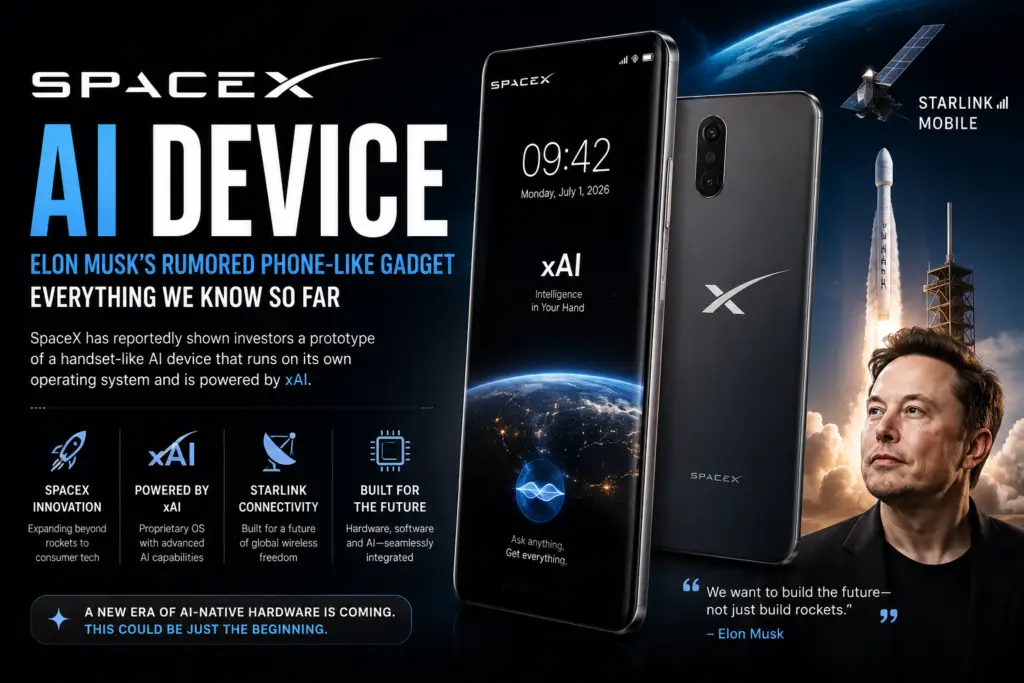
SpaceX has reportedly shown investors a prototype of a handset-like AI device — a gadget that sounds a lot like a phone but runs on its own operating system and leans on xAI’s technology instead of Android or iOS. Here’s everything confirmed so far, and why it matters for the future of AI hardware.
What Is the SpaceX AI Device?
Definition: The SpaceX AI device is a prototype gadget, reportedly demonstrated to investors before the company’s public listing, described as “handset-like” and slimmer than an iPhone.
Expansion: According to reporting cited by TechCrunch, SpaceX’s founder and CEO Elon Musk has shown investors a prototype of a handset-like AI device, with the device reportedly sleeker and slimmer than an iPhone, prompting comparisons to something between a small touchscreen phone and the Rabbit R1. That comparison matters, because the Rabbit R1 was one of the first mainstream attempts at a dedicated AI hardware companion — and it struggled to find a lasting audience. The SpaceX AI device appears to be aiming at similar territory, but with a hardware and manufacturing pedigree the earlier wave of AI gadget startups never had. TechCrunch
Importantly, this isn’t a finished consumer product. SpaceX reportedly showed the device to investors and stakeholders before it went public, and told them it’s at an early enough stage that the design could still change. In other words, what leaked is a snapshot of an evolving prototype, not a launch-ready SpaceX AI device.
Has Elon Musk Confirmed the SpaceX AI Device?
Question: Has Musk confirmed the reports?
Direct Answer: No — he has denied them. Musk has denied the reporting, calling it “utterly false.” That denial hasn’t stopped the story from spreading, in part because SpaceX has made other moves lately that fit the same pattern of ambition beyond rockets.
How the SpaceX AI Device Was Revealed
The initial report on the SpaceX AI device came from the Wall Street Journal, which described the prototype being shown to investors ahead of SpaceX’s IPO. TechCrunch’s coverage, published July 1, 2026, situates this reveal inside a much larger story: SpaceX going public, acquiring xAI, and increasingly behaving like a company that wants a foothold in consumer technology and telecommunications — not just launch vehicles and satellites.
This timing is worth noting. SpaceX completed its IPO in June 2026, and showing a hardware prototype to investors during that process suggests the device was part of the pitch for what SpaceX could become next, not just a side R&D project buried in a lab.
SpaceX AI Device vs. the Competition
The SpaceX AI device isn’t emerging in a vacuum. It’s the latest entrant in a crowded — and so far mostly disappointing — race to build standalone AI hardware. Here’s how it compares to the most talked-about alternatives.
| Device | Company | Status | Operating System | Key Differentiator |
|---|---|---|---|---|
| SpaceX AI device | SpaceX / xAI | Prototype shown to investors | Proprietary OS integrating xAI technology | Backed by SpaceX/Tesla manufacturing and chip access |
| OpenAI device | OpenAI (with Jony Ive) | In development, reportedly delayed | Undisclosed | Design-led, aims to feel “more peaceful and calm than the iPhone” |
| Rabbit R1 | Rabbit Inc. | Launched, underperformed | Custom | Physical “push to talk” AI assistant button |
| Humane AI Pin | Humane | Launched, later discontinued | Custom | Wearable projector-based interface |
The pattern across this table is telling: ambition is high, but consumer follow-through has been rare. That’s the backdrop against which any new SpaceX AI device has to prove itself.
Why Would SpaceX Build an AI Device?
Definition: SpaceX’s motivation appears to be twofold — a bid to control its own hardware and software ecosystem, and a strategic move into wireless services where a proprietary device would give it more leverage.
Expansion: A rocket and satellite company doesn’t casually decide to build a handset. SpaceX has manufacturing scale, in-house chip relationships, and a sister company (Tesla) that already mass-produces complex electronics. As TechCrunch notes, SpaceX and Tesla have the manufacturing expertise to mass-produce AI devices, along with access to the chips needed to power on-device compute. That capability gap is exactly what sank earlier AI hardware startups — Humane and Rabbit had novel software ideas but no manufacturing muscle behind them.
The Wireless Connection: Starlink Mobile
One of the clearest strategic threads tying the SpaceX AI device to the rest of the company’s roadmap is wireless. SpaceX has signaled interest in expanding into wireless service, with Starlink Mobile positioned as a potential competitor to Verizon and AT&T. A proprietary device is a natural companion to a proprietary network — it’s the same playbook Apple has used for years, pairing hardware with a service ecosystem to keep users locked in.
The wireless ambitions go further than speculation about a device. At least one analyst has floated the idea that T-Mobile or AT&T could be acquisition targets as SpaceX expands into wireless, though any such deal would come at a steep price. Whether or not an acquisition ever happens, it underscores that a SpaceX AI device wouldn’t exist in isolation — it would likely be one piece of a bigger connectivity strategy spanning satellites, mobile network access, and now, potentially, the handset itself.
The xAI Integration Angle
Question: What role does xAI play in the SpaceX AI device?
Direct Answer: xAI reportedly supplies the underlying intelligence layer, running on a custom operating system rather than existing platforms.
Musk folded xAI into SpaceX earlier in 2026, and that acquisition appears directly relevant to the device story. The SpaceX AI device is reportedly designed to run on a proprietary operating system that integrates xAI’s technology, similar to how OpenAI’s device is expected to work. This approach would keep the device out of platforms controlled by other companies, like Google’s Android, while creating something built around native AI interfaces rather than app icons and touchscreens as the primary interaction model.
That’s a meaningful bet. It means the SpaceX AI device wouldn’t just be a phone with a chatbot bolted on — it would be designed from the ground up around conversational or ambient AI as the primary way people interact with it.
The Graveyard of Failed AI Devices
Here’s the part of the story that tempers the hype: standalone AI hardware has a rough track record so far.
- Humane AI Pin — a wearable projector-based device that launched with strong buzz and quickly lost momentum, eventually shutting down.
- Rabbit R1 — a pocket-sized companion device marketed as an alternative to app-based smartphones, but criticized for limited functionality relative to price.
- Multiple smaller AI wearables and pins — largely failed to find product-market fit outside of tech-enthusiast early adopters.
TechCrunch’s reporting is blunt about this history: the graveyard is crowded with unsuccessful launches of AI devices from companies like Humane and Rabbit, and a company wanting to sell an AI device does not mean consumers actually want to buy one — yet. That caveat applies just as much to the SpaceX AI device as it does to OpenAI’s competing project. Manufacturing scale and chip access solve one problem; they don’t automatically solve the harder problem of convincing people they need another screen in their pocket.
SpaceX AI Device: Frequently Asked Questions
Is the SpaceX AI device an actual phone?
Not officially. It’s described as “handset-like” and phone-ish in form factor, but SpaceX hasn’t marketed it as a phone, and the reported design could still change before any public unveiling.
When will the SpaceX AI device launch?
There’s no confirmed launch date. The prototype was shown privately to investors, and reports suggest it’s still early in development.
Does the SpaceX AI device compete with OpenAI’s device?
Indirectly, yes. Both are being built with proprietary operating systems, both integrate closely with their parent company’s AI models, and both are aiming to be “native AI” hardware rather than smartphones with an AI feature added on. OpenAI’s version, developed with former Apple design chief Jony Ive, has reportedly faced its own development delays.
Why is SpaceX interested in hardware at all?
Because it fits a broader pattern: SpaceX going public, moving into wireless with Starlink Mobile, and absorbing xAI all point toward a company trying to build a full consumer technology stack — not just rockets and satellites.
Has SpaceX confirmed any of this?
No. Musk has publicly denied the reporting. Until SpaceX or Musk formally addresses it, the SpaceX AI device remains an unconfirmed, investor-only prototype based on media reporting.
What Happens Next
Given SpaceX’s manufacturing capacity, chip access, and now-integrated xAI technology, the pieces required to eventually ship a real SpaceX AI device clearly exist. What’s far less certain is timing, final form factor, and — most importantly — whether SpaceX will actually push this into mass production rather than treating it as one of several exploratory bets. TechCrunch’s own framing captures the uncertainty well: it’s unclear whether SpaceX is simply testing ideas or genuinely planning to mass-produce and market the device.
There’s also a competitive subtext worth watching. Musk has a long history of racing rivals he perceives as threats, and OpenAI’s device — helmed by a former Apple design chief — is exactly the kind of high-profile project that tends to provoke a competitive response from him.
Key Takeaways
- A SpaceX AI device prototype was reportedly shown to investors before the company’s IPO, described as sleeker and slimmer than an iPhone.
- Elon Musk has publicly denied the reporting, calling it “utterly false.”
- The device reportedly runs a proprietary operating system integrating xAI technology, avoiding platforms like Android.
- SpaceX’s wireless ambitions, including Starlink Mobile, suggest a device could pair with a broader connectivity strategy.
- Standalone AI hardware has a difficult track record, with Humane and Rabbit both failing to gain lasting traction.
- No launch date, pricing, or final design has been confirmed — the SpaceX AI device remains an early-stage, unconfirmed project.