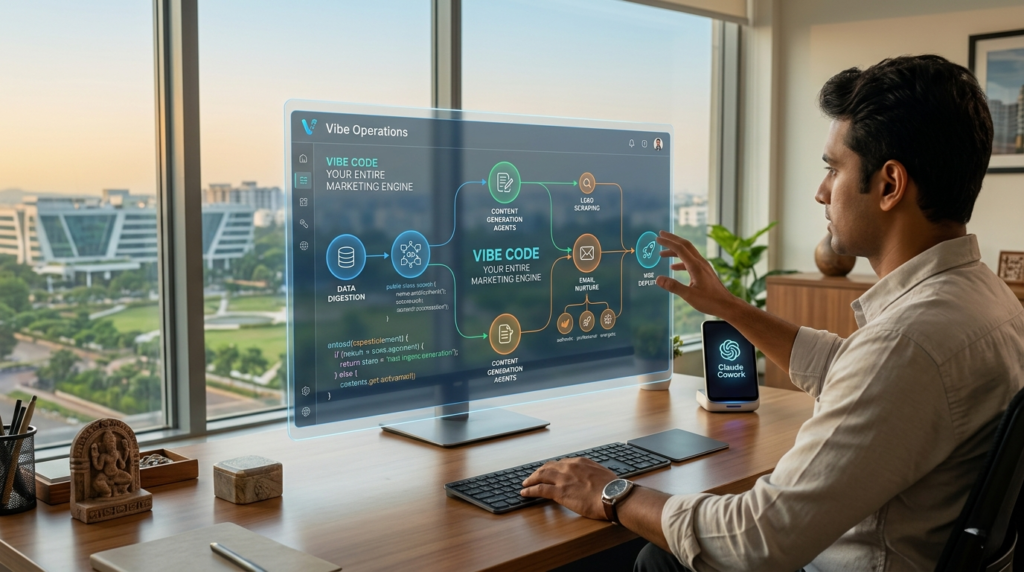
The era of manual, labor-intensive marketing is coming to a close. For years, founders and marketing teams have been trapped in a cycle of “good intentions”—planning content that never gets posted, designing lead magnets that sit in drafts, and staring at empty dashboards. But a new paradigm is shifting the landscape: the ability to vibe code your entire marketing engine.
Coined by AI visionaries like Andrej Karpathy, “vibe coding” isn’t about writing complex syntax; it’s about describing a “vibe” or a desired outcome in plain English and letting AI agents build the underlying systems. When applied to marketing, this means you can transition from a scattered content creator to a high-level systems architect in less than 24 hours.
If your marketing is either working while you sleep or it isn’t working at all, it’s time to stop optimizing for engagement and start optimizing for pipeline. Here is the comprehensive guide on how to vibe code your entire marketing engine and automate your business growth.
1. Defining the Paradigm: What Does It Mean to Vibe Code?
To vibe code your entire marketing engine is to use generative AI—specifically tools like Claude 3.5/4, ChatGPT-5, and Replit Agent—to create an automated ecosystem that handles everything from lead scraping to content distribution.
In traditional marketing, you are the engine. You write the posts, you send the emails, and you analyze the data. When you vibe code your entire marketing engine, you become the director. You describe the “vibe” of your brand, the logic of your sales funnel, and the outcomes you want to achieve. The AI then “codes” the automations, the API connections, and the content schedules that make it happen.(Vibe Marketing Strategy, AI Marketing Automation, Agentic Workflow Systems, Marketing Engine 2026)
The Philosophy of “Vibe First”
In the past, building a marketing automation stack required a “DevOps” mindset. You needed to understand Webhooks, JSON payloads, and API documentation. Vibe coding bypasses the technical “how” and focuses on the “what.” By utilizing natural language, you give the AI a set of constraints and a desired aesthetic or “vibe,” and the machine handles the plumbing.
2. The 5-Step Framework to Vibe Code Your Marketing Engine
Building a comprehensive system in a single day requires a structured approach. You cannot afford to get bogged down in technical debt. Follow this “code first, refine later” mindset.
Step 1: Data Digestion and Brand Synthesis
The foundation of a “vibe” is your past success. To vibe code your entire marketing engine, you must first give the AI a baseline of what “good” looks like for your specific brand.
- The Goal: Identify content patterns that correlate with commercial outcomes, not just likes.
- The Action: Export your last 100 LinkedIn posts, your top-performing email subject lines, and your CRM data. Feed this into a Large Language Model (LLM).
- The Vibe Prompt: “Analyze these transcripts and posts. Distill the tone, the core message, and the specific pain points that lead to conversions. This is the ‘vibe’ we will use to build our engine.”
Step 2: Architecting the Content Generation Agent
Instead of writing posts one by one, you must vibe code a content engine that operates autonomously.
- The Goal: Create a system that generates 30 days of high-quality, brand-aligned content in minutes.
- The Action: Set up a recursive loop where the AI generates an idea, critiques it against your brand voice, and then formats it for different platforms (X, LinkedIn, Blog).
- The Outcome: You aren’t just getting text; you are getting a system that understands why certain topics work for your audience.
Step 3: Automating Lead Scraping and Enrichment
A marketing engine without fuel (leads) is a Ferrari without gas. Part of the process to vibe code your entire marketing engine involves building “Scraper Agents.”
- The Goal: Automatically find potential clients who are “vibing” with your niche.
- The Action: Use a “vibe” description to find leads: “Find companies that recently posted about AI integration in manufacturing, find the Head of Operations, and verify their professional email.”
- Integration: Connect this scraper directly to your CRM via an AI-written Python script that runs on a schedule.
Step 4: Vibe Coding Your “Nurture” Sequence
Once you have leads, the system must talk to them. This is the most sensitive part of the engine.
- The Goal: A self-correcting email sequence that adjusts based on the lead’s behavior.
- The Action: Describe the outcome: “Build a 4-part email sequence that moves a prospect from ‘curious’ to ‘booked call’. If they click a link about ‘cost savings’, the next email should focus on ROI. If they click ‘technical specs’, focus on architecture.”
- The Vibe: Ensure the AI maintains a “human-to-human” feel, avoiding the robotic “Dear [Name]” tropes of the 2010s.
Step 5: The “Vibe Deploy” Phase
Launch your system. Unlike traditional coding, you don’t need a massive deployment pipeline.
- The Action: Use tools like Replit or Zapier Central to host your agents.
- Monitoring: Set up a “Vibe Dashboard”—a simple AI-generated interface that tells you the health of your engine in plain English (e.g., “The engine is performing well, but engagement on LinkedIn is dipping; shall I adjust the tone to be more provocative?”).
3. Comparison: Traditional Marketing vs. Vibe Coding
Organizing your marketing strategy into a system requires understanding the shift in effort and output.
| Feature | Traditional Marketing | Vibe Coding Your Engine |
| Execution | Manual task-based (Writing, Posting) | Result-based (Prompting, Directing) |
| Speed | Weeks to build a single funnel | 24 hours to vibe code your entire marketing engine |
| Feedback Loop | Monthly reviews of spreadsheets | Real-time AI-driven pivots |
| Technical Skill | Requires SEO/Copy/Dev specialists | Requires “Vibe” clarity and English fluency |
| Scalability | Linear (More work = More time) | Exponential (Systems work while you sleep) |
| Consistency | Fluctuates with human energy | Infinite; the “vibe” never gets tired |
4. Deep Dive: Why “Vibe Marketing” is the New SEO
In 2026, search engines are increasingly driven by LLMs. This means traditional keyword stuffing is dead. What matters now is “semantic resonance”—or the vibe. When you vibe code your entire marketing engine, you are essentially optimizing for how AI perceives and recommends your brand.
Cognitive Amplification
The human brain is excellent at strategy but poor at repetitive execution. By vibe coding, you amplify your cognitive reach. You can oversee ten different “vibes” or sub-brands simultaneously because the execution is handled by agents that stay “on-vibe” 24/7.
Systematic Automation vs. Simple Tools
Don’t confuse vibe coding with using a scheduling tool like Buffer. A scheduling tool is a calendar; a vibe-coded engine is a thinker. It doesn’t just post; it looks at the comments, senses the sentiment, and suggests the next three posts based on what the market is actually vibing with.
5. Technical Implementation: The “VibeOps” Stack
To effectively vibe code your entire marketing engine, you need a stack that supports natural language instruction.
- The Brain (LLM): Claude 3.5 Sonnet or GPT-4o. These models are currently the best at understanding nuance and brand voice.
- The Fabric (Automation): Make.com or Zapier. This is the “nervous system” that connects your brain to your hands.
- The Hands (Agents): Replit Agents or custom GPTs. These are the specific workers that execute tasks like “Scrape LinkedIn” or “Draft Blog Post.”
- The Memory (Vector Database): Pinecone or Supabase. This allows your engine to remember what it did yesterday so it can improve tomorrow.
6. Overcoming the “Content Fatigue” Obstacle
One of the biggest risks of AI marketing is the “slop” factor—generic, uninspired content. When you vibe code your entire marketing engine, you avoid this by using a “Negative Vibe” prompt.
Pro-Tip: Tell your AI what NOT to do.
“Do not use corporate jargon. Do not use emojis in every line. Do not sound like a salesman. Sound like a helpful peer who happens to be an expert in AI systems.”
By defining the boundaries of the “vibe,” the engine produces content that feels authentic and human, even though a human didn’t type the words.
7. Actionable 24-Hour Checklist
If you want to vibe code your entire marketing engine by this time tomorrow, follow this schedule:
- Hour 1-3: Audit your best work. Create your “Brand Vibe Manual” (a 2-page document describing your tone, mission, and target audience).
- Hour 4-8: Build the Content Agent. Connect your LLM to a social media API. Generate 10 posts and refine the prompt until they are indistinguishable from your own writing.
- Hour 9-12: Build the Lead Agent. Set up a scraper that looks for “intent signals” (e.g., people asking for recommendations in your niche).
- Hour 13-18: Build the Nurture Agent. Create the email workflows that trigger when a lead is captured.
- Hour 19-24: Stress test. Run the engine for one “cycle” and verify that all parts are talking to each other.
8. The Economic Impact of a Vibe-Coded Engine
Why go through this effort? Because the ROI is decoupled from your time.
When you vibe code your entire marketing engine, your cost per lead drops significantly because you are no longer paying for high-touch human labor for low-leverage tasks. Instead, your “overhead” is just the cost of API tokens—pennies compared to a marketing agency retainer.
Furthermore, a vibe-coded engine is an asset. If you ever sell your company, you aren’t just selling a brand; you are selling a self-sustaining customer acquisition machine.
9. Common Pitfalls and How to Avoid Them
Even though you can vibe code your entire marketing engine in a day, there are traps to watch out for:
- The “Set and Forget” Fallacy: Even an automated engine needs a “Director.” Check your engine weekly to ensure the “vibe” hasn’t drifted into “uncanny valley” territory.
- API Fragility: Sometimes social platforms change their rules. Ensure your engine has “fallback” modes (e.g., if the LinkedIn API breaks, the engine should save drafts to a Google Sheet instead of just stopping).
- Over-complication: Start with one channel. Vibe code your LinkedIn engine first. Once that works, “clone” the vibe for Email and X.
10. Conclusion: Step Into the Era of Vibe Coding
The barrier to building a world-class marketing department has dropped from $100k/year to the ability to articulate a vision. When you vibe code your entire marketing engine, you reclaim your most valuable resource: your focus.
You no longer have to worry about “what to post” or “who to email.” You only have to worry about the “vibe” of your business and the value you provide to your customers. The engine handles the rest.
Are you ready to stop grinding and start vibing? The tools are ready. The agents are waiting for your instructions. It’s time to build the engine that powers your future.
Frequently Asked Questions: Mastering the Vibe Code Revolution
1. What exactly does it mean to “vibe code” a system?
Vibe coding is a shift in how humans interact with technology. Traditionally, if you wanted to build a marketing engine, you needed to understand the “syntax”—the specific steps of setting up a CRM, writing API calls, or configuring complex Boolean logic in automation tools.
When you vibe code your entire marketing engine, you move from being a “coder” to being a “vibe curator.” You use natural language to describe the feel, the logic, and the objective of the system. For example, instead of setting up a 10-step Zapier workflow manually, you tell an AI agent: “I want a system that feels helpful and high-end. It should find tech founders in Odisha, analyze their latest LinkedIn post, and send a personalized email that references their specific challenges without sounding like a bot.” The AI “codes” the connections and the logic to match that “vibe.”
2. Do I need to know how to code to vibe code my entire marketing engine?
The short answer is no, but you do need “System Literacy.” While you don’t need to write Python or JavaScript, you must understand how data flows from one point to another. Think of it like being a Movie Director. A director doesn’t need to know how to operate the camera or set up the lighting personally, but they must understand what a “good shot” looks like and how to instruct the crew to get it.
To vibe code your entire marketing engine, your “crew” consists of AI agents like Claude, ChatGPT, or Replit Agent. Your job is to provide the “script” (the prompts) and the “vision” (the marketing strategy). If you can explain your business process to a human intern, you can vibe code it into an automated engine.
3. Which AI tools are best for building a vibe-coded marketing engine in 2026?
The landscape has evolved rapidly. To effectively vibe code your entire marketing engine, you generally need a “stack” consisting of three layers:
- The Orchestrator: Tools like Claude 3.5/4 or ChatGPT-5 act as the brain. They understand the nuance of your “vibe.”
- The Environment: Replit Agent or GitHub Copilot Workspace are excellent for deploying the actual code that the AI generates. They allow you to “vibe code” a web app or a scraper in minutes.
- The Glue: Make.com or Zapier Central serve as the nervous system, connecting your AI brain to your email, social media, and CRM.
4. How long does it actually take to vibe code an entire engine?
While the headline suggests “in a day,” this assumes you have a clear vision of your brand. If you already know your target audience and have a library of past successful content, you can realistically vibe code your entire marketing engine in 8 to 12 hours of focused work.
The breakdown usually looks like this:
- 2 Hours: Defining the “Brand Vibe” and feeding historical data to the AI.
- 4 Hours: Building and testing the Content Generation and Lead Scraping agents.
- 2 Hours: Setting up the “Nurture” sequences and CRM integrations.
- 2 Hours: Final “Vibe Check” and deployment.
5. Is “vibe coding” just another word for “prompt engineering”?
Not exactly. Prompt engineering is about getting a single specific output (like a blog post). Vibe coding is about building a persistent system. When you vibe code your entire marketing engine, you aren’t just asking for a post; you are building a machine that knows how to generate posts, when to post them, and how to respond to the people who comment. It’s the difference between ordering a meal (prompting) and building a kitchen that cooks for you (vibe coding).
6. How do I ensure my vibe-coded content doesn’t sound “robotic”?
This is the biggest challenge for many founders. The secret to maintaining a “human vibe” is the Feedback Loop. When you vibe code your entire marketing engine, you shouldn’t just tell the AI to “write a post.” Instead, give it a “Negative Constraint List.”
Tell the engine: “Never use the word ‘delve’. Never start a sentence with ‘In today’s fast-paced world.’ Use short, punchy sentences. Mention local context like ‘the heat in Bhubaneswar’ or ‘the tech growth in Odisha’ to ground the content in reality.” By providing these guardrails, the “vibe” remains authentic.
7. Can I use this for B2B industries like SaaS or Manufacturing?
Absolutely. In fact, B2B is where vibe coding shines. In B2B marketing, the “vibe” is often “Authority and Trust.” You can vibe code your entire marketing engine to act as a technical researcher. It can scan white papers, summarize industry trends, and reach out to decision-makers with highly specific, value-driven insights. It turns your marketing from “shouting into the void” to “having 100 intelligent conversations at once.”
8. What are the security risks of automating my marketing this way?
Security is paramount when you vibe code your entire marketing engine. Since you are often connecting your AI to your CRM (which contains sensitive client data) and your social media accounts, you must:
- Use API Keys, not Passwords: Never give an AI agent your raw login credentials. Use official API integrations.
- Human-in-the-Loop (HITL): For the first 30 days, set your engine to “Draft Mode.” Review the outputs before they go live to ensure the “vibe” hasn’t drifted or become inappropriate.
- Data Privacy: Ensure you are using enterprise-grade AI models that do not train on your proprietary business data.
9. How do I measure the ROI of a vibe-coded engine?
Measuring ROI when you vibe code your entire marketing engine is different from traditional tracking. You should look at:
- Time Reclaimed: How many hours a week did you spend on manual posting before?
- Lead Velocity: How much faster are leads moving from “Awareness” to “Booked Call”?
- Cost Per Acquisition (CPA): Since the engine runs on tokens rather than salaries, your CPA should drop by 40-70% over six months.
10. What happens if the AI “hallucinates” or breaks the vibe?
This is why “VibeOps” is a discipline. If the engine starts producing content that doesn’t feel right, you don’t “debug code”—you “retune the vibe.” You provide a correction: “The last three posts felt too aggressive. Soften the tone and focus more on community building.” The engine will immediately adjust all future outputs based on this new instruction.
11. How does vibe coding impact SEO in 2026?
SEO is no longer about keywords; it’s about “Entity Resonance.” Search engines now analyze the overall “vibe” and authority of a site. When you vibe code your entire marketing engine, you ensure that every piece of content—from a tweet to a 3,000-word white paper—is semantically linked. This creates a massive “Content Web” that tells Google you are a leading authority in your niche, far better than any manual SEO strategy could.
12. Is vibe coding the “End of Marketing Agencies”?
It is the end of low-value marketing agencies that just “manage social media.” However, it is a massive opportunity for strategic agencies. Agencies that help clients vibe code their entire marketing engine will become “Engine Architects.” The value shifts from “doing the work” to “designing the system that does the work.”