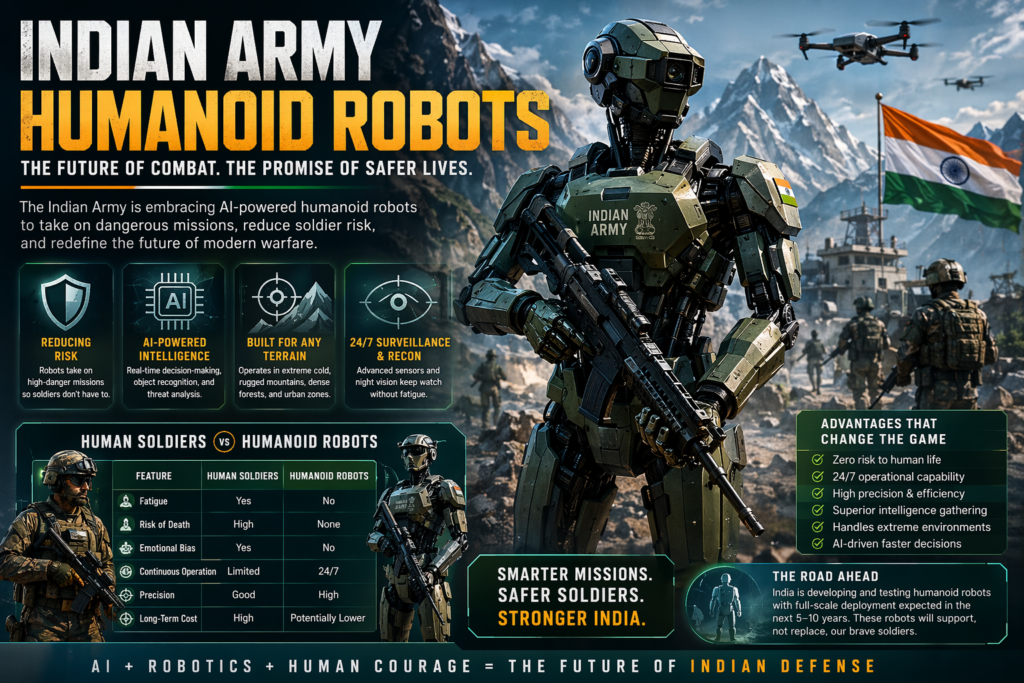
The **Indian Army is actively exploring humanoid robots to reduce battlefield risks and enhance operational efficiency. In simple terms, these robots are being designed to take on dangerous missions so human soldiers don’t have to.
As modern warfare evolves, Indian Army humanoid robots are emerging as a powerful solution to minimize casualties, improve surveillance, and strengthen defense capabilities in high-risk environments.
🤖 What Are Indian Army Humanoid Robots?
📌 Definition
Indian Army humanoid robots are advanced AI-powered machines designed to resemble human movement and perform combat or support roles in military operations. These robots are not just mechanical tools—they are intelligent systems capable of decision-making, navigation, and interaction.
📌 Expansion
Unlike traditional drones or automated weapons, humanoid robots can:
- Walk on uneven terrain
- Use weapons or tools
- Perform rescue operations
- Assist soldiers in real-time combat
⚔️ Why the Indian Army Is Investing in Humanoid Robots
🛡️ Reducing Soldier Risk
One of the primary motivations behind developing Indian Army humanoid robots is to reduce human casualties. High-risk missions such as:
- Bomb disposal
- Hostage rescue
- Urban warfare
can be handled more safely using robots.
🏔️ Border Challenges and Terrain
India faces unique geographic challenges:
- High-altitude regions like Ladakh
- Dense forests
- Extreme weather conditions
Deploying Indian Army humanoid robots in these areas can significantly improve operational efficiency without risking human lives.
🧠 Key Features Expected in Indian Army Humanoid Robots
🔫 Combat Readiness
These robots are expected to:
- Carry weapons
- Engage in tactical combat
- Operate autonomously or via remote control
This makes Indian Army humanoid robots highly versatile in modern warfare.
🤖 AI Capabilities
Powered by Artificial Intelligence, these robots can:
- Analyze threats in real-time
- Recognize faces and objects
- Make split-second decisions
👁️ Surveillance and Reconnaissance
Surveillance is a major advantage:
- 24/7 monitoring
- Infrared and night vision
- Data transmission to command centers
This makes Indian Army humanoid robots critical for intelligence gathering.
📊 Human Soldiers vs Humanoid Robots
| Feature | Human Soldiers | Humanoid Robots |
|---|---|---|
| Fatigue | Yes | No |
| Emotional Decision-Making | Yes | No |
| Risk of Death | High | None |
| Adaptability | High | Improving |
| Cost (Long-term) | High | Potentially Lower |
| Continuous Operation | Limited | 24/7 |
👉 While humans bring intuition and adaptability, Indian Army humanoid robots offer unmatched endurance and risk-free deployment.
🌍 How Other Countries Are Using Combat Robots
🇺🇸 United States
The **United States Department of Defense has heavily invested in robotic systems like:
- Boston Dynamics robots
- Autonomous drones
🇨🇳 China
China is aggressively developing:
- Armed robotic dogs
- AI surveillance systems
🇷🇺 Russia
Russia has tested:
- Combat robots like Uran-9
- Autonomous battlefield systems
India’s push toward Indian Army humanoid robots ensures it remains competitive in global defense innovation.
🚀 Advantages of Humanoid Robots in Warfare
Here’s why Indian Army humanoid robots are a game-changer:
- ✅ Zero risk to human life in dangerous missions
- ✅ 24/7 operational capability
- ✅ High precision and reduced human error
- ✅ Enhanced surveillance and intelligence
- ✅ Ability to operate in extreme environments
- ✅ Faster decision-making using AI
⚠️ Challenges and Risks
⚖️ Ethical Concerns
The use of Indian Army humanoid robots raises ethical questions:
- Should machines make life-and-death decisions?
- Who is accountable for errors?
These concerns are widely debated in global defense communities.
🧩 Technical Limitations
Despite advancements, challenges remain:
- High development costs
- Limited adaptability in unpredictable environments
- Risk of hacking or cyber attacks
🔮 Future of Robotic Warfare in India
📈 Integration Strategy
The Indian military is likely to:
- Combine robots with human soldiers
- Use them for support rather than replacement
- Integrate AI with existing defense systems
⏳ Timeline Expectations
While prototypes are under development, full deployment of Indian Army humanoid robots may take:
- 5–10 years for large-scale use
- Gradual adoption in specialized units first
❓ Frequently Asked Questions (FAQs)
1. What are Indian Army humanoid robots used for?
They are designed for combat support, surveillance, rescue missions, and reducing risks to human soldiers.
2. Will robots replace soldiers in the Indian Army?
No. Indian Army humanoid robots will assist soldiers, not replace them entirely.
3. Are these robots fully autonomous?
Not yet. Most systems will be semi-autonomous with human supervision.
4. How advanced is India in military robotics?
India is rapidly catching up, with initiatives focused on AI and robotics integration.
5. Are humanoid robots already deployed in combat?
Currently, they are in development and testing stages, not widely deployed.
🧾 Conclusion
The rise of Indian Army humanoid robots marks a transformative shift in how modern warfare is approached. By combining artificial intelligence with robotics, the Indian defense sector is taking a proactive step toward safer, smarter, and more efficient military operations.
What makes this development particularly significant is its focus on human safety. Warfare has always carried immense risks, but with the introduction of humanoid robots, those risks can be significantly reduced. These machines are not just tools—they represent a strategic evolution in defense thinking.
However, this transition is not without challenges. Ethical concerns, technical limitations, and high costs remain barriers that need careful consideration. The balance between human judgment and machine intelligence will be crucial in shaping the future of warfare.
Globally, nations are racing toward robotic military dominance, and India’s entry into this space ensures it remains competitive. The development of Indian Army humanoid robots is not just about technology—it’s about redefining national security in an AI-driven world.
As we move forward, one thing is clear: the battlefield of the future will not just be fought by humans, but by intelligent machines working alongside them. And in that future, Indian Army humanoid robots will play a pivotal role in protecting lives while enhancing military capabilities.