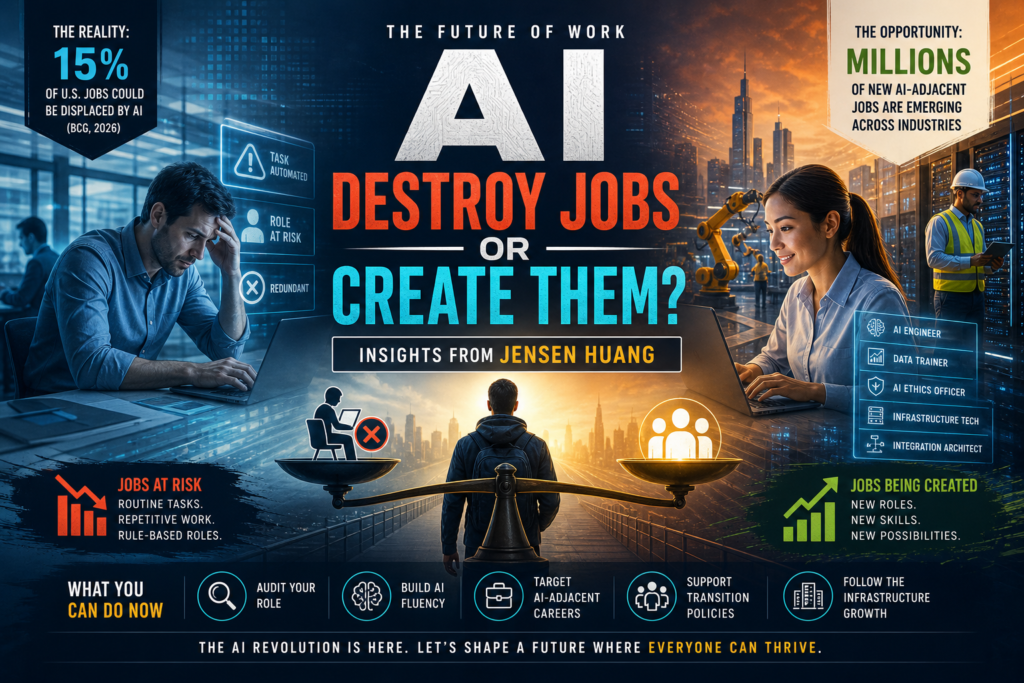
AI job creation is happening right now — and it’s outpacing the roles being displaced, according to Nvidia CEO Jensen Huang. But workers, economists, and policy experts aren’t so sure the story is that simple.
In May 2026, Huang made headlines when he told a Milken Institute audience that AI is “creating an enormous number of jobs” — pushing back hard against the narrative that artificial intelligence is primarily a job-killing technology. The claim landed in the middle of one of the most anxious labor conversations in modern history. So who’s right? This post unpacks both sides, using Huang’s arguments as a springboard to explore the real data, the emerging roles, and what workers can actually do about it.
The Big Question Workers Are Actually Asking
Millions of workers in knowledge-work, creative, and administrative roles have spent the past few years watching AI capabilities accelerate at an unsettling pace. The anxiety is real, measurable, and not irrational.
Polls consistently show that a majority of American workers believe AI poses some threat to their current job. Coding assistants can write software. Generative AI can draft emails, marketing copy, and legal summaries. AI-powered tools can analyze financial data faster than any human analyst. Against this backdrop, the rise of AI job creation as a counterargument can feel tone-deaf — especially when it comes from the CEO of the company that sells the chips powering the very systems people fear.
But dismissing Huang’s argument entirely would also be a mistake. Technological disruption has always been messy, two-directional, and poorly predicted in real time. The industrial revolution, the rise of computing, the internet — each eliminated categories of work while spawning industries that hadn’t existed before.
The question isn’t simply “will AI take jobs?” The better question is: what kinds of jobs will AI take, what kinds will it create, and how long will the transition hurt?
What Jensen Huang Said About AI Job Creation
Speaking at a Milken Institute event on May 4, 2026, Huang was direct: “AI creates jobs.” He framed this not as wishful thinking but as an industrial-scale reality already in motion.
Tasks vs. Jobs — A Critical Distinction
Huang made a nuanced argument that often gets lost in the broader debate. He said that people who fear AI job displacement “misunderstand that the purpose of a job and the task of a job are related” — but are not the same thing.
This is a meaningful distinction. A paralegal’s tasks might include drafting boilerplate contracts, summarizing case law, and formatting briefs. AI can increasingly handle all three. But the paralegal’s job — understanding client context, navigating sensitive conversations, exercising judgment in ambiguous situations, maintaining relationships — is a different category of work entirely.
AI job creation, in Huang’s framework, doesn’t just mean new job titles. It means that even as AI absorbs discrete tasks, the broader human function within an organization often remains — and sometimes expands, because the employee can now operate at a higher level.
This isn’t unique to Nvidia’s perspective. Labor economists have long distinguished between “task displacement” and “employment displacement,” and the research suggests that the former happens much faster and more completely than the latter.
AI as America’s Re-Industrialization Engine
Beyond the task-vs-job argument, Huang made a macro-level point: AI infrastructure itself is a massive job creator. The AI industry runs on physical hardware — data centers, GPUs, networking equipment, cooling systems — all of which require workers to design, build, operate, and maintain.
Huang described AI factories as a new breed of industrial facilities, comparing them to the manufacturing plants that powered previous American economic eras. This re-industrialization argument positions AI job creation not just in the software layer but deep in the physical economy: construction workers, electrical engineers, supply chain specialists, and logistics professionals.
He also argued that AI represents “the United States’ best opportunity to re-industrialize” — a geopolitically charged claim that frames AI not just as a tech story but as an economic competitiveness story.
The Other Side: What the Data Says About AI and Jobs
Huang’s optimism is compelling — but it’s worth stress-testing against the available evidence. The data presents a more complicated picture.
According to research cited in a 2026 BCG report, as much as 15% of U.S. jobs could be eliminated over the next several years as a direct result of AI. That’s not a fringe estimate from an AI doomer — it’s a mainstream financial analysis from one of the world’s leading management consultancies.
Other credible projections are similarly sobering. The IMF has suggested that nearly 40% of global jobs are exposed to AI in some form, with advanced economies facing the highest concentration of at-risk roles precisely because they have more knowledge-intensive work.
Roles at Risk
The jobs most vulnerable to AI-driven displacement tend to share a few characteristics:
- High repetition with defined outputs — data entry, invoice processing, basic customer service scripts
- Structured information synthesis — routine legal research, standardized financial reporting, templated content production
- Decision-making within narrow, rules-based parameters — loan underwriting based on fixed criteria, basic insurance claim assessment
- Pattern recognition in stable environments — quality control inspections on uniform production lines, basic medical image screening
These aren’t low-skill roles by traditional measures. Many are filled by college-educated professionals with years of experience. The disruption is landing squarely in the middle of the economy.
Roles Being Born
On the other side of the ledger, AI job creation is generating demand for roles that didn’t exist five years ago and are already commanding significant salaries:
- AI prompt engineers — specialists who design the instructions and workflows that govern AI model behavior
- AI trainers and evaluators — humans who review model outputs, flag errors, and help refine AI judgment
- AI integration architects — professionals who embed AI tools into existing business workflows and systems
- AI ethics and governance officers — roles focused on ensuring AI deployment complies with emerging regulatory frameworks
- AI infrastructure technicians — workers who maintain the physical data centers and hardware stacks that Huang described
- Autonomous systems supervisors — humans in the loop for AI-driven processes that still require human oversight for legal or safety reasons
The challenge is that these new roles often require different skills, different locations, and different educational backgrounds than the roles being displaced. That transition gap is real and potentially severe.
Comparison Table: AI Job Destruction vs. AI Job Creation Arguments
| Dimension | AI as Job Destroyer | AI as Job Creator |
|---|---|---|
| Primary Advocates | Labor economists, displaced workers, some academics | Tech executives, supply-side economists, Nvidia’s Jensen Huang |
| Timeframe | Near-term displacement already measurable | Long-term creation still emerging |
| Scale of Impact | Up to 15% of U.S. jobs at risk (BCG, 2026) | Millions of new AI-adjacent roles projected |
| Who Benefits First | AI companies, shareholders, early adopters | Eventually broader economy, but transition takes time |
| Geographic Concentration | Urban knowledge workers, white-collar sectors | Spread across infrastructure, tech hubs, and manufacturing |
| Reskilling Required | Moderate to significant for displaced workers | High — new roles require new skills |
| Historical Parallel | Automation displacing factory workers in the 1980s | Internet boom creating software economy in the 1990s–2000s |
| Key Risk | Transition period causing inequality and social instability | Over-optimism leading to inadequate policy response |
The table above illustrates why this debate is so charged: both arguments are largely correct — they’re just describing different time horizons and different populations of workers.
Why “Doomer” Narratives May Be Doing Real Harm
Huang made a point at the Milken Institute that deserves more attention than it typically gets. He expressed concern that science fiction-style AI fear narratives — the idea that AI will dominate or destroy humanity — are not just wrong, but counterproductive.
His specific worry: if the American public becomes so frightened of AI that they refuse to engage with it, the U.S. will cede the competitive ground to countries that don’t share those fears.
This is a legitimate concern. Workforce adoption of AI tools is already highly uneven. Workers who actively learn to use AI as a productivity multiplier are pulling ahead — in output, in value to employers, and in compensation. Workers who avoid AI out of fear or distrust are not being protected by their hesitation; they’re being left behind.
Ironically, as the TechCrunch reporting on Huang’s comments noted, some of the most alarming AI narratives have originated within the tech industry itself — not as genuine safety warnings but as marketing strategies designed to hype the transformative power of products. This has created a confused information environment where workers can’t easily distinguish between legitimate concerns and manufactured anxiety.
The upshot: healthy skepticism about AI’s limitations is good. Blanket fear that prevents workers from building AI fluency is bad — both for individual career prospects and for AI job creation at scale. (AI job creation, )
How Workers Can Prepare for an AI-Driven Economy
Understanding the AI job creation landscape intellectually is useful. Knowing what to actually do about it is more useful. Here is a practical framework for workers navigating this shift.
1. Audit Your Role for Task vs. Job Vulnerability
Following Huang’s own logic: map out the specific tasks you perform and ask honestly which ones AI can already do better than you. Then identify the parts of your job — the judgment calls, relationships, contextual knowledge, and creative synthesis — that AI cannot yet replicate. Double down on those.
2. Develop AI Fluency as a Core Skill
You don’t need to be an engineer to benefit from AI proficiency. Workers who know how to prompt AI effectively, interpret its outputs critically, and integrate it into their workflow are already more productive. That productivity premium translates into higher compensation and greater job security.
3. Target AI-Adjacent Career Paths
The AI job creation wave is generating specific, high-demand roles (listed above). Workers in adjacent fields — legal, finance, healthcare, marketing — who develop even moderate AI expertise are positioning themselves at the intersection of domain knowledge and AI capability, which is exactly where employers are struggling to find talent.
4. Advocate for Transition Support
Individual adaptation only goes so far. Workers should also engage with the policy conversation — supporting reskilling programs, portable benefits systems, and education investments that smooth the transition for workers who cannot easily self-retrain. The transition gap between displacement and AI job creation is where real harm concentrates, and bridging it requires institutional action, not just individual hustle.
5. Follow the Infrastructure Build-Out
Huang’s re-industrialization argument contains a practical tip: the physical infrastructure layer of the AI economy — data centers, power systems, hardware manufacturing — is creating jobs that are geographically distributed and accessible without a coding background. These are not the roles that typically make technology headlines, but they are real, well-compensated, and growing rapidly.
The Workforce Anxiety Gap: Why Both Sides Miss the Point
The AI workforce impact debate tends to polarize into two camps: the techno-optimists who say AI creates more than it destroys, and the skeptics who warn of mass unemployment. Both camps are describing real phenomena. What they often miss is the transition problem.
Even if AI job creation eventually surpasses displacement in total numbers, the workers displaced today are not necessarily the workers who will fill the new roles tomorrow. A 50-year-old administrative professional whose role is automated doesn’t automatically become an AI infrastructure technician. The gap between the jobs that disappear and the jobs that appear is wide in terms of geography, skill requirements, and time.
This is the core tension in Huang’s argument. He is almost certainly right that AI is generating enormous economic activity and, with it, enormous job growth. He is also, at minimum, glossing over the uneven distribution of that growth — who benefits, when, and what happens to those who are displaced before the new wave arrives.
The honest answer to “Is AI destroying or creating jobs?” is: both, simultaneously, with the creation skewed toward people who already have advantages and the destruction concentrated among people who have fewer options.
The Bottom Line on AI Job Creation
AI job creation is no longer a theoretical conversation reserved for economists, policymakers, or Silicon Valley executives. It is already reshaping hiring trends, business models, and workforce expectations across industries worldwide. As companies integrate artificial intelligence into their operations, the debate is becoming less about whether AI will impact employment and more about how quickly workers, businesses, and governments can adapt to the transformation.
At the center of this discussion is a simple truth: AI job creation and job displacement are happening simultaneously. Artificial intelligence is automating repetitive, rules-based, and data-heavy tasks faster than most people expected. Administrative support roles, routine customer service functions, basic reporting, scheduling, data entry, and some content generation tasks are increasingly being supported—or replaced—by AI-powered systems. This naturally fuels fear among workers who see their day-to-day responsibilities becoming partially automated.
However, focusing only on what AI removes misses the larger economic picture. Historically, transformative technologies have not simply eliminated work; they have changed the nature of work itself. The internet reduced demand for certain traditional roles while creating digital marketing, software development, cybersecurity, e-commerce logistics, and social media management industries. Similarly, AI job creation is generating entirely new career opportunities that did not meaningfully exist a few years ago.
Today, businesses are actively hiring AI specialists, machine learning engineers, AI product managers, prompt engineers, AI governance consultants, automation strategists, and data infrastructure professionals. Beyond technical roles, organizations increasingly need professionals who understand how to apply AI tools in real business environments. This means marketers, designers, HR professionals, operations leaders, educators, and legal experts with AI fluency are becoming more valuable—not less.
This is why Jensen Huang’s argument resonates with many business leaders. His position is not that AI causes zero disruption, which would be unrealistic. Instead, his core message is that AI job creation grows when businesses use artificial intelligence to improve productivity, reduce operational bottlenecks, and unlock new forms of economic activity. More productivity can mean lower costs, faster innovation, and entirely new markets—each of which creates demand for labor in different forms.
Still, optimism alone is not enough. The biggest challenge is transition. The workers losing tasks today are not automatically prepared for the roles created tomorrow. A finance analyst displaced by automation does not instantly become an AI systems architect. A support executive whose workflow is heavily automated cannot simply switch into AI governance without retraining. This transition gap is the most important risk in the broader AI job creation conversation.
Because of this, workers should avoid both extremes: blind optimism and total panic. AI is neither a magical employment machine nor an unstoppable force of mass unemployment. It is an amplifier. Workers who learn how to collaborate with AI tools are increasing their productivity and strategic value. Workers who avoid AI entirely may face more career friction over time.
The smartest response is practical preparation. Professionals should audit their roles and identify which tasks are automatable versus which responsibilities require judgment, creativity, negotiation, leadership, empathy, and cross-functional decision-making. These human strengths remain difficult to replicate. Building complementary skills around AI adoption, workflow design, analytics, and decision support will position workers closer to areas benefiting most from AI job creation.
Companies also carry responsibility. Businesses that aggressively automate without investing in employee reskilling risk damaging morale, increasing turnover, and widening inequality. Forward-looking organizations are pairing automation strategies with internal training programs, AI literacy initiatives, and role redesign efforts. Sustainable AI job creation depends on businesses treating workforce adaptation as a strategic priority, not an afterthought.
Governments and educational institutions must also accelerate change. Traditional degree programs and slow-moving workforce policies are poorly aligned with the speed of AI disruption. Short-form certifications, industry partnerships, apprenticeship models, and practical AI literacy programs will be essential to making AI job creation more inclusive.
Ultimately, the future of work will not be determined by AI alone but by how humans respond to it. Artificial intelligence is already creating new opportunities, industries, and infrastructure layers across software, manufacturing, logistics, cloud computing, and enterprise services. The economic upside is real, and AI job creation is likely to expand significantly through 2026 and beyond.
But growth does not automatically mean fairness. Without proactive adaptation, the benefits of AI job creation may concentrate among already-advantaged workers, companies, and regions. The most realistic outlook is balanced: AI will eliminate some roles, transform many others, and create entirely new categories of employment.
The winners in this new economy will not simply be those who fear AI least, but those who learn fastest, adapt intelligently, and position themselves where human capability and machine efficiency intersect. In that sense, AI job creation is less about technology replacing humans and more about redefining what valuable human work looks like in an AI-powered economy.