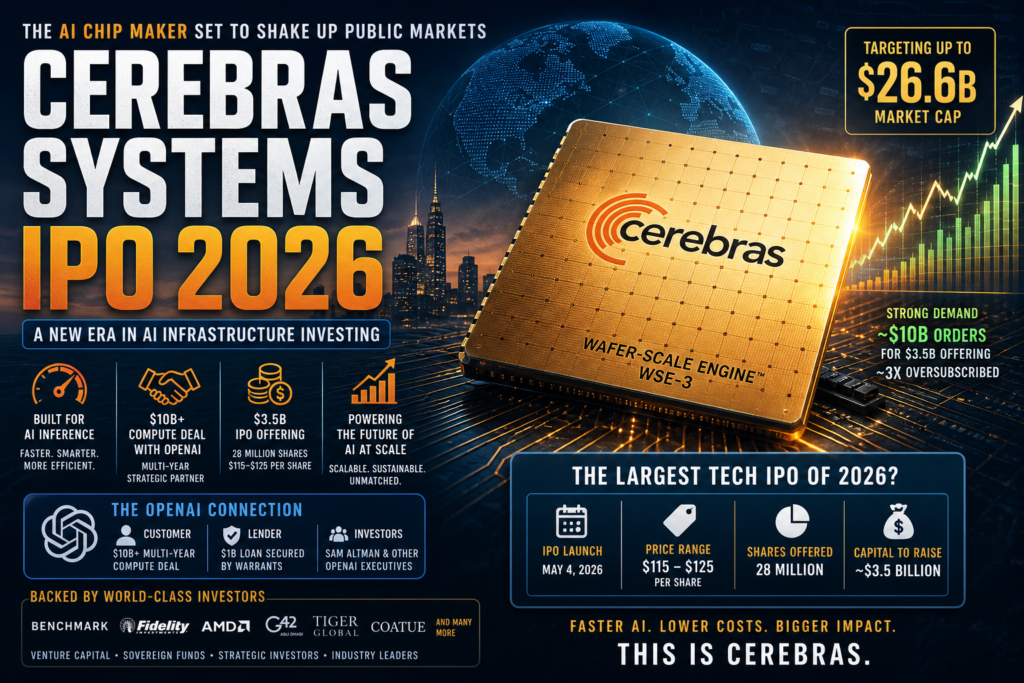
The Cerebras Systems IPO is shaping up to be the largest tech offering of 2026 — and it carries the fingerprints of some of the biggest names in AI, from OpenAI’s Sam Altman to a roster of sovereign wealth funds. Here’s everything you need to know about who Cerebras is, what they make, and why this debut could signal a new era for AI infrastructure investing.
What Is the Cerebras Systems IPO?
Definition: The Cerebras Systems IPO refers to the company’s initial public offering of shares on a U.S. stock exchange, allowing public investors to buy equity in the AI chip maker for the first time.
Cerebras Systems is an AI-focused semiconductor company best known for its Wafer-Scale Engine — a chip architecture that departs radically from conventional GPU-based AI computing. After a false start in 2024 that was blocked by a federal regulatory review, the Cerebras Systems IPO is now officially moving forward. On May 4, 2026, the company announced plans to sell 28 million shares at a price range of $115 to $125 per share, targeting a raise of approximately $3.5 billion and a market capitalization of up to $26.6 billion.
This is not a quiet, under-the-radar debut. Banks are already reporting roughly $10 billion in orders for the $3.5 billion on offer — a nearly 3x oversubscription rate that strongly suggests the final pricing will land above the announced range.
The Numbers Behind the Cerebras Systems IPO
Understanding the scale of this offering requires putting the figures in context. Here is a snapshot of the key financial milestones that led to the IPO:
| Event | Date | Valuation / Amount |
|---|---|---|
| Series G Raise | September 2025 | $8.1B post-money valuation; $1.1B raised |
| OpenAI Multi-Year Compute Deal | January 2026 | $10B+ contract value |
| OpenAI Loan to Cerebras | December 2025 | $1B secured by warrants (33M+ shares) |
| Series H (Final Private Round) | February 2026 | $23B valuation; $1B raised |
| IPO Price Range Announced | May 4, 2026 | $115–$125/share; targeting $3.5B raise |
| IPO Implied Market Cap (High End) | May 2026 | $26.6 billion |
At the high end of its IPO range, Cerebras would hand its Series H investors — who came in at a $23 billion valuation just a few months ago — an immediate paper gain of roughly 15%. That kind of quick appreciation, combined with overwhelming order books, is what earns a debut the label “blockbuster.”
What Does the $3.5 Billion Raised Mean for Cerebras?
Capital at this scale allows Cerebras to do three things simultaneously:
- Scale manufacturing of its next-generation Wafer-Scale Engine chips to meet surging demand from AI model developers
- Expand its customer base beyond the handful of large enterprise and government clients it serves today
- Invest in R&D to maintain its performance advantage over GPU-based alternatives before competitors close the gap
What Makes Cerebras Different? The Wafer-Scale Engine Explained
What Is the Wafer-Scale Engine?
Definition: The Wafer-Scale Engine (WSE) is a single-chip AI processor manufactured by Cerebras that spans an entire silicon wafer — far larger than conventional chips, which are cut into many smaller dies from a single wafer.
Most AI chips, including those made by NVIDIA, AMD, and Intel, are small dies that must communicate with each other across high-latency connections when training or running large models. The WSE eliminates this bottleneck by placing the entire compute surface on one massive chip, reducing the overhead of inter-chip communication dramatically.
The current generation, WSE-3, is Cerebras’ most capable chip to date. The company claims it is significantly faster than GPU-based chips for AI inference — the compute workload that handles real-time user prompts — while consuming less power per query.
Why Inference Speed Matters Right Now
Inference is the compute task that runs every time a user types a prompt into ChatGPT, Gemini, or any other AI assistant. As generative AI scales to hundreds of millions of daily users, inference cost and latency have become the primary bottlenecks for AI providers. A chip that is measurably faster and more energy-efficient at inference is not just a nice-to-have — it is a competitive moat.
This is precisely why OpenAI — already one of the world’s most resource-intensive AI operators — signed a multi-year deal worth more than $10 billion in compute with Cerebras in January 2026.
The OpenAI Connection: Customer, Lender, and Investor
The relationship between OpenAI and Cerebras is one of the most layered partnerships in the AI industry — and it is central to the Cerebras Systems IPO story.
OpenAI as a Customer
OpenAI is one of Cerebras’ most significant customers. The $10 billion-plus multi-year compute agreement signed in January 2026 gives OpenAI access to Cerebras’ inference infrastructure at scale. For Cerebras, having OpenAI on the books as a customer is both a revenue anchor and a credibility signal to public market investors.
OpenAI as a Lender
In December 2025, OpenAI loaned Cerebras $1 billion, secured by warrants that allow OpenAI to purchase more than 33 million shares of Cerebras stock. This means that while OpenAI does not currently hold a large equity stake, it has the right to acquire one — positioning it as a potential major shareholder post-IPO.
OpenAI Executives as Angel Investors
Several current and former OpenAI executives are individually named as angel investors in Cerebras:
- Sam Altman — OpenAI CEO and co-founder
- Greg Brockman — OpenAI President and co-founder
- Ilya Sutskever — Former OpenAI Chief Scientist (now founder of Safe Superintelligence)
- Adam D’Angelo — OpenAI board member and Quora CEO
While Sam Altman’s individual stake was not large enough to require disclosure in Cerebras’ SEC filing, he was quoted directly in the company’s S-1 — a notable signal of how intertwined these two organizations have become.
What About Conflicts of Interest?
This web of relationships was not without controversy. Elon Musk’s legal team cited the OpenAI-Cerebras relationship as evidence in Musk’s lawsuit against OpenAI, alleging that OpenAI executives had undisclosed personal financial interests in a company that was also an OpenAI vendor. OpenAI at one point reportedly considered acquiring Cerebras outright; that deal never materialized, but the relationship deepened in other ways.
Who Else Is Investing in Cerebras? The Full Investor Picture
The Cerebras Systems IPO benefits from a remarkably broad and credentialed investor base spanning venture capital, sovereign wealth, and strategic corporate investors.
Shareholders With More Than 5% Stake (Per SEC Filing)
- Alpha Wave (Rick Gerson)
- Benchmark (via partner Eric Vishria)
- Eclipse (Lior Susan)
- Fidelity
- Foundation Capital (via partner Steve Vassallo)
Additional Named Institutional Investors
- Abu Dhabi Growth Fund
- Abu Dhabi’s G42 (also a major customer)
- Altimeter Capital
- AMD (strategic investor)
- Atreides Management
- Coatue Management
- Moore Strategic Ventures
- Tiger Global
- Valor Equity Partners
- VY Capital
- 1789 Capital
Angel Investors (Named on Cerebras Website)
Beyond institutional money, Cerebras lists a Silicon Valley “who’s who” of angel investors, including:
- Andy Bechtolsheim (Sun Microsystems and Arista co-founder)
- Lip-Bu Tan (Intel CEO)
- The OpenAI executives named above
This investor diversity — spanning U.S. venture firms, Middle Eastern sovereign funds, chip industry executives, and AI lab founders — is unusual even by the standards of high-profile AI startups.
A Rocky Road to the Public Markets
The Cerebras Systems IPO has not been a straight line. Understanding the delays helps investors assess the risk profile of the offering.
The 2024 Attempt That Never Happened
Cerebras first filed to go public in 2024. The process was halted by a U.S. federal security review of an investment from G42, the Abu Dhabi-based cloud provider. G42 is both a Cerebras investor and a major customer — a dual relationship that raised concerns about potential technology transfer to a foreign government. Cerebras ultimately shelved the IPO, describing the review as still ongoing at the time of its more recent SEC filing.
Rebuilding Momentum: 2025 to 2026
Rather than retreat, Cerebras doubled down on growth. The timeline of its recovery is instructive:
- September 2025: Raised $1.1 billion at an $8.1 billion valuation, led by Fidelity and Atreides — a sign that institutional confidence had not evaporated.
- January 2026: Signed the landmark $10 billion+ compute deal with OpenAI, providing revenue visibility that is essential for IPO pricing.
- February 2026: Closed the $1 billion Series H at a $23 billion valuation, with Benchmark leading via a special-purpose vehicle.
- May 2026: Launched the IPO process with a $26.6 billion target cap and a reportedly oversubscribed order book.
The sequencing matters. Each step added a layer of legitimacy — marquee customers, marquee investors, and a clear revenue story — that the 2024 attempt lacked.
Why the Cerebras Systems IPO Matters for the Broader AI Market
The Cerebras Systems IPO is not just a liquidity event for its investors. It is a bellwether for the entire AI infrastructure investment cycle.
It Tests the Market for AI Hardware
Until now, public market exposure to AI hardware has been dominated almost entirely by NVIDIA, with AMD and Intel playing secondary roles. Cerebras would be the first pure-play AI chip maker to go public, giving investors a direct bet on alternative AI silicon without the revenue diversification of incumbent chipmakers.
It Could Open the Gates for Bigger Offerings
If the Cerebras Systems IPO prices well and trades up in the secondary market, it signals appetite for even larger tech offerings. The companies watching most closely include SpaceX, OpenAI itself, and Anthropic — all of which have been named in speculation about future public market debuts. A strong Cerebras showing materially improves the conditions for those offerings.
It Validates the AI Inference Market
Cerebras has built its business case on a specific bet: that inference — not training — will be the dominant AI compute workload of the next decade as models move from the lab to widespread deployment. If the market rewards Cerebras at a $26 billion-plus valuation, it is effectively endorsing that thesis. This has downstream implications for every company building inference infrastructure, from cloud hyperscalers to startups.
Key Risks Investors Should Know Before the Cerebras Systems IPO Prices
No IPO analysis is complete without examining the downside scenarios.
Customer Concentration Risk
Cerebras’ dependence on a small number of large customers — including OpenAI — creates significant revenue concentration risk. If OpenAI were to shift its compute spend, renegotiate terms, or develop competing in-house silicon (as Google has done with TPUs), the impact on Cerebras’ financials could be severe.
Geopolitical and Regulatory Overhang
The unresolved federal review of G42’s investment has not disappeared — Cerebras acknowledged it as an ongoing matter in its S-1. Any escalation in U.S.-UAE technology restrictions could affect both a key customer relationship and investor confidence.
Competition From Established Players
NVIDIA’s GPU ecosystem benefits from years of software optimization (CUDA), a massive developer community, and virtually unlimited capital for R&D. Cerebras must continuously justify its performance advantage as NVIDIA, AMD, and emerging competitors like Groq invest heavily in their own inference architectures.
IPO Lock-Up and Post-Listing Volatility
With $10 billion in demand chasing $3.5 billion in shares, early secondary market trading could be volatile. Investors who purchase at elevated post-IPO prices may face significant drawdowns once lock-up periods expire and early shareholders sell.
Frequently Asked Questions About the Cerebras Systems IPO
Q: When is the Cerebras Systems IPO date? The company launched its IPO roadshow on May 4, 2026. Based on standard timelines, pricing and first-day trading are expected within one to two weeks of that announcement.
Q: What is Cerebras Systems’ valuation at IPO? At the high end of the announced range ($125/share for 28 million shares), the implied market cap is $26.6 billion. Given the reported oversubscription, the final market cap could exceed that figure.
Q: What exchange will Cerebras list on? The company has not publicly specified the exchange as of this writing. Watch for SEC filing updates that will confirm the ticker symbol and exchange.
Q: How does Cerebras compare to NVIDIA? Cerebras is not a direct GPU competitor. Its WSE-3 chip is designed specifically for AI inference workloads and claims advantages in speed and power efficiency for that specific task. NVIDIA’s GPUs are more general-purpose and benefit from a vastly larger software ecosystem. Cerebras targets a specific, high-value slice of the AI compute market rather than competing head-on.
Q: Is OpenAI a shareholder in Cerebras? Not yet in the traditional equity sense, but OpenAI holds warrants to purchase over 33 million Cerebras shares — a right it acquired through the $1 billion loan it extended to Cerebras in December 2025.
The Bottom Line
The Cerebras Systems IPO is more than just another public listing in the tech sector—it represents a major milestone in the evolution of artificial intelligence infrastructure. At a time when investors are actively searching for the next big AI opportunity beyond established players like NVIDIA and AMD, the Cerebras Systems IPO offers a rare chance to gain exposure to a company building specialized AI hardware from the ground up. With a targeted valuation of up to $26.6 billion and a fundraising goal of approximately $3.5 billion, the Cerebras Systems IPO has already positioned itself as one of the most anticipated tech market events of 2026.
What makes the Cerebras Systems IPO especially compelling is that Cerebras is not trying to compete directly with traditional chipmakers on the same battlefield. Instead, the company has built its reputation around the Wafer-Scale Engine, a radically different architecture designed specifically for AI workloads. This strategic differentiation gives the Cerebras Systems IPO a strong narrative: while most semiconductor companies are adapting older chip models for AI, Cerebras was built for AI from day one. That message resonates strongly in today’s market, where investors increasingly reward specialization over generalization.
Another major factor driving excitement around the Cerebras Systems IPO is the company’s unusually deep relationship with OpenAI. From a multi-year compute contract reportedly worth over $10 billion to a $1 billion loan backed by warrants, OpenAI’s involvement provides both financial credibility and strategic validation. Public investors often seek proof that a young technology company has real enterprise demand before buying into an IPO. In the case of the Cerebras Systems IPO, having OpenAI as a customer, lender, and ecosystem partner helps reduce some of that uncertainty.
However, investors should not view the Cerebras Systems IPO through rose-colored glasses. Like many fast-growing technology companies entering public markets, Cerebras carries meaningful risks. The company remains heavily dependent on a relatively small number of customers, with OpenAI representing a major anchor. If a large client reduces spending, renegotiates terms, or shifts toward in-house hardware, the business could face material revenue pressure. This customer concentration risk is one of the biggest concerns surrounding the Cerebras Systems IPO.
Regulatory issues are another variable investors cannot ignore. Cerebras previously delayed its public market debut due to a federal security review connected to investments from Abu Dhabi-linked entities, including G42. While the company has now moved forward with its offering, geopolitical scrutiny remains part of the Cerebras Systems IPO narrative. In an era where AI hardware is increasingly treated as strategic infrastructure, government oversight could influence future partnerships, expansion plans, and investor sentiment.
Competition also remains fierce. While the Cerebras Systems IPO highlights technological innovation, the broader AI chip market is not standing still. Established giants like NVIDIA continue to dominate AI compute through mature software ecosystems, customer loyalty, and enormous research budgets. Cerebras may have a differentiated architecture, but sustaining that advantage over the long term will require relentless execution, product innovation, and scaling efficiency. The success of the Cerebras Systems IPO therefore depends not just on market hype, but on operational discipline after listing.
Still, the broader symbolism of the Cerebras Systems IPO cannot be overstated. This IPO is effectively a public referendum on the AI infrastructure thesis itself. If investors embrace the offering and the stock performs strongly post-listing, it could pave the way for future debuts from other high-profile AI companies, including Anthropic, OpenAI, and even SpaceX. A successful Cerebras Systems IPO would signal that public markets are ready to fund the next generation of AI infrastructure companies at scale.
Ultimately, the Cerebras Systems IPO is not simply about buying shares in another semiconductor business. It is a high-conviction bet on a specific future: one where inference workloads dominate AI economics, alternative chip architectures gain relevance, and AI infrastructure becomes as foundational as cloud computing was in the previous decade. For investors comfortable with volatility and long-term thematic investing, the Cerebras Systems IPO could be one of the most important opportunities of 2026. Whether it becomes the next major AI success story or a cautionary tale will depend on execution after the opening bell—but either way, the market will be watching closely.