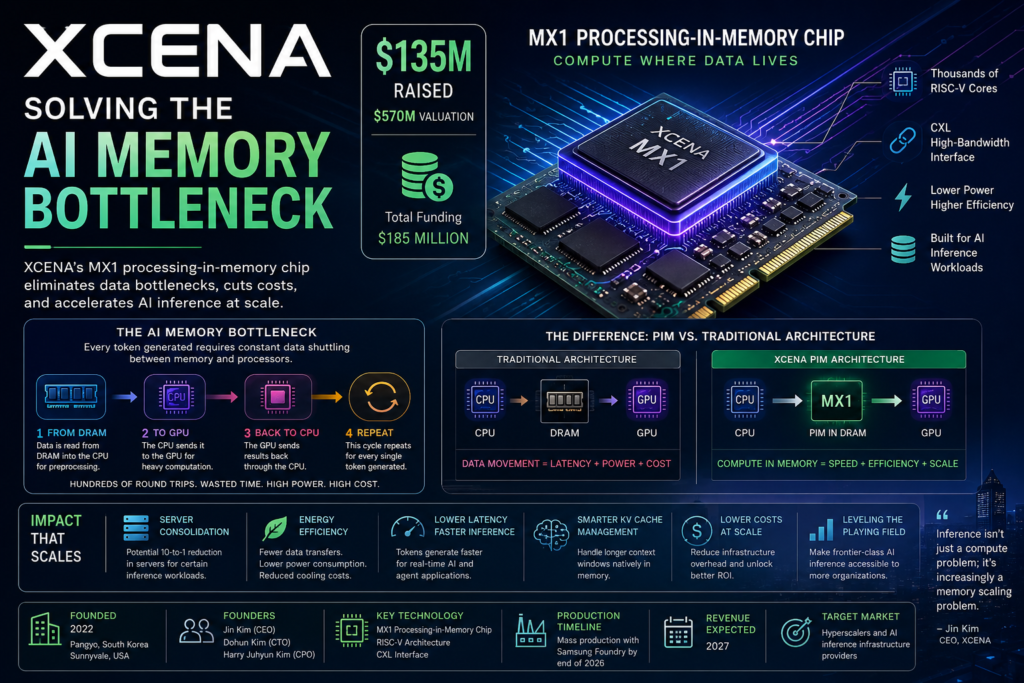
Every second you wait for an AI response, your query is caught in a traffic jam — not because the GPU isn’t fast enough, but because data has nowhere efficient to go. South Korean chip startup XCENA has raised $135 million at a $570 million valuation to fix exactly that: the AI memory bottleneck that quietly underlies every large language model inference request on the planet.
What Is the AI Memory Bottleneck?
Definition: The AI memory bottleneck is the performance and efficiency constraint that occurs when a processor — CPU or GPU — must repeatedly move data back and forth from external memory (DRAM) to execute AI inference tasks. Each round trip consumes time, energy, and money.
Most conversations about AI hardware cost center on compute: the price of Nvidia GPUs, the wattage of a data center, the billions spent training frontier models. But the subtler constraint — the one that grows more painful with every inference request — is memory architecture.
Here is the chain of events that occurs every time a user prompts a large language model:
- Data is read from DRAM (short-term memory) into the CPU for preprocessing.
- The CPU sends it to the GPU for heavy matrix computation.
- The GPU sends results back through the CPU.
- That cycle repeats — for every single token generated.
When ChatGPT answers a 500-word question, that relay race runs hundreds of times. The AI memory bottleneck is structural: it is baked into how modern AI infrastructure separates storage from computation. And as models grow larger and inference volumes explode, the cost compounds.
Why XCENA Believes Memory — Not Compute — Is the Constraint
The Data Relay Race Problem
XCENA CEO Jin Kim frames the thesis plainly: “Inference isn’t just a compute problem; it’s increasingly a memory scaling problem.”
CPUs and GPUs have both become dramatically more capable over the past two decades. Memory, by contrast, has stayed largely passive — a warehouse that waits to be called upon rather than a participant in computation. “CPUs and GPUs have both gotten smarter over the decades. Memory never did. XCENA wants to change that,” Kim told TechCrunch.
This is the core insight behind the company’s technology: the AI memory bottleneck does not exist because memory chips are too slow in isolation. It exists because they are structurally isolated from the compute that needs them. Moving data between memory and processors burns power, introduces latency, and requires far more hardware than necessary.
XCENA’s claim — that what previously required 10 servers could potentially run on just one — sounds bold. It makes sense, though, once you understand how much redundant infrastructure is dedicated purely to shuttling data.
How the XCENA MX1 Chip Works
Definition: The XCENA MX1 is a processing-in-memory (PIM) chip that integrates compute capabilities directly within the DRAM module, eliminating most round-trip data transfers between memory and the CPU/GPU.
The MX1 connects to the host CPU via CXL (Compute Express Link) — a dedicated, high-bandwidth interconnect — and runs computation directly inside the memory module before data ever needs to travel to a processor.
The tasks it handles are not the heavy matrix multiplication that makes GPUs necessary. Instead, the MX1 targets the surrounding orchestration work: preprocessing, KV cache management (the system that stores prior conversation context so a language model does not have to reprocess it from scratch), and data caching. These tasks currently run on CPUs — expensive, power-hungry, and not purpose-built for the job.
The chip is built on a RISC-V foundation — an open-source instruction set architecture — with thousands of small, efficient cores purpose-built for data processing tasks. XCENA also designs its own internal memory hierarchy, interconnect bus, and DRAM controller in-house, a level of vertical integration uncommon even among large semiconductor companies.
The MX1 is currently a prototype. Mass production is scheduled through Samsung’s foundry by the end of 2026, with revenue expected starting in 2027.
XCENA vs. The Competition: How the Players Stack Up
The AI memory bottleneck is not a problem XCENA alone is pursuing. But the company’s approach distinguishes it from competitors in meaningful ways.
| Company | Focus Area | Architecture | Core Count | Status |
|---|---|---|---|---|
| XCENA | Processing-in-memory (PIM) for AI inference | RISC-V, custom interconnect | Thousands of small cores | Pre-revenue; MX1 prototype |
| Astera Labs | CXL-based memory connectivity | Standard CXL controllers | Not applicable (connectivity focus) | Publicly listed (Nasdaq) |
| Marvell Technology | Next-gen memory connectivity and custom silicon | General-purpose cores | Handful of general-purpose cores | Large established player (Nasdaq) |
| Samsung / SK Hynix | HBM memory for GPU stacks | DRAM-adjacent PIM experiments | Varies | Memory giants; customers and potential competitors |
XCENA’s differentiation comes down to depth of vertical integration and core density. CEO Kim notes that while Marvell operates in the same broad space, the comparison on intellectual property is stark: Marvell’s approach relies on a handful of general-purpose cores, while XCENA has thousands of specialized cores designed specifically for in-memory data processing. Whether that translates to meaningful performance advantages in production will be tested once the MX1 reaches hyperscaler environments.
Why $135M in Funding Validates the Memory-Centric Thesis
The funding round — a Series B co-led by Seoul-based VC firms Altinum and IMM Investment, alongside Corstone Asia, SBI Investment, and Mirae Asset Capital — brings XCENA’s total raised to $185 million. The $570 million valuation is a meaningful signal from investors who have watched the memory-centric AI infrastructure narrative accelerate.
The broader market context supports that enthusiasm. This month, the three companies that dominate global memory chip production — Samsung, SK Hynix, and Micron — each crossed a trillion-dollar valuation for the first time. Memory prices and memory-related equities have surged since the second half of 2025, reflecting a shift in how the industry perceives the AI memory bottleneck: no longer a secondary concern, but a primary one.
XCENA’s founders — CEO Jin Kim, CTO Dohun Kim, and CPO Harry Juhyun Kim — are all veterans of Samsung and SK Hynix, the exact companies that supply memory for Nvidia’s GPU stacks. Their credibility with the institutional memory ecosystem is real, and their target customers — hyperscalers spending tens of billions annually on AI infrastructure — have strong financial incentive to explore architectures that reduce data-center overhead. For a hyperscaler, even a modest improvement in memory efficiency can translate to hundreds of millions in annual savings.
What This Means for AI Inference Infrastructure Costs
The practical implications of solving the AI memory bottleneck extend well beyond one startup’s product roadmap. Here is what a shift toward processing-in-memory architectures could mean across the industry:
- Server consolidation: XCENA claims a potential 10-to-1 server reduction for certain inference workloads, which would dramatically lower hardware procurement costs and floor-space requirements.
- Energy efficiency: Eliminating CPU-to-DRAM round trips reduces power draw. At data-center scale, this translates to measurable reductions in cooling load and electricity costs.
- Faster inference latency: Less data movement means tokens generate faster, which matters for real-time applications and AI agent pipelines.
- KV cache economics: As context windows grow longer, the cost of managing KV cache (the memory of prior conversation turns) compounds. Handling it natively in the memory module removes a significant CPU burden.
- Lower barriers for smaller operators: Server consolidation could make frontier-class AI inference accessible to organizations that cannot afford current infrastructure footprints.
- Competitive pressure on Nvidia: While XCENA does not challenge GPU training workloads, addressing the memory layer underneath AI compute puts pressure on the total cost equation that has made Nvidia so dominant.
Key Questions Answered
What exactly does XCENA’s chip do that a standard GPU cannot?
GPUs excel at matrix multiplication — the math that powers model training and the forward pass of inference. They are not designed, however, for the surrounding data orchestration: fetching data from memory, managing conversation context, preprocessing inputs. The XCENA MX1 handles those tasks inside the memory module itself, removing them from the CPU and reducing the burden on the overall system. GPU and MX1 are complementary, not competing.
Is the AI memory bottleneck a new problem?
No. Memory bandwidth constraints have been a recognized challenge in high-performance computing for decades, sometimes called the “memory wall.” What is new is the scale at which AI inference has made the bottleneck economically urgent. Running billions of inference requests daily — across ChatGPT, Gemini, Claude, and thousands of enterprise deployments — turns a theoretical efficiency gap into a multi-billion-dollar operational cost.
What is CXL and why does it matter here?
CXL (Compute Express Link) is an open industry standard interconnect that provides high-bandwidth, low-latency communication between CPUs and memory devices. It functions as a dedicated express lane. XCENA’s MX1 uses CXL to connect the processing-in-memory chip to the host CPU, enabling direct communication without the bandwidth limitations of traditional memory buses. CXL adoption has accelerated in 2025–2026 as hyperscalers have sought more flexible memory pooling architectures.
When will XCENA’s chip be available commercially?
Mass production chips are scheduled to come off Samsung’s foundry lines by the end of 2026. XCENA expects to begin generating revenue in 2027. The company is currently in early-stage conversations with several global memory vendors and hyperscaler customers, though none have been named publicly.
How does this relate to the broader AI chip shortage?
The AI chip shortage has primarily referred to GPU scarcity — specifically Nvidia’s H100 and successor chips. The AI memory bottleneck is a distinct but related challenge: even with ample GPU compute, inference workloads are throttled by the speed and efficiency at which data reaches those GPUs. XCENA’s thesis is that solving the memory layer unlocks more of the compute capacity that organizations have already paid for.
What Happens Next for XCENA and the AI Memory Bottleneck
XCENA is not operating in isolation. Its Series B success comes as the entire memory industry repositions around AI-native architectures. Samsung and SK Hynix — the companies that trained XCENA’s founders — are themselves exploring processing-in-memory capabilities, though their primary business remains supplying high-bandwidth memory to GPU manufacturers.
The competitive question for XCENA is whether a 90-person startup can establish enough differentiated IP — its RISC-V core density, its vertical integration, its custom DRAM controller — before larger players move decisively into the same space. Kim acknowledged Marvell as a competitor operating in the memory connectivity layer, but argued the IP gap is significant.
The real test will be hyperscaler adoption. XCENA’s ideal customers are organizations spending tens of billions annually on AI infrastructure — the Amazons, Googles, and Microsofts of the world. These companies move slowly on new silicon, requiring extensive validation cycles. Mass production in late 2026, revenue in 2027, and meaningful market share likely beyond that.
What the $135 million round confirms, regardless of XCENA’s individual outcome, is that the AI memory bottleneck thesis has arrived at the center of venture and infrastructure investment. The industry spent 2023 and 2024 convinced that more GPU compute was the answer to every AI infrastructure problem. The capital now flowing toward memory-centric architectures suggests a more nuanced picture is emerging: compute and memory are equally essential — and the AI memory bottleneck may have been the more underrated constraint all along.
Summary: XCENA and the AI Memory Bottleneck at a Glance
| Factor | Detail |
|---|---|
| Company | XCENA |
| Founded | 2022 |
| Headquarters | Pangyo, South Korea + Sunnyvale, USA |
| Founders | Jin Kim (CEO), Dohun Kim (CTO), Harry Juhyun Kim (CPO) |
| Series B raised | $135 million |
| Post-money valuation | $570 million |
| Total funding | $185 million |
| Key technology | MX1 processing-in-memory chip (RISC-V, CXL) |
| Primary target | Hyperscalers; AI inference infrastructure |
| Production timeline | Samsung foundry, end of 2026 |
| Revenue expected | 2027 |