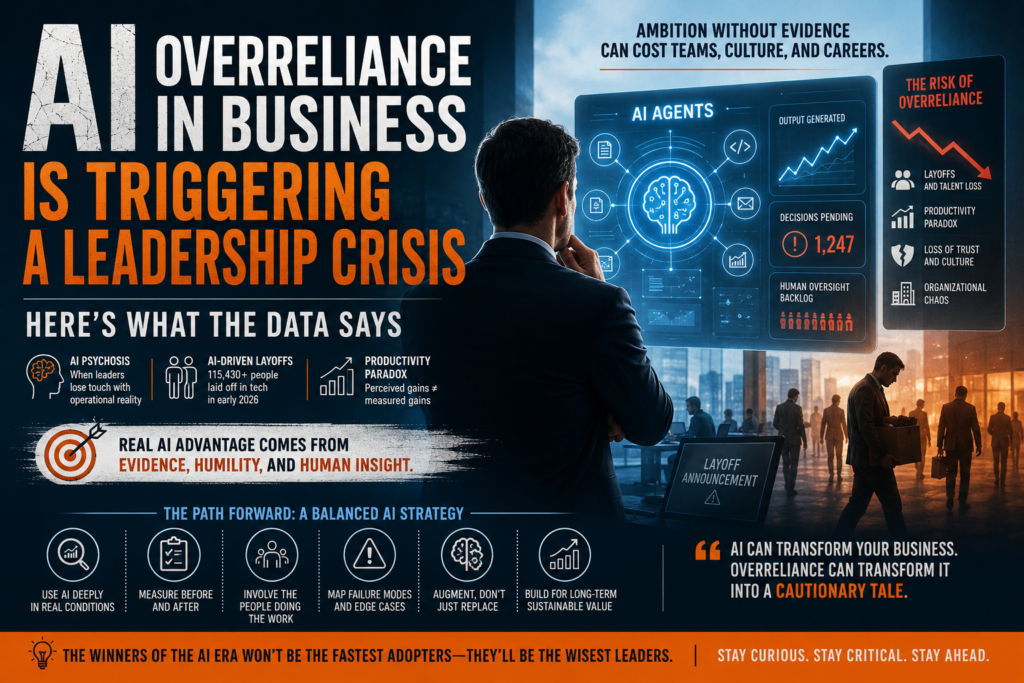
When companies grow obsessed with AI at the expense of operational reality, the consequences show up fast: mass layoffs, productivity paradoxes, and organizational chaos. AI overreliance in business is no longer a theoretical risk — in 2026, it is unfolding in boardrooms and balance sheets across the tech industry.
What “AI Overreliance in Business” Actually Means
Definition: AI overreliance in business occurs when an organization’s leadership makes strategic decisions — including workforce restructuring, product development, and capital allocation — based on an inflated or untested belief in AI’s current capabilities, without grounding those decisions in measurable, real-world performance data.
This is distinct from enthusiastic AI adoption, which is healthy and necessary. The critical difference is the gap between what AI can demonstrably do today and what executives believe it can do after a promising demo or a weekend of experimentation. That gap, it turns out, can swallow careers, teams, and in some cases, company culture.
The AI Psychosis Problem: When Leaders Lose Touch with Reality
A sharp new term has entered the business lexicon in 2026: AI psychosis. It was coined, pointedly, not by a skeptic, but by Box founder and CEO Aaron Levie — a vocal AI enthusiast with 2.7 million followers on X and an active record of backing AI startups.
Levie’s argument is that executives who engage positively with AI — generating a contract, building a prototype, running a quick test — tend to experience what he calls “the happy path.” They see AI perform well in a controlled, low-stakes scenario, and then make the leap to believing that agents can handle the full complexity of operational work at scale. That belief, without the corrective friction of doing the actual job, creates something that looks a great deal like a delusion.
Why CEOs Are Especially Vulnerable
CEOs are not immune to poor judgment — they are structurally positioned to be overconfident about AI in ways that frontline employees simply are not. According to Levie’s analysis, executives are “sufficiently distant from the last mile of work” that generates real value with AI. They do not review code, uncover bugs, or identify calls to hallucinated libraries before software ships. They do not spend days combing through contracts for ambiguous clauses. They are not the people who catch the 10 or 20 failure modes that follow every promising prototype.
This distance from operational reality is precisely what makes AI overreliance in business a C-suite phenomenon more than a middle-management one.
The “Happy Path” Illusion
Here is how the cognitive trap works:
- A CEO or founder experiments with an AI tool on a representative but simple task.
- The tool performs impressively — summarizing a document, drafting a proposal, generating code.
- The executive extrapolates: “If it can do this, it can do everything like this.”
- Decisions — including hiring freezes, layoffs, and agent rollouts — follow from that extrapolation.
- The messy exceptions, edge cases, and failure modes only surface later, after the structural changes have been made.
Levie’s prescription is direct: use AI “a ton” in real conditions, work through the failure modes yourself, and emerge with a calibrated view of both the genuine upside and the irreducible human work that remains. That is the opposite of the AI overreliance pattern most headlines are capturing right now.
AI-Driven Layoffs: Real Costs Behind the Headlines
The practical consequence of AI overreliance in business is showing up most visibly in the labor market. In the first five months of 2026 alone, approximately 115,430 people were laid off from 152 tech companies — a figure already approaching the total for all of 2025, when 124,636 people lost jobs across 275 companies, according to industry tracker Layoffs.fyi.
What makes the 2026 wave different is not just the scale but the stated rationale: a significant proportion of companies are explicitly attributing workforce reductions to AI productivity gains, whether realized or anticipated.
The ClickUp Case Study
One of the starkest examples is ClickUp, a project management startup whose CEO, Zeb Evans, publicly announced the layoff of 22% of the company’s workforce after deploying roughly 3,000 AI agents to handle internal operations. Evans was explicit that this was not a cost-cutting measure. His vision was a “100x org” — a leaner human workforce whose primary job would be reviewing and approving the work generated by AI agents at high speed.
The ambition is coherent in theory. The problem is that it assumes AI agents are already performing human-quality work reliably enough to restructure an entire organization around them. The current evidence does not support that assumption.
2026 Layoff Numbers in Context
It is worth noting that not every company citing AI as a layoff rationale is telling the complete story. Many observers — and a growing body of analysts — argue that what is being called “AI-driven restructuring” often masks more conventional business decisions: declining growth, pressure from investors, market contraction, or a desire to cut costs before a fundraising round. The AI narrative provides a more forward-looking frame than “we over-hired.”
That does not mean AI overreliance in business is not a real driver. For a subset of companies, it clearly is. But the two phenomena — genuine AI-driven restructuring and AI-washed cost-cutting — are running in parallel, making the true picture harder to read.
What the Productivity Research Actually Says
Perhaps the most important corrective to the AI overreliance pattern is the actual evidence on AI and productivity. It is, to put it charitably, inconclusive.
A meta-analysis published in UC Berkeley’s California Management Review found no robust relationship between AI adoption and aggregate productivity gains across organizations. A separate study from the National Bureau of Economic Research did find productivity improvements from AI adoption, but noted a significant “productivity paradox”: workers consistently perceived their productivity gains as larger than what was measured in output.
MIT researchers who tested AI agents across thousands of real-world tasks concluded that agents are not yet delivering human-quality results consistently. Their projection: at the current rate of improvement, large language models should be able to complete most text-based tasks at a minimally acceptable quality level by approximately 2029 — with human-level outperformance arriving a few years after that.
Research published in the Harvard Business Review adds a further wrinkle. When AI tools make everyone more productive at generating output — reports, code, proposals, analyses — the bottleneck simply migrates upstream. Executives and decision-makers, who must authorize and act on that output, become the constraint. More throughput without more leadership bandwidth does not produce efficiency. It produces a queue.
AI Overreliance vs. Balanced AI Strategy: A Comparison
| Dimension | AI Overreliance in Business | Balanced AI Strategy |
|---|---|---|
| Decision basis | Executive demos and “happy path” tests | Real-world pilots with measurable KPIs |
| Workforce approach | Mass layoffs replaced by agents | Upskilling alongside selective automation |
| Productivity claims | Assumed before data is collected | Validated against baseline metrics |
| Failure mode awareness | Low — edge cases ignored | High — failure modes systematically mapped |
| Leadership involvement | Top-down mandate without operational testing | Leaders use AI deeply alongside their teams |
| Risk horizon | Short (cuts costs now, risks chaos later) | Long (invests now, compounds returns sustainably) |
| Employee trust | Eroded rapidly | Maintained through transparency |
| AI role | Replacement | Augmentation and acceleration |
The table above illustrates that the core issue is not whether to adopt AI aggressively — it is whether the adoption is grounded in evidence or driven by narrative.
How to Avoid AI Overreliance: A Leadership Checklist
If you are a business leader navigating the current AI moment, these questions can serve as a reality check before making major structural decisions.
- Have you personally used the AI tool under conditions that mirror real operational complexity? Demos are not data.
- Can you articulate the 10 most likely failure modes of your current AI deployment? If not, you are working from the happy path.
- Have you measured a productivity baseline before and after AI adoption? Perception of improvement is not the same as measured improvement.
- Have you consulted the people doing the last mile of work? They will know what agents are missing that you cannot see from the top.
- Is your layoff or restructuring plan contingent on AI performance targets being met? If so, what happens if those targets are not met in the expected timeframe?
- Are you accounting for the upstream bottleneck? More AI output means more decisions for your senior team. Have you modeled that capacity?
- Is your AI adoption timeline synchronized with the actual research on LLM capability maturity? Most models will reach baseline competence on most text tasks around 2029. Significant human outperformance likely follows by the early 2030s.
Running through this checklist is not anti-AI. It is the exact posture Levie recommends: use it enough to understand it, including its limits.
The Path Forward: Balancing Ambition with Reality
AI overreliance in business is, at its core, a failure of epistemic humility — a willingness to act at scale on beliefs that have not been sufficiently tested. This failure is especially dangerous because it is often dressed in the language of boldness, vision, and competitive necessity.
The companies that will extract durable value from AI are not necessarily the ones that moved fastest to replace headcount with agents. They are the ones that moved thoughtfully — running real pilots, collecting honest data, preserving institutional knowledge through the transition, and adjusting the pace of change to what the evidence actually supports.
The irony of the current moment is that the most genuinely AI-forward posture is also the most evidence-driven one. Leaders who spend real time in the trenches with these tools — not just in demos, but in conditions that expose the failure modes — will make better decisions. They will know where agents reliably deliver, where human oversight remains essential, and where the productivity gains are real versus perceived.
That knowledge is not a brake on ambition. It is the foundation for building organizations that can actually sustain what AI makes possible over the next decade.
The companies that mistake “AI-pilled” for “AI-ready” are going to learn the difference. The question is whether they learn it before or after the organizational chaos sets in.
Bottom Line: Why AI Overreliance in Business Is the Leadership Test of 2026
The debate around artificial intelligence is no longer about whether organizations should adopt AI. That question has already been answered. The real challenge facing executives, founders, and boardrooms today is how to embrace innovation without falling into the trap of AI overreliance in business.
Across industries, leaders are under intense pressure to move quickly. Investors want efficiency gains. Competitors are announcing AI initiatives. Employees are experimenting with generative AI tools. In this environment, it is easy for decision-makers to assume that every successful AI demonstration automatically translates into enterprise-wide transformation. Unfortunately, that assumption is where AI overreliance in business begins.
The evidence emerging throughout 2026 suggests that many organizations are confusing AI potential with AI readiness. While large language models and AI agents have delivered impressive breakthroughs, their real-world performance often varies depending on context, complexity, oversight requirements, and data quality. A tool that performs exceptionally well during a controlled demonstration may struggle when exposed to thousands of operational edge cases.
This is why AI overreliance in business has become one of the most important strategic risks for modern enterprises. The problem is not AI itself. The problem is leadership making large-scale decisions based on expectations that have not yet been validated through measurable operational outcomes.
One of the clearest examples is workforce restructuring. Many companies have announced layoffs while citing anticipated AI productivity improvements. However, productivity gains that are expected in theory do not always materialize in practice. When organizations reduce headcount before confirming sustainable performance improvements, they expose themselves to execution risks, service disruptions, and the loss of institutional knowledge.
Another danger of AI overreliance in business is the productivity illusion. Employees often feel more productive when using AI because tasks appear to be completed faster. Yet research increasingly shows that perceived productivity and measured productivity are not always the same thing. Organizations that fail to distinguish between the two may overestimate returns and underestimate operational costs.
Leadership teams should also recognize that AI-generated output creates new management challenges. More reports, analyses, code, proposals, and recommendations do not automatically translate into better business outcomes. Someone still needs to evaluate, prioritize, approve, and act on that information. In many organizations, executive attention becomes the new bottleneck. This reality directly contradicts the simplistic narrative that AI automatically eliminates organizational constraints.
The most successful companies will not be the ones that blindly pursue automation at every opportunity. Instead, they will be the organizations that develop a disciplined approach to AI adoption. They will test systems under real conditions, measure outcomes rigorously, document failure modes, and continuously refine workflows. Most importantly, they will view AI as a tool for augmentation rather than an immediate replacement for human expertise.
A balanced strategy helps organizations avoid AI overreliance in business while still capturing significant benefits from automation. Human judgment, domain expertise, creativity, relationship management, and strategic thinking remain critical competitive advantages. AI can accelerate these capabilities, but it cannot fully replace them.
Leaders should remember that every major technological revolution follows a similar pattern. Early enthusiasm often creates inflated expectations. Over time, practical experience separates genuine value from hype. Organizations that survive this transition are usually the ones that combine innovation with evidence-based decision-making.
The future undoubtedly belongs to companies that effectively integrate AI into their operations. However, the winners of the next decade will not be determined solely by how aggressively they adopt AI. They will be determined by how intelligently they deploy it. Avoiding AI overreliance in business does not mean slowing down innovation. It means ensuring that innovation is supported by data, operational experience, and realistic expectations.
As AI capabilities continue to improve, executives must resist the temptation to make transformational decisions based solely on optimism. Sustainable success comes from balancing ambition with accountability, experimentation with measurement, and automation with human oversight. In that sense, the biggest challenge of 2026 is not technological. It is managerial.
Ultimately, AI overreliance in business serves as a reminder that leadership quality matters more than ever. The organizations that thrive will be those whose leaders understand both the extraordinary capabilities and the genuine limitations of AI. They will embrace progress without abandoning prudence, and they will build systems that leverage technology while preserving the human expertise that drives long-term success.
Frequently Asked Questions (FAQ)
1. What is AI overreliance in business?
AI overreliance in business occurs when organizations make strategic, operational, or workforce decisions based on exaggerated assumptions about AI capabilities rather than verified performance data. It often happens when leaders overestimate what AI can currently achieve and underestimate the need for human oversight.
Instead of using AI as a productivity tool, companies begin treating it as a complete replacement for human expertise. This creates risks related to quality control, operational failures, customer experience, and long-term business performance.
2. Why is AI overreliance in business becoming a major concern in 2026?
The rapid growth of generative AI and autonomous agents has created unprecedented excitement among business leaders. While these technologies offer significant opportunities, many executives are making decisions based on projected outcomes rather than measured results.
As a result, AI overreliance in business has become a concern because organizations are implementing layoffs, restructuring teams, and changing workflows before fully validating whether AI systems can consistently perform at the required level.
3. How does AI overreliance in business affect employees?
One of the most visible effects of AI overreliance in business is workforce uncertainty. Employees may face layoffs, role reductions, or increased pressure to supervise AI-generated work.
In some organizations, valuable institutional knowledge is lost when experienced workers are replaced too quickly. This can create operational challenges that ultimately reduce productivity instead of improving it.
4. Is AI overreliance in business the same as AI adoption?
No. There is a significant difference between AI adoption and AI overreliance in business.
AI adoption involves integrating AI tools into workflows based on testing, performance metrics, and measurable business outcomes. AI overreliance occurs when leaders assume AI can solve problems without sufficient evidence, leading to unrealistic expectations and potentially harmful decisions.
5. What are the biggest risks of AI overreliance in business?
The primary risks include:
- Poor strategic decisions
- Premature workforce reductions
- Lower service quality
- Increased operational errors
- Loss of employee trust
- Productivity misconceptions
- Overdependence on automated systems
- Reduced organizational resilience
These risks make AI overreliance in business a significant leadership challenge rather than simply a technology issue.
6. Can AI actually improve productivity?
Yes. Numerous studies suggest AI can improve productivity in specific tasks such as content creation, coding assistance, research, customer support, and data analysis.
However, AI overreliance in business occurs when organizations assume that task-level productivity gains automatically translate into company-wide performance improvements. Real productivity gains must be measured against business outcomes, not perceptions.
7. How can leaders avoid AI overreliance in business?
Leaders can reduce the risk of AI overreliance in business by:
- Running pilot programs before scaling
- Measuring productivity baselines
- Consulting frontline employees
- Identifying failure modes
- Maintaining human oversight
- Tracking business outcomes instead of assumptions
- Implementing gradual automation strategies
These practices create a more balanced and sustainable AI strategy.
8. Will AI replace most jobs in the future?
AI will likely automate certain tasks and transform many job functions. However, most experts believe that human skills such as critical thinking, leadership, creativity, relationship building, and complex decision-making will remain highly valuable.
The biggest challenge is not job replacement itself but ensuring that organizations avoid AI overreliance in business while transitioning to new operating models.
9. What industries are most vulnerable to AI overreliance in business?
Technology companies are currently the most visible examples, but the risk extends to finance, healthcare, legal services, consulting, education, manufacturing, and customer service.
Any industry experiencing rapid AI adoption can face problems if leaders prioritize hype over evidence. That is why understanding AI overreliance in business is becoming essential across virtually every sector.
10. What is the key lesson leaders should take away?
The most important lesson is that AI should enhance human capabilities, not replace strategic thinking. Organizations that avoid AI overreliance in business will be better positioned to achieve sustainable growth, maintain employee trust, and capture long-term value from AI investments.
Successful AI transformation requires more than technology. It requires disciplined leadership, continuous measurement, operational expertise, and a willingness to adapt when reality differs from expectations. That combination—not blind automation—is what will define the most successful organizations of the AI era.