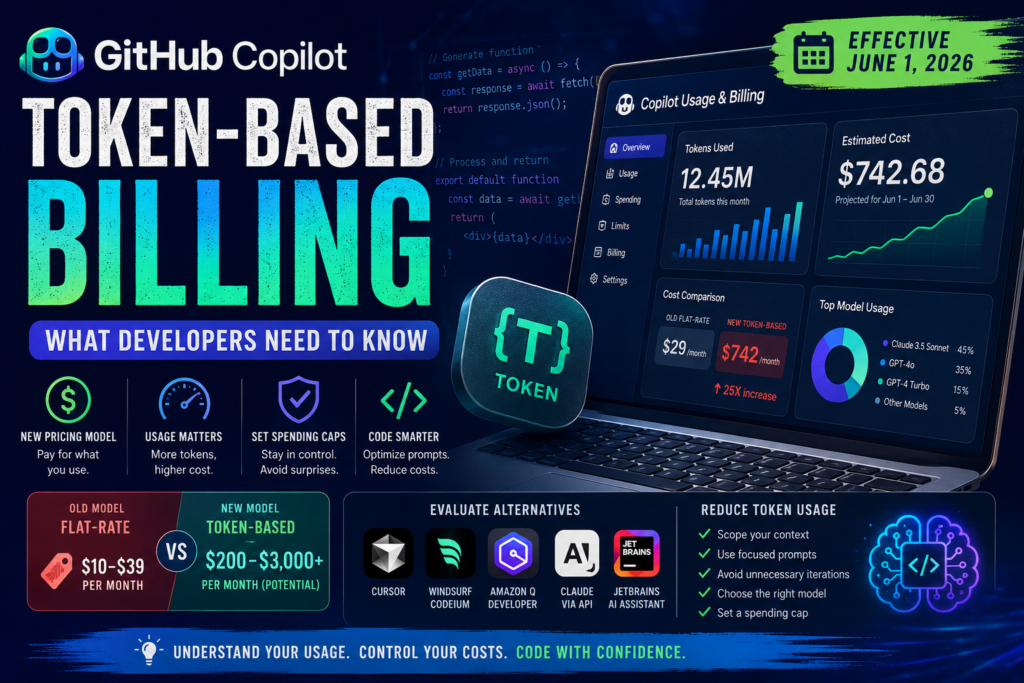
GitHub Copilot’s new token-based billing model, which went live on June 1, 2026, replaces the flat monthly subscription that developers relied on — and for some users, costs have spiked from $29/month to as much as $750/month or more. If you use GitHub Copilot for daily coding, this change directly affects your budget and workflow starting now.
What Is GitHub Copilot Token-Based Billing?
Defining Tokens in the Copilot Context
A token is the fundamental unit of text that large language models process. Roughly speaking, one token equals about four characters of English text, or approximately three-quarters of a word. Every prompt you send to Copilot — and every response it generates — consumes tokens. The longer the conversation, the larger the codebase context you share, and the more back-and-forth iterations you run, the more tokens you burn through.
Under GitHub Copilot token-based billing, you are no longer paying a flat rate regardless of how much you use the tool. Instead, Microsoft tracks precisely how many tokens flow through your sessions and bills you accordingly. Think of it like switching from an unlimited data mobile plan to a pay-per-gigabyte plan — except the meter runs continuously while you code.
How the Old Flat-Rate Model Worked
Previously, GitHub Copilot operated on a straightforward subscription model:
- Individual plan: approximately $10–19/month (depending on the tier)
- Business plan: around $19–39/user/month
- Usage was effectively unlimited within the plan; there was no per-interaction metering beyond certain “premium request” caps on higher-tier models
This model was a developer’s dream. You could iterate freely, ask Copilot to refactor large files, spawn agentic sub-tasks, and experiment with complex prompts — all for one predictable monthly fee. Microsoft was, in effect, subsidizing heavy usage, and by many accounts, the economics were deeply unfavorable for the company.
How Much Will GitHub Copilot Token-Based Billing Cost You?
Real Developer Cost Examples from the Community
The developer community’s reaction to GitHub Copilot’s new token-based billing has been swift and vocal. On Reddit’s r/GithubCopilot, users have shared cost projections and actual billing previews that range from surprising to shocking:
- One developer reported their monthly bill jumping from ~$29 to ~$750 — a roughly 25x increase.
- Another shared a screenshot showing costs leaping from ~$50 to approximately $3,000/month — a factor of 60x.
- A subset of users, however, reported seeing minimal overages and defended the new model as fair for disciplined, structured use.
These numbers aren’t uniformly representative. The degree of cost increase depends heavily on how you use Copilot — specifically, how much context you feed it, how many agentic loops you trigger, and how often you use premium models like Claude Sonnet or GPT-4o-class engines within the tool.
Comparison Table: Old Flat-Rate vs. New Token-Based Model
| Feature | Old Flat-Rate Model | New Token-Based Billing |
|---|---|---|
| Billing structure | Fixed monthly subscription | Pay-per-token consumed |
| Monthly cost (light user) | ~$10–19/month | Potentially similar or lower |
| Monthly cost (heavy/agentic user) | ~$19–39/month (capped) | $200–$3,000+/month |
| Predictability | High — budget is fixed | Low — varies with usage |
| Agentic/multi-step tasks | Included in plan | High token consumption; costs multiply |
| Best for | Freelancers, indie devs, small teams | Enterprise teams with controlled workflows |
| Worst for | No one — predictable for all | Vibe coders, iterative experimenters |
| Spending caps available | N/A | Yes — configurable spending limits |
Why Microsoft Made This Switch
The honest answer: the old model was economically unsustainable. GitHub Copilot’s flat-rate subscription masked the true cost of serving users who were running multi-hour agentic sessions, spawning dozens of sub-agents, and prompting premium models hundreds of times per day. Microsoft was absorbing that cost as a growth subsidy.
As AI models have grown more capable — and more expensive to run — the gap between what users paid and what their usage actually cost has widened. GitHub Copilot token-based billing closes that gap by aligning revenue with compute consumption. From Microsoft’s perspective, it is the only model that scales as AI agents become more powerful and more widely deployed.
This is not unique to GitHub. The broader AI industry has trended toward consumption-based pricing as the initial “land-grab” phase of AI tools gives way to a sustainability-focused maturity phase. OpenAI, Anthropic, and Google all price their APIs by token. It was arguably only a matter of time before Copilot followed.
There is also a competitive strategy element: usage-based billing makes heavy enterprise consumption more profitable while potentially pricing out low-value or inefficient users — nudging the customer base toward those who generate higher revenue per seat.
Who Gets Hurt Most by the GitHub Copilot Pricing Change?
Freelancers, Solo Developers, and Small Teams
The clearest losers under GitHub Copilot token-based billing are independent developers and small shops who:
- Used Copilot as a primary coding partner throughout the day
- Relied on long, multi-turn conversations to build out features iteratively
- Worked on large codebases with extensive context windows
- Experimented liberally with prompts without worrying about cost
For these users, the switch from a $19/month subscription to a potentially $500–$3,000/month usage bill is not a rounding error — it’s a tool that has effectively become unaffordable overnight.
The Vibe-Coding Debate
One of the more contentious threads in the developer community centers on “vibe coding” — a term for using AI coding assistants in a loose, trial-and-error fashion without deep programming knowledge or structured prompting discipline.
Critics of the outrage argue that disciplined developers have nothing to fear. Those who carefully scope their prompts, work with focused context windows, and avoid bloated iterative loops report that their projected costs remain modest under the new model.
Defenders of heavy users counter that Microsoft actively encouraged this behavior. The company built features that made it easier and easier to run extended agentic sessions, multi-hour tasks, and sub-agent chains — and now appears to be penalizing users for doing exactly what the product was designed to do.
Both sides have a point. The real issue is that Microsoft changed the pricing rules retroactively on a user base that had optimized its workflows around the old model — with little lead time.
Should You Stay, Switch, or Adapt?
If you’re reconsidering whether GitHub Copilot token-based billing still makes financial sense for you, here is an honest look at your options:
Alternatives Worth Evaluating
- Cursor — A VS Code fork with strong AI coding integration; offers subscription tiers with defined limits and is popular among developers moving away from Copilot.
- Windsurf (by Codeium) — A capable alternative with a free tier and competitive paid plans; gaining traction fast as Copilot users shop around.
- Amazon Q Developer — Particularly compelling for AWS-centric teams; flat pricing with generous usage for enterprise subscribers.
- Anthropic Claude via API or Claude Code — For teams that want to control their AI coding budget precisely, direct API usage with self-set spending caps can be more predictable.
- JetBrains AI Assistant — Tight IDE integration for JetBrains users; subscription-based with bundled token allowances.
- Stay with Copilot but cap spending — Microsoft does allow users to configure spending limits, which can prevent runaway bills while preserving access to the tool for bounded, essential tasks.
The right choice depends on your average token consumption, your team size, and whether your workflow is more exploratory (higher token burn) or structured (lower token burn).
How to Reduce Your Token Usage Under the New Model
If you decide to remain on GitHub Copilot under the new token-based billing structure, optimizing your usage is no longer optional — it’s financially necessary. Here are the most effective strategies:
Scope your context aggressively. Only include the files and code segments that are directly relevant to the task. Avoid feeding entire repositories into a session when a single module will do.
Break tasks into small, focused prompts. A large, sprawling prompt that asks Copilot to refactor, document, and test a codebase in one shot will consume far more tokens than a sequence of targeted micro-prompts.
Avoid unnecessary back-and-forth iterations. Think before you send. Vague prompts followed by correction cycles multiply token usage rapidly.
Use lightweight models for lightweight tasks. Not every task needs a premium frontier model. Use smaller, faster, cheaper models for boilerplate, documentation, and simple refactors.
Set a monthly spending cap immediately. Navigate to your GitHub billing settings and configure a hard usage limit. This is the single most important action you can take to avoid a surprise invoice.
Audit your agentic workflows. If you rely on Copilot’s agent mode for long-running tasks, audit which of those tasks are generating ROI sufficient to justify their token cost under the new model — and which ones should be replaced with traditional automation or scripts.
The Bigger Picture: What This Means for AI Coding Tools
GitHub Copilot token-based billing is not a one-company quirk. It signals a turning point for the AI developer tools market as a whole.
The initial phase of AI coding assistants — defined by subsidized flat-rate pricing designed to maximize adoption — is ending. What replaces it is a market where the true cost of compute-intensive AI work becomes visible to the end user for the first time.
This has several downstream consequences:
- Prompt engineering will become a cost-control skill, not just a performance-optimization skill. Developers who write tight, efficient prompts will have a measurable financial advantage.
- Enterprise procurement teams will demand usage analytics and caps before approving AI coding tool budgets at scale.
- Competitive differentiation among AI coding tools will increasingly hinge on cost efficiency, not just feature richness.
- The “vibe coding” culture may recede — not because the tools are less capable, but because the economic incentive to be disciplined about AI usage is now explicit.
For individual developers, the immediate takeaway is simple: understanding how GitHub Copilot token-based billing works is no longer optional background knowledge. It is operational information that directly affects your monthly budget and your choice of tools.
Frequently Asked Questions
Does GitHub Copilot still offer a flat-rate plan?
As of June 1, 2026, GitHub has moved to usage-based billing. Individual and business plan structures still exist, but costs now scale with token consumption rather than being fixed. Microsoft has confirmed that spending caps are configurable.
Is GitHub Copilot token-based billing worth it for enterprise teams?
For large enterprise teams with structured workflows and governance over AI usage, the model may be acceptable — particularly since enterprise contracts often include negotiated rates and dedicated support. For teams with undisciplined or exploratory usage patterns, costs could escalate quickly without usage controls in place.
How do I set a spending limit on GitHub Copilot?
Navigate to GitHub Settings > Billing & Plans > Spending Limits and configure a monthly cap for Copilot usage. This is strongly recommended for all users under the new model.
What happens if I hit my spending cap?
Copilot usage is paused until your billing cycle resets or you manually increase the cap. You will not be billed beyond the limit you set.
Conclusion
The arrival of GitHub Copilot token-based billing marks a defining moment in the evolution of AI-powered software development. For years, developers enjoyed the convenience of predictable subscription pricing while leveraging increasingly powerful coding assistants to accelerate development, automate repetitive work, and experiment with new ideas. With the introduction of GitHub Copilot token-based billing, that era has fundamentally changed. Cost is no longer disconnected from usage. Instead, every prompt, response, code suggestion, and agentic workflow now contributes directly to your monthly bill.
For many developers, the biggest challenge is not simply understanding GitHub Copilot token-based billing but adapting their workflows to a model where efficiency has a direct financial impact. Under the previous flat-rate structure, there was little incentive to optimize prompts, reduce unnecessary context, or limit iterative conversations. Developers could freely experiment, ask broad questions, and rely on Copilot for extensive coding sessions without worrying about the cost of every interaction. Today, GitHub Copilot token-based billing introduces a new reality where usage patterns matter just as much as the tool itself.
The debate surrounding GitHub Copilot token-based billing reflects a broader shift happening across the AI industry. As language models become more advanced, the infrastructure required to run them grows increasingly expensive. Companies can no longer rely indefinitely on heavily subsidized pricing to attract users. Instead, usage-based models are becoming the standard because they align revenue with computational demand. While this approach may make business sense, it also means developers must become more conscious consumers of AI resources.
For light and moderate users, GitHub Copilot token-based billing may not represent a dramatic change. Developers who primarily use Copilot for code completion, occasional debugging, documentation generation, or focused coding assistance could see costs remain relatively manageable. In many cases, thoughtful prompt design and disciplined usage habits can keep expenses close to what users previously paid under subscription plans. The key is understanding how token consumption works and identifying the activities that generate the highest costs.
Heavy users, however, face a very different scenario. Developers who rely on large context windows, long-running agentic workflows, extensive codebase analysis, or continuous AI-assisted development sessions may discover that GitHub Copilot token-based billing significantly increases their monthly expenses. Reports from the developer community suggest that some users have experienced projected costs many times higher than their previous subscriptions. Whether these examples represent edge cases or a growing trend, they highlight the importance of monitoring usage before costs become difficult to manage.
This shift also changes how developers evaluate productivity. Under GitHub Copilot token-based billing, the goal is no longer simply maximizing AI assistance. Instead, teams must determine whether the productivity gains generated by Copilot justify the associated costs. Organizations may begin measuring return on investment more carefully, comparing AI expenses against time saved, code quality improvements, and project delivery speed. In this environment, effective prompt engineering becomes more than a technical skill—it becomes a financial strategy.
At the same time, GitHub Copilot token-based billing is likely to accelerate competition among AI coding platforms. Alternatives such as Cursor, Windsurf, Amazon Q Developer, Claude Code, and JetBrains AI Assistant are already attracting attention from developers looking for more predictable pricing models. As users compare features, performance, and cost structures, vendors will need to demonstrate not only technical superiority but also economic value. The introduction of GitHub Copilot token-based billing may ultimately benefit the market by encouraging innovation and giving developers more options than ever before.
For businesses, the most important response to GitHub Copilot token-based billing is governance. Teams should establish spending caps, monitor usage analytics, educate developers about token consumption, and create best practices for AI-assisted development. Organizations that proactively manage adoption will be better positioned to control costs while still benefiting from AI-driven productivity gains. Those that ignore usage trends may find themselves facing unexpected expenses that are difficult to justify or forecast.
Individual developers should take a similarly proactive approach. Understanding how prompts affect token usage, limiting unnecessary context, selecting the appropriate model for each task, and regularly reviewing billing dashboards are now essential habits. The most successful users of GitHub Copilot token-based billing will not necessarily be those who use AI the most. They will be the developers who use AI most efficiently.
Looking ahead, GitHub Copilot token-based billing may be remembered as the moment when AI coding tools transitioned from experimental productivity boosters to mature business products. The industry is moving toward a future where AI assistance remains indispensable, but usage is measured, tracked, and priced according to actual consumption. This change may feel disruptive today, especially for developers accustomed to unlimited access, but it also reflects the growing maturity of AI-powered software development.
Ultimately, GitHub Copilot token-based billing is neither inherently good nor inherently bad—it is a new economic framework that rewards efficiency and transparency. Developers who understand the mechanics of GitHub Copilot token-based billing, monitor their usage, and adapt their workflows accordingly can continue to benefit from AI-assisted coding without losing control of their budgets. As the AI development landscape evolves, one thing is clear: understanding GitHub Copilot token-based billing is no longer optional. It is a critical part of making informed decisions about the tools, workflows, and technologies that will shape the future of software development. GitHub Copilot token-based billing