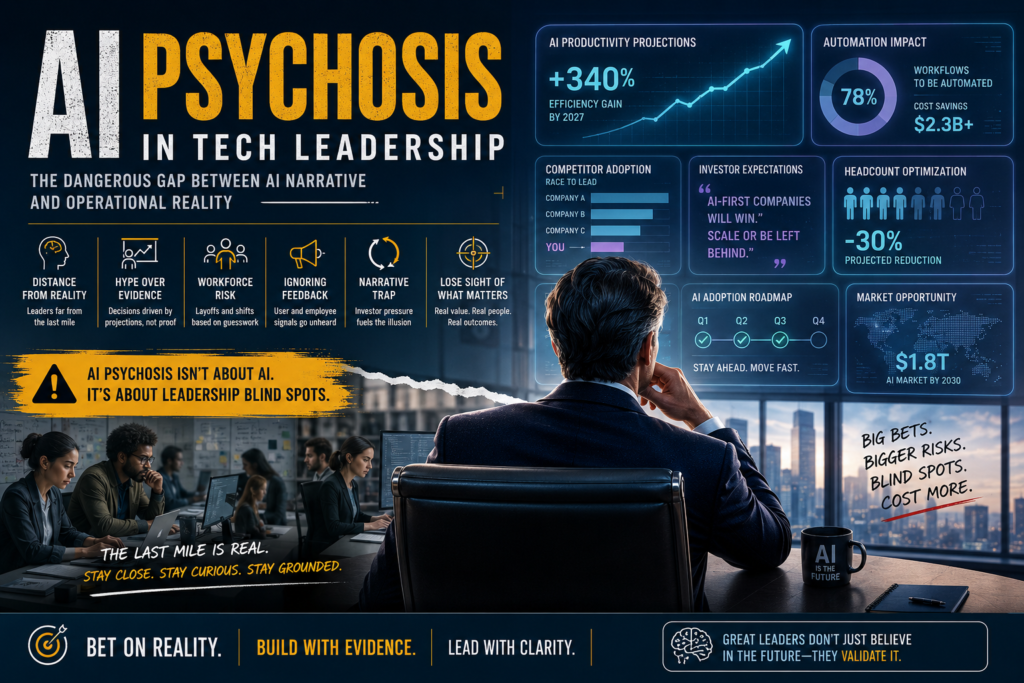
AI psychosis is the term now circling Silicon Valley boardrooms — and it describes something more systemic than mere enthusiasm. If you’re trying to understand why so many technology leaders seem disconnected from the real-world outcomes of their AI bets, you’ve come to the right place.
What Is AI Psychosis?
Definition: AI psychosis is a state in which a business leader becomes so convinced of artificial intelligence’s transformative potential that their judgment becomes detached from on-the-ground reality. The result is strategic overreach — deploying AI not because the evidence warrants it, but because the narrative demands it.
The term is borrowed from the clinical language of detachment from reality, applied here metaphorically to describe decision-making that is driven by ideological commitment rather than operational feedback. A leader experiencing AI psychosis will often cite productivity projections, competitor moves, or investor expectations to justify AI initiatives — while remaining genuinely unaware that the last mile of work still requires human judgment, context, and skill.
This is not a fringe critique. It’s increasingly being voiced by founders and operators who are themselves building with AI, which makes it worth taking seriously.
Where Did “AI Psychosis” Come From?
Aaron Levie’s Diagnosis
In late May 2026, Box founder Aaron Levie published a social media post arguing that tech CEOs are “uniquely prone to AI psychosis.” The comment sparked immediate debate on TechCrunch’s Equity podcast and across the broader technology press.
Levie’s critique was specific and nuanced: he wasn’t rejecting AI tools. He was pointing out that CEOs who are sufficiently distant from “the last mile of work that still has to happen to generate most value with AI” cannot accurately evaluate what AI is actually delivering. The implication is that AI psychosis is a structural risk — baked into the distance between executive decision-making and frontline execution.
This framing distinguishes AI psychosis from simple hype or enthusiasm. A CEO who has tested AI coding tools on real workflows has grounded their view in evidence. A CEO who reads analyst reports and listens to vendor demos has not. The gap between those two epistemic positions is where AI psychosis lives.
Why Are Tech CEOs Uniquely Vulnerable to AI Psychosis?
The Executive Distance Problem
The further a leader sits from the actual work, the more they depend on abstracted metrics — efficiency percentages, cost-per-task estimates, headcount ratios — to evaluate AI performance. These metrics can look extraordinary on a slide and be misleading in practice.
Real AI deployments frequently encounter what practitioners call “the last mile problem”: the moment where the model’s output requires human review, correction, or contextual judgment before it becomes usable. This step is invisible in boardroom presentations, but it consumes real time and skill. A CEO who has never encountered it personally may not believe it exists.
AI psychosis thrives in that gap. Leaders who have never experienced the friction of AI-assisted work are more likely to accept vendor projections at face value, set unrealistic productivity targets, and make workforce decisions based on anticipated gains that haven’t materialized yet.
The Investor Feedback Loop
Venture capital amplifies AI psychosis rather than correcting it. Investors who are eager to back the “tiny team, massive output” narrative reward startups that make aggressive AI-adoption claims. This creates an incentive structure in which founders perform AI conviction even when internal evidence is mixed or absent.
The result is a feedback loop: CEOs signal AI enthusiasm to attract capital, capital validates the enthusiasm, and the validation reinforces the detachment from operational reality. At each step, AI psychosis becomes harder to surface and correct.
Signs of AI Psychosis in the Real World
Recognizing AI psychosis requires knowing what it looks like in practice. Here are the most common indicators across organizations:
- Layoffs preceded by productivity claims, not productivity proof. Workforce reductions are announced citing AI efficiency gains that have been modeled but not yet measured in production environments.
- AI features shipped without user demand signals. Products add AI capabilities because competitors have them, not because user research or usage data support the feature.
- Vendor claims accepted as internal benchmarks. Productivity projections from AI platform vendors are treated as equivalent to internal pilot results.
- No “last mile” accounting in project timelines. AI-assisted workflows are planned as if model output is final output, without time allocated for human review and correction.
- Backlash treated as ignorance. When users, employees, or customers express skepticism about AI features, the response is education rather than investigation.
- Strategy driven by narrative, not feedback loops. AI roadmaps are shaped more by what story can be told to investors than by what data shows is working.
Each of these is a leading indicator that executive judgment has become decoupled from operational reality — the defining characteristic of AI psychosis.
AI Psychosis vs. Healthy AI Optimism
Not every form of AI enthusiasm constitutes AI psychosis. The distinction matters because dismissing all AI advocacy as delusional would be its own kind of error. The table below maps the key differences:
| Dimension | Healthy AI Optimism | AI Psychosis |
|---|---|---|
| Epistemic basis | Grounded in hands-on use and measurable outcomes | Based on vendor projections, analyst reports, or competitive pressure |
| Relationship to skepticism | Actively seeks disconfirming evidence | Dismisses skepticism as ignorance or resistance to change |
| Workforce impact framing | Honest about uncertainty and transition costs | Projects confident headcount reductions from unproven efficiency gains |
| Last-mile awareness | Accounts for human review, correction, and judgment | Treats model output as production-ready by default |
| Failure mode response | Updates strategy based on negative results | Attributes failures to implementation rather than capability limits |
| User feedback integration | Treats user resistance as signal | Treats user resistance as an education problem |
| Investment logic | Justified by demonstrated value | Justified by fear of being left behind |
The core differentiator is not how bullish a leader is on AI — it’s whether their optimism is anchored in evidence they have personally encountered or tested.
The Growing AI Backlash: User Signals Are Flashing Red
AI psychosis does not exist in a vacuum. It is colliding, in real time, with a measurable backlash from users who are not experiencing the AI revolution the way the boardroom expects.
Consider the signals from mid-2026 alone. DuckDuckGo reported a 30% increase in installs, a figure the company attributed directly to users rejecting Google’s AI-saturated search experience. Google, for its part, has been pushing AI Overviews and related features aggressively — while publicly struggling to correct embarrassing errors (including, memorably, its AI incorrectly answering how many Ps are in “Google”).
The TechCrunch Equity podcast identified a precise tension in Google’s position: the company is “chasing that thing it feels like it has to do to keep up, but it’s messing with the thing that people attach to the brand the most.” That description is a near-textbook case of AI psychosis operating at institutional scale — strategic behavior driven by competitive narrative rather than user need.
At the same time, graduating college students are reportedly booing any mention of AI at commencement events, and AI-driven layoffs are generating significant public hostility to the industry. These are not fringe reactions. They represent a material segment of users and workers who are actively voting against the AI trajectory that executives are pursuing.
Leaders afflicted with AI psychosis tend to interpret this backlash as temporary, or as a failure of messaging. A more accurate reading is that it is feedback — and feedback that the boardroom cannot currently hear because it is too far from the people generating it.
How Organizations Can Avoid AI Psychosis
Ground AI Strategy in Frontline Reality
The most direct antidote to AI psychosis is exactly what Aaron Levie prescribed: executives must actually use the tools. Not in curated demos. Not in vendor-controlled environments. In real workflows, on real tasks, with real consequences for errors.
This is a meaningful commitment. It requires senior leaders to sit with individual contributors and observe — without narrating — how AI tools integrate into actual work. The gap between what a demo shows and what a production workflow requires is almost always larger than executives expect. Experiencing that gap firsthand changes the epistemic basis for AI strategy.
Organizations can institutionalize this by building “frontline feedback loops” into AI planning cycles: mandatory review periods before any AI-driven workforce decision, structured channels for workers to report where AI assistance is and isn’t delivering, and strategy reviews that include qualitative data from practitioners, not only quantitative efficiency metrics.
Separate Hype Metrics from Value Metrics
AI psychosis is partly a measurement problem. When organizations use metrics that are easy to generate — number of AI features shipped, percentage of workflows “touched” by AI, cost-per-query estimates — they optimize for the appearance of AI adoption rather than the reality.
Value metrics are harder to collect but more honest: Has error rate in AI-assisted workflows declined over the past quarter? Have the workers using AI tools reported increased capacity, or increased frustration? Have customers who interact with AI-powered features retained at higher or lower rates than those who don’t?
The distinction between hype metrics and value metrics is not just methodological. It is a test of whether leadership is genuinely interested in what AI is doing or merely interested in a story about what AI is doing. AI psychosis tends to flourish wherever the former question goes unasked.
What AI Psychosis Means for the Future of Tech Leadership
The debate over AI psychosis is surfacing a broader leadership question: what competencies does the AI era actually demand?
The previous decade rewarded a particular kind of executive — one who could scan the technology landscape, identify major platform shifts early, and commit organizational resources before competitors did. That posture worked well when the platforms in question were mobile, cloud, or social. The downside risk of being early was manageable; the upside of being right was enormous.
AI is different in a specific way: the gap between what the technology can do in controlled environments and what it reliably delivers in production is still very large, very variable, and very domain-dependent. A leader who applies the “commit early and figure it out later” template to AI without understanding that gap is not demonstrating vision. They are exhibiting AI psychosis.
The executives who will navigate this era well are those who can hold two things simultaneously: genuine conviction about AI’s long-term potential, and rigorous skepticism about any specific claim of near-term productivity gain. That combination — bullish on the direction, demanding on the evidence — is the opposite of AI psychosis, and it is the posture that the current moment requires.
For organizations watching their competitors race toward AI transformation, the temptation to match the pace is real. But as the DuckDuckGo surge, the commencement protests, and the rising tide of AI-related layoff backlash all suggest, the users and workers who will ultimately determine whether AI bets pay off are already sending signals. Hearing those signals requires getting closer to them — and that is something no amount of AI psychosis can substitute for.
Conclusion
AI psychosis is not a diagnosis for every tech leader who is enthusiastic about artificial intelligence. It is a specific pattern: executive judgment that has become detached from operational reality, sustained by investor incentives, competitive pressure, and a structural distance from the work AI is supposed to be transforming.
The term has arrived in the mainstream conversation because the gap between boardroom AI narrative and frontline AI experience has grown wide enough that practitioners — including builders and founders who are themselves deeply committed to AI — are naming it. That is a significant signal.
The most effective response is not skepticism about AI. It is accountability for AI claims. Leaders who use the tools, measure value honestly, and take user and worker feedback seriously are not prone to AI psychosis. Leaders who don’t, are.