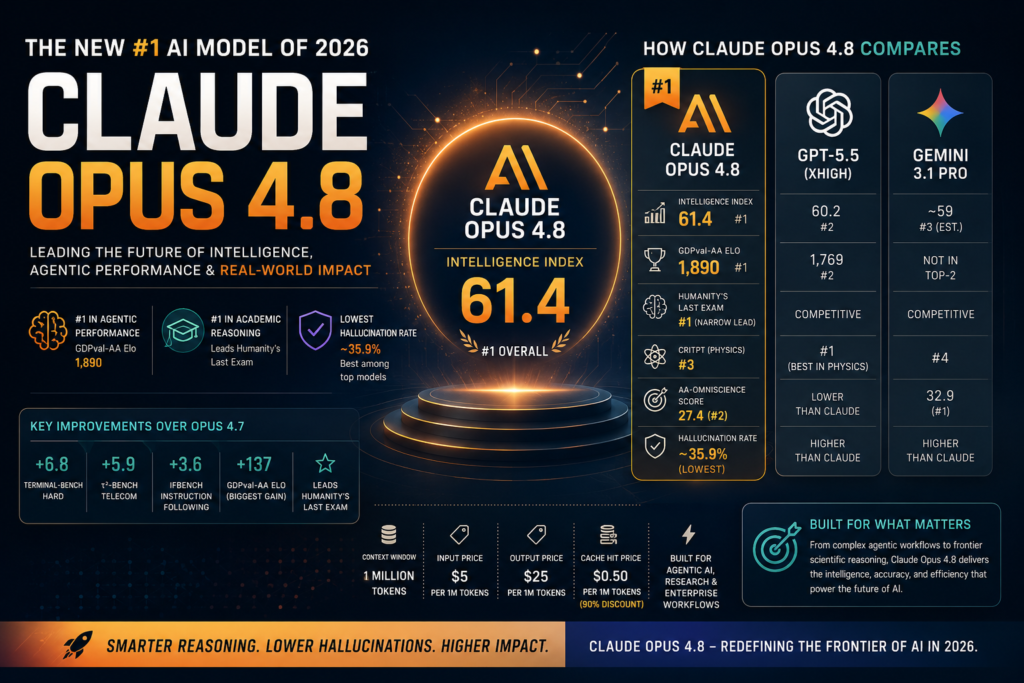
Claude Opus 4.8 is currently the top-ranked AI model on the Artificial Analysis Intelligence Index, scoring 61.4 and edging past GPT-5.5 to reclaim Anthropic’s position at the frontier. If you’re evaluating AI tools for complex knowledge work, agentic tasks, or scientific reasoning, this release deserves your full attention.
What Is Claude Opus 4.8?
Definition: Claude Opus 4.8 is Anthropic’s flagship large language model, released in May 2026, and the latest iteration in the Claude 4 family. It is designed for high-complexity tasks including multi-step agentic workflows, frontier academic reasoning, and long-context document processing.
Expansion: Every major AI lab is locked in a performance race, and Claude Opus 4.8 represents Anthropic’s most competitive entry yet. Rather than simply upgrading a single capability, Anthropic made simultaneous advances in real-world task completion, scientific reasoning, and instruction-following — the three axes where enterprise users feel the gap most acutely. The result is a model that doesn’t just score well on paper; it changes the competitive landscape.
Claude Opus 4.8 Benchmark Results Explained
Understanding where Claude Opus 4.8 leads — and where it still trails — requires looking at four benchmark dimensions independently.
Artificial Analysis Intelligence Index
What is the Artificial Analysis Intelligence Index? It is an independent composite score that aggregates performance across a wide range of academic, reasoning, and real-world agentic evaluations to produce a single model ranking.
Claude Opus 4.8 scores 61.4 on this index — up 4.1 points from Opus 4.7 and 1.2 points ahead of GPT-5.5 (xhigh), the previous leader. Crucially, Anthropic achieved this gain while using approximately the same number of output tokens as its predecessor, meaning the performance lift came from smarter reasoning rather than more verbose responses.
GDPval-AA: Agentic Performance
What is GDPval-AA? It is Artificial Analysis’s primary evaluation suite for measuring agentic performance on knowledge work tasks, scored using an Elo rating system similar to competitive game rankings.
Claude Opus 4.8 scored 1,890 Elo on GDPval-AA, which translates to an implied win rate of approximately 67% against GPT-5.5 xhigh in head-to-head task comparisons. It also achieved this performance with 15% fewer turns per task and 35% fewer output tokens than Opus 4.7 — a meaningful efficiency gain for production deployments where API costs matter.
One caveat worth noting: Claude Opus 4.8 still uses roughly 30% more turns than GPT-5.5 to complete agentic tasks, suggesting there is still room to close that particular efficiency gap.
Scientific and Academic Reasoning
This is arguably the biggest qualitative shift in Claude Opus 4.8. Previous Claude models have trailed OpenAI and Google on complex academic benchmarks. That changes with this release.
- Humanity’s Last Exam: Claude Opus 4.8 leads by 1 point in an extremely tight three-way contest between Anthropic, Google DeepMind, and OpenAI.
- CritPt (frontier physics benchmark): Developed by Argonne National Laboratory and the University of Illinois Urbana-Champaign, this benchmark tests graduate-level physics reasoning. Claude Opus 4.8 outperforms Gemini 3.1 Pro but remains behind GPT-5.4 and GPT-5.5 on this specific test.
Hallucination Rates and Knowledge Accuracy
What is AA-Omniscience? It is Artificial Analysis’s evaluation for factual accuracy and hallucination behavior across a range of knowledge queries.
Claude Opus 4.8 ranks #2 on the AA-Omniscience Index with a score of 27.4, behind only Gemini 3.1 Pro (32.9). Its factual accuracy sits at 46.6%, with a hallucination rate of approximately 35.9%. Notably, Anthropic continues to demonstrate substantially lower hallucination rates than peer models from both Google and OpenAI — a consistent differentiator that matters significantly for enterprise use cases where factual reliability is non-negotiable.
How Claude Opus 4.8 Compares to GPT-5.5 and Gemini 3.1 Pro
| Benchmark | Claude Opus 4.8 | GPT-5.5 (xhigh) | Gemini 3.1 Pro |
|---|---|---|---|
| Intelligence Index Score | 61.4 (#1) | 60.2 (#2) | ~59 (#3 est.) |
| GDPval-AA Elo | 1,890 (#1) | 1,769 (#2) | Not ranked top-2 |
| Humanity’s Last Exam | #1 (narrow lead) | Competitive | Competitive |
| CritPt (Physics) | #3 | #1 | #4 |
| AA-Omniscience Score | 27.4 (#2) | Lower than Claude | 32.9 (#1) |
| Hallucination Rate | ~35.9% (lowest) | Higher | Higher |
| Context Window | 1M tokens | Comparable | Comparable |
| Output Price (per 1M tokens) | $25 | Comparable | Comparable |
Bottom line: Claude Opus 4.8 is the strongest all-around model when real-world agentic task performance is the priority. GPT-5.5 holds advantages in terminal-style efficiency (fewer turns). Gemini 3.1 Pro leads on raw knowledge retrieval (AA-Omniscience).
Key Improvements Over Claude Opus 4.7
Claude Opus 4.8 does not just increment its predecessor — it makes material improvements across several distinct dimensions. The most significant gains include:
- Terminal-Bench Hard: +6.8 points, reflecting stronger performance in command-line and developer-facing agentic tasks
- τ²-Bench Telecom: +5.9 points, indicating better handling of complex, domain-specific reasoning chains in technical industries
- IFBench (Instruction Following): +3.6 points, meaning the model more reliably executes multi-step or nuanced user instructions
- GDPval-AA Elo: +137 points from Opus 4.7, by far the largest single-benchmark gain
- Humanity’s Last Exam: Moved from trailing OpenAI to leading the field (by 1 point)
- CritPt Physics: Overtook Gemini 3.1 Pro, though still behind GPT-5.5
Scores remained relatively flat on AA-LCR (legal and compliance reasoning), GPQA (general-purpose question answering), and SciCode (scientific coding tasks), suggesting those are areas to watch in future releases.
Token Efficiency: Does Claude Opus 4.8 Do More with Less?
The question: Does better performance mean higher API costs?
The direct answer: For most use cases, no. Across the overall Intelligence Index, Claude Opus 4.8 uses approximately the same number of output tokens as Opus 4.7 while delivering significantly higher scores. Performance improved without proportional cost increases.
The efficiency story is more nuanced on specific task types:
- On GDPval-AA agentic tasks, Claude Opus 4.8 used 35% fewer output tokens and 15% fewer turns than Opus 4.7 — a direct cost reduction for agentic pipelines.
- On the broader Intelligence Index, token usage held roughly flat, meaning gains came from quality of reasoning rather than quantity of output.
For teams running Claude in automated pipelines or multi-agent systems, the GDPval-AA efficiency improvement is financially material. Fewer turns per task means lower costs per completed workflow.
Pricing and Context Window
Claude Opus 4.8 maintains the same commercial specifications as Opus 4.7:
- Input pricing: $5 per million tokens
- Output pricing: $25 per million tokens
- Cache writes: $6.25 per million tokens (25% premium, 5-minute TTL)
- Cache hits: $0.50 per million tokens (90% discount)
- Context window: 1 million tokens
The prompt caching structure is particularly valuable for agentic applications that repeatedly reference large system prompts or documents — the 90% discount on cache hits can reduce operational costs dramatically in those workflows.
Who Should Use Claude Opus 4.8?
Claude Opus 4.8 is not the right choice for every use case — but it is the strongest current option for specific high-value applications.
Best fit for:
- Knowledge workers running complex agentic workflows — The GDPval-AA leadership is directly relevant. Tasks like research synthesis, report generation, and multi-step information retrieval favor this model.
- Scientific and research teams — The Humanity’s Last Exam leadership and CritPt performance make Claude Opus 4.8 the most capable frontier model for academic and graduate-level scientific reasoning (with the exception of physics-specific tasks where GPT-5.5 still leads).
- Enterprises with hallucination sensitivity — Claude’s consistently lower hallucination rates across generations make it the preferred choice where factual reliability carries legal, compliance, or reputational stakes.
- Developers building long-context applications — The 1M token context window, combined with aggressive cache pricing, makes large document workflows cost-effective.
Consider alternatives if:
- Your primary use case is high-speed, low-turn agentic execution — GPT-5.5’s greater turn efficiency may be preferable for latency-sensitive pipelines.
- Raw knowledge retrieval accuracy is your top priority — Gemini 3.1 Pro currently leads the AA-Omniscience index.
What These Benchmarks Mean for the Future of AI in 2026
The Claude Opus 4.8 release signals something larger than one model update: it closes the gap between academic benchmark performance and real-world task completion that has long been an industry-wide tension.
For years, models that led on academic tests underperformed in practice, while models that excelled at real-world tasks were often criticized for softer reasoning ability. Claude Opus 4.8 moves decisively toward resolving that tradeoff. It leads on both GDPval-AA (real-world tasks) and Humanity’s Last Exam (academic frontier reasoning) simultaneously.
Three broader implications stand out:
1. Agentic performance is now the primary competitive axis. The GDPval-AA Elo gap between Claude Opus 4.8 and GPT-5.5 (+121 points) is the largest single differentiator in the current rankings. This reflects where the industry’s most valuable applications live: automated knowledge work, not just conversational Q&A.
2. Hallucination control is becoming a moat. Anthropic’s sustained advantage in hallucination rates — despite aggressive performance improvements — suggests architectural or training-level commitments to factual accuracy. As enterprises expand AI deployment into regulated workflows, this gap will matter more.
3. Token efficiency will drive adoption at scale. The combination of strong performance and flat-to-improving token efficiency means Claude Opus 4.8 is not just the best model — it may be the most economically viable frontier model for high-volume production workloads.
Frequently Asked Questions About Claude Opus 4.8
Is Claude Opus 4.8 the best AI model available in 2026? By the Artificial Analysis Intelligence Index, yes — Claude Opus 4.8 holds the #1 position as of May 2026 with a score of 61.4. However, GPT-5.5 leads on turn efficiency for agentic tasks, and Gemini 3.1 Pro leads on raw knowledge accuracy. “Best” depends on your specific use case.
How much does Claude Opus 4.8 cost? Input is priced at $5 per million tokens, and output at $25 per million tokens. Cache hit pricing drops to $0.50 per million tokens — a 90% discount that significantly reduces costs for applications that repeatedly reference the same context.
What is Claude Opus 4.8’s context window? 1 million tokens — equivalent to Opus 4.7 and sufficient for processing very large documents, codebases, or extended multi-turn conversations without truncation.
How does Claude Opus 4.8 compare to GPT-5.5? Claude Opus 4.8 leads on the overall Intelligence Index (+1.2 points), GDPval-AA agentic performance (+121 Elo), and hallucination rates. GPT-5.5 uses fewer turns per agentic task (~30% fewer) and leads on the CritPt physics benchmark.