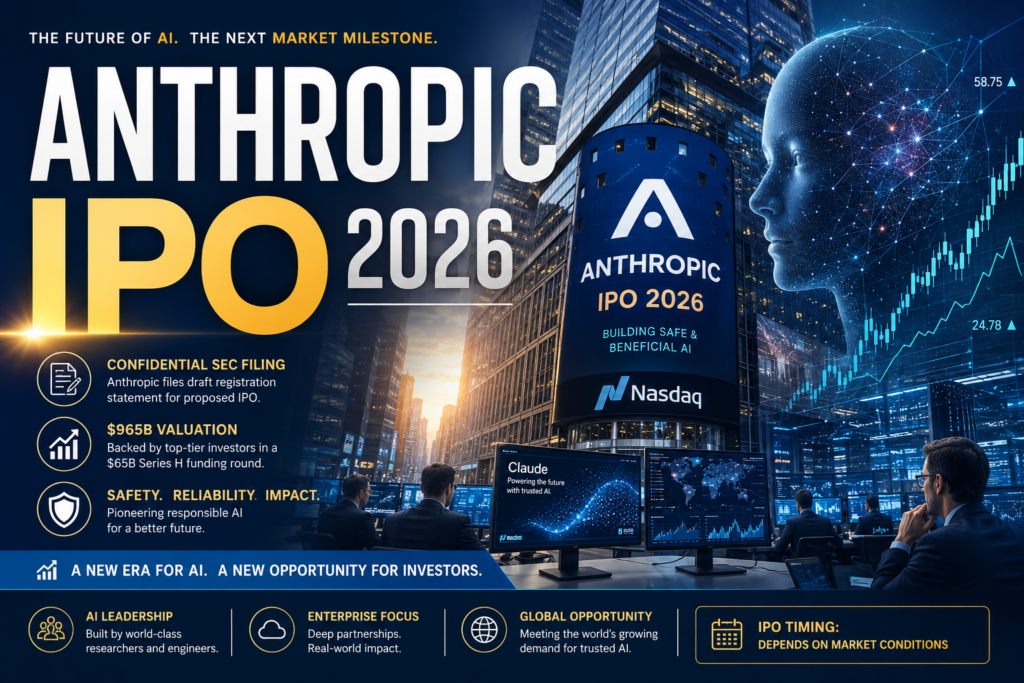
The Anthropic IPO is official — and it could be the most consequential tech market debut of the decade. On June 1, 2026, Anthropic, the AI safety company behind the Claude family of models, announced it had confidentially filed a draft registration statement with the U.S. Securities and Exchange Commission for a proposed initial public offering, setting the stage for a landmark moment in the history of artificial intelligence.
If you’re an investor, a tech professional, or simply someone who follows the AI arms race, here’s everything you need to know about the Anthropic IPO — what triggered it, how it compares to rivals, and what it signals about the future of AI development.
What Is the Anthropic IPO?
Definition: The Anthropic IPO refers to Anthropic’s filing for an initial public offering — a process by which a private company offers shares to the public on a stock exchange for the first time, raising capital and creating a publicly tradeable equity.
Anthropic has not yet set a share price or determined the number of shares to be issued. The company stated that its proposed offering will depend on market conditions and other relevant factors. What makes this filing distinctive is its confidential nature: rather than publishing a full S-1 prospectus immediately, Anthropic submitted a draft registration statement — a process that allows companies to work through the SEC review process privately before making their offering details public.
The Anthropic IPO marks a transition for a company that has, until now, remained one of the most influential private players in the AI industry. With a near-trillion-dollar valuation, going public is not merely a funding event — it is a structural transformation with industry-wide implications.
Key Facts About the Anthropic IPO Filing
Confidential SEC Filing — What That Means
A confidential SEC filing, formally known as a draft registration statement, is a mechanism available to qualifying companies under the JOBS Act. It allows a business to submit its S-1 document privately so the SEC can review it without the details becoming public record immediately.
This approach is increasingly common among high-profile tech companies because it:
- Reduces early market speculation before pricing is set.
- Allows the company to incorporate SEC feedback before a public filing.
- Provides flexibility to delay or cancel the IPO if market conditions shift.
Anthropic’s use of this route signals a deliberate, measured approach to its public debut — consistent with its stated culture of careful, safety-first decision-making.
Valuation, Funding, and the Road to $1 Trillion
The Anthropic IPO follows a fundraising period of extraordinary velocity. Less than a week before filing, Anthropic closed a $65 billion Series H round, pushing its valuation to approximately $965 billion — just shy of the trillion-dollar threshold that would put it alongside the world’s most valuable companies.
The Series H round was co-led by Altimeter Capital, Dragoneer, Greenoaks, Sequoia Capital, Capital Group, Coatue, and D1 Capital Partners — an investor roster that reads like a who’s-who of institutional capital and suggests significant appetite for a public offering. Analysts widely interpreted the round as a deliberate pre-IPO positioning move.
Why Is Anthropic Going Public Now?
The AI IPO Wave of 2026
The Anthropic IPO does not exist in a vacuum. It is landing in what many are calling a white-hot IPO season for AI and technology companies.
Notably, SpaceX has filed its own initial public offering, targeting a $2 trillion valuation and seeking to raise more than $75 billion. That filing has already generated enormous institutional interest and has put public market appetite for mega-cap tech firmly back on the table.
This macro environment matters for the Anthropic IPO because:
- Investor appetite for high-growth tech is demonstrably strong.
- The presence of other landmark IPOs (SpaceX, and potentially OpenAI) creates a competitive but validated market window.
- AI-focused institutional investors are seeking public equity exposure to AI leaders, a vehicle that has been unavailable until now.
How the Series H Round Set the Stage
The $65 billion Series H was not just a capital raise — it was a market signal. By attracting blue-chip institutional investors at a near-trillion-dollar valuation, Anthropic essentially previewed the investor community that will be most relevant to its public debut. The round validated demand, established a pricing reference point, and built the public narrative necessary for a successful IPO roadshow.
Put simply: the Series H was the dress rehearsal. The Anthropic IPO is the opening night.
Anthropic IPO vs. OpenAI IPO: How Do They Compare?
OpenAI remains the other elephant in the room. While the Anthropic IPO proceeds, its primary rival continues to raise private capital — most recently a $122 billion round in March 2026 at an $852 billion post-money valuation — and is also widely expected to file for an initial public offering.
The table below compares the two companies across the dimensions most relevant to public market investors:
| Factor | Anthropic | OpenAI |
|---|---|---|
| Current Valuation | ~$965 billion | ~$852 billion (post-money) |
| IPO Status | Confidential S-1 filed (June 2026) | Expected; not yet filed |
| Most Recent Funding Round | $65B Series H (May 2026) | $122B round (March 2026) |
| Primary AI Product | Claude (Sonnet, Opus, Haiku) | ChatGPT, GPT-4o, o-series |
| Organizational Structure | Public Benefit Corporation (PBC) | Transitioning to for-profit |
| Core Positioning | Safety-first AI research and deployment | AGI development and broad consumer reach |
| Enterprise Focus | Strong via Claude API and partnerships | Strong via Azure/Microsoft integration |
| Founding Story | 2021 OpenAI spinout; safety-focused mission | 2015 nonprofit; expanded commercial mandate |
The comparison reveals a fundamental strategic divergence: Anthropic has built its brand around AI safety and responsible deployment, while OpenAI has pursued the broadest possible consumer and enterprise surface area. For investors, both profiles carry distinct risk and return characteristics.
The Anthropic IPO may close before an OpenAI offering materializes, potentially giving Anthropic the advantage of establishing its public market narrative first.
What Does the Anthropic IPO Mean for Investors?
Opportunities
The Anthropic IPO represents a rare chance to invest directly in one of the two leading frontier AI labs. Historically, access to this category of company has been limited to institutional and venture investors. A public offering changes that equation.
Key opportunity factors include:
- Market leadership in enterprise AI: Claude models are deeply embedded in enterprise workflows via the Anthropic API and partnerships with major cloud providers, creating recurring revenue potential.
- Safety differentiation: As governments globally introduce AI regulation, Anthropic’s safety-first positioning may provide a structural advantage in regulated sectors including healthcare, finance, and legal.
- Near-trillion-dollar valuation headroom: If Anthropic reaches parity with or surpasses its current private valuation on public markets, early public investors could benefit from substantial appreciation.
- Favorable IPO timing: The 2026 tech IPO window is arguably the most favorable since 2021, with institutional investors actively seeking high-quality AI exposure.
- Founder credibility: Led by Dario Amodei (CEO) and Daniela Amodei (President), both veterans of OpenAI, Anthropic’s leadership team carries exceptional credibility with both the research community and enterprise buyers.
Risks
No investment analysis of the Anthropic IPO is complete without acknowledging the risk landscape:
- Path to profitability is unclear: Like most frontier AI labs, Anthropic’s compute costs are enormous. The company has not publicly detailed its revenue or margin profile.
- Competitive intensity is extreme: OpenAI, Google DeepMind, Meta AI, and Microsoft all operate well-funded AI programs. The competitive moat for any single lab is not yet established.
- Regulatory uncertainty: AI regulation is evolving rapidly across the EU, UK, US, and Asia. Compliance costs and restrictions could materially affect Anthropic’s business model.
- Model commoditization risk: As AI capabilities converge across providers, differentiating on model quality alone becomes increasingly difficult.
- Valuation premium: A near-$1 trillion valuation for a company that has not disclosed profitability implies significant forward growth already priced in by the market.
The Bigger Picture: AI Lab IPOs and the Future of Safe AI
The Anthropic IPO is not just a financial event — it is a test of whether a safety-focused AI company can thrive under the scrutiny and short-term performance pressures of public markets.
Anthropic was founded in 2021 by former OpenAI researchers with the explicit mission of building AI systems that are safe, interpretable, and beneficial. That mission is baked into its corporate structure as a Public Benefit Corporation (PBC), a legal designation that requires the company to balance shareholder returns against its stated public benefit mission.
This creates a fascinating tension: public markets typically reward growth and profit above all else. Can Anthropic maintain its safety-first culture and governance when quarterly earnings reports and shareholder expectations enter the picture?
The answer to that question may shape not only Anthropic’s future, but the broader trajectory of how frontier AI development is financed and governed. If the Anthropic IPO succeeds on its own terms — delivering returns while staying true to its mission — it could serve as a template for mission-driven AI companies navigating public markets.
Conversely, if market pressure leads to mission drift, it will raise urgent questions about whether the PBC structure is sufficient protection, and whether public capital and responsible AI development can genuinely coexist.
Frequently Asked Questions About the Anthropic IPO
What did Anthropic file with the SEC?
Anthropic submitted a confidential draft registration statement to the SEC for a proposed initial public offering. The company has not yet set a share price or determined the number of shares to be offered. The timing of the Anthropic IPO will depend on market conditions.
What is Anthropic’s current valuation?
Following its $65 billion Series H funding round in May 2026, Anthropic’s valuation reached approximately $965 billion — just below the $1 trillion mark.
How does the Anthropic IPO compare to the OpenAI IPO?
The Anthropic IPO has a filed (though confidential) registration statement, giving it a concrete first-mover advantage in timing. OpenAI, valued at roughly $852 billion after its March 2026 funding round, is widely expected to file its own IPO but has not yet done so. Both companies are likely to enter public markets in the near to medium term.
Who are the key investors backing Anthropic ahead of its IPO?
Anthropic’s Series H round — the most recent pre-IPO financing — was co-led by Altimeter Capital, Dragoneer, Greenoaks, and Sequoia Capital, with participation from Capital Group, Coatue, and D1 Capital Partners, among other institutional investors.
Is Anthropic profitable?
Anthropic has not publicly disclosed detailed financial statements, including revenue or profitability figures. As with most frontier AI labs, significant investment in compute infrastructure and research suggests that near-term profitability is not the primary focus. The company’s S-1 filing, once public, will be the primary source for this information.
What is Claude, and why does it matter for the Anthropic IPO?
Claude is Anthropic’s family of AI models, including Claude Haiku, Claude Sonnet, and Claude Opus, deployed across enterprise, developer, and consumer use cases. Claude is the primary commercial product underpinning the Anthropic IPO thesis — its adoption and monetization trajectory will be among the most closely watched metrics by prospective investors.
Summary: The Anthropic IPO at a Glance
The Anthropic IPO represents one of the defining market events of 2026. With a near-trillion-dollar private valuation, a blue-chip investor base, and a differentiated safety-first positioning, Anthropic enters public markets at a moment of peak institutional appetite for AI exposure. At the same time, its path to profitability, the competitive intensity of the AI landscape, and the tension between mission and market pressure make this one of the most complex — and consequential — IPOs in recent memory.
For investors, technologists, and policy observers alike, the Anthropic IPO is worth watching closely. What it reveals about the future of AI financing, governance, and commercial viability will reverberate far beyond the trading floor.